
The World Health Organisation (WHO) has reviewed the exercise science literature and formulated some physical activity guidelines for adults (age 18-64 years), the muscle strengthening recommendation is:
Adults should also do muscle strengthening activities at moderate or greater intensity involving all major muscle groups on 2 or more days a week.
What is muscle strengthening?
Muscle strengthening can also be referred to as strength training, weight training or resistance training. Muscle strength training involves placing a load on muscle tissue and challenging the muscle tissue to contract against the resistance for a short period. These short duration, heavy loads engage the body’s anaerobic energy systems. When planned well and performed regularly strength training improves neuromuscular performance and strengthens musculoskeletal tissue. By engaging the neuromuscular and musculoskeletal systems strength training can positively influence balance, bone density, metabolism, tendon/ligament strength and muscle strength.
Some examples of strength training are weightlifting (dumbbells, barbells, kettlebells, weight stack machines), bodyweight exercises (push-ups, pull-ups), holding a position isometrically (planks, yoga postures) and explosive plyometrics (jumping, hopping, landing).
“Muscle strength training positively influences the musculoskeletal and neuromuscular systems.”
Compound movements
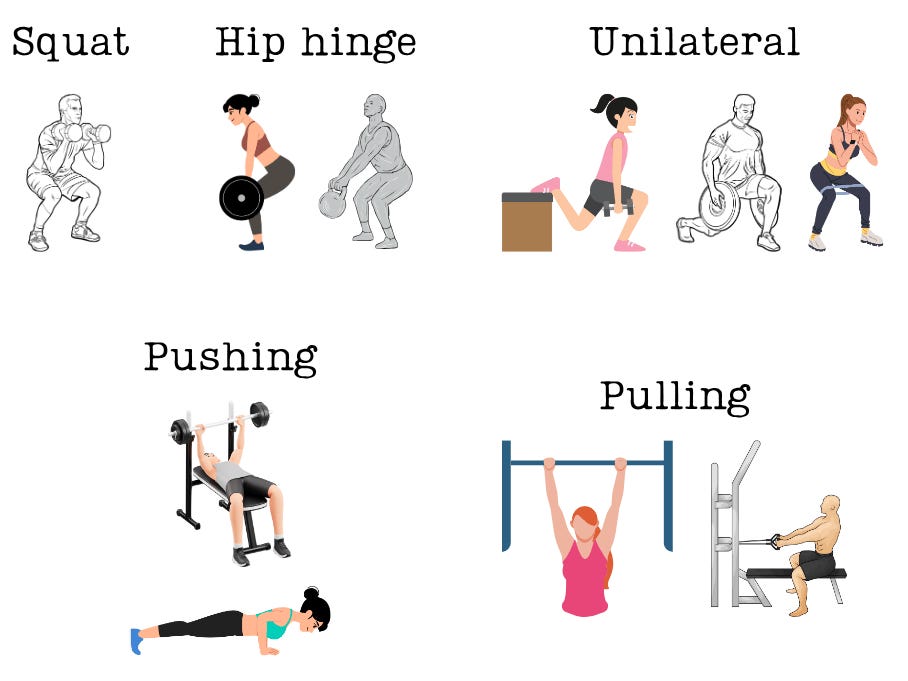
Compound movements are a good way to meet the WHO’s recommendation that muscle strengthening should involve all muscle groups. Compound movements are coordinated body movements that challenge multiple muscles in the one exercise. For example, a squat utilises the ankle, knee and hip joints, and their associated lower limb musculature, while also introducing postural challenges to the trunk.
Lower limb compound exercise movements are classified as a squat, hip hinge and unilateral; upper body compound movements are classified as a pushing or pulling exercise.
Progressive overload
The overarching principle for muscle strength training is progressive overload. The principle promotes gradual increases in the loads that are placed on the musculoskeletal and neuromuscular systems. After muscle strength training for a period, loads that once felt difficult, may now feel easier, as strength improvements emerge. The progressive overload principle suggests more load will need to be introduced to continue challenging the body’s physiology and building strength.
Getting started with strength training.
A good place to start when formulating a strength training program is to choose a mix of compound movement exercises that address all of the body’s muscle groups.
The next step is to load the compound movement exercises in a way so that it takes a fair amount of effort to get to 15 repetitions (reps). This can involve some trial and error, as a guide you want to move the load for x15 reps and upon completion feel like you could do only another 2-3 reps till failure. This ‘sweet spot’ of getting to x15 reps, with a feeling that you could only do another x2-3 more is at a moderate intensity. Such an intensity is considered sufficiently challenging for the musculoskeletal and neuromuscular systems.
Intensities greater than moderate may be achieved by choosing a heavier load where the ‘sweet spot’ of x2-3 reps to failure is achieved at a lower amount, say x10 or x8 reps. It is best to start at around 12-15 reps and increase the load (reducing reps) over time.
The final step is to organise these compound movement exercises and their associate loads into a program that incorporates multiple sets of each exercise. When starting out with strength training x2-3 sets is considered sufficient.
An example - Alison wants to support her bone health!
Alison identifies a need to support her bone density by participating in strength training and decides to collaborate with an Exercise Physiologist. Alison commits to five sessions over five weeks so that she can gradually build the skills needed to strength train independently at home. During these consultations Alison’s goals and health history are initially discussed, next they collaborate on a timeline for preparation of her strength training program. A major discussion Alison has with the Exercise Physiologist involves her access to exercise equipment, she shares that she has a collection of dumbbells and is also open to purchasing some equipment. The program they formulate is below:
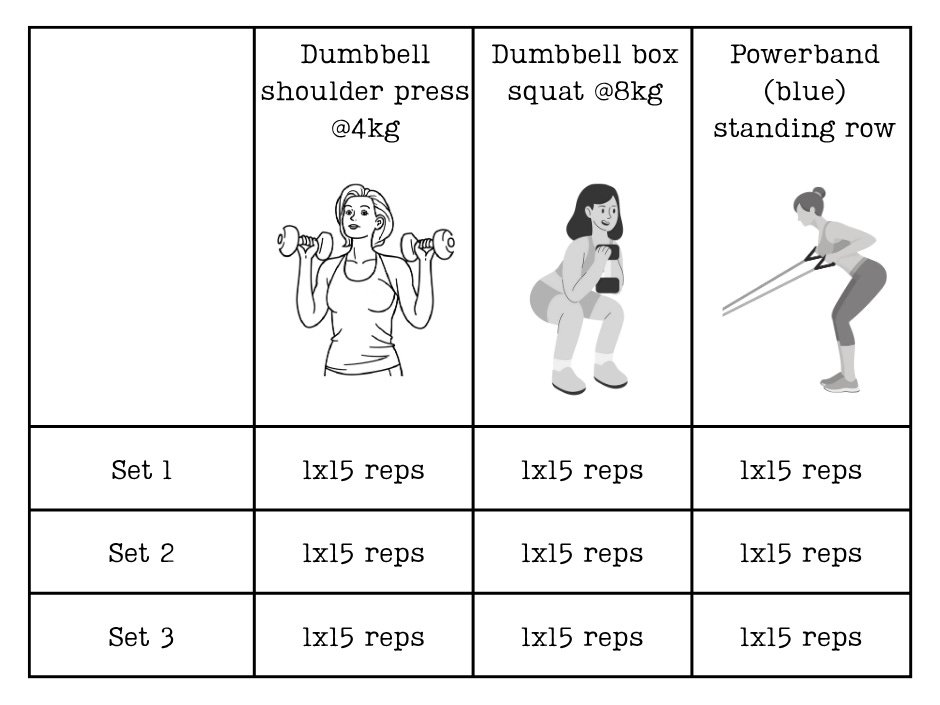
A big part of formulating this program is trialling the dumbbell and power band loads so that Alison is accessing the x12-15 rep ‘sweet spot’. The last two Exercise Physiology sessions focus on Alison learning the compound movements. Following the fifth session she commits to training independently for a period and will undertake a review in five weeks. The review will examine training loads, introduce more exercises (compound movements) and discuss strength training programming that is optimised for bone health.
Some finishing points
Once a strength training program has been established the WHO recommends that it be performed on two or more days a week.
The WHO’s recommendation for muscle strengthening activities may also incorporate activities such as occupational lifting, only if the appropriate intensities are achieved. This article has focused on strength training programming.
Strength training programming can take many shapes, this article is intended to introduce foundational concepts to a novice audience.
This post is part of small series built around the WHO’s physical activity guidelines for adults (age 18-64 years), here’s the links for part one and part two. The next series post will examine the sedentary behaviour recommendations.
Thanks for reading, Warwick.. (Movement Health, Forster Tuncurry Massage)
(If you found this article helpful and would like to support my writing, you could, shout me a coffee).
Haff, G.G., & Triplett, N.T. (2016). Essentials of Strength Training and Conditioning, Fourth Edition. Champaign, IL: Human Kinetics.
World Health Organization. (2020). WHO guidelines on physical activity and sedentary behaviour. Geneva. https://iris.who.int/bitstream/handle/10665/336656/9789240015128-eng.pdf?sequence=1
*Disclaimer, this is a discussion and does not represent an exercise prescription, for exercise or injury advice seek an appropriately trained health professional.
Comments
Nothing yet. Say the first thing.
Sign in to join the conversation.