
The World Health Organisation (WHO) has reviewed the exercise science literature and formulated some physical activity guidelines for adults (age 18-64 years), the aerobic exercise recommendation is:
Adults should do at least 150–300 minutes of moderate intensity aerobic exercise/physical activity; or at least 75–150 minutes of vigorous intensity aerobic exercise/physical activity; or an equivalent combination of both throughout the week.
What is aerobic exercise/physical activity?
Aerobic exercise is a form of physical activity that primarily utilises the oxidative energy system. The body has multiple energy systems, and the oxidative energy system is engaged when moving the body for extended periods (greater than 3 minutes) at low to moderate intensities. Aerobic exercise is often rhythmic in nature, some examples are dancing, swimming, hiking. walking, rowing, jumping rope, cycling and running (there’s more). The oxidative energy system requires oxygen, therefore utilising the body’s cardiorespiratory system for the transfer of oxygen around the body and the removal of carbon dioxide. By engaging the cardiorespiratory system, aerobic exercise can positively influence heart, lung and circulatory health.
“Aerobic exercise improves health by positively influencing the cardiorespiratory systems.”
Aerobic exercise/physical activity intensity?
The WHO recommendation includes moderate and vigorous intensity guidelines. Imagine a scale that starts at one for very light activity and finishes at ten for maximal exertion, a moderate intensity may be considered a four-six and vigorous seven-eight. The talk test can also be used to gauge intensity, if you’re walking at a tempo where your breathing rate means you could talk but not sing, this tempo may be considered moderate and if you’re unable to talk it represents a vigorous intensity.
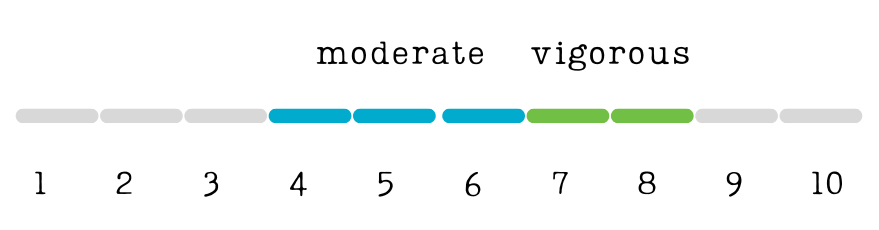
Once an understanding of moderate and vigorous aerobic exercise intensity has been developed, this knowledge can be used to work towards the WHO’s recommendations of:
150–300 minutes moderate intensity aerobic exercise weekly.
75–150 minutes vigorous intensity aerobic exercise weekly
(or an equivalent combination of both.)
Getting started with aerobic exercise/physical activity.
The first thing to do is a choose a form of physical activity that goes for an extended period and reaches a moderate or vigorous level of intensity. A common and easily accessible form of aerobic exercise is walking. Next some planning is required to ensure enough walking is done across the week to fulfill the WHO guideline. A 30-minute walk at a moderate intensity, six days a week totals 180 minutes satisfying the aerobic exercise recommendation (150-300 minutes/week).
Aerobic exercise can be any task that reaches a moderate or vigorous intensity and can include household tasks like gardening or occupational tasks. As a basic rule, I like an aerobic task or activity to go for at least 10-minutes duration, anything less is at a dose that’s likely insufficient to impact an individual’s health.
If you’re getting started with aerobic exercise, I would suggest starting at a moderate intensity to build up a tolerance for possible exploration of vigorous intensities later. If aerobic exercise duration is a challenge start small and build up, perhaps start at 15-minutes moderate intensity walking four times weekly, then build up to 20-minutes, then expand to five times weekly. Be creative…
A golfers tale…
Dennis has been working closely with his GP on reducing his blood pressure, as a part of his management he meets with an Exercise Physiologist to talk about some achievable options for engaging with aerobic exercise. Dennis tells the Exercise Physiologist that he does lots of aerobic exercise when walking around the golf course, he plays golf twice a week. Upon further exploration it emerges Dennis’s walking speed on the course is a slow wander (he feels like he could sing a song, three/ten intensity) and consists of short, regular five-minute walks before stopping to play the golf ball. While Dennis’s walking of the golf course is better than being sedentary, unfortunately he doesn’t reach the required intensity or duration required to meaningfully engage with aerobic exercise and therefore positively influence his cardiorespiratory system. The Exercise Physiologist and Dennis collaborate on some ways for greater engagement with aerobic exercise that supports his blood pressure goals.
Lastly…
The WHO aerobic exercise recommendation is the minimum requirement, moderate or vigorous aerobic exercise in excess of the recommendation is likely to confer additional health benefits.
This post is part of small series built around the WHO’s physical activity guidelines for adults (age 18-64 years), part one can be found here. The next series post will examine the muscle strengthening recommendations.
Thanks for reading, Warwick (Movement Health, Forster Tuncurry Massage)..
(If you found this article helpful and would like to support my writing, you could, shout me a coffee).
Haff, G.G., & Triplett, N.T. (2016). Essentials of Strength Training and Conditioning, Fourth Edition. Champaign, IL: Human Kinetics.
World Health Organization. (2020). WHO guidelines on physical activity and sedentary behaviour. Geneva. https://iris.who.int/bitstream/handle/10665/336656/9789240015128-eng.pdf?sequence=1
*Disclaimer, this is a discussion and does not represent an exercise prescription, for exercise or injury advice seek an appropriately trained health professional.
Comments
Nothing yet. Say the first thing.
Sign in to join the conversation.