

To get my posts for free by email, subscribe and not just follow
Everyone is now recognising that the old US-led liberal world order has ended. I wrote about it in my previous post, here . The past several weeks saw a host of market shifts and many excited commentaries about impending crises, particularly a “deepening debasement trade” and a dollar exchange rate “collapse” that allegedly implied “capital wars” and a “loss of status of the dollar as a reserve currency”. I am sure everyone recognises the expressions in quotation marks. Others, even more catastrophic, could be found on certain corners of the net. It is true that the world is not immune to a significant financial crisis on the visible horizon, but I found a lot of exaggeration in the recent commentariat commotions. Some were wrong, some were premature, many were confused or simply overstated. The geopolitical world order has definitely changed, but not yet the monetary and financial order that gyrates around the dollar dominance, which is under erorosion, but only in the long-term it will change into a multipolar monetary order. This post is about all those issues
In a previous post (here), I enumerated seven potential risks that beset the US economy and, therefore, the world economy: inflation above target, a depreciating dollar, an AI bubble, high debt financing, a basis trade collapse, private credit losses, and the unwinding of the yen carry trade. Except for the basis trade crash, all other risks have given signs of heightened potential menace in the last few weeks. The basis trade crisis may come back if the newly appointed FED Chairman later implements his preference for a much smaller FED balance sheet. The paramount risk, of course, is the AI bubble crash, which, when it finally happens, will trigger a US recession. The effects of the recent Supreme Court decision striking down as obviously unconstitutional the bulk of President Trump´s tariffs will create messy uncertainty but will be positive in the long run for the US Economy. The 15% universal tariff under section 122 can last no more than 150 days. The others he can use, based on different legislation, require investigations and justifying Reports, and none of those statutes allows unconditional general tariffs, only targeted ones.
1. The dollar exchange rate depreciation and the price of gold
The two events that sparked discussions about impending dramatic changes were the simultaneous acceleration of a weaker dollar and a surge in gold and silver prices, particularly from 19th to 27th January. Many interpreted this as a deepening sign of the so-called “dollar debasement trade,” suggesting a move away from the dollar and dollar assets into precious metals, which were viewed as safer. From this, many inferred that investors were abandoning dollar assets in favour of gold, seeing it as a sign of a significant decline in the dollar’s stature as a “reserve currency,” a term often used to describe a currency’s international role. Those statements contain several misinterpretations and misconceptions, namely:.
1. It was wrong to talk about a collapse of the dollar exchange rate
2. It was misleading to talk about the worsening of the dollar debasement
3. It was wrong to confuse the dollar depreciation in terms of gold with a generalised flight from dollar assets
4. It was wrong to conflate the dollar’s depreciation in gold terms with its role as the dominant international currency, which is poorly described by the term “reserve currency”.
Despite all the help from Trump´s Administration to undermine the dollar and the international monetary order, announcing a collapse is at least quite premature. I will now expand these four points
1.1. The non-collapse of the dollar exchange rate
The following chart shows a brief period of sharp depreciation in the dollar, coinciding with an acceleration in the gold price from Jan 19th to Jan 27th. All the old myths about gold resurfaced as if they were zombies. The “real money” was gold, with centuries of history behind it, the fundamental gauge of value, the ultimate safe asset, etc.
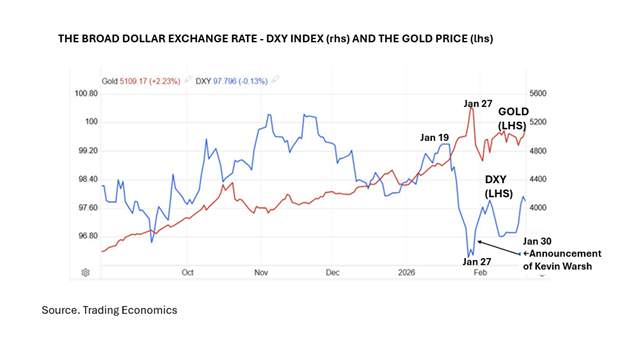
From Jan 27th onwards, the dollar recovered while the gold price tanked, but it began to recover again on Feb 3rd. Markets produced several a posteriori rationalisations about the recovery of the dollar and the decline in the gold price: some economic data improved; Iran tensions abated as negotiations began; profit-taking selling gold in a crowded trade that triggered a short-lived rout. Despite the date difference, some also cited Kevin Warsh’s announcement as an explanation for the market’s development, invoking his alleged hawkish reputation. However, President Trump would not have chosen a FED Chair who didn´t commit to a policy of significant rate cuts. Warsh is a lawyer and a veteran of past Republican administrations who, in his time as a FED Board Member under Obama, earned his hawkish reputation by speaking against monetary easing during the worst recession since the 1930s. The billionaire investor, Stanley Druckenmiller, whom he currently advises, said after the announcement in an interview with the FT, “I’ve seen him go both ways.” Warsh, in recent statements, voiced his preference for a much smaller FED balance sheet to offset his endorsement of rate cuts. However, if balance sheet tightening is implemented, it will create instability and liquidity stress in the money and repo markets, risking a crisis in the basis trade (see my post here
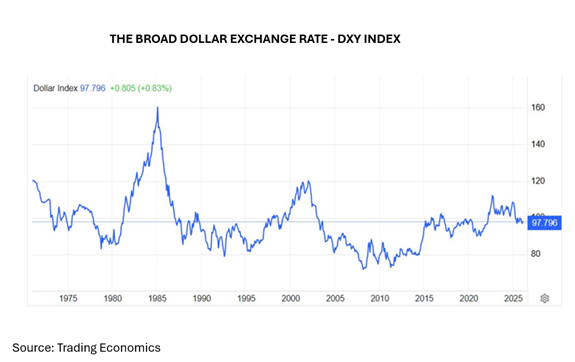
Besides the recent appreciation of the dollar, which has denied that a collapse was imminent, we also have to acknowledge that the dollar exchange rate against a basket of G7 currencies (the DXY index) has been in a relatively high plateau over the past few years. What is ongoing is not a collapse.
1.2. The misleading debasement in terms of gold
The term “debasement trade” is used in market literature when the price of precious metals, especially gold, rises. It stems from a vague analogy with the historical practice of reducing the gold content of coins that circulated as money in ancient times. Today, debasement is supposed to result solely from an increase in gold prices, implying a depreciation of the currency relative to gold. However, this does not occur only with the dollar. Any currency or asset, when valued in terms of gold, depreciates during periods of sharp gold price increases. To call it the “debasement trade” of a particular currency is not a precise analogy with the debasement of gold coins of old. The dramatic increase in gold prices has no monetary significance whatsoever. Gold can neither serve the functions of money nor be the foundation for any experiment with a gold-standard monetary system, which is now definitively relegated to history as a bad idea.
Gold is now primarily an asset among others, with the specific feature of being a speculative asset that does not generate income, meaning its price depends on the eyes of the beholder. As many investors start buying gold, often during stressful crises out of fear, others follow driven by greed and FOMO (fear of missing out), creating a self-reinforcing upward momentum. Historical repeated patterns help lay the groundwork for such behaviours. Asset pricing theory states that an asset’s fundamental value is the present value of its future income stream. From this perspective, the ‘irrationality’ of initial movers in buying gold shifts to the ‘more rational’ behaviour of followers seeking capital gains. Nevertheless, the history of speculative assets is a litany of bubbles and crashes. The gold price in real terms, adjusted for inflation, remained at the same level as in the early 1980s until last year!
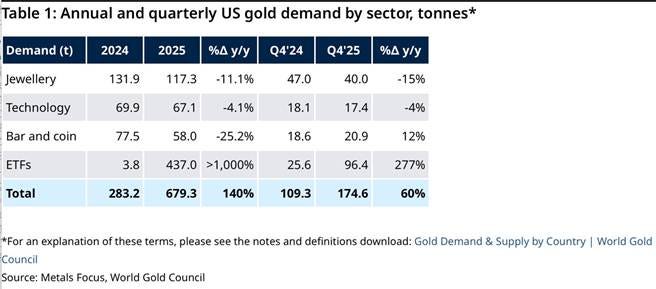
More recently, the initial movement began in China after the West’s seizure of Russian financial reserves prompted China to invest its surplus in domestically stored gold. Other Asian investors followed suit, then retail investors worldwide, mainly through purchasing ETFs linked to gold, as shown in the following table.
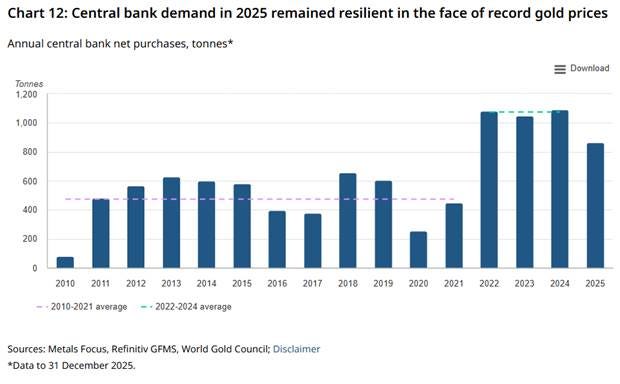
The World Gold Council also clarifies that Central Banks reduced their purchases in 2025 and had started buying more in 2022, long before Trump´s Administration shenanigans began to raise concerns about the future of the dollar.
1.3. Dollar depreciation does not imply a flight from US assets
.
The Foreign Exchange market, where currencies are traded, dwarfs all other financial markets. Its daily turnover is 7.5 trillion US, whereas for the global equity market it is around 1 trillion, and for the global bond market it is just around 300 billion. Demand and supply of currencies transcend the motivations for transacting in a currency to buy goods, services, or assets denominated in that currency. The Forex market is an asset market in its own right, with investors trading it for profit and speculating on its future price (the exchange rate) direction. In an asset market, prices are affected by expectations and risk considerations. Naturally, trade of goods and services and transacting on real and financial assets influence the exchange rate over time, but in the short-term, marginal flows that move the exchange rate depend on interest rates, relative monetary expectations, inflation prospects, terms-of-trade shocks, trade policy surprises, risk premia assessment and the costs of hedging with derivatives.
. Hedging activity has been a significant driver of the depreciation of the dollar exchange rate since April last year. Many foreign investors wanted to hold US assets but, fearing uncertainty and risk, have been hedging currency risk by, e.g., selling dollars forward and buying Euros forward, or doing a USD/EUR FX swap (spot + forward). The dealers who do the forward leg, where the investor sold dollars for euros, to cover their forward exposure, sell dollars spot and buy the pair forward. The selling of dollars spot puts depreciating pressure on the dollar. So, there can be many reasons for the dollar’s depreciation, unrelated to the trade balance or foreign sales of US assets: hedging, derivative flows, increased risk premia, macro and monetary policies, idiosyncratic shocks…
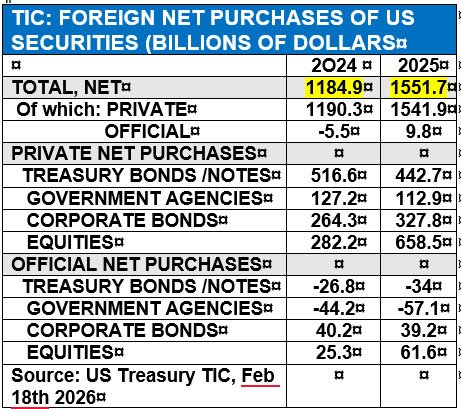
Consequently, it is not correct to look at the depreciating dollar exchange rate to conclude that it is associated with the sale of US assets. To check whether such a sale is ongoing, we must look for indicators that directly indicate it. The evidence clearly indicates the opposite of such a flight. The Table below shows the numbers for foreign purchases of US securities during 2025, which were just released in the Treasury TIC for December:
Source: US Treasury TIC, Feb 18th 2026
The foreign official sector, mainly central banks, has ditched government-related debt, and TIC Table 5 indicates that China, India, and Brazil are the main countries responsible for that. For instance, Table 5 includes T-Bills purchases, which are not included in the previous general Table, and shows that China decreased its holdings of US Treasury debt by $76.5 bn. There are geopolitical reasons for this behaviour. The foreign private sector, though, was quite buoyant in increasing its purchases. However, it is true that there has been a longer-term decline in official purchases, as shown in this slide.
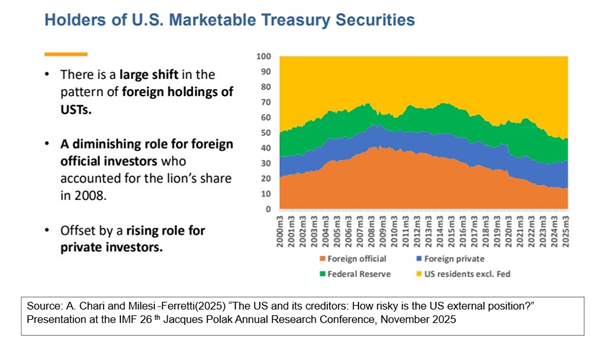
The official reserve holdings of US Treasuries peaked in 2008 and have been decreasing ever since, not totally offset by foreign private demand. This decline, offset by domestic demand, has several causes: a general reduction in the total size of official reserves; the dollar’s appreciation since then until last year; and increased holdings by the FED as a result of QE. So, even before last year’s negative events, there was a structural trend that is bound to continue, gradually undermining the position of the dollar assets in official reserves. However, the use of the dollar in global finance is crucial, and that will ensure continued demand for Treasuries as the liquid and safest asset in a fully collateralised worldwide financial system. As we saw in the recent TIC numbers, the foreign private sector continues to increase its holdings of all types of US financial assets, including Treasuries.
This recent trend may be disturbed by a possible unwinding of the yen carry trade. For decades, the near-zero Japanese interest rates induced a very sizable trade in which international investors would borrow in Japanese markets at such low interest cost and apply the proceeds mostly to dollar Treasuries, earning a big spread that they bet would not be wiped out by a yen appreciation. Likewise, domestic institutional investors would apply the proceeds of Japan´s trade surplus in US Treasuries. All this ensured a stable demand of Treasuries. However, Japan, now with inflation around 3%, has started to change its monetary policy by increasing policy rates, and the huge public debt, 240% of GDP, has also pushed up bond yields, with the 10Y bond now at 2.2% and the 30Y at 3.4%. These levels had been higher but, surprisingly, fell after the Government’s landslide victory in the recent Parliamentary elections (Feb 8th), despite its promise to cut taxes and increase the deficit. The size of the victory ensures stability and optimism spread in Japan, leading to that development, accompanied also, surprisingly, by an initial yen appreciation. Nevertheless, the expectation of higher policy rates may contribute to two movements detrimental to US Treasuries. Japanese investors will shift from US Treasuries to Japanese bonds after the full normalisation of monetary policy, and foreign investors will unwind the carry trade by selling Treasuries to repay their borrowing in the Japanese domestic market. There was a small episode of that unwinding in the Summer of 2024, based on expectations. Still, the conditions are now in place for a full movement that, with the repatriation of capital by Japanese investors and the unwind of the carry trade, could reach close to USD 1 trillion. That possible risk has not happened so far, and the Japanese holdings even increased in 2025. Something that in the future may offset negative shocks to Treasuries´ demand would be the sudden expansion of dollar stablecoins issuance and usage, as they require reserves in Government debt. I wrote three long posts on stablecoins that can be read on my Substack (at vconstancio.substack.com), but, contrary to my expectations, big banks and financial institutions are being very cautious in studying and deciding whether to issue stablecoins in a hurry. Perhaps they do not like their profitability level and are analysing whether the quick tokenisation of banks’ deposits on blockchains is a better idea.
Regarding real asset transactions like Foreign Direct Investment (FDI), the US BEA data go only until Q3 2025, but they indicate an increase of $219 bn in 2025 Q1-Q3 compared with the previous year. Likewise, in offshore funding in dollars, the difference between the cost of getting dollar funding offshore and getting it in the US money market, which is called the “cross-currency basis”, has been very low, indicating that there has been no difficulty in dollar funding stress internationally. For instance, the EUR/USD basis is currently between 2 and 3 basis points. So far, there is no generalised flight from the dollar and dollar assets.
1.4. It is misleading to characterise a currency’s international status as being a “reserve currency”
A currency fulfilling the functions of an international money cannot be limited to serving as a store of value and a reserve currency. Even stranger is restricting it to central bank holdings as an indicator. A global currency must also be the dominant international means of payment and the crucial unit of account for the pricing and invoicing of world trade, as well as for financial instruments and transactions in the global financial system.
The restrictive designation of being the “reserve currency originates from the early days of the International Monetary System (IMS), when global liquidity was ensured by official sources. Central banks used reserves for rare FX interventions. Central Banks and official liquidity became much less relevant over time. That phase ended in the 1960s with the establishment of the private Eurodollar system—offshore dollar deposits and credit in banks based in Europe and later worldwide. With credit provision in dollars, this private system had a multiplier effect, amplifying the initial deposits. The system expanded to enormous proportions, and its creation of private offshore dollar liquidity resolved earlier concerns about the lack of official international liquidity. The total dollar deposits in banks outside the US have been close to domestic US deposits (16 to 18 trillion).
After the emergence of derivatives, the dollar became the dominant currency, which propelled the off-balance-sheet size of those banks. For instance, the FX Swaps, forwards were $111 trillion in 2024 (See the BIS Annual Report 2025, Ch. II page 52 )
The international private system requires US debt securities, the safer and more liquid type of securities, to be used as collateral, now that we operate within a fully collateralised transaction regime in the global financial system. This is particularly significant in the REPO market. The US Repo market at Q3 2025 was $12.6 trillion (Source: OFR), and the EU market was at 12.4 trillion euros (Source: ICMA) or 14.4 trillion dollars in June 2025, using the EURUSD level of that date. However, ≈ $3.6 trillion in the EU market was denominated in dollars, which surely happens in other countries. The collateral used in the two markets is mostly Government debt securities in repos, the majority of which have 24-hour maturities, and the maturities up to a week represent ≈ 85% or the total. It is mind-blogging that the repo overnight market, which has a daily rollover of many trillions, is the crucial (and very risky) short-term funding backbone of the global financial system.
In the forex market, the dollar also functions as an intermediary for many currencies, with trades passing through it. This is why the dollar accounts for 90% of global forex market turnover, as each transaction involves two legs. The following slide briefly illustrates the different aspects of the dollar’s role as the global currency.
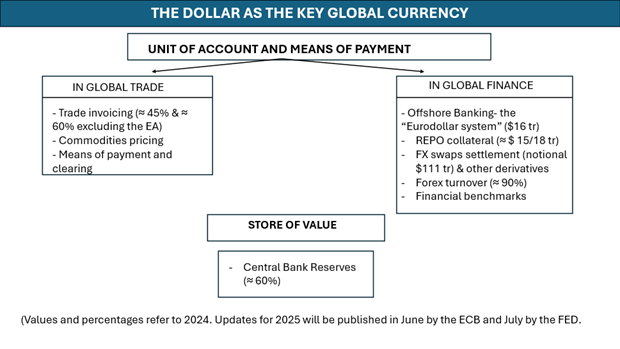
In summary, the importance of dollar assets held by the world’s central banks has lost relevance as an indicator of the dollar’s primary role as an international currency. Charles Kindleberger preferentially used the designation of “key currency” and many others, e.g. Peter Mehrling, use “global currency” instead of “reserve currency”. If the dollar lost some weight in central banks’ reserves in favour of gold, especially due to its price effect, that is certainly far less significant than the way the market commentariat often portrays it. As I mentioned above, gold has no money function and is merely an asset competing with others as a store of value, a role it fails to maintain in real terms over the long term. Like any speculative asset, it is prone to booms and busts, as history has duly recorded,.
To get my posts for free by email, subscribe and not just follow
2. The dollar’s long-term erosion and a multipolar international monetary system
2.1. An apparent stable situation
The previous section illustrated that the dollar, as the incumbent global currency, benefits from its deep embedding in the world trade and financial systems. When those world systems were infinitely less complex, it took around 35 years to complete the substitution of the British pound by the dollar, and we don´t even see this time any other currency ready to start competing. A static analysis of the numbers seems to point to a stable situation.
A general picture of currency competition is shown in the following chart, published last June by the ECB and referring to 2024. Updated numbers will be published by the ECB next June and by the FED in July.
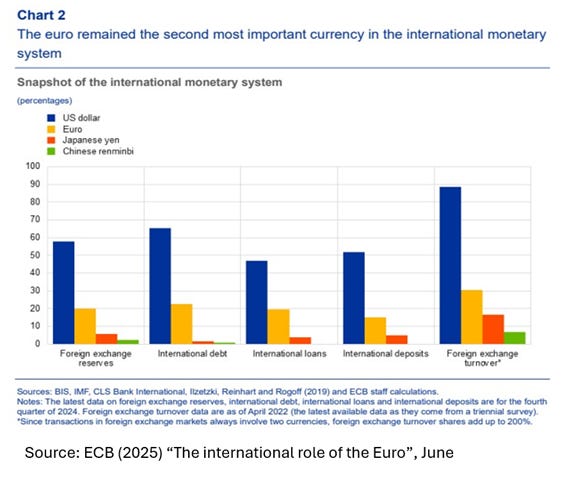
The relative positions depicted on the slide have been relatively stable over the past 24 years, as the weighted composite index published by the FED illustrates.
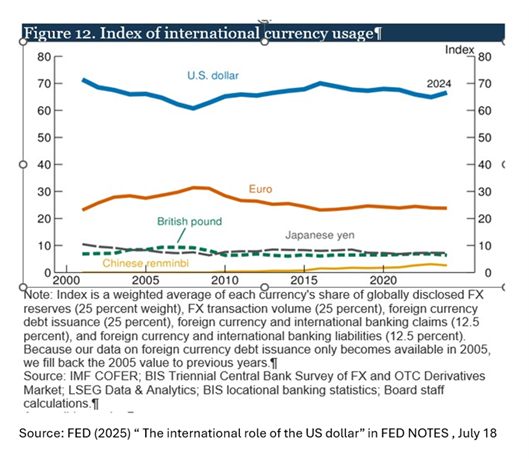
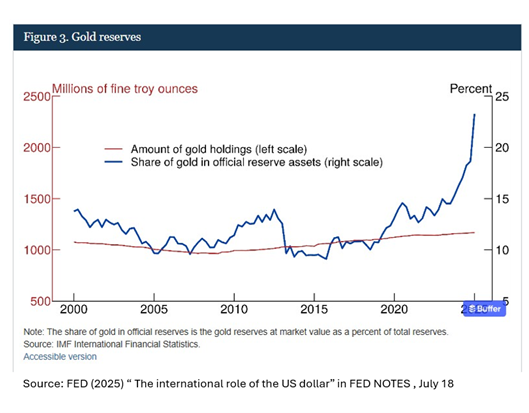
The index will likely show a slight decline in 2025, as the dollar share of official reserves is expected to decline and not be offset by increases in other sub-indicators. The following slide shows the price effect of gold appreciation in 2024, which rose further in 2025, explaining the bulk of the 8 percentage-point gain in the gold share of total official reserves. The increase in the tons of gold held by official authorities has, on the contrary, been quite subdued and gradual. (see the chart below)
2.2. Competitor currencies obstacles
Currencies that aspire to have a significant international role are aware of the 101 conditions that must be satisfied to ensure success:
1) A sizable country with relevance in world trade and finance
2) Stable and sound macroeconomic policies that ensure a low inflation regime and a fully convertible, stable currency
3) Money and capital markets that are deeply liquid, open to free movement of capital and efficient (low-cost transactions)
4) Rule of law and investor´s rights protection~
5) Geopolitical power, including military
It is a hard list to comply with, but until recently, the US dollar did it. The imposition of sanctions on several countries related to the dollar’s role, compounded by President Trump´s disparagement of the rule of law, domestic and international, has undermined trust and credibility. The US withdrawal from multiple international organisations and the attempt to undercut the United Nations with Trump´s “Board of Peace”, confirm the Administration´s arrogant unilateralism. The present reckless US fiscal policy and the efforts to control the FED, have raised doubts concerning the dollar. The arbitrary use of tariffs for purely political purposes, now struck down by the Supreme Court, has added to the perception of US policy instability. The messy adjustment to the SCOTUS decision on tariffs will increase policy uncertainty for a long period of time. As we have seen, though, the present situation has not yet significantly changed international use of the dollar, in part because there aren´t any alternatives immediately available.
The euro misses points 3 and 5, with no proximate prospect of fulfilling them. The absence of a capital markets union that includes equities and bonds.is still far away. The crucial project of a unified bond market with a pan-European safe asset is not even being pursued. Without a sizable, deep, efficient bond market, the euro cannot become a global currency and will stay only a strong regional one. The central and Nordic European countries fear that schemes to enlarge the issuance of a European safe asset could slide down a slippery slope toward debt mutualisation. They suspect that even the schemes proposed without such mutualisation would lead to similar results.
Nevertheless, the issue of the euro´s internationalisation recently gave signs of life. The EU Commission sent for on the 13th Feb a Staff Note to the Eurogroup (the meeting of theFinance Ministers of the Euro area member countries) titled “Strengthening the international role of the euro” [i]. The document has useful content, but it´s not clear enough about the need for a true Capital Markets Union, a project launched by the Commission in 2015 that never really progressed and was recently toned down to the Savings and Investment Union. In this project, the need to integrate the European bond markets around a sizable, pan-European safe asset is not even mentioned. Still, the lack of ambition is just a reflection of the absence of political will to take the main goal seriously. The document repeats the misleading idea that the Savings and Investment Union is about increasing the efficiency of European capital markets to avoid having Europeans send their savings abroad for better returns. This notion has been repeated in all official Reports, totally ignoring the fact that the macroeconomic policy regime imposed in Europe leads to a surplus in its external Current Account (≈ 3% of GDP !), which by definition, implies that the Euro Area is an exporter of capital, applying savings abroad and having a deficit in its Financial Account. The sending of net savings abroad is a macroeconomic issue, and not a matter of microeconomic efficiency.
Still, it´s important that the Staff Note (not explicitly endorsed by the Commission) was sent to Ministers with such a clear title, something that didn´t happen since the 2018 Commission Communication sent to the European Summit with the same title.[ii] Some marginal decisions will certainly contribute positively to the final objective.
China has recently reaffirmed its strong aim to internationalise the renminbi. However, China falls short on points 2, 3, and 4 of the necessary conditions, and given the current very low level of renminbi international usage, it faces a challenging task ahead. As usual, the international use of a currency begins with trade, aid, and credit flows. China’s growth of exports to Emerging Countries has exceeded growth to the Advanced Economies for years, and with its Belt & Road Initiative, China has become the primary creditor of EME. It is therefore possible that invoicing trade in renminbi is already higher than what is statistically reported and will continue to increase, albeit with absolute values that remain small at the global scale.
The efforts to use the digital yuan, China´s CBDC, cross-border within the m-bridge platform, built under the umbrella of the BIS, with Thailand, the UAE and Saudi Arabia, are still in an experimental stage for tourists, as is the case also with Singapore. The problem with this channel is that the renminbi is not a fully convertible currency, as it´s still subject to capital controls, and the exchange rate is manipulated by the authorities rather than determined by market forces. In this situation, countries will refrain from accumulating renminbi balances resulting from trade deficits with China. Additionally, small countries are concerned with currency substitution and renminbi dominance.
2.2. The long-term path to a multipolar currency system
President Trump´s policy shenanigans are undermining the dollar, and, in the long term, the geopolitical of multipolarity, already here, will be reflected in the international monetary order. China´s efforts will eventually succeed in giving the renminbi a significant position. The euro is already a strong regional currency and a significant international currency, and is bound to play an even greater role as the dollar suffers from reckless US policies. Nevertheless, the international monetary order is not about to crumble, triggering an international crisis of epic proportions. The dollar will continue to dominate for decades ahead. However, the world is now on an unavoidable long-term path to a future tri-polar monetary system.
To get my posts for free by email, subscribe and not just follow
[i] Find it at https://www.consilium.europa.eu/media/buspxaox/strengthening-the-international-role-of-the-euro-note-for-the-eurogroup.pdf
[ii] Find it at https://commission.europa.eu/publications/towards-stronger-international-role-euro-commission-contribution-european-council-and-euro-summit-13_en#files
Comments
Nothing yet. Say the first thing.
Sign in to join the conversation.