
Subscribe to get posts by email for free
1. Introduction
I took a longish season´s vacation and saw, aghast but not surprised, the US entering a new era. By words and deeds, the Trump Administration turned the US into an explicit Imperial Nation, withdrew from a host of multilateral institutions, and claimed for itself the right to take over other countries, capture their resources and “run” them for an undefined period. The developments of the past few weeks gave me a sense that narrow economic subjects reek of triviality in the new context. It is even possible that the mayhem in international relations may coexist this year with an uneventful economic evolution that will just be a sort of continuation of 2025 performance. The economic event that could change that scenario is the unavoidable, significant correction in the US stock market happening this year rather than in 2027. The sizeable market reactions to recent Trump threats over Greenland have already been significant.
The resistance to writing about narrow economic events led me to this post, where, after one year of Trump 2.0, I try to organise my thoughts on the new world order and what Europe should do in this new environment.
An unrecognisable US started a new age of Imperialism and gunboat diplomacy, and, symbolically, this happened on the eve of a new era regarding nuclear arms. In fact, on the 5th of February, the last remaining US-Russia treaty on nuclear arms control expires. It put a ceiling of 1500 on nuclear warheads ready to be used and a limit of 700 on the places from which they could be launched (silos, planes, submarines). It is true that Russia had already suspended its participation in 2023, albeit continuing to comply with its rules, whereas the US’s future intentions have yet to be disclosed. The penultimate Treaty to end was highly relevant to Europe, as it concerned intermediate-range nuclear missiles (INF), which Trump withdrew from in 2019.
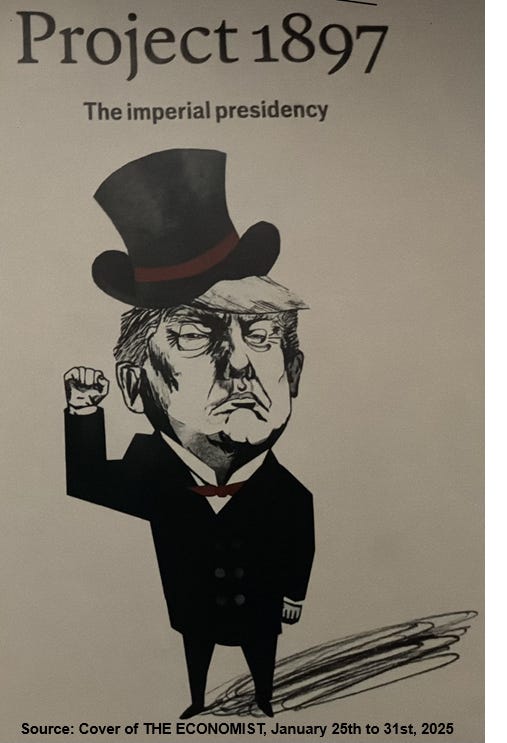
The recent geopolitical developments should not come as a complete surprise, as they were generally announced in President Trump´s inaugural speech in January. THE ECONOMIST got it right, producing an excellent editorial and a Cover for its 25th January edition, which I reproduce at the top of this post. In the speech, Trump said that America is “a growing nation” that “increases our wealth, expands its territory”. The only former President Trump mentioned was William McKinley (1897-1901), promising that “we will restore the name of a great president, William McKinley, to Mount McKinley”. McKinley was an imperialist who annexed Hawaii to the US and started and won the American-Spanish War over Cuba, in which settlement Spain had to turn over to the US its main overseas colonies of Puerto Rico, Guam, and the Philippines, while Cuba was promised independence but remained under the control of the United States Army until May 20, 1902. So, now Trump wants to take Greenland, but the revolt in the Senate forced him to give up the use of force against a NATO country. McKinley also increased import tariffs by 50% in a time when there was not yet a full income tax in the US, a dream invoked several times by Trump after the so-called “liberation day”. As The Economist wrote, “Project 1897 is combined with Project 2025”.
2. Implementation
In April there was the launch of tariffs and the beginning of the Trade War, and in November, in the National Security Strategy, we saw the implementation of the imperialist drive. The document stated that the US “will reassert and enforce the Monroe Doctrine to restore American preeminence in the Western Hemisphere, and to protect our homeland and our access to key geographies throughout the region.” Regarding Europe, the diagnosis was that its “…economic decline is eclipsed by the real and more stark prospect of civilizational erasure”. This would allegedly result from “… activities of the European Union and other transnational bodies that undermine political liberty and sovereignty, migration policies that are transforming the continent and creating strife, censorship of free speech and suppression of political opposition, cratering birthrates, and loss of national identities and self-confidence” The myth of population replacement by Muslims and dark races, was given credence in that outlandish verdict. The document saw hope only in the ”--- the growing influence of patriotic European parties indeed gives cause for great optimism “, meaning the extreme nationalist and populist parties, something that the strategy intends to help by interfering in the European democratic process by “ Cultivating resistance to Europe’s current trajectory within European nations”. Things could not be more clear: the US Administration intention is to make the EU implode from within under a wave of radical nationalism, ending a project that, according with Trump “was created to screw America”.
Since Christmas, we have followed several striking events that materialise the new policy:
- A military operation captured Venezuela´s nasty dictator, not to restore democracy, but use a previous agreement with the regime in place to get access and explore what Trump called “our oil”. Before that, a bombing campaign killed 85 people in small boats in Venezuelan waters, as several oil ships were seized, including one navigating under a Russian flag.
- A serious threat to take over Greenland as US territory, either by purchasing it or by “other means”. The growing likelihood that the Senate would pass a WAR Powers Act prohibiting the use of military force in Greenland and the offer of a still mysterious and uncertain deal to get partial sovereignty led to the abandonment of the “use of force” and the announced additional tariffs on some European countries. To be continued, though.
- A set of bombings of Islamic State activists in coordination with the Government of Nigeria, another big oil producer.
- The threat to intervene militarily to protect the protesters in Iran, another relevant oil producer
- President Trump signed a Memorandum instructing the Government to implement the withdrawal of the US from 66 international organisations, 35 non-UN institutions and 31 belonging to the UN. A movement of total refusal of multilateralism
- President Trump announced his intention to increase the defence budget by 50% to $1.5 trillion
- President Trump gave an interview to the New York Times, stating that he doesn´t recognise the limits of any international law and that the only limits to his decisions as commander in chief come from his own “morality”. A foreign policy of raw power is now the norm.
- President Trump launched a criminal investigation into the FED Chair’s behaviour regarding building renovations, in a clear manoeuvre of intimidation related to the independence of the FED to set interest rates, an institutional of great global importance.
- The US recently made an extraordinary proposal for what is called the Charter of the Board of Pearce, a body foreseen in the UN resolution on the Gaza peace plan proposed by the US. Trump invited 60 countries, including Russia and China, to become members (an excess for the purpose), and the proposal does not mention Gaza, it establishes a global mission to “promote stability” and “restore dependable and lawful governance” in any conflict zone the Chairman designates. The first Chairman will be, you guessed it, Donald Trump, with the following powers: The power to veto any decision made by the Board; Exclusive authority to invite, renew, or remove member states; The final word on the interpretation and application of the charter; The appointment of his successor as Chairman. The ability to create or dissolve subsidiary entities. In short, he wants to substitute the United Nations and become the Emperor of the World, no less. France declined the invitation, and Trump threatened it with 200% tariffs on wine and champagne. Norway, Sweden and Denmark also declined. In the end, 21 countries signed today in Davos, and 19 more have confirmed joining. From Europe, only Hungary is among the 40, and from Latin America, only Argentina and Paraguay. Predictably, the Trump friend, Meloni said that Italy needs more time to decide but remains open/interested.
-
3. Civilisation erasure.
The US became sadly unrecognisable in the space of a year, including through a scary domestic authoritarian drive. In foreign policy, gone are the pretensions to pay tribute to multilateral cooperation or aspiring to shepherd the maintenance of some global public goods. Former allies and foes now face an aggressive negotiator willing to leverage all its power to extract the maximum advantage. The World is now confronted with the full effects of the Kindleberger Trap, meaning there is no hegemon creating global public goods or fostering cooperation initiatives. The Thucydides Trap, according to the realist school of international relations, should not be far away, implying that the incumbent hegemon will enter into conflict, possibly a violent one, with the incoming great power, China, in the present case. [i] This may be proven wrong because we still rely on the MAD (Mutual Assured Destruction) strategy to avoid actual wars.
An aspect of imperialist ambition that emerges from that shocking list is the aim of securing access to natural resources, especially oil, since large-scale energy consumption will be a vital enabler, or a barrier if absent, for AI implementation and growth, seen as the frontier technology for the power of nations. From now on, for the US, it all revolves around geopolitics, the power struggle among big nations, and geoeconomics, a renewed separate subject-matter where economic policy is subordinate to the goals of national power, not just economic efficiency. Many mainstream economists would say there is no difference between the two goals, but they lose that battle when we consider the consequences of the multipolar world we now live in, as I will address later.
Nevertheless, the overriding meaning of the new US position is the definitive demise of the so-called rules-based liberal international order that the US built after the Second World War. The US withdrawal from multilateral cooperation, the implementation of an aggressive, transactional, selfish foreign policy in a multipolar World, and the raw power politics are what I really call civilisation erasure. After two world wars, humanity tried to build global institutions (the UN, GATT/WTO, IMF, WB), establishing principles and behavioural rules for States in International Affairs. It was not a perfect order, as it was regularly violated by the great powers. However, there were many victories besides those violations and nations were trying to hide or disguise them, fulfilling the maxim by the French moralist La Rochefoucauld that “Hypocrisy is the homage that vice pays to virtue” The virtue was recognised in lofty principles like these in the UN Charter “Article 2 (4)- All Members shall refrain in their international relations from the threat or use of force against the territorial integrity or political independence of any state…” or “…the United Nations shall promote…..(c) universal respect for, and observance of, human rights and fundamental freedoms for all without distinction as to race, sex, language, or religion.”
All that is now put into question, or even destroyed, by the Trump Administration’s new strategy. If fully successful, it would be an unequivocal retrocess [ii] of civilisation. Full success is not yet assured. There is some resistance in the US and around the world. There are real obstacles: the Venezuela adventure may still fail, the US economy may slow down, the Republicans may lose the midterm elections, curtailing Presidential powers, and the Republicans may lose the Presidential 2028 elections.
Men and History
We must, however, be aware that the world will not go back to the era of liberal globalisation and US unipolar hegemony. Behind the malignant narcissism and the delusional excesses of Trump, there are some structural changes that will not go away entirely. I am not with Carlyle when he said that “The History of the world is but the Biography of great men“, where, to apply it to Trump, we should read powerful instead of great. Tolstoy took the opposite position: “In historical events, the so-called great men are labels giving names to events” In History, big structural trends tend ultimately to be decisive, despite the nudges generated by some individuals.
The big structural change is obviously the emergence of China as a great power. The unipolar moment that the world lived in since 1990 ended around 2015. This was recognised for the first time in a US official document in the National Security Strategy signed by Trump in 2017, where the word “multipolar” is used to characterise the world’s geopolitical situation. During the unipolar period, the liberal illusion dominated that economic goals of wealth enrichment through globalisation would lead to democracy and a smooth integration of Russia and China into the Western liberal order. Montesquieu’s magic of the “doux commerce” would work again. Russia would be satisfied with being in the G8, while NATO was being enlarged close to its borders. China, after its 2001 admission to the WTO, was supposed to follow economic growth with democratic reforms. In the end, the realist school of foreign relations was correct: in a world of great powers, economic growth tends to induce military advancements, and even if countries genuinely proclaim their exclusive defensive goals, the other established powers will perceive this as a threat. That is the rationale of the Thucydides trap. The new world geopolitics will continue to reflect those three structural features: multipolarity, geoeconomics as part of statecraft, and the absence of a hegemon providing global public goods.
The reasons why the emergence of China changes everything in the world order are easily listed:
a) Competition with China makes the hegemon (US) less available to continue to shepherd an order of things that gives a free hand to the coming great power that threatens its position
b) Things are aggravated when the challenger misbehaves in breaching the rules by trade malpractices, using subsidies, forcing technological transfers, exerting control over imports, etc. There are exceptions in the WTO rules that allow legitimate responses by other countries, but Trump preferred to breach the rules. The US began under Obama the “pivot to Asia” and introduced some mild restrictions on China. Trump, in his first mandate, increased tariffs on China from 3% to 19% and paralysed the WTO by failing to appoint US representatives to its Settlement Committee, where disputes are arbitrated. Biden kept both policies and started an aggressive industrial policy. The incumbent’s fight for its position is bipartisan and will not go away.
c) Middle-sized countries discover that, from economic interdependence with the great powers, dependence may come in the form of coercion. Supply chains can be disrupted with severe consequences for smaller countries.
d) Besides trade, the challenger started initiatives to attempt to undermine the dominant international role of the hegemon’s currency, despite its assured lack of effectiveness for a long period of time to come.
Mainstream economics, which felt it was in power during the unipolar phase of “Hyper-globalisation” (Dani Rodrik), discovered that questions of power cannot be completely ignored in understanding what influences the economic behaviour of nations. Already in the New Trade Theory, developed by Krugman and others, had introduced concepts of imperfect competition and increasing returns, revealing that strategic trade policies and identifiable externalities are new legitimate policies that challenge free trade. Krugman (Is free trade passé?, JEP 1987) [iii] wrote, “There is still a case for free trade as a good policy, and as a useful target in the practical world of politics, but it can never again be asserted as the policy that economic theory tells us is always right.” In 1945, the eminent thinker Albert Hirschman empirically documented that national power goals influence the structure of trade, stating that “…relations of influence, dependence and domination arise right out of ´mutually beneficial´ trade”.[iv] Hirschman’s book is, therefore, a seminal work in the development of the new discipline of geoeconomics,[v] which suddenly gained popularity. In a multipolar world characterised by competitive struggles between major countries, economies function even less as a pure result of rational individual behaviour and perfect markets.
All this implies that the system’s rules would have to be adjusted to the new environment in order to essentially survive. Fred Bergsten, the founder of the Institute for International Economics (now, the Peterson Institute), wrote in 2002 a very sensible book [vi]about US versus China and the reforms of the system that a new relationship would entail. He advocated that the US should adopt towards China a strategy of “Conditional Competitive Cooperation,” where the conditionality refers to China’s respect for the newly agreed rules. Reform of the WTO would be central to adopting greater flexibility to accommodate some Chinese preferences and to clarify the use of exemptions and countervailing measures.
The IMF would also undergo significant reforms. China would refrain from “manipulating the currency”; a new clause would allow “countervailing currency intervention,” and China would have to fully comply with standards of data disclosure, etc. Boldly, he proposed that “In return for accepting and implementing those reforms, China should, over time, be granted full quota and voting-parity with the US in the IMF.” These and other recommendations were founded on principles of accepting the existence of different economic and political systems, and of “decoupling of the economic (and global commons) issues from the more contentious security and values topics,” a typical economist’s illusion. In any case, the moment has passed to think that desirable tweaks could save the global multilateral system fundamentally intact. We are heading for darker times as China wants to blossom in the sun, and the US, as the relatively declining hegemon, refuses to acknowledge the new status.
What should the European Union do?
Naturally, the EU is not a great power in the geopolitical arena because it lacks sufficient political unity and a common defence policy with nuclear deterrence. Consider Russia. It has a GDP lower than Italy’s and a declining population of 140 million. Nonetheless, it is a geopolitical power because it possesses 5400 nuclear warheads, with 1500 permanently ready to be launched, slightly more than the US. China has 600 and is rapidly increasing its stockpile, France has 290, and the UK has 225. The EU has none. De Gaulle’s Force de Frappe will remain French, and the UK’s arsenal, with warheads made in the US, which are sent there regularly for maintenance, will also stay outside any exclusive European arrangement.
The US has dozens of military bases in Western Europe, plus quite a number of smaller military facilities. Six bases in 5 countries, dispose of nuclear warheads, with around 100 ready to go. All those facilities are manned by around 80 thousand military personnel. Since WW II, European Governments have been dependent on that and would hate to see it disappear. Nevertheless, no European believes anymore in the US implementation of Article 5 in Europe´s benefit. With the EU’s full commitment to Ukraine after the Russian invasion, dependence on the US became overwhelming. The EU lacks sufficient military intelligence needed in Ukraine, as well as sufficient weaponry to help Ukraine, which, at Trump’s whim, it must now purchase from the US. In this situation, Europe had to accept the unbalanced July trade agreement imposed by Trump, despite the US being quite dependent on several specific European intermediate goods, in sectors like pharmaceuticals, chemicals, and precision machinery, which Europe could use as retaliation, even without using the Anti-Coercion Mechanism it created in 2023. If and when there is a settlement to the war in Ukraine, Europe will be freer to play the geoeconomic game more forcefully.
Foreign and defence policies are now mentioned in the European Treaties, but decision-making is by unanimity, as they are essentially intergovernmental policies. There is, however, the possibility of enhanced cooperation in foreign and security matters among at least 9 member countries, but it must be authorised unanimously by the European Council, which includes all the countries. Nevertheless, many developments are taking place in Europe in this domain. National defence expenditures are being increased, and there is a European Common Budget initiative for defence, which Canada has joined in terms of joint procurement. Within 5 to ten years, the EU will dispose of conventional sophisticated weaponry and military intelligence fully capable of assuring its own defence, albeit without common nuclear deterrence. In fact, I don´t see sufficient political unity and trust for this last bit to be possible. Naturally, ensuring 100 nuclear warheads are in permanent readiness is not the problem. That is what France currently has. The problem, however, is deeply political, which nowadays means nationalistic. History and culture naturally carry a great weight in such an issue, and there is simply no unity on the matter. Nevertheless, what will be achieved will be enough to reassure those who have the imagination to fear a Russian invasion.
In defence and other matters, the EU countries should strive for greater European autonomy and a gradual reduction of dependence on the US, which has become, despite temporary fluctuations, an unreliable partner. Naturally, if the US fully and consistently will uphold the values of liberal democracy and respect for human rights, Europe will always be inclined to prioritise its relations with America, but without exclusivity or renewed excessive dependence. Europe is open to the world, preserving its autonomy and identity.
In trade, the Agreement with the Latin American Mercosur countries (if it passes the French Parliament), and the coming Treaty with India would be landmarks for an open trade system, involving more than two billion people. The EU’s extensive cooperation with the South sets a relevant benchmark.
Regarding China, Europe cannot be the victim of the distorted China macroeconomic policies that, by compressing domestic consumption for years on end, make Chinese production and GDP dependent on a huge net export surplus (1 trillion USD in 2025). Free trade depends on all countries avoiding permanent global imbalances of excessive surpluses or deficits, as both cases represent a capture of a big chunk of global demand that will be lacking elsewhere, creating a deflationary bias. Surplus countries compress domestic demand and then use the demand of others through exports; deficit countries expand their own demand through domestically over-expansionary policies, creating a shortfall for other countries. Besides, global imbalances create conditions for financial instability and exchange rate misalignments. After the 1980s episodes, global imbalances have returned and are one of the big debates of 2026 in the G7 and the G20. The US will blame China, and China will blame the US, but without cooperation, all other countries will suffer a deflationary bias. Europe must put pressure on both big economies. Otherwise, while keeping an open dialogue, Europe will be forced to step up its restrictions on Chinese imports and respond more forcefully to any new US tariffs.
Europe´s openness to trade with all parts of the world should also be prepared to restore relations with Russia, if and when an acceptable settlement is reached on the Ukraine war. Recent statements by the German Chancellor, Merz, go in that direction.
Finally, the EU also needs to prioritise its own economic prosperity. Currently, when comparing living standards, necessarily using PPP-adjusted variables, the EA GDP per capita is still around 80% of that of the US, achieved with productivity per hour at 88% of the US level, but with 12% fewer average working hours per employee, which counts as an improvement to the standard of living. In fact, using the well-known standard of Charles Jones and Peter Klenow (2016) [vii] that calculates a composite indicator of the level of living that includes the level of consumption, the inequality of consumption distribution, the amount of leisure given by relative duration of work, and life expectancy, a Danish think-tank published the following comparison with the US: [viii]
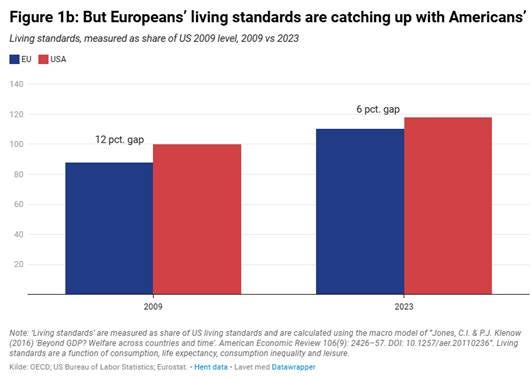
The difference was only of 6% in 2023. The EU economy can ensure, with less work and higher life expectancy than the US, a comfortable life for its citizens, along with greater fairness. With its fiscal and external balances in better shape than those of the US and growing in an open, international-competition context, the EU meets the OECD definition of a competitive economy. We do not need to be equal to the US to be competitive. We do not have to fully close our structural gaps with the US: e.g. lower productivity, less innovation, smaller tech firms. What we must do is to increase productivity to improve our citizens´ lives. which will get us closer. For that purpose, we must improve energy efficiency through diversification, enhance technological performance through smart industrial policy, leverage increased defence expenditures and restructure finance by significantly expanding European safe bonds and unifying our equity markets. Europe lacks sufficient political unity to turn the euro into a true global currency or to become a military superpower, but it can ensure its own economic resilience and prosperity, even if it remains below but close to the technological frontier.
[i] See Allison, G. (2017). Destined for war: Can America and China escape Thucydides’s trap? Boston, MA: Houghton Mifflin Harcourt.. On the realist school, see Mearsheimer, J. J. (2001, 2014). The tragedy of great power politics (Updated ed.). New York, NY: W. W. Norton & Company. The first edition was in 2001. Mearsheimer is considered to defend an offensive realist, whereas an earlier codifier of the realist school is considered a defensive realist, Waltz, K. N. (1979). Theory of international politics. New York, NY: McGraw-Hill.
[ii] An old word derived from the Latin retrocedere, meaning the same as retrogradation or regress (to go back, to return to the past)
[iii] Paul Krugman (1987) “ Is free trade passé? “ in the Journal of Economic Perspectives, Vol I, Number 2 pages 131-144-
[iv] Albert Hirschman (1945,1980) “ National Power and the structure of foreign trade”, University of California Press
[v] For a useful overview, see Aggarwal, Vinod K., & Cheung, Tai Ming (eds.) — The Oxford Handbook of Geoeconomics and Economic Statecraft (online 2024; print 2025). For an interesting view, see Blackwell, R.D. and Jennifer Harris (2017) “War by other means: Geoeconomics and Statecraft” A Council on Foreign Relations Book published by The Belknap Press of Harvard University Press
[vi] Fred Bergsten (2022) “The United Staes vs China: the quest for global economic leadership” Polity Pres
[vii] Charles >Jones and Peter Klenow (2016) “ Beyond GDP? Welfare across countries and time” in American economic Review 106(9): 2426–2457
[viii] Think Tank Europa “ The European Union is becoming the world’s quality of life superpower” in Economy and industrial policy 5 October 2025 at https://thinkeuropa.dk/en/notat/2025-10-the-european-union-is-becoming-the-worlds-quality-of-life-superpower
Comments
Nothing yet. Say the first thing.
Sign in to join the conversation.