
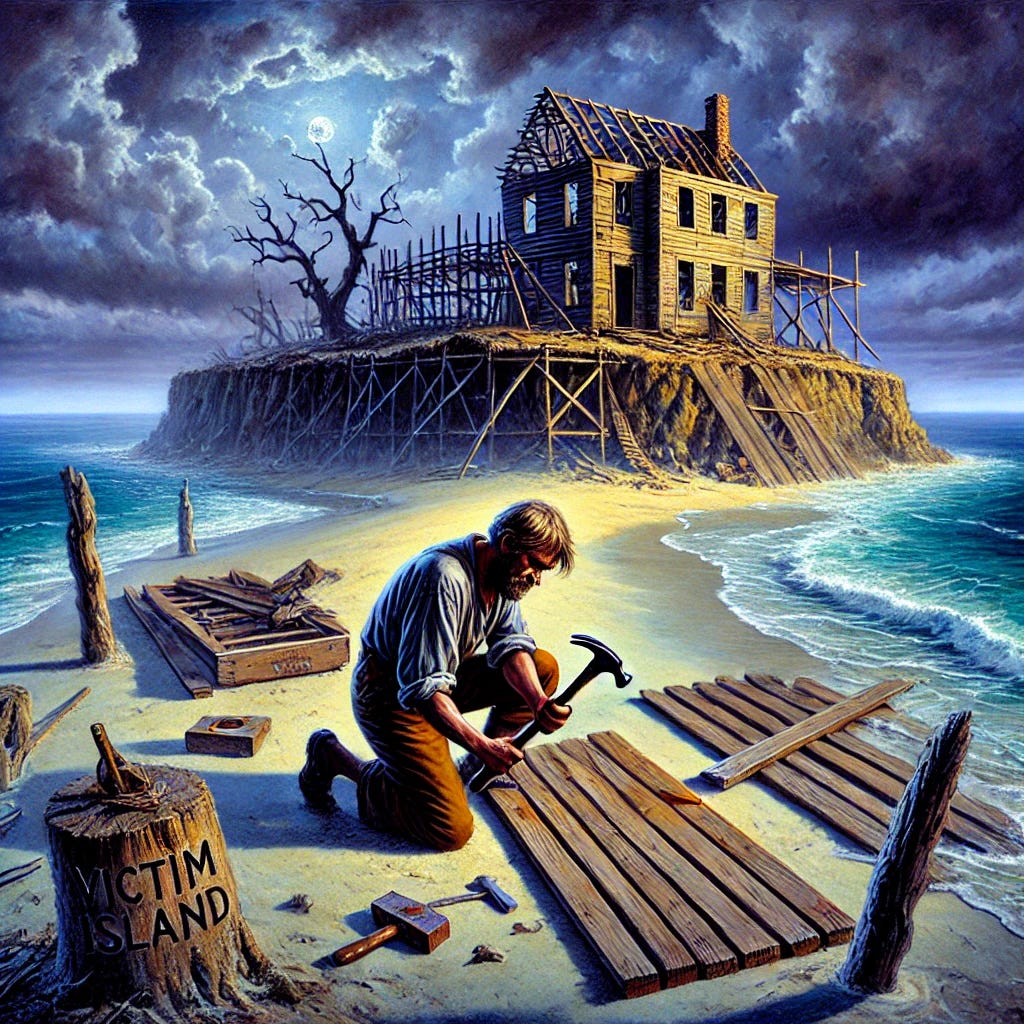
A few years ago, I found myself having the same conversations over and over again—both with myself and with others. I had a long list of reasons why life had been unfair to me. I had my "victim card," and I had gotten a few punches on it. Abuse as a child. Poverty in my teenage years. Bankruptcy. A stroke that left me paralyzed on one side. Each event was painful. Each event was real. And yet, I found myself trapped—not just in my past, but in my narrative of it.
It wasn’t until I stepped back that I realized what I had done. I had moved to Victim Island—and worse, I had started building a house there.
Victim Island is an easy place to find. The entrance is wide, and the current will take you there without much effort. Something painful happens—maybe something completely unfair, something you never deserved—and instead of grieving and moving forward, you set up camp. You build a house. You fill it with all the pictures of the terrible things that happened to you. And every day, you sit there, looking at them, adding more to the collection, replaying them in your mind.
And the longer you stay, the harder it is to leave.
It’s easy to believe the lie that if we just keep thinking about what happened, we’ll somehow find justice, resolution, or peace. But that’s not how it works. There is no peace on Victim Island—only misery, a growing sense of resentment, and an ever-expanding ledger of all the debts the world has failed to pay us.
And here’s the harsh truth: the longer you stay, the more people will stop wanting to visit. Not because they don’t care, but because they can’t rescue you. Only you can decide to leave.
One of the biggest signs of emotional intelligence is not being a victim. Emotional intelligence doesn’t mean pretending bad things never happened—it means refusing to let them define you. It means realizing that, no matter what happens to us, we always have the power to decide how we will respond.
A person with low emotional intelligence blames others for their unhappiness.
A person with high emotional intelligence takes ownership of their emotions and actions.
Many people in our culture have become experts at removing people from their lives who make them uncomfortable. They say things like:
"I just can’t be myself around you."
"You make me feel bad."
"You bring a negative energy."
But what they’re really saying is: "I have no control over my own emotions, so instead of learning to manage them, I’m going to control my environment by eliminating people."
This is what emotional immaturity looks like. And, ironically, it doesn’t bring more happiness—it brings less. Because when you remove every challenge from your life, you remove every opportunity to grow.
There came a point in my life when I realized that staying on Victim Island wasn’t serving me. It wasn’t bringing me peace. It wasn’t making me happy. It was just keeping me stuck.
So I made a decision: I got on a boat and I left.
It wasn’t easy. It meant letting go of my anger. It meant releasing the idea that the world owed me something. It meant accepting that while what happened to me wasn’t fair, it was still my responsibility to build a meaningful life.
And now? I pass by Victim Island often. I see the people still living there, clinging to their lists of who owes them what. And as I sail by, I call out:
"I’ll give you a ride if you’re willing to leave."
Because the truth is, happiness doesn’t live on Victim Island. Peace doesn’t live there. Healing doesn’t live there.
The only way to move forward is to let go.
So if you’re tired of the misery, if you’re done keeping score, if you’re ready to stop replaying the past—grab your things.
The boat is waiting.
Are you coming?
No posts
Comments
Nothing yet. Say the first thing.
Sign in to join the conversation.