
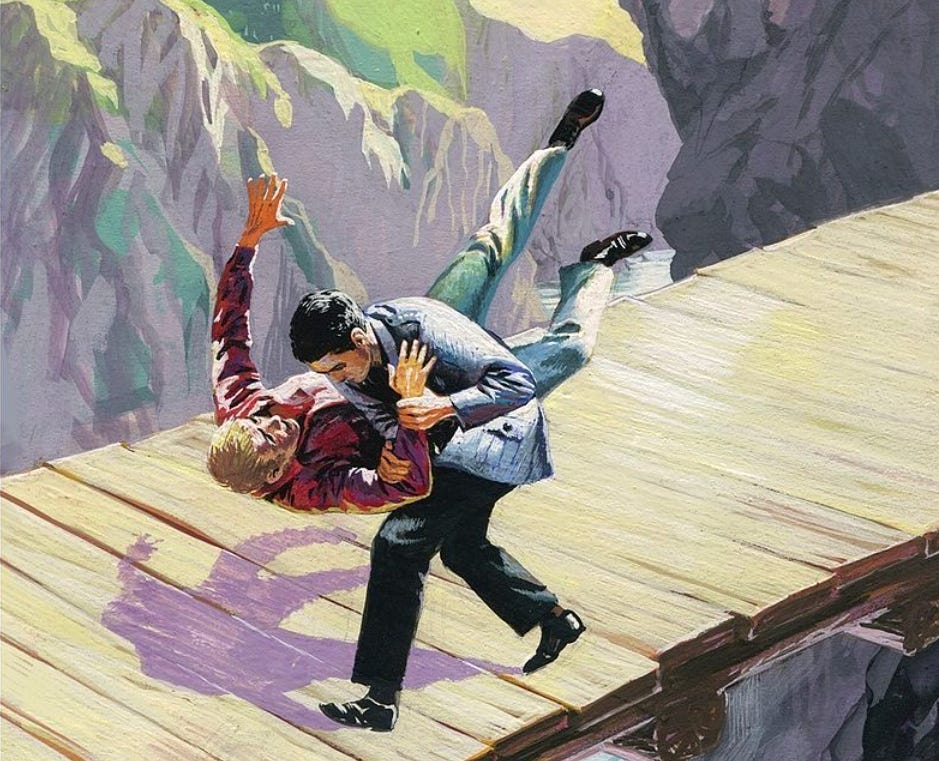
Patrick told me, “Where I grew up, there were a lot of fucked-up kids. It was a kind of a fucked up-place. The thing that makes it so hard is not that things are fucked up…but that it makes you impervious to advice.”
This statement landed like a brick through a window. Our relationship to advice is critical.
Most people receive a density of advice from their mid-teens to the early-twenties and then it tapers off. Post-school, the mechanisms for seeking or receiving advice regarding purpose and vocation disappear.
For some people (and artists), the posture of seeking advice threatens to upset a (perceived) power structure so they consciously or unconsciously avoid it. (I am thinking especially of boys and men in the “fucked-up” place of late patriarchal capitalism.) This can be a benefit or detriment. At the opposite extreme, some artists seek advice frequently and indiscriminately, suffering from a (metaphorical) weak or unstable center of gravity. This can result in work detached from the artist’s authenticity.
A life in art is – or can be – a life of constant creative and personal evolution and profound transformation. This path is the wilderness – where the goal is to experience the wilderness. Advice can lead you to the river or over a cliff. Or, it can lead out out of the wilderness to a cul-de-sac.
Here are some questions about advice for you to consider. (If you want to respond in the comments or privately by message, text, or call, I love to hear your thoughts.)
What is your relationship to advice?
How was that relationship formed?
How has advice affected your trajectory?
What has been the best (or worst) advice you received as an artist?
Last year, when I was invited to write reviews for a publication relaunch, I said, “How about I write an advice column instead?” That iteration was a one-and-done, but I liked the questions and knowing what I wrote had directly been solicited.
On one hand, I like the structure of an advice column – I like structures in general. Jerry Saltz’s social media posts that begin “Artists:…” and go on to tell artists “blah blah blah” irritate me. It’s like he’s holding court. An advice column, structured as such, can feel a little condescending like that. I’d like to find a way to humbly invite and answer questions. I’m open to ideas.
In a proper Village Disco, the proprietor sweeps the floor and occasionally acts as the Wujek Dobra Rada in a flannel at the bar. That’s the atmosphere I’m looking to create.
What do you think is the best structure for a useful exchange here? (Comment, message, text, or call. If you want me I’ll be in the bar.)
Below is a reprint of one of the questions I answered in ArtVoices, lightly edited and stripped of the “Dear Artist…” greeting and sign-off.
Their Question:
Do you find it disrespectful and disappointing when people come to your openings, give merely a cursory glance to the artwork and then spend more time drinking the free wine and indulging in banal chat about politics, the weather, their home repairs, etcetera?
My Answer:
Even though we make art in relative solitude, driven by personal impulses, most of us hope our work resonates with viewers, moves them to think or feel something new. During the run of an exhibition, we’re not usually around to see how it’s received. Openings uniquely bring the artist, the work, and the audience into the same room.
And yet. It’s hard—maybe impossible—for even the most invested viewers to have a patient or profound experience with an artwork during what is essentially a party. This is the main reason I almost never go to openings. I usually excuse myself in advance, explaining that I want my first encounter with the art to occur in better conditions. Also, as parties go, openings are kind of lame.
A generous view of opening receptions is that they celebrate the artist, the gallery and and the accomplishment of the exhibition. The art presses itself against the wall. Those who fail to engage with the work are not disrespecting the art as much as honoring you, the artist, by showing up.
That said, I hear you. it can be a letdown, watching people guzzle Costco wine while ignoring your work. However, you are not powerless. Your disappointment is saying: you want more. This is good news and you can do something about it because artists are inherently problem solvers.
Years ago, I had a solo show of paintings connected to a road trip out West. There was an opening reception, but I wanted something different to happen, something not unconnected but adjacent to the work. I organized a literary reading at the gallery, inviting several writers to read poetry or prose on the theme “Travel by Road.” After the reading, I facilitated an open conversation about the readings, the paintings, and the theme.
The event was more satisfying than any art opening I’ve attended (if I do say so myself). I continued to organize readings and conversations between artists and writers at that gallery and other galleries since. Writers, who have their own community may or may not attend art openings, but they make a thoughtful and articulate audience. Meanwhile, if you host a reading your art becomes the catalyst for creative exchange.
The disappointment you feel in the engagement at your opening is real. But so is your ability to articulate the kind of engagement you crave and to build it. In the process, you may cultivate the more thoughtful and engaged community you’re looking for.
Thank you for being here. Time to sweep the floor.
Like an empty fire
Like your desire
Like an empty fire
Stand tall, go higher…
We stay united through the storm
(Hey, hey, hey, hey, hey)
Lay all your love right on my door
(Hey, hey, hey, hey, hey)
Comments
Nothing yet. Say the first thing.
Sign in to join the conversation.