
In this post:
- Are artists required to have art exhibitions? (Hint: No!)
- What are exhibitions for?
- How do galleries provide context?
- How can a gallery affect the reception and trajectory of an artist’s work?
and,
- The program at The Front Gallery in New Orleans.
Thank you as always for being here. I’d love to hear your thoughts.
This is what a friend told me when I was complaining that I didn’t have time to see shows lacking effort, rigor, or a modest level of professionalism. (This exchange was not about the current show.)
I strongly, firmly, evangelically believe that art deepens our relationship to ourselves and the world and is worth doing. Artists are not required to exhibit their work. What an artist makes is their business alone and their studio practice should feel protected from any unsolicited opinion. This changes when artwork is exhibited. Exhibition is an invitation to engage with the work.
For artists, it’s worth revisiting the reasons why we have exhibitions. Here are some reasons:
- To flaunt achievement.
- To sell work.
- To declare the art’s autonomy from the artist.
- To offer “closure.” (Similar to an author’s publication, exhibition marks the end of something, making room for the next investigation.)
Exhibitions are the put-me-in-coach, moment for a body of work. Art on view in public benefits from critical discourse and feedback. Our relationship with the art deepens when we discuss it with other people.
The Front and other artist collectives prioritize self-expression over sales. Still, self-expression does not (or should not) mean self-expression without consideration of the viewer or the collective.
In New Orleans, a city that feels like a small town, some artists seem to consider viewers as a kind of extended family. Yes-dear acceptance and auntie-like approval are encouraging, but don’t kick the can of our creative development down the road. My father used to watch me do handstands in our yard. His counting the seconds didn’t make me better because a) I knew he wasn’t really counting, and b) He didn’t really care if I was a good gymnast. I think it would be helpful for artists installing their own shows to imagine viewers who are completely indifferent to them, their cute personality or backstory, and care only about the art. The work needs to be convincing. Viewers want to have a meaningful experience, to be moved or changed. They at least want it to be worth the effort they made to see it. I do handstands, but I’m not asking anyone to drive across town and watch because I’m terrible at it and they would gain nothing.
The Front has become a space of wildly inconsistent programming. In the past couple of years, some shows have been excellent and some have been terrible. Several have seemed like an exhibit in a community center or pop-up boutique. This inconsistency is a problem. The Front’s mission statement says the space is “dedicated to cultivating the growth and stability of contemporary art in New Orleans.” There is wiggle room but “contemporary art” suggests the artists are engaged in - or at the very least, are mildly interested in - the broader discourse of it. Earrings are not contemporary art and I feel nothing but sad when I see them in an art gallery.
An art gallery provides context. Serious art suggests adjacent art is serious. Objects whose purpose it is to educate or decorate have have other places to exist beyond critical scrutiny. A contemporary art gallery, like the numbers on the side of a pool, tells a viewer they can dive deep. Knowing a gallery’s mission and program helps us engage accordingly. The mission may be found on the gallery’s website, but a better way to understand it is to browse the roster of artists and shows.
One artist’s show affects the perception and understanding of the other artists’ work. This is what context does. As problematic as I find hyper-careerism in art, I recognize that some artists are trying to steer toward their highest aspirations – gallery representation in a major city, the Venice Biennale… It’s hard to attract the right kind of critical attention in the wrong context.
In 2008 The Front was formed by a small group of artists. Paul Chan – who famously staged “Waiting for Godot” in the LowerNinth Ward – wrote about the origin of The Front in e-flux Journal in 2010:
Some of my students, a motley crew of MFA students from various schools, art teachers, and artists unaffiliated with any institution, decided to organize themselves into a kind of collective. Rather than wait for Godot or any other project …
The artists spent 11 months renovating the space which went on to mount shows covered in major art publications. The Front managed to be a wholly New Orleans enterprise participating in the global matrix of contemporary art.
Fast forward to the present. Some shows at The Front fit the mission to contribute to the “growth and stability of contemporary art in New Orleans.” Others seem completely disinterested in it.
When I visited The Front last week, I walked into the heavy, vibe-establishing and not-rigorous smell of recently smoked weed. I was in a back gallery when I heard a voice in the next room say, “Each room is transformed by a different person…” Actually, it’s not a bad premise for a space. But it is a shift from the original format and mission.
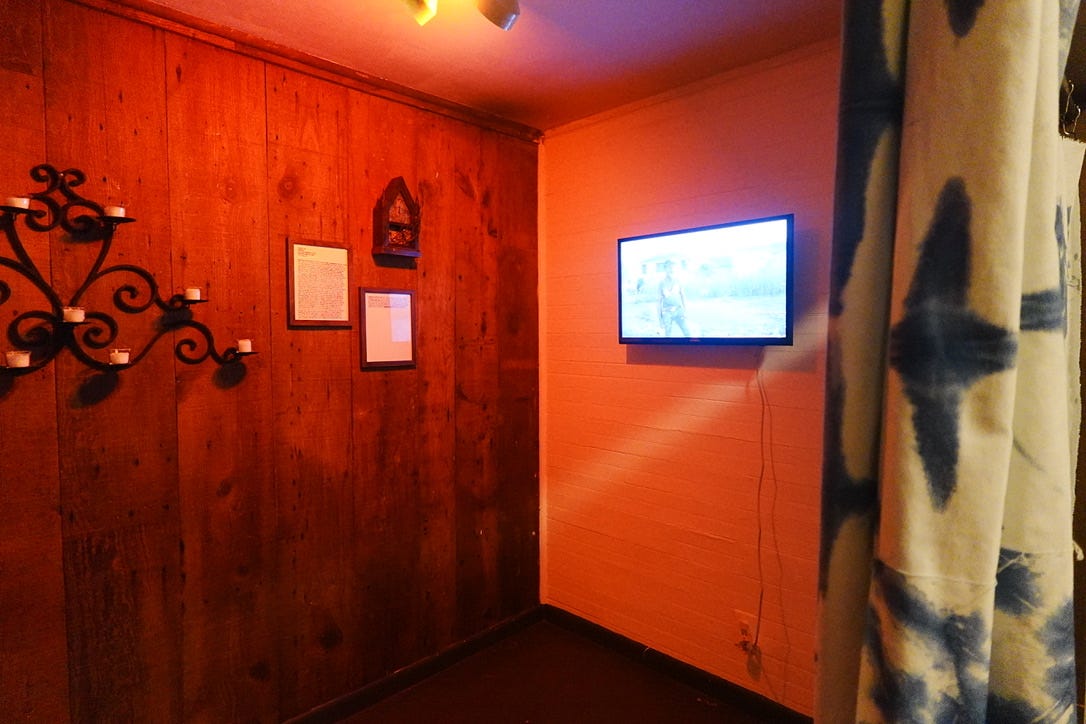
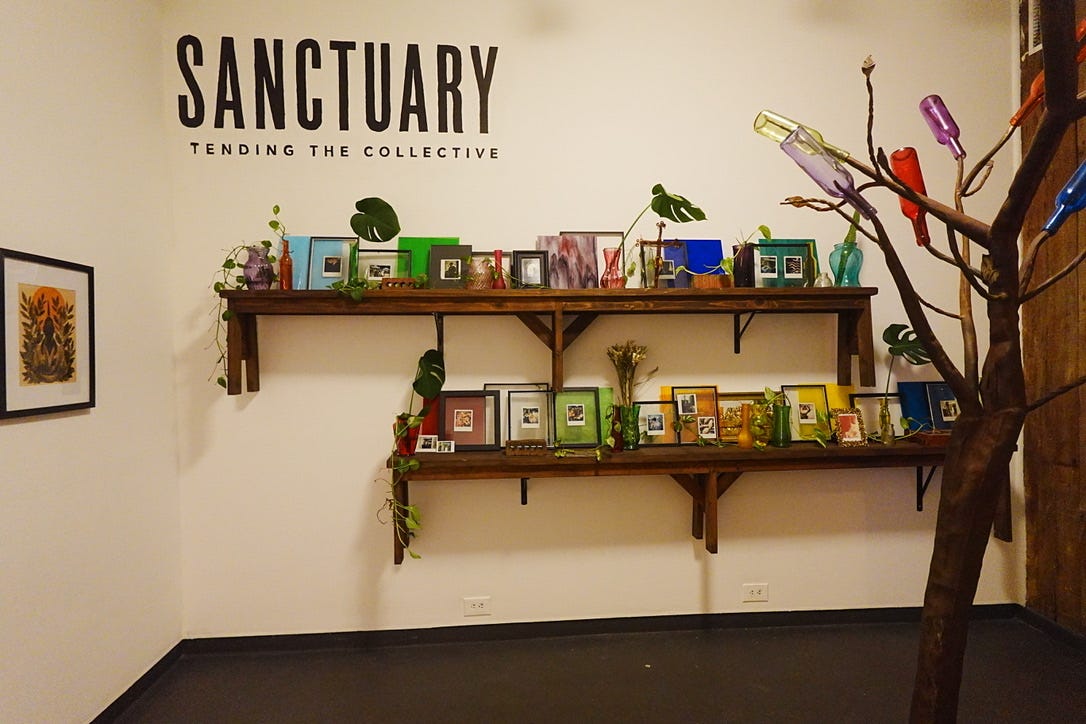
Carl Harrison Jr., has effectively transformed Room 4 at The Front. The furnishings allude to a domestic space with framed pictures and houseplants on display. There is also a sculpture of bottle tree. It’s not presented as a stand-alone artwork, rather part of the installation. A video playing in the little alcove is a documentary about Harrison’s community garden where he keeps bees. The video is fine, but the project itself is beautiful, suggesting the garden, not the art show, is his most authentic expression. It’s also educational.
I generally don’t “learn” when I’m looking at art. That’s not what I go to it for. I’m not being disparaging when I say this exhibition would be poignant in a different context, an undesignated space or a community center. The work is not saying, “I’m invested in the growth and stability of contemporary art in New Orleans.” It’s saying “I’m invested in the growth and stability of New Orleans.”
Some artists want their art exhibited in a white cube where their work is easily understood within the framework of contemporary art. Some artists don’t care about that. Some artists may want to upend the existing expectations of contemporary art spaces, but they’d have to engage it to change it. It would take clarity and work, and followthrough. Personally, I like the idea of a space that invites artists (or anyone!) to creatively transform a room with exhibits relevant to the community. But this is not the existing mission of The Front and it seems the program is currently trying to be too many things at once. I grew up hearing my dad use the expression “get with the program.” I’d love to get with and behind a solid program at The Front. But first, I’d like to understand what that program is.
Comments
Nothing yet. Say the first thing.
Sign in to join the conversation.