
This week, Nature Medicine published a 25-page study evaluating how well large frontier AI models perform on clinical reasoning tasks. The models tested included GPT-5, Gemini 2.5 Pro, Claude 3.5, and several others. The paper was submitted seven months ago, in November 2025. By the time it landed in your inbox or journal feed, at least two of those named models had already been updated or replaced by newer versions with substantially different capabilities.
The numbers in that paper’s comparison tables were aging while the paper was in peer review.
This is not a failure of that research team. It is not an editorial lapse. It is a structural collision between two timelines that are simply incompatible: AI systems now iterate every few months, while peer-reviewed journals operate on cycles of six to eighteen months. The result is a growing body of literature that is simultaneously scientifically honest and practically stale — sometimes before the ink dries.
For medical educators teaching the next generation of clinicians, and for healthcare professionals trying to make evidence-informed decisions about AI tools, this creates a genuine problem that requires a new kind of reading literacy. You need to know not just what a paper says, but whether what it says will still matter in six months.
This article gives you the framework to make that judgment.

When we say an AI research study is “redundant,” we do not mean it was poorly conducted or should not have been written. We mean that by the time it reaches publication, its central claim; usually a performance comparison between specific AI models, describes a world that no longer exists.
Think of it this way. A study published in early 2026 that reports GPT-5 achieved 84% accuracy on a medical image question set is, in a narrow sense, true. That model, on that dataset, at that moment, did achieve that score. But by the time a clinician reads the published version, a successor model may already be in clinical evaluation. The 84% figure is a historical record, not a benchmark for current decision-making…!
The problem compounds when that paper appears in a prestigious journal. High-impact publication confers an authority that the finding may not have earned over time. A medical educator who incorporates it into curriculum, or a hospital administrator who cites it in a procurement decision, may be relying on a snapshot that has already been superseded.
Other disciplines studying AI — computer science, engineering, economics — also grapple with rapid model iteration. But medicine has atleast three additional layers that make the obsolescence problem acutely serious.
The clinical validation gap. Before an AI system can be responsibly used in patient care, it must be validated across real clinical environments: diverse patient populations, varying equipment quality, real-world noise, and integration into clinical workflows. This takes time — often years. The model a team begins validating is frequently not the model they finish validating. By publication, it may not even be the model currently deployed.
The benchmark-to-bedside gap. A study showing an AI model achieves 90% accuracy on a curated medical question set tells us almost nothing about whether that model reduces misdiagnoses, shortens time-to-treatment, or prevents adverse events in practice. The questions medicine most needs answered — does this tool change patient outcomes? — require study designs that are inherently slow, expensive, and difficult to replicate as models evolve underneath them.
The proprietary opacity problem. Many of the most powerful clinical AI systems are developed inside large technology companies and released commercially before any independent peer-reviewed evaluation exists. When academic researchers do publish independent evaluations, the commercial product has often already been updated — sometimes without public announcement. Researchers are, in a real sense, studying a moving target through a narrow window.
Before concluding that AI research in medicine has become a journal-publishing exercise in futility, it is important to understand why the system still needs to exist — and why abandoning it can create more problems than it solves.
Medicine cannot operate on the technology sector’s principle of “move fast and break things.” A radiology AI that systematically misses early-stage lung cancers, deployed without peer-reviewed scrutiny, causes patient harm that no subsequent correction can undo. High-impact journals — for all their delays — provide layers of oversight that informal dissemination channels do not: independent peer review, statistical auditing, mandatory conflict-of-interest disclosure, and a permanent, traceable scientific record. Removing that filter from clinical AI is not a reform. It is a patient safety risk.
The U.S. Food and Drug Administration, the European Medicines Agency, and their counterparts worldwide increasingly require published clinical evidence as part of the approval pathway for AI-based medical devices. A preprint — however well-conducted — carries no regulatory weight. If academic medicine retreats from high-impact journals, the evidentiary void is filled by internal validation data produced and controlled by the companies seeking approval. That is not a system that serves patients or clinicians.
Not every AI study in medicine aims to demonstrate what a model can do. Some of the most important — and most durable — research documents what AI systems get wrong, where they fail, and which populations they underserve. A study showing that a clinical AI systematically underperforms on images from portable equipment common in resource-limited settings remains instructive for years, regardless of which specific model it evaluated. The failure pattern transfers across model generations even when the model itself is replaced. These studies belong in high-impact journals because their findings compound in value over time rather than decaying.
Intellectual honesty requires acknowledging what critics of the current system are right about. A specific and identifiable category of AI research in medicine is, at the moment of publication, producing diminishing returns.
Studies whose core contribution is a head-to-head comparison of named AI models — Model A achieved 88%, Model B achieved 79% on benchmark X — have a useful life measured in weeks - months, not years. They are informative at the moment of submission and increasingly archival by the moment of publication. When they appear in prestige journals with high impact factors, they create a misleading impression of settled evidence. Educators who teach from them and clinicians who cite them in practice decisions are working from a photograph of a landscape that has since changed…!
Commercial AI models change continuously through fine-tuning, infrastructure updates, and prompt/context/loop modifications — usually without public announcement and without version locking. A study evaluating “Frontier GPT-5” as though it were a stable, reproducible entity analogous to a drug formulation is making an assumption that is not true. Unlike a clinical drug trial, where the compound being tested is chemically defined and can be replicated, AI model evaluations may describe a system that no longer exists in the tested form by the time a reader tries to replicate the work. The scientific record preserves not a reproducible finding but a time capsule.
Performance on a controlled clinical evaluation dataset does not equal clinical readiness. Scores on USMLE questions, curated radiology image sets, or standardized medical vignettes reflect a model’s ability to perform on a specific, tightly controlled task format. They do not reflect how that model behaves when images are low quality, when clinical context is ambiguous, when documentation is incomplete, or when patients present atypically — which is to say, they do not reflect real clinical conditions. Publishing benchmark comparisons in high-impact journals lends them an authority that systematically overstates their clinical meaning.

Not all AI studies in medicine age at the same rate. The most useful question is not “should this be published in a high-impact journal?” but “what type of contribution is this study making, and how long will that contribution remain actionable?”

This can be a working framework for medical educators and clinicians reading the literature.
Read it. Teach it. Cite it with confidence.
These are studies whose core findings transfer across model generations because they address the evaluation ecosystem, the clinical deployment context, or structural patterns that recur regardless of which specific models are being tested.
Examples include: novel evaluation methodologies and adversarial testing frameworks; analyses of systemic bias or demographic inequity in AI training data; prospective clinical trials using AI as an intervention with patient outcomes as primary endpoints; failure mode taxonomies linked to clinical consequences; benchmark design critiques that reveal what existing assessments actually measure versus what they are assumed to measure; and systematic reviews or meta-analyses that synthesize evidence across model generations rather than profiling a single one.
These belong in high-impact journals. Their value compounds over time.
Read it. Use it with context. Revisit it within two years.
These studies address real clinical questions but are partially anchored to the capabilities of current model generations, meaning their conclusions will need updating as models improve.
Examples include: clinical workflow integration studies that embed AI into real healthcare environments and measure operational downstream effects (time savings, error rates, staff workload); comparative effectiveness studies pitting AI-assisted clinical performance against clinician-only performance on real-world, multi-site data; and interpretability analyses that explore how a class of model approaches a clinical task, rather than evaluating a single named version.
These belong in journals, but readers should treat specific quantitative findings as estimates valid for current-generation models rather than permanent benchmarks.
Read it as context. Do not teach it as established fact. Check the date.
These studies make claims that are accurate when submitted and increasingly historical by publication. Their value lies in establishing a moment-in-time record, not in providing durable clinical guidance.
Examples include: head-to-head accuracy comparisons of named commercial or open-source AI models on standardized test sets; prompt engineering evaluations on clinical question banks; single-institution retrospective accuracy assessments using proprietary datasets; and leaderboard-style publications that rank current model performance without a methodological framework that transfers to future evaluation.
These are better suited to preprint servers, conference proceedings with explicit versioning, or journal formats designed for rapid technical communication — not full research articles in prestige publications.
The Nature Medicine study that opened this piece offers a nearly perfect illustration of why these tiers matter — because it contains contributions from all three within a single paper.
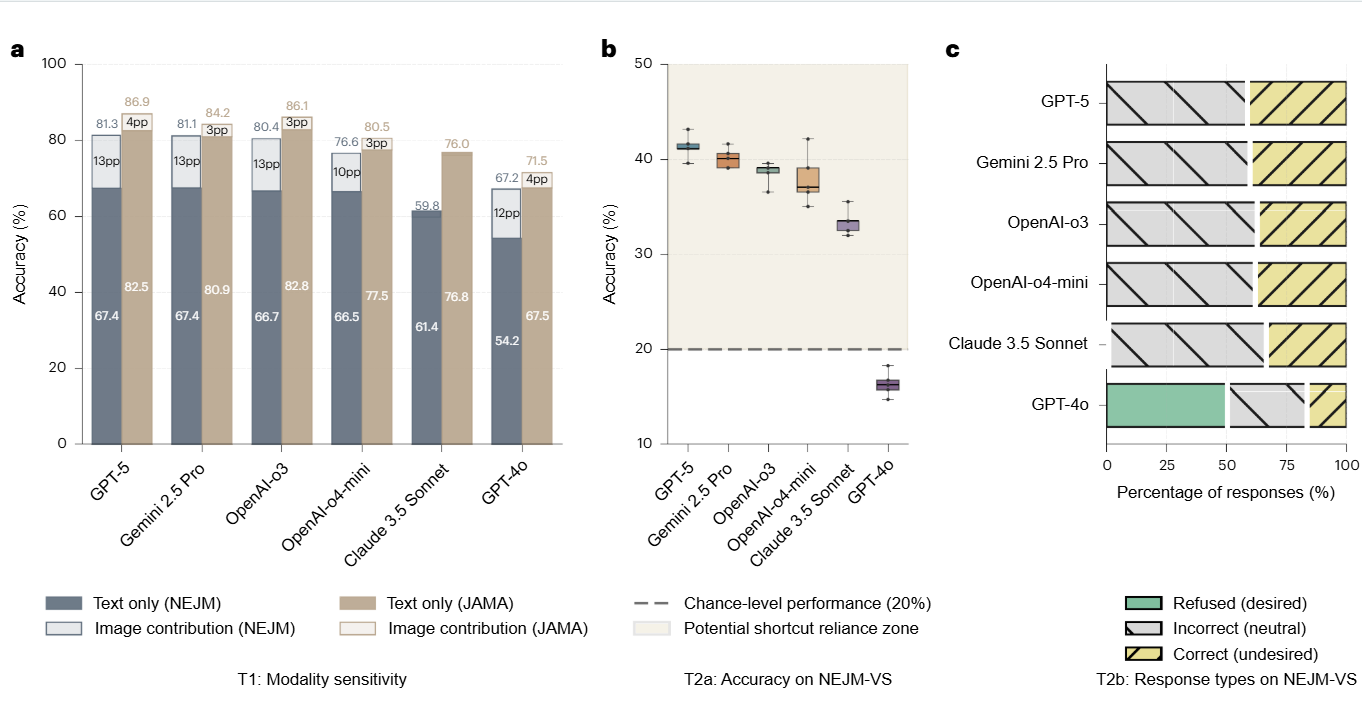
On the surface, the paper reads like a model comparison study: GPT-5 scored X% on NEJM questions; Gemini 2.5 Pro scored Y%; Claude 3.5 did Z on JAMA benchmarks. These specific figures will be historical data within twelve months. They represent exactly the kind of time-stamped snapshot that does not, on its own, justify a 25-page article in a flagship journal.
Beneath the model comparison lies a set of contributions that will outlast every model named in the paper.
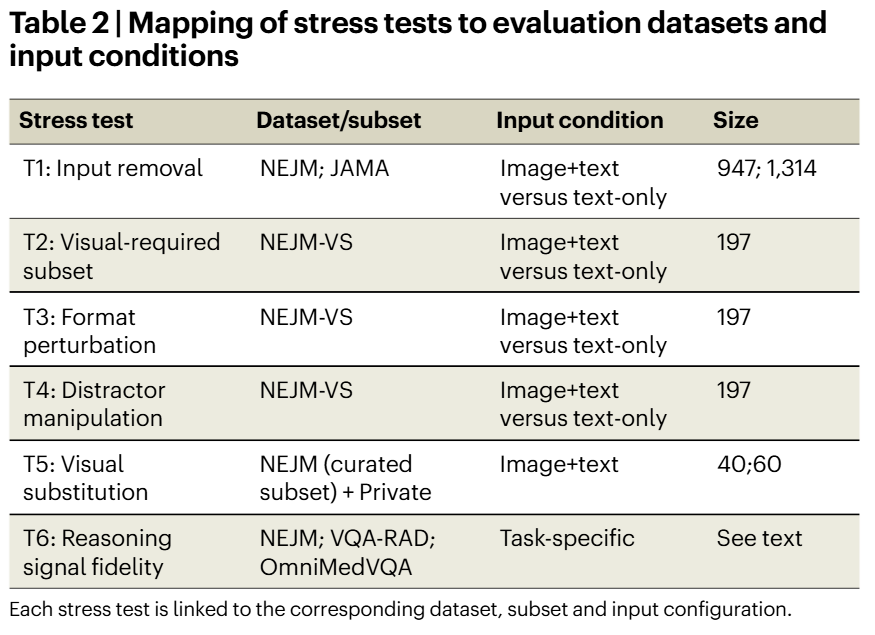
An adversarial testing framework. The paper introduces six structured stress tests — assessing how models behave when clinical images are removed, when answer order is randomized, when distractor options are introduced, when visual content is substituted — that can be applied to any future model. This is a methodology, not a snapshot. It transfers directly to evaluating the next generation of systems, and the one after that.
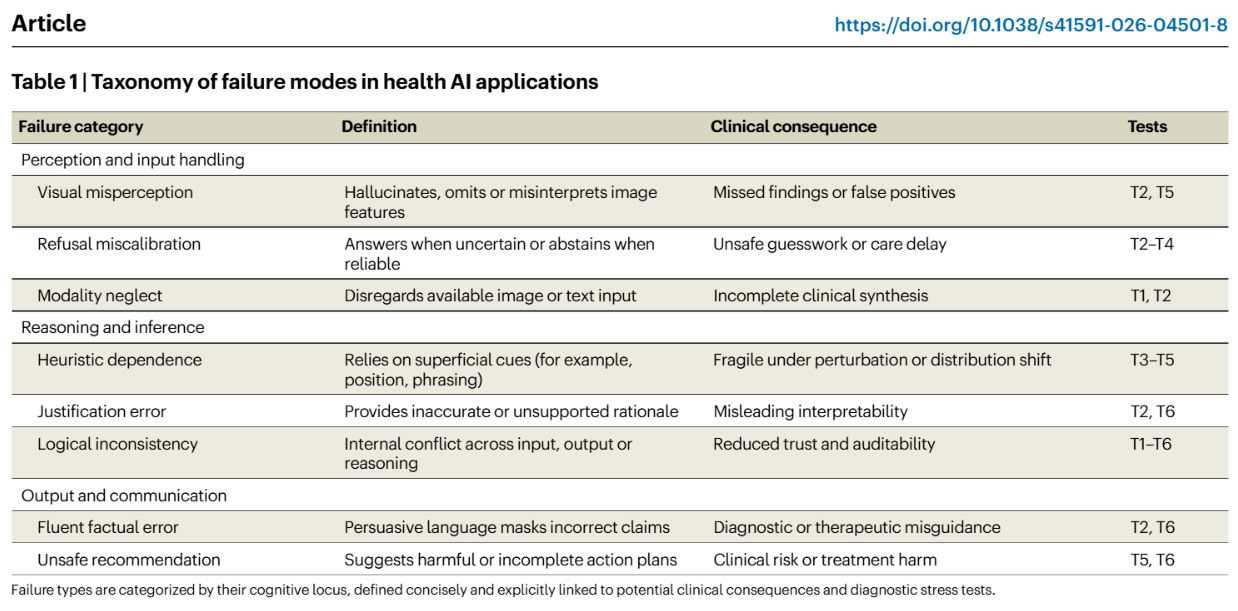
A clinical failure taxonomy. Table 1 of the paper maps eight categories of model failure — including visual misperception, heuristic dependence, logical inconsistency, and unsafe recommendation — directly to their downstream clinical consequences, such as missed findings, diagnostic misguidance, and treatment harm. No equivalent structured vocabulary exists elsewhere in the literature. This taxonomy will be cited and extended long after GPT-5 is a historical footnote.
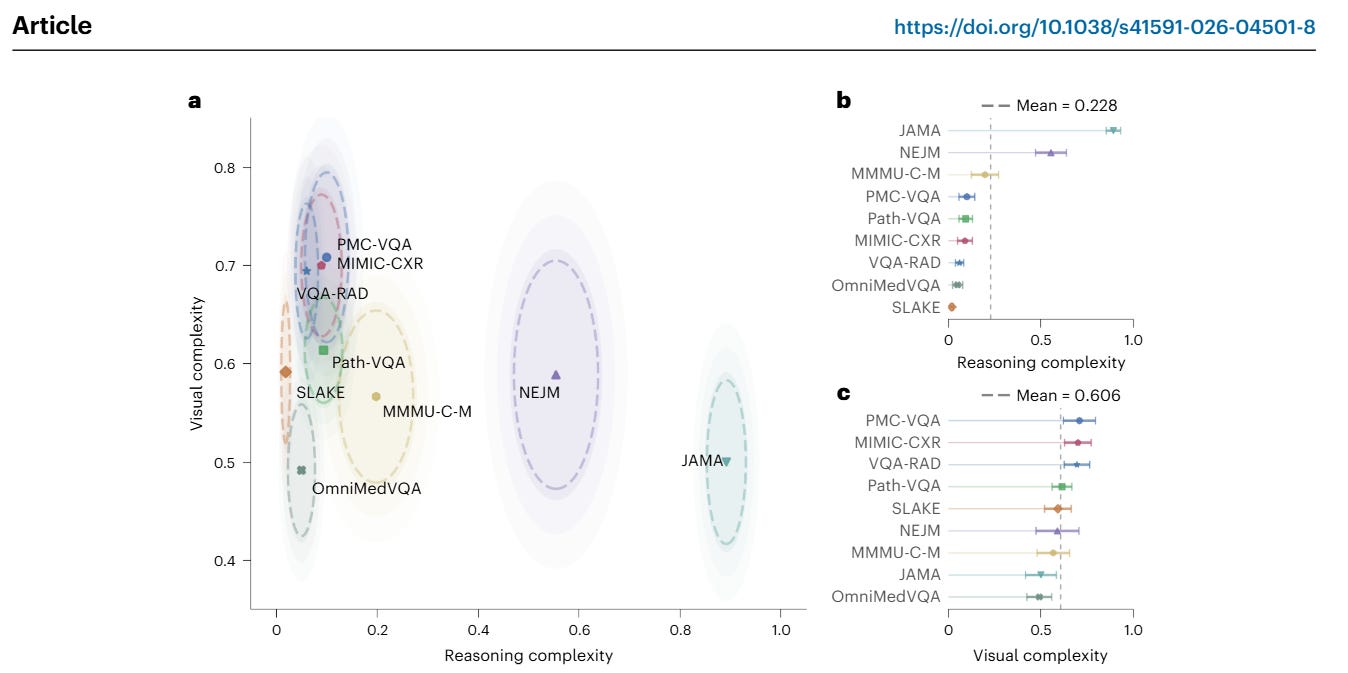
A benchmark profiling method. The authors created a clinician-annotated rubric that positions each medical AI benchmark on two axes: reasoning complexity and visual complexity. This reveals, for the first time in structured form, that widely used benchmarks measure fundamentally different cognitive demands — which explains why a model can perform well on one and poorly on another despite similar headline accuracy scores. This insight applies to every benchmark and every model that follows.
The shortcut learning finding. Perhaps most important for clinical educators: the paper shows that several tested models maintain high accuracy on medical image benchmarks even when the clinical image is completely removed from the input. The models are relying on text cues, answer-position patterns, and memorized associations — not genuine visual reasoning. This failure pattern will recur in future model generations until the benchmarks themselves are redesigned. It is a finding about a structural flaw in how we evaluate clinical AI, not about any particular system’s capabilities.
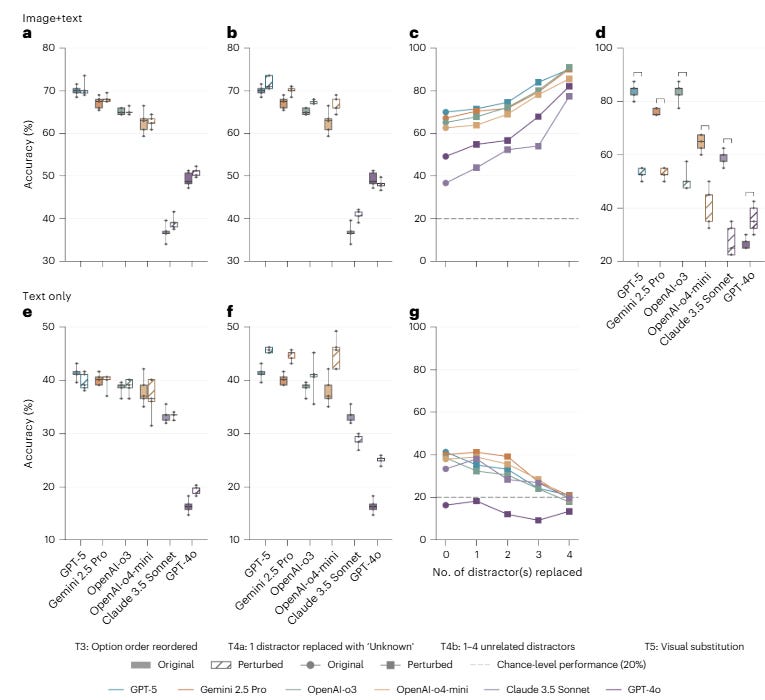
The paper deserved to be published in Nature Medicine. Its methodological contributions are genuinely important. But those contributions were framed as supporting material for a model comparison that will age poorly. Had the paper led with “we propose an adversarial evaluation framework and a clinical failure taxonomy for health AI” rather than “we evaluated GPT-5 and Gemini,” it would read as foundational work rather than a benchmark snapshot that happens to contain foundational work…!
The redundancy was not in the paper’s existence. It was in its framing choices..!

When incorporating AI research into curriculum, we need to explicitly teach students to distinguish between study type and study age. A 2024 paper with a transferable methodology may be more relevant today than a 2026 paper reporting model comparison results. We have to train students to ask, before accepting a finding: “Is this a claim about a specific model, or a claim about how AI behaves structurally?” The latter survives model updates. The former does not.
We have to update ourselves and consider building AI literacy modules around landmark methodology papers and failure taxonomies rather than around model performance comparisons. The adversarial testing framework and clinical failure taxonomy described above are the kind of conceptual tools that will serve clinicians across every model generation they encounter in their careers.
When you encounter an AI study, four questions will help in orienting your reading before you reach the results:
First, which specific model version was tested, and when was the study submitted — not published? A seven-month gap between submission and publication is standard. Much can change.
Second, is the claim about a specific model’s performance, or about a structural behavior pattern? One ages; the other does not.
Third, was the evaluation conducted on a curated controlled dataset, or in a real clinical environment with real patients? Benchmark performance and clinical performance are not the same thing, and should not be treated as equivalent.
Fourth, does the study include validation under adversarial or perturbation conditions — degraded images, ambiguous inputs, distractor options — or only under optimal conditions? Performance under stress reveals clinical readiness in a way that optimal-condition benchmarks do not.
It is never wise to use a single peer-reviewed AI benchmark study as the primary evidence base for procurement or deployment decisions. Ask vendors for independent evaluation data, stress-test results, and failure mode documentation. The existence of a journal publication does not mean the specific model version evaluated is the one being sold or deployed. Require version-locked documentation and ongoing post-deployment monitoring as part of any AI contract.
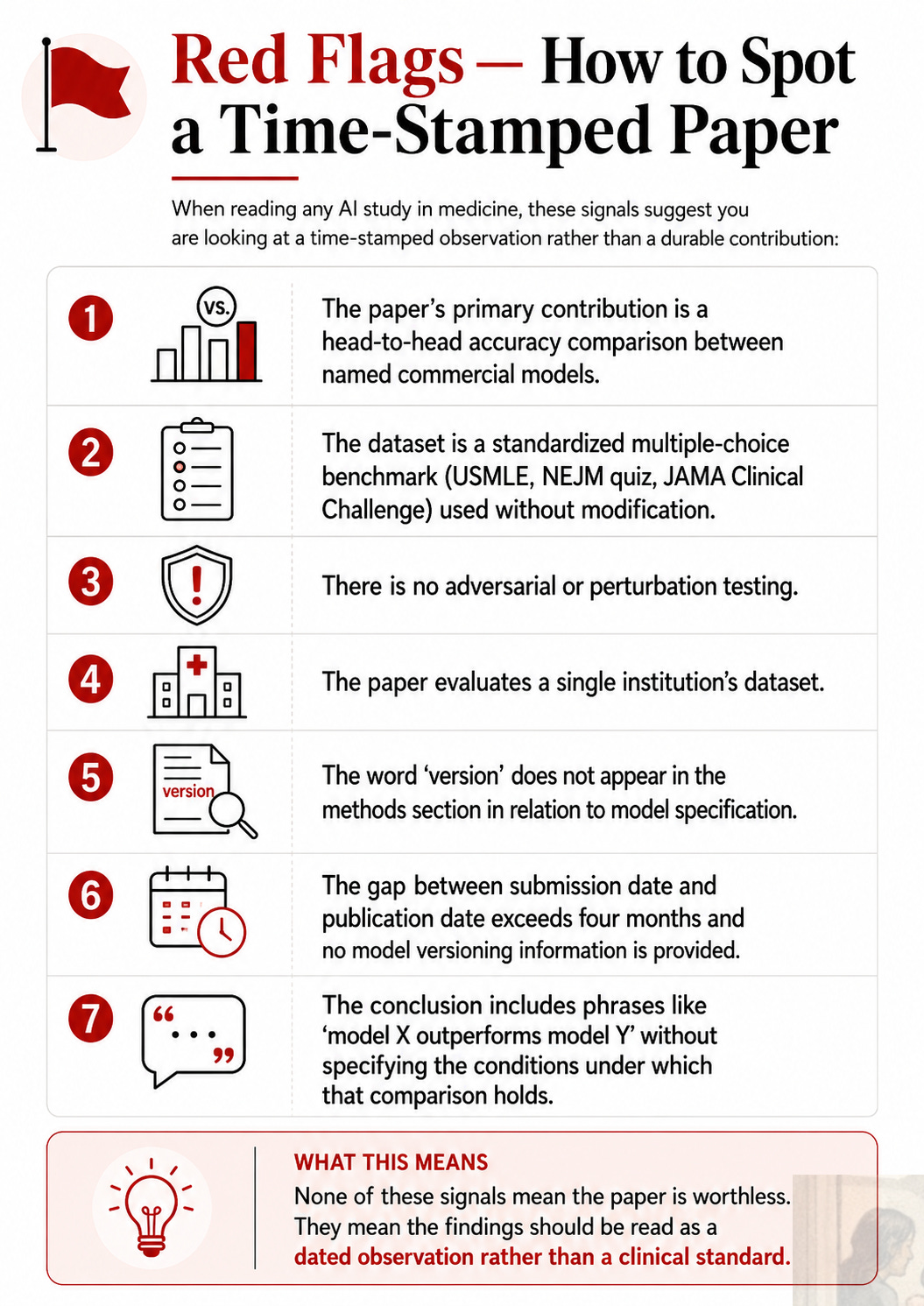
When reading any AI study in medicine, these signals suggest you are looking at a time-stamped observation rather than a durable contribution:
The paper’s primary contribution is a head-to-head accuracy comparison between named commercial models.
The dataset is a standardized multiple-choice benchmark (USMLE, NEJM quiz, JAMA Clinical Challenge) used without modification.
There is no adversarial or perturbation testing.
The paper evaluates a single institution’s dataset.
The word “version” does not appear in the methods section in relation to model specification.
The gap between submission date and publication date exceeds four months and no model versioning information is provided.
The conclusion includes phrases like “model X outperforms model Y” without specifying the conditions under which that comparison holds.
None of these signals mean the paper is worthless. They mean the findings should be read as a dated observation rather than a clinical standard.
Individual reading skills are necessary but not sufficient. The publication infrastructure itself needs reform in three areas.
Journals can start categorising AI submissions by study type at intake. A benchmark comparison study and a methodological innovation are different scientific artifacts. Journals in other fields already make this distinction through article type classifications. Medical journals should explicitly designate AI benchmark studies as time-sensitive technical reports — with appropriate formatting, shorter length, and explicit versioning requirements — distinct from full research articles making durable clinical claims.
Model versioning should be mandatory, like drug lot numbers. Pharmaceutical trial reports require detailed documentation of the compound’s formulation, batch number, and storage conditions because reproducibility depends on knowing exactly what was tested. AI model evaluations should require equivalent disclosure: the exact model version, API parameters, inference conditions, and any known changes to the model between submission and publication.
Academic incentives should reward compounding contributions. A researcher who develops an adversarial evaluation framework that fifty subsequent teams apply to new models has contributed more durable scientific value than one who publishes a model comparison that no one can replicate. Career advancement structures in academic medicine — hiring decisions, grant evaluations, promotion criteria — should explicitly value open methodologies, reusable frameworks, and living review contributions, not only high-impact single-paper output.

Publication date is not the same as relevance date. Always check submission date and model version.
Methodology papers outlast model comparison papers by years, sometimes decades.
Benchmark performance and clinical performance are not the same thing. Treat them as distinct.
Failure mode and bias studies have longer shelf lives than capability demonstration studies.
A finding about how AI behaves structurally is more valuable than a finding about how one named model performed last quarter.
Thanks for reading! This post is public so feel free to share it.
No posts
Comments
Nothing yet. Say the first thing.
Sign in to join the conversation.