
A few months ago, I wrote a blog; “ What a Discharge Summary Quietly Reveals About How an Institution Actually Works”
What a Discharge Summary Quietly Reveals
The post travelled. People shared it. Doctors wrote back. Parents wrote back. Hospital administrators said it was eye-opening. Residents said they had forwarded it to their seniors. It went across cities, across specialties, across countries. Someone told me it was discussed in a quality meeting. Someone else said it was pinned in a department WhatsApp group…!!
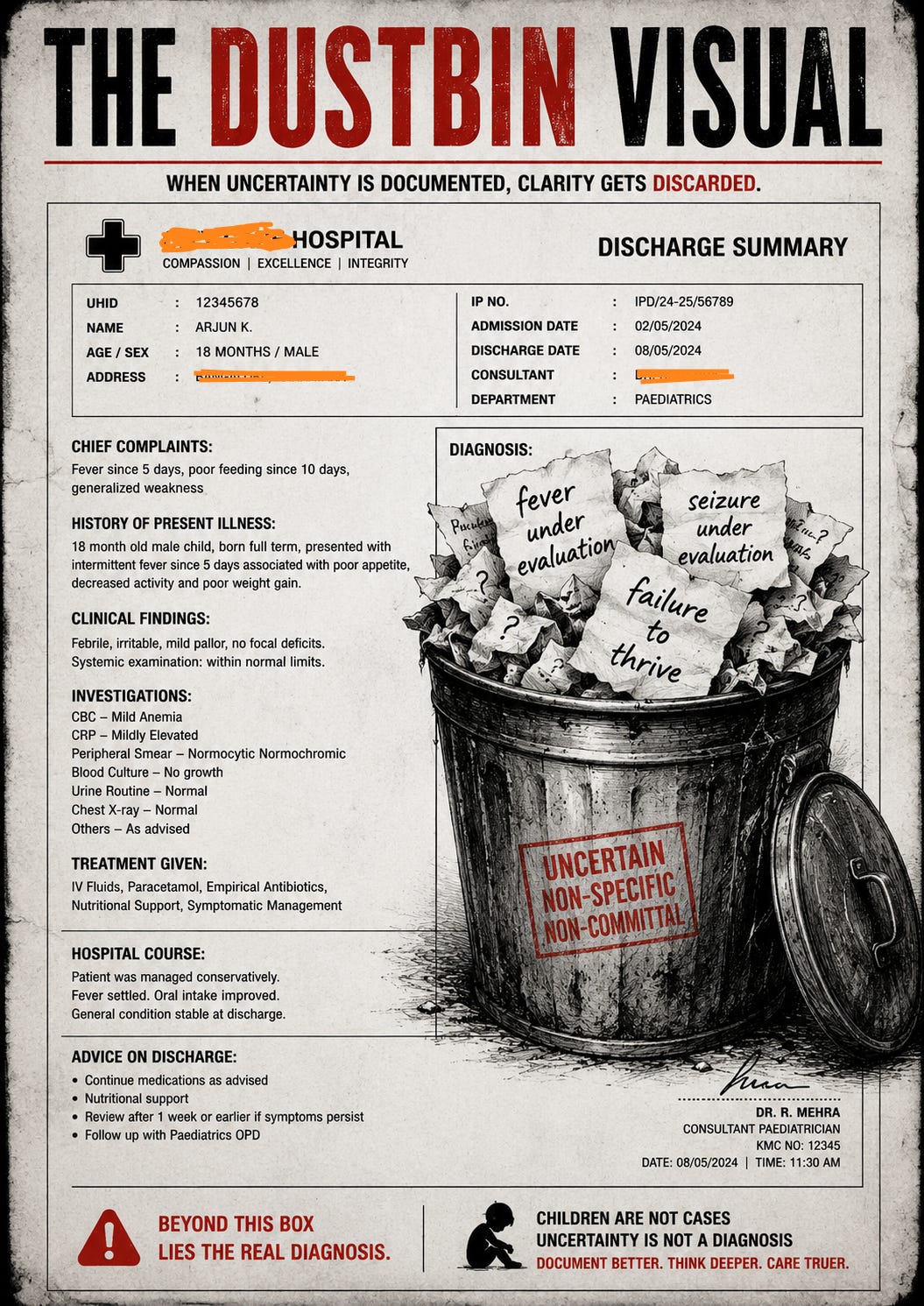
Since then, I came across many kids who came back from tertiary care centres with a discharge summary carrying various inappropriate Final diagnoses…...
The diagnoses columns read as usual:
Global developmental delay
Fever under evaluation
Acute malnutrition
Failure to thrive
Seizure under evaluation etc etc etc…!
And so I am writing again. Not because I think this post will do what the last one could not.
Let us be precise about where we stand in 2026.
Hospitals in India are using AI to detect diabetic retinopathy on fundus images. AI is reading ECGs. AI is triaging radiology worklists. AI is predicting sepsis scores. AI is transcribing OPD conversations. AI is generating billing summaries, analysing insurance claims, flagging drug interactions, and personalising patient reminders.
Hospitals are also spending crores on AI-powered CCTV systems to monitor footfall, on chatbots to answer patient queries, on dashboards that track bed occupancy in real time, on tools that predict when a ventilator will next need servicing.
We have AI for revenue. We have AI for operations. We have AI for marketing.
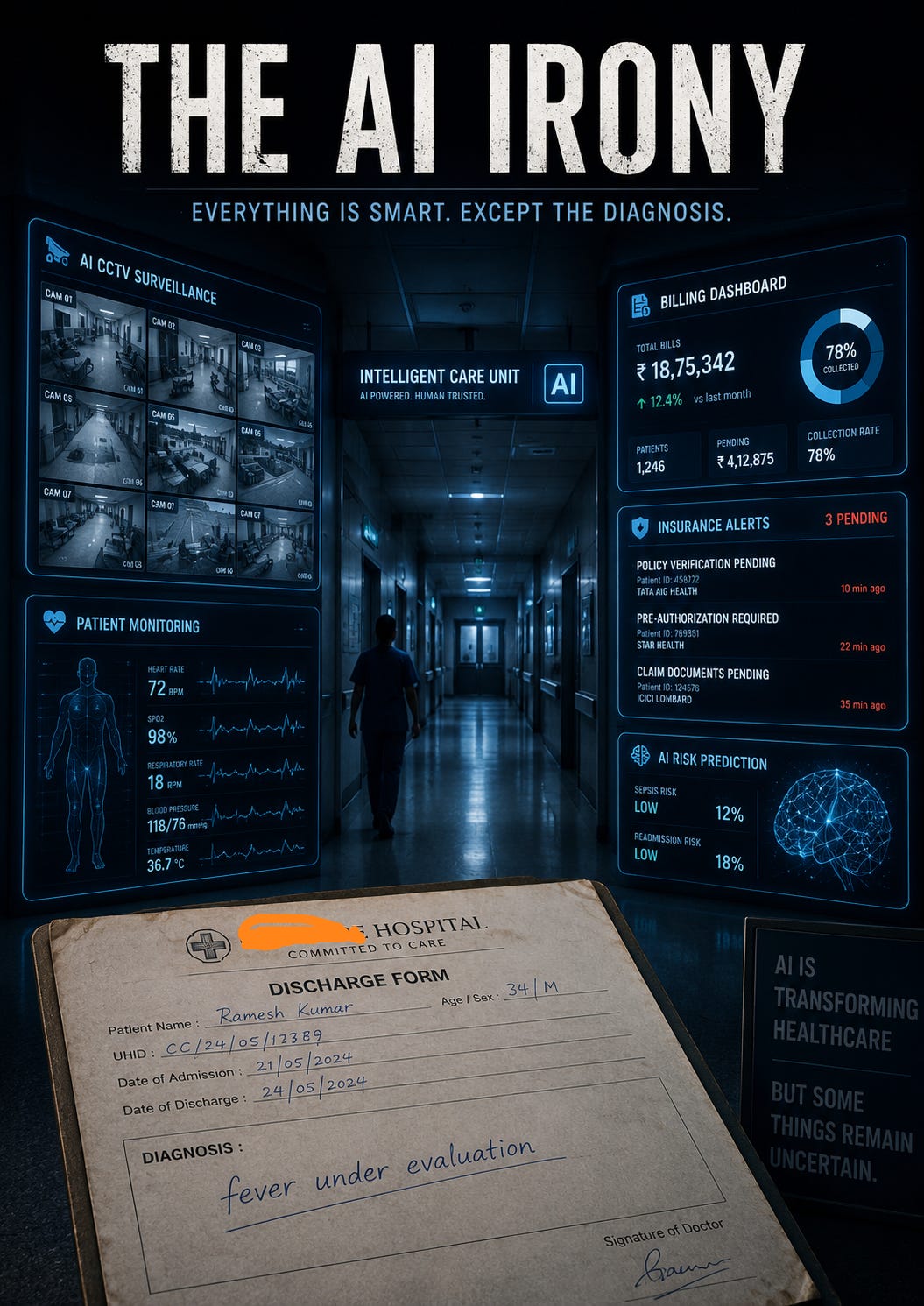
We apparently do not have AI for the one document that travels with the child after she leaves the building.
This is not a gap in technology.
This is a gap in what we have decided matters.
The International Classification of Diseases, Tenth Revision, was released in 1994. Thirty years ago. It has codes for almost every condition in clinical medicine. It has specific codes that distinguish between febrile seizures and epilepsy, between severe acute malnutrition with complications and without, between developmental delay with a known cause and developmental delay that is unspecified. It has the granularity to make vague language unnecessary.
ICD-11 is already in use. It is more precise. It is digitally native. It is designed to work with modern hospital information systems.
Every hospital in India that files insurance claims uses ICD-10 codes. The billing department knows these codes. The medical records department knows these codes. The software knows these codes. The insurer checks these codes.
But the treating unit writes “fever under evaluation” in the diagnosis column and walks away…!!
This is not ignorance. A hospital that uses ICD-10 for billing cannot claim it does not know ICD-10 exists. It knows. It uses it selectively. It uses it where money is at stake.
It does not use it where only clarity is at stake.
And clarity, apparently, is not worth the same as money.
Medical colleges are where diagnostic habits are born and where they calcify.
Every junior doctor who writes “fever under evaluation” as a discharge diagnosis learned to do so in a teaching hospital. They saw seniors do it. They saw consultants sign off on it. They saw the discharge summary go out with that language and nobody complained. So they did the same. And they will teach the same to the next batch.
This is how institutional habits survive. Not through active instruction in bad practice. Through silence in the presence of bad practice.
A postgraduate resident writes a discharge summary at 11 pm after 36 hours of work. She copies the format from last month’s summary. The diagnosis column has the same words. The consultant countersigns it in 90 seconds during a break between two procedure calls. It goes through. The family is given the file. The next patient is admitted to the same bed.
Nobody failed in their intention. Everyone failed in their accountability…!
Medical colleges train residents in procedures. They train them in examinations. They train them in presentations. They do not train them, with any seriousness, in clinical writing. The discharge summary is treated as paperwork. It is assessed, if at all, for completeness of physical data fields. Not for clinical coherence. Not for diagnostic honesty. Not for the quality of reasoning it transfers to the next provider.
If a postgraduate student submits a thesis with a vague hypothesis and an unsupported conclusion, it is rejected.
If the same student submits a discharge summary with a vague diagnosis and no reasoning, it is stamped and filed.
We have decided that writing for examiners requires rigour. Writing for patients does not.
This question is harder to excuse.
Corporate hospitals have resources. They have EMR systems. They have quality teams. They have NABH accreditation processes that run for months. They have committees for everything. They have compliance officers.
They also have brand decks that say things like “patient-centred care” and “clinical excellence” and “outcomes that matter.”
And yet the discharge summary comes out saying “seizure under evaluation.”
What did the unit think was causing the seizures? Was it structural? Metabolic? Genetic? Idiopathic? … Where is the ILAE…!!?
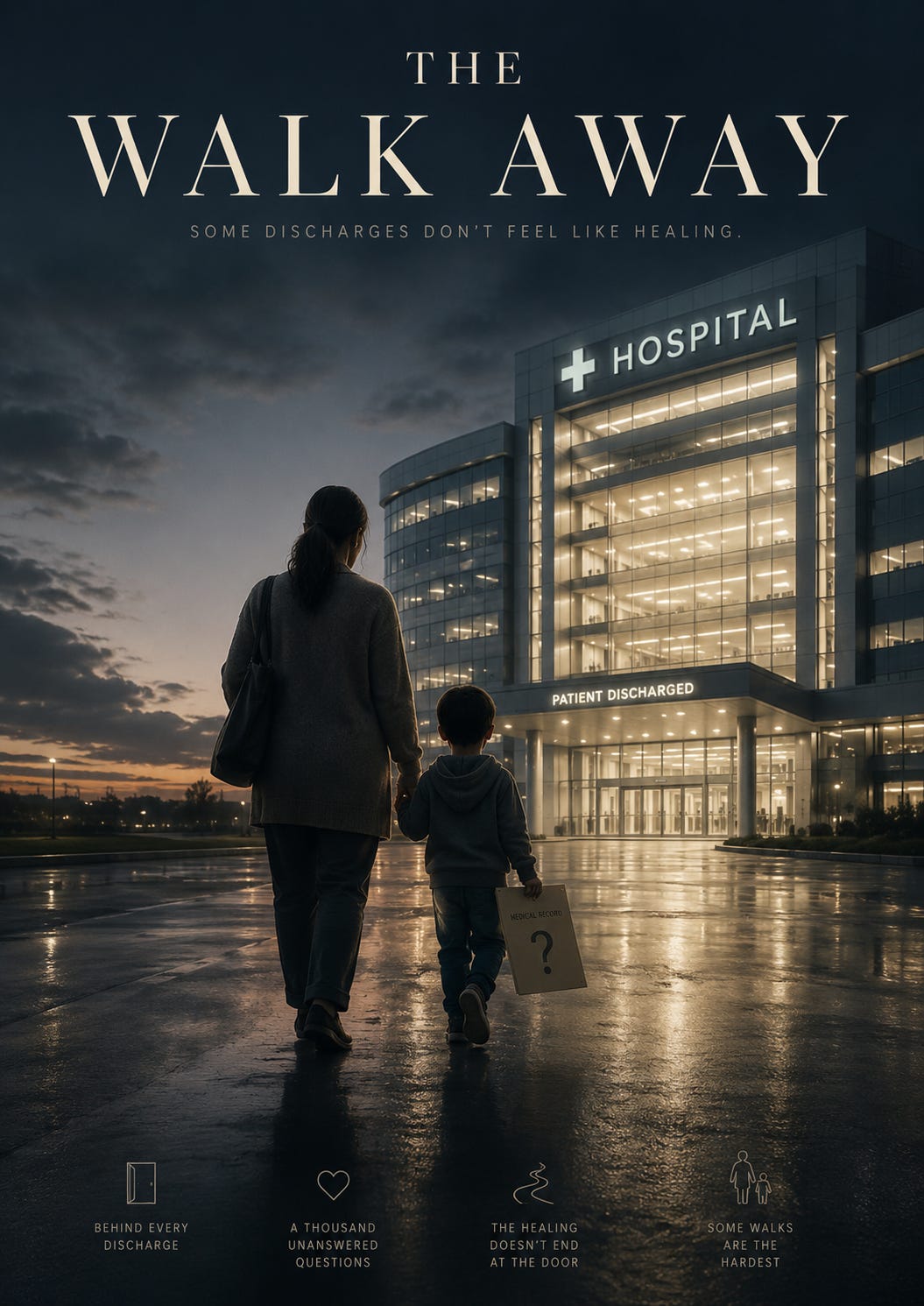
None of this is in the diagnosis column. Sometimes none of it is anywhere in the summary.
But the bill is itemised to the last capsule. The signature of the department head is on the prescription. The discharge package has a welcome kit and a branded folder and a feedback form.
The thinking of the clinical team during the admission is random.
This is not a documentation problem. This is a trust problem. The family has trusted this institution with their child and their money. They are leaving with a folder that does not tell the next doctor what this institution actually concluded.
Every time I raise this, someone tells me about the limitations of electronic medical record systems. Forms are rigid. Coding takes time. The system crashes. The interface is built for billing, not for clinical documentation.
These are real complaints. They are not excuses.
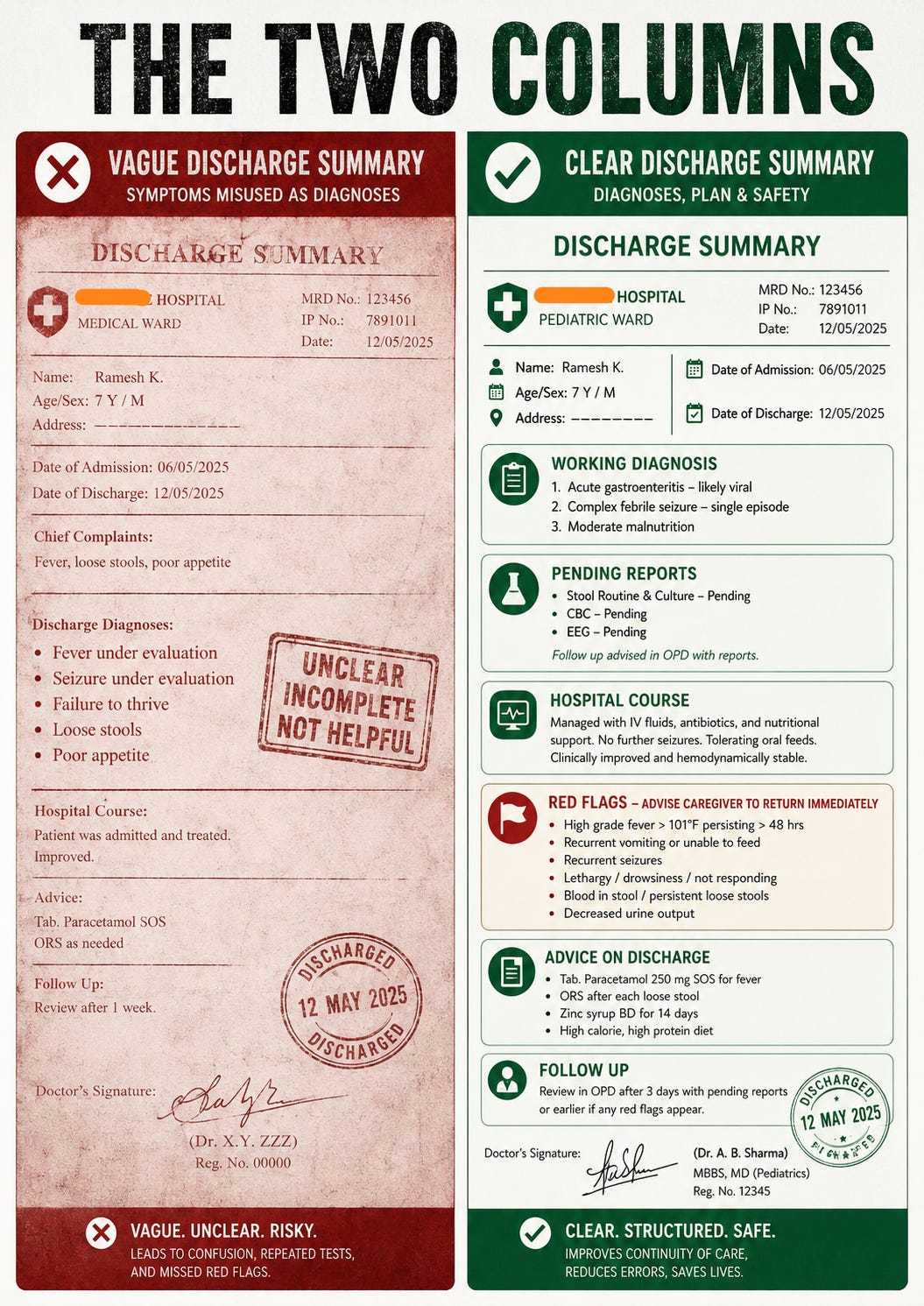
A hospital that wanted to fix this would build a discharge summary template that separates: final diagnosis, working diagnosis, comorbidities, unresolved problems, pending investigations, red flag symptoms, follow-up date, and family counselling notes. This takes one conversation with the software vendor and one policy decision from the medical director.
A hospital that wanted to fix this would configure ICD-10 or ICD-11 mandatory fields at the point of discharge. The doctor cannot close the encounter without selecting a coded diagnosis. This is already done in insurance-linked discharges. It can be done routinely.
A hospital that wanted to fix this would use any afforadble frontier AI Models — not to replace the thinking, but to audit the output. A simple language model can be prompted to flag if the discharge diagnosis is a symptom rather than a diagnosis, if unresolved problems have no follow-up plan, if the admitting complaint has no explanation in the summary. This is not complicated. This is a prompt and a checklist.
Hospitals that wanted to fix this could fix it in a single day…..!
They have not fixed it because they have not wanted to fix it.
Not the hospital…!
The hospital has already been paid. The bed is already occupied by someone else. The summary is in the file. NABH will check that a discharge summary exists. It will not check whether the diagnosis is clinically coherent.
The cost is borne by the child, who may return to a peripheral centre with the same unresolved problem and no documentation of what was already done.
The cost is borne by the family, who paid for an admission and received a description of their anxiety rather than a clinical conclusion.
The cost is borne by the next doctor, who must reconstruct the diagnostic reasoning from scratch, often without the investigations that were done, often without knowing what diagnoses were considered and excluded.
The cost is borne by the healthcare system, which repeats evaluations, reschedules tests, and readmits children because the clinical thinking of one admission never successfully transferred to the next point of care.
This is an expensive failure. It is invisible on no spreadsheet except the patient’s own.
I have thought about this more carefully after the first post.
The first blog embarrassed nobody with actual authority. The families who read it had no leverage. The residents who forwarded it could not change the culture that produced the problem. The administrators who called it insightful continued to run systems that produced the same outcome.
For this to change, someone with power must decide it matters.
That could be a National Medical Commission that mandates discharge summary quality standards as part of Undergraduate/postgraduate training assessment. That could be NABH revising its documentation audit criteria to include diagnostic coherence rather than just field completion. That could be insurance companies refusing to process claims where the principal diagnosis is a symptom code without a qualifying clinical narrative. That could be hospital medical directors adding discharge summary quality to their monthly unit audit rather than only to their annual NABH preparation sprint.
Any one of these would begin to move the needle.
All of them together would transform it.
None of them requires new technology. None of them requires new money. All of them require a decision that the quality of clinical thinking, as expressed in written documents, is a legitimate performance metric and not merely the aesthetic preference of doctors who write blogs.
This may be a feasible audit to begin….for medical teams reading this. Read this
Audit as a Quality Improvement Tool
Open any ten random discharge summaries from your paediatric ward. From the last month. Look only at the diagnosis column.
Ask these questions:
Is the principal diagnosis a confirmed disease, a working diagnosis, or a symptom?
If the admission complaint was fever, does the diagnosis tell us what the fever most likely represented?
If the diagnosis is “developmental delay,” does the summary tell us what workup was done, what was found, what remains pending, and what intervention was started?
If the diagnosis includes “under evaluation,” does the summary tell us what the evaluation revealed so far and what happens next?
If the answer to most of these is no, you have a systemic problem. It is not a junior doctor problem. It is not an overwork problem. It is a standards problem. And it has a solution.
If you find that ten out of ten summaries are clinically coherent, honest, and useful to the next doctor — please write to me. I will publish your institution’s name and what you did. Not as a promotional act. As evidence that this is possible.
Children are still going home with files full of unfinished sentences.
The child with seizures leaves without her family knowing if the hospital thought this was epilepsy or something else.
The child with fever leaves without the next doctor knowing what dangerous diagnoses were excluded.
The child with developmental delay leaves without a single sentence about what should happen next.
The hospital has been paid. The beds have been filled.
The AI has been deployed for the CCTV and the billing and the chatbot.
The diagnosis column is still a dustbin…!
I am not going to pretend that writing this twice changes what writing it once could not. I am not going to end with a call for optimism that I do not currently feel.
But the institutions must know this:
The families are not powerless forever. Literacy is rising. Consumer courts exist. Social media exists. The gap between what hospitals claim in their branding and what they deliver in their documentation is a gap that will eventually be filled — either by the institution choosing to close it, or by someone outside the institution forcing the question.
The diagnosis column is a place where the hospital’s thinking becomes a matter of record.
Right now, in too many places, it is a record of the absence of thinking.
That should embarrass everyone who signed the summary.
It should embarrass everyone who stamped it.
It should embarrass everyone who built the system that allowed it to leave the building.
The child has gone home.
The question is still open.
Someone should answer it.
Thanks for reading! This post is public so feel free to share it.
This is Part Two of a series on discharge documentation in paediatric practice. Part One can be read here.
No posts
Comments
Nothing yet. Say the first thing.
Sign in to join the conversation.