
Every June, India sends its children back to school with new uniforms, polished shoes, sharpened pencils, labelled water bottles and a strange confidence that the academic year begins on a clean slate.
It does not.
In pediatric outpatient departments, the new school year announces itself differently. It arrives as fever. It arrives as cough, cold, wheeze, sore throat, vomiting, fatigue, poor feeding, breathlessness, and that familiar phrase parents bring with them: “Doctor, school has just reopened.”
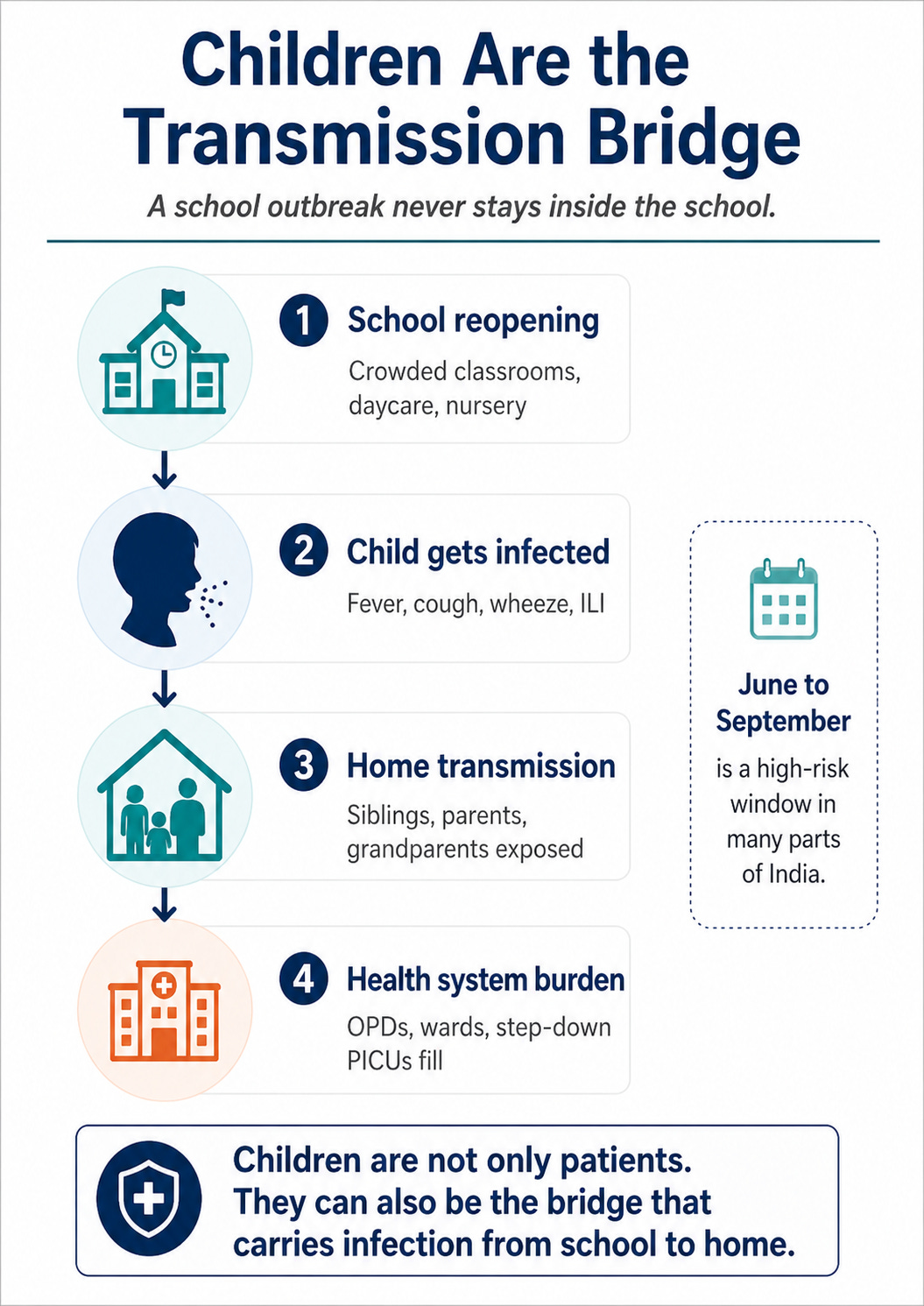
Within a few weeks of school reopening, the pattern becomes hard to miss. Daycare children start falling sick. Nursery children follow. Primary school children carry infection back home. Pediatric OPDs swell. Wards begin to fill. Step-down PICUs see more children with viral wheeze, bronchiolitis, influenza-like illness and Pneumonias. Some children recover in two days. Some need oxygen. Some need high-flow support. Some fragile infants and children with underlying disease get pushed into severe illness by viruses that began their journey in crowded classrooms and daycare rooms.
And the chain does not stop with the child…!
A preschooler with fever is not only a patient. He is also a bridge. He carries infection to a newborn sibling, a pregnant mother, an asthmatic father, a diabetic grandmother, or an elderly grandfather who never entered the school but still pays the biological price of school transmission.
This happens every year. We discuss it in OPD corridors, pediatric meetings, parent WhatsApp groups and school offices. We complain about it. We warn each other about it. But we still do not have a simple, widely used, school-facing protocol for the June to September viral surge.
That is the failure.
India has disease surveillance and influenza like illnesses data. India has pediatricians who can recognize the seasonal rise before any dashboard does. India has schools that can mobilize parents overnight for fees, uniforms, transport changes, annual day costumes and examination circulars. Yet when it comes to preventing predictable viral spread after school reopening, most schools still operate on improvisation, denial and attendance pressure.
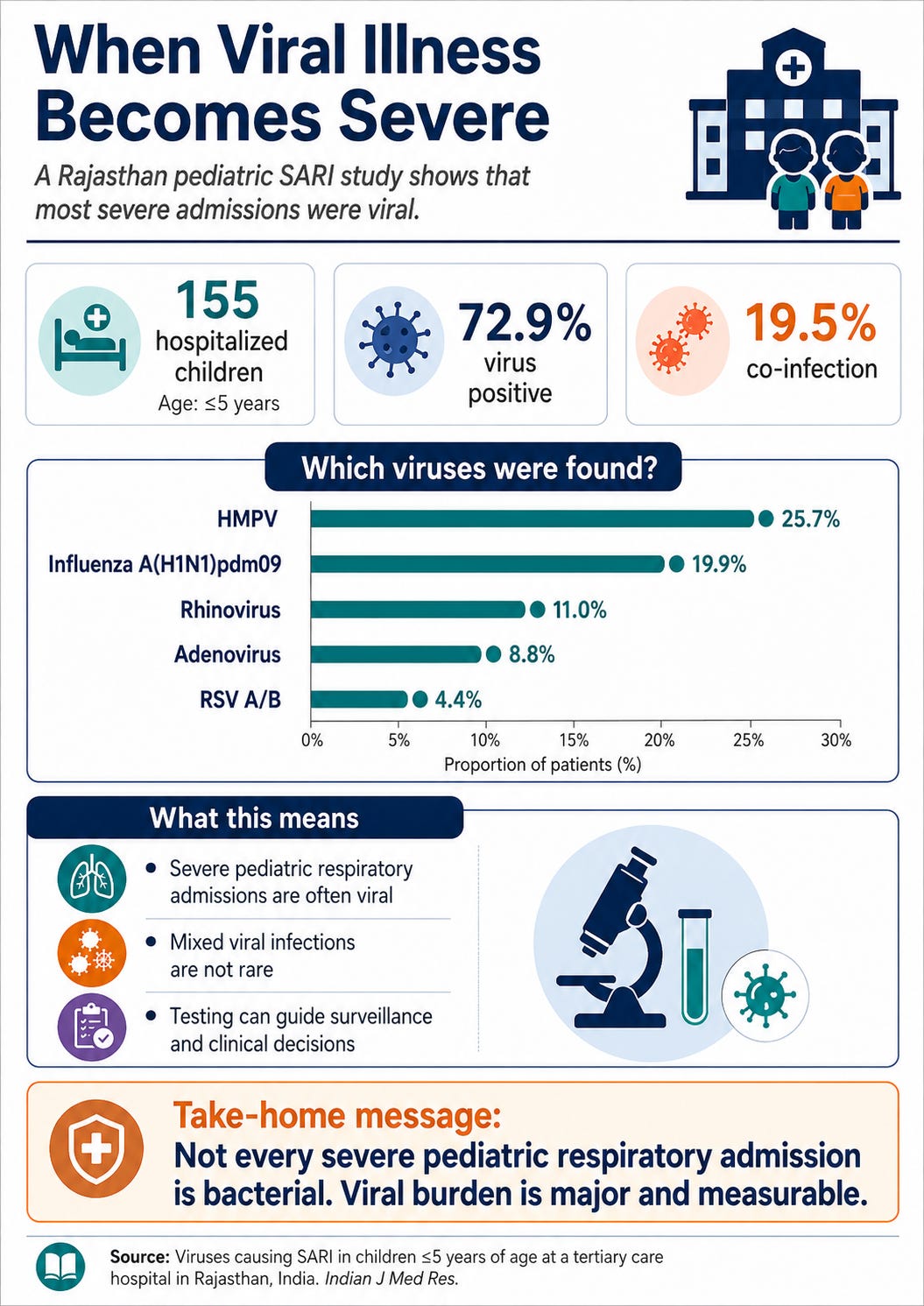
We are not dealing with one virus. That is the first point schools must understand. The child with fever and cough in July may have influenza, RSV, rhinovirus, adenovirus, human metapneumovirus, parainfluenza, SARS-CoV-2, or a combination of viruses. Clinically, many of these infections look similar at the beginning. A mild cold in one child can become bronchiolitis in an infant, wheeze in an asthmatic child, pneumonia-like illness in another, and hospitalization in a high-risk child.
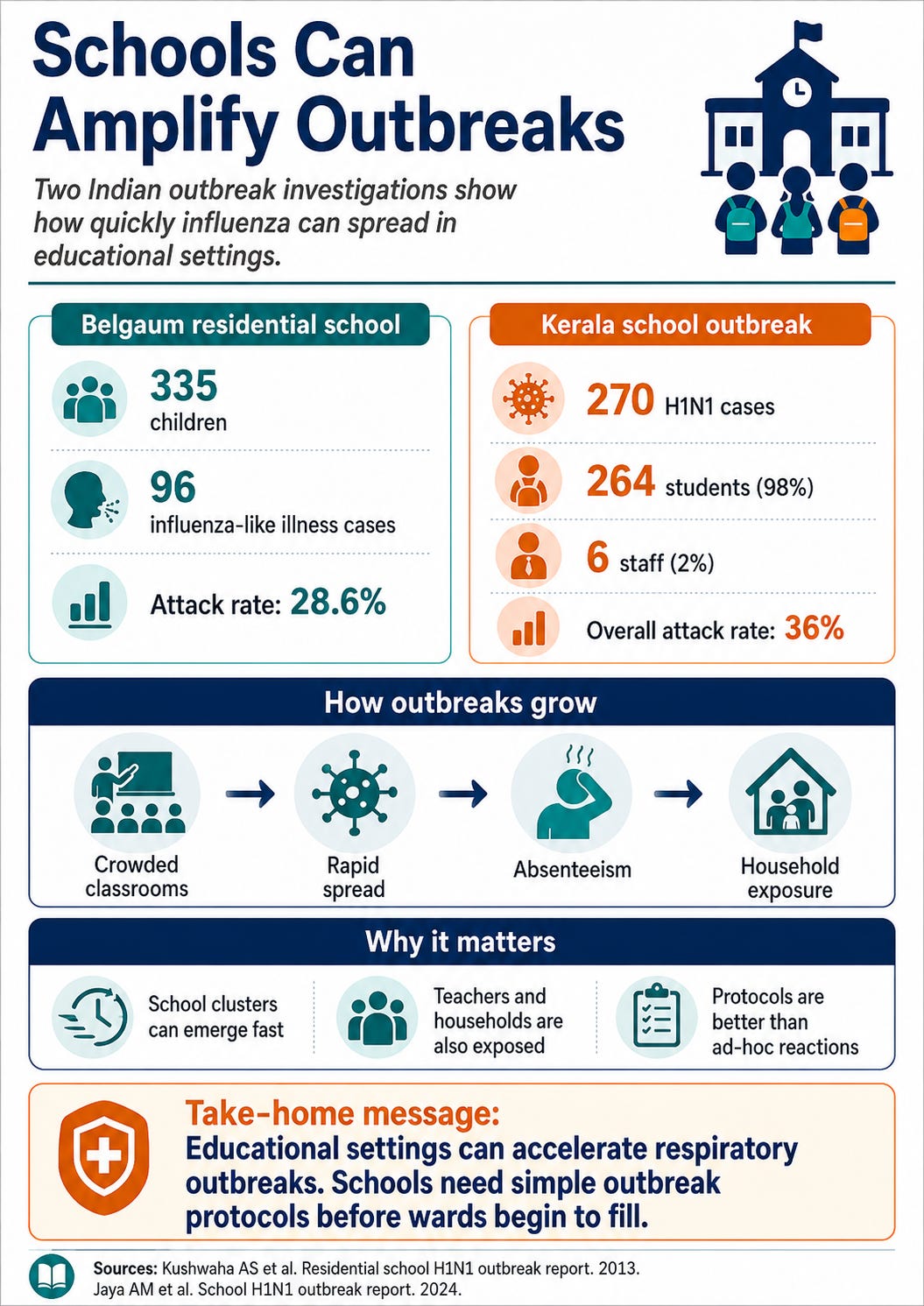
The second point is more uncomfortable. Schools and daycare centres are perfect transmission machines unless they are deliberately managed. Young children sit close, share toys, touch faces, wipe noses, cough openly, forget hand hygiene, sleep in groups, eat together, cry into caregivers’ shoulders, and often cannot explain symptoms early. Nursery and daycare children cannot be expected to behave like trained adults. Infection control in these spaces cannot depend on the child’s discipline. It has to depend on adult systems.
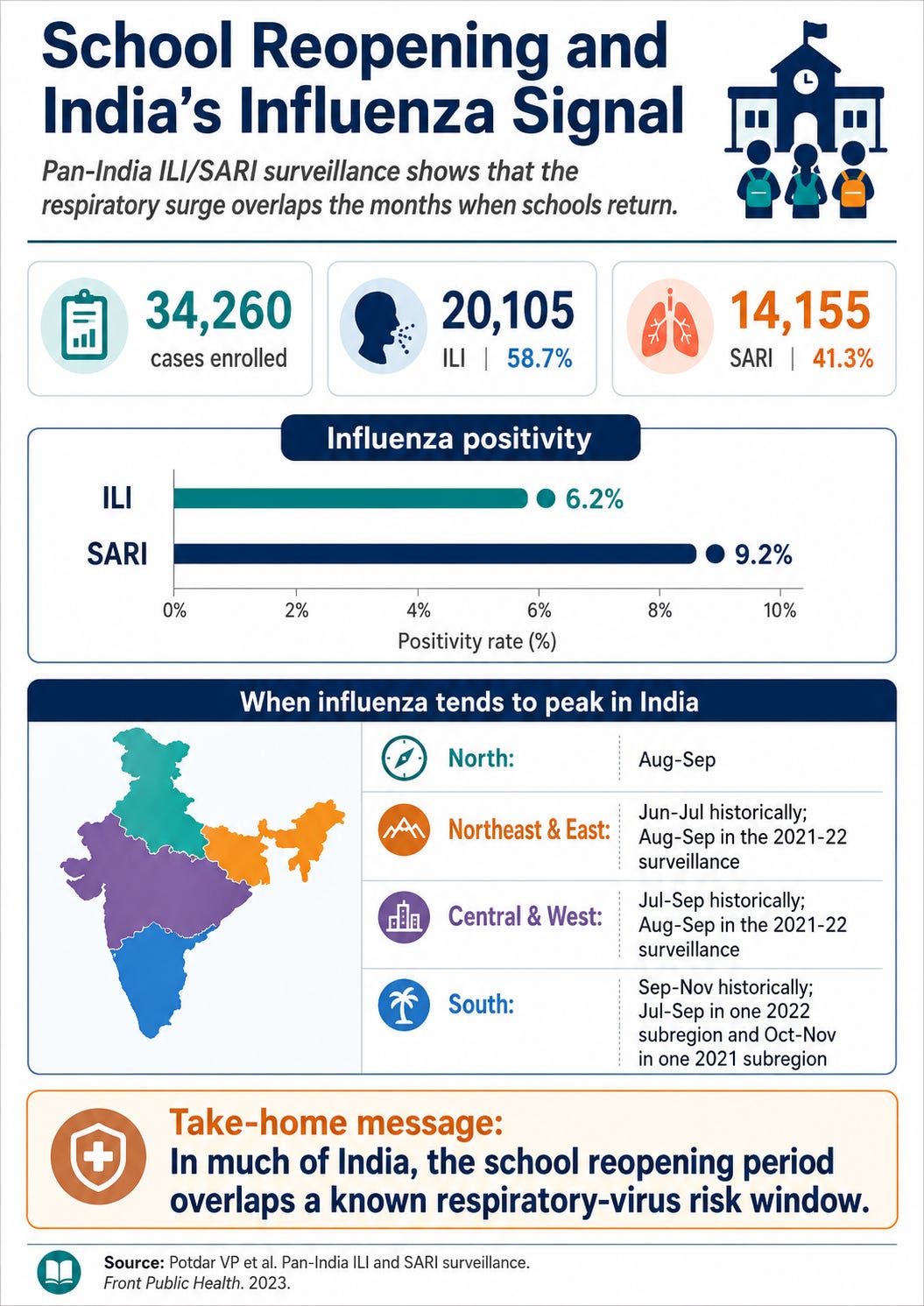
The third point is that school reopening in India overlaps with the monsoon respiratory-virus season in many regions. This is not just an anecdote from one pediatric OPD. Indian surveillance and hospital studies have repeatedly shown that influenza-like illness and severe acute respiratory infection rise in seasonal patterns, with monsoon and post-monsoon peaks in several parts of the country. The exact virus changes. The geography changes. The timing varies between North India, South India, Western India, Eastern India and the Northeast. But the larger truth remains: June to September is not a neutral period. It is a biologically risky window.
Yet our school calendar behaves as if infection risk is irrelevant….!
We reopen crowded institutions into a known transmission season. We allow febrile children to attend because parents cannot miss work, because exams are near, because daycare is essential, because “it is only a cold,” or because schools quietly reward attendance more than responsibility. Then we wait for pediatric OPDs to absorb the consequences.
This is not a call to close schools. That would be irrational and inappropriate. Children need school. They need learning, food, play, language, friendships, discipline, teachers, routine and escape from the loneliness that screens have created. Repeated closures damage children in ways we have already seen during the pandemic.
The question is not whether schools should remain open. They should.
The question is why they remain open without a respiratory infection protocol…!
A sensible school-health policy does not begin with panic. It begins with thresholds. It tells schools what to do before the outbreak, during the outbreak, and after the outbreak. It tells parents when not to send a child. It tells teachers what to watch for. It tells daycare staff how to reduce spread. It tells pediatricians and public health authorities when a cluster deserves attention.
At the minimum, every daycare, nursery, kindergarten and primary school should have a June to September respiratory illness plan.
The first step is pre-reopening preparation. Schools should send a health advisory before reopening, not after half the class is coughing. Parents should be told clearly that fever, active cough, breathing difficulty, vomiting, loose stools, lethargy or poor feeding are valid reasons to keep a child home. Schools must stop demanding medical certificates for every short illness absence. That single habit drives unnecessary OPD visits, exposes other children in clinics, burdens parents, and turns pediatricians into attendance clerks…!
The second step is vaccination awareness. Influenza vaccination is not a magic shield, but it is a rational preventive tool, especially for children at higher risk of severe illness, children with asthma or chronic lung disease, congenital heart disease, neurodevelopmental disability, immunosuppression, prematurity history, and those living with elderly or medically fragile adults. Staff in daycare and nursery settings should also be part of this conversation. A school cannot claim to care about child health and then ignore preventable influenza morbidity.
The third step is the sick-child rule. It has to be simple enough to print on a school notice board. Fever means stay home. A child with fever should return only after being fever-free for at least 24 hours without antipyretics and clinically better. A child with persistent cough, breathlessness, fast breathing, poor oral intake, drowsiness, chest indrawing, bluish lips, or oxygen saturation concern needs medical evaluation, not classroom sympathy. Toddlers with active respiratory symptoms should not be sent to daycare merely because adults have no backup plan. That is harsh to say, but necessary. Daycare convenience cannot become community transmission policy.
The fourth step is class-level surveillance. Schools already maintain attendance registers. They need one additional column during June to September: reason for absence. Fever. Cough. Cold. Wheeze. Vomiting. Loose stools. Rash. Unknown. If three or more children in one class develop influenza-like symptoms within a few days, the school should alert its medical advisor or local health contact. If absenteeism rises sharply in a class, the school should not wait for rumours. It should act.
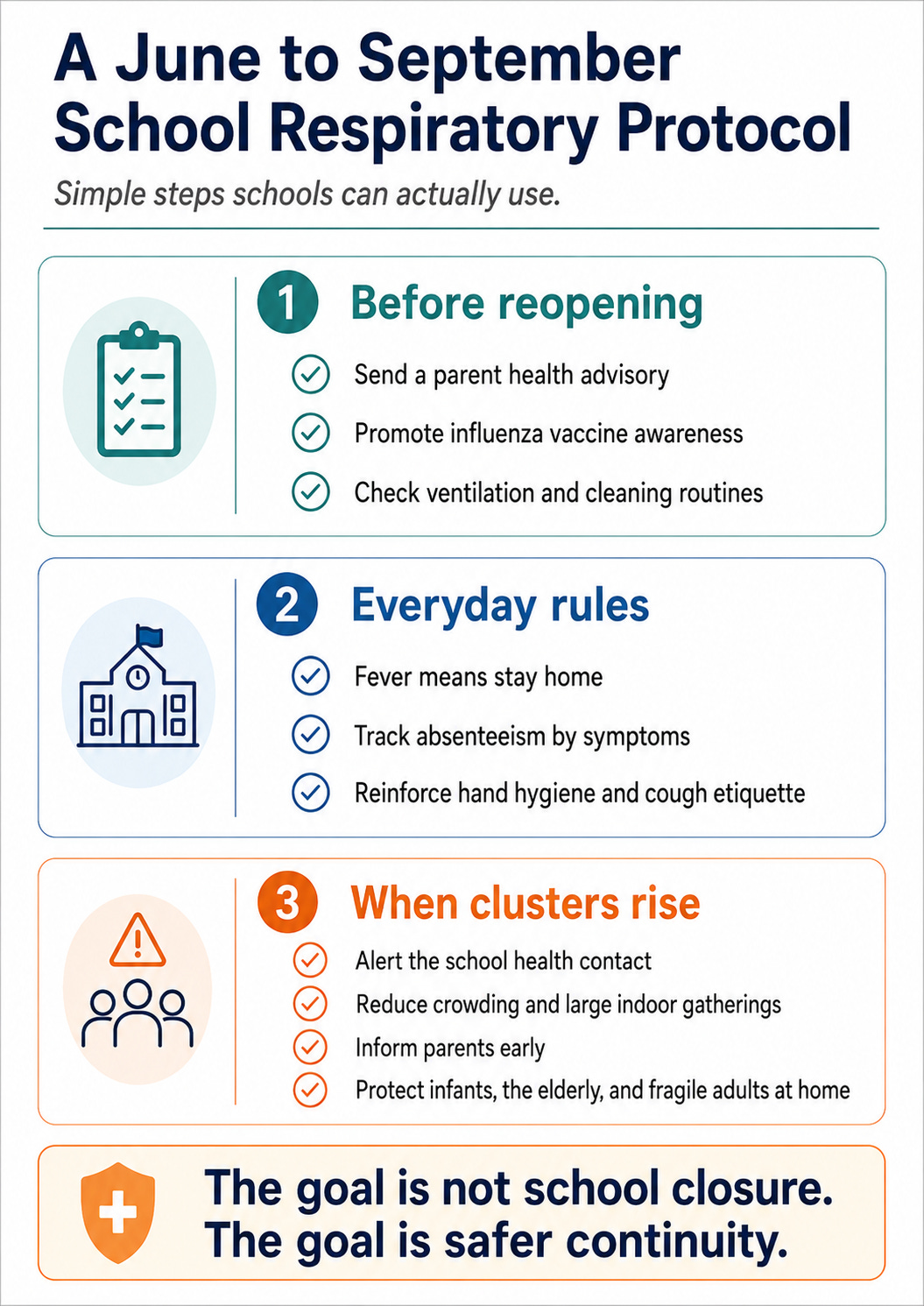
The fifth step is layered control. During clusters, schools can reduce assemblies, improve ventilation, avoid indoor crowding, stagger meals, clean high-touch surfaces, disinfect shared toys in daycare, keep symptomatic staff away, and encourage masks for older children and staff during active outbreaks. None of this is dramatic. None of this requires shutting the school; but requires seriousness.
The sixth step is honest parent communication. Schools should stop sending vague circulars saying “viral fever is spreading, take care.” That means nothing. Parents need clear instructions: do not send a febrile child; inform the class teacher if your child has influenza-like illness; seek care urgently for breathing difficulty, poor feeding, persistent high fever, lethargy, seizures, dehydration or worsening wheeze; protect infants and elderly household members if one child is sick. Good communication reduces panic. Bad communication creates gossip.
The seventh step is hospital-public health linkage. Pediatricians are often the first to see the signal. When multiple children from the same school or locality present with similar illness, there should be a simple reporting pathway. Not every cluster needs laboratory testing. Not every outbreak needs media attention. But repeated clustering should not remain trapped as OPD anecdote. It should become surveillance intelligence.
This is where India’s current approach is incomplete. We have ILI and SARI definitions. We have national surveillance networks. We have laboratory capacity in many regions. We have outbreak investigation experience. But these systems often sit above the everyday school setting. Schools need a practical bridge between clinical medicine and public health.
A school respiratory protocol should not be a 90-page document that nobody reads. It should be a two-page operational checklist.
Before reopening: advisory, vaccination awareness, sick-child rule, ventilation check, daycare cleaning plan.
During routine weeks: absenteeism tracking, hand hygiene, cough etiquette, symptom-based exclusion, parent communication.
During clusters: class-level alert, temporary reduction of crowding, masking where feasible, enhanced cleaning, medical consultation, public health intimation if severe or unusual.
During severe outbreaks: targeted class-level pause only if needed, not blind school closure.
After the season: review what happened, how many children were absent, how many were hospitalized, what worked, and what failed.
It protects learning by preventing avoidable disruption. It protects children by reducing viral load and repeated exposure. It protects hospitals by flattening seasonal surges. It protects grandparents by recognizing that the school-child-household chain is real.
The opposition to such a protocol will be predictable. Some will say children fall sick anyway. True. Children do fall sick. A young child may have several respiratory infections a year. But inevitability is not the same as helplessness. Road accidents happen too. We still use helmets, seat belts, speed limits and school-zone rules. Viral infections will continue. That is not an argument against prevention. It is an argument for adult competence.
Some will say schools cannot manage this. That is false. Schools already manage far more complex systems when they want to: transport routes, fee collection, examinations, uniform rules, digital portals, parent meetings, CCTV, annual functions and competitive coaching schedules. A fever policy is not beyond institutional capacity. It is beyond institutional priority.
Some will say parents will not cooperate. Some will not. That is exactly why schools need written policy. A parent who sends a febrile child should not be treated as merely “adjusting.” They are placing other children and households at risk. Working parents need support, but the solution cannot be to convert daycare into an infection exchange.
Some will say this is alarmist. It is not. Alarmism is shouting after the ward is full. Public health is acting before the ward fills.
The June to September pediatric viral surge is not a mystery. It is a recurring event hiding in plain sight. Every pediatrician knows it. Every school has seen it. Every parent has lived it. Every hospital has absorbed it. What we lack is the courage to stop calling it normal.
The first lesson of the school year should not be that fever spreads faster than policy.
If we can reopen schools with new timetables, new books and new fee structures, we can reopen them with a respiratory illness protocol. The children are already giving us the data. They give it through crowded OPDs, full pediatric wards, anxious parents, exhausted nurses and oxygen beds occupied by illnesses that began as “just a cold” in a classroom.
Every June, the virus enters school with the children.
The question is whether adults will finally be ready before it does…..!
Thanks for reading! This post is public so feel free to share it.
Further readings:
https://pmc.ncbi.nlm.nih.gov/articles/PMC10624221
https://link.springer.com/article/10.1186/s12879-024-09536-1
https://ijmr.org.in/viruses-causing-severe-acute-respiratory-infections-sari-in-children-5-years-of-age-at-a-tertiary-care-hospital-in-rajasthan-india/
https://journals.lww.com/jfmpc/fulltext/2024/13030/an_outbreak_of_h1n1_influenza_a_among_the_students.47.aspx
https://ncdc.mohfw.gov.in/uploads/glimpse_pdfs/1770281948_Pandemic-Influenza-H1N1-2009.pdf
https://www.cdc.gov/children-and-school-preparedness/infection-prevention/docs/IPC-Science-Brief_508.pdf
No posts
Comments
Nothing yet. Say the first thing.
Sign in to join the conversation.