
Today, July 1st, marks National Doctors' Day in India. Timelines overflow with tributes — *saviours*, *modern gods*, *Vaidyo Narayana Hari*, the old Sanskrit line that once equated the healer with the divine. Patients, politicians, and corporates alike post garland photos and stories of miraculous recoveries.
As a pediatric professor, a lifelong student of medical education, and a doctor who still tries to practice ethically in an increasingly transactional world, I find myself pausing this year. Not in gratitude. In quiet, uncomfortable reflection.
What are we actually celebrating? The ideals of a profession that once stood apart from the marketplace — or the rituals that persist, hollowed out, while the profession itself has been industrialised around us?
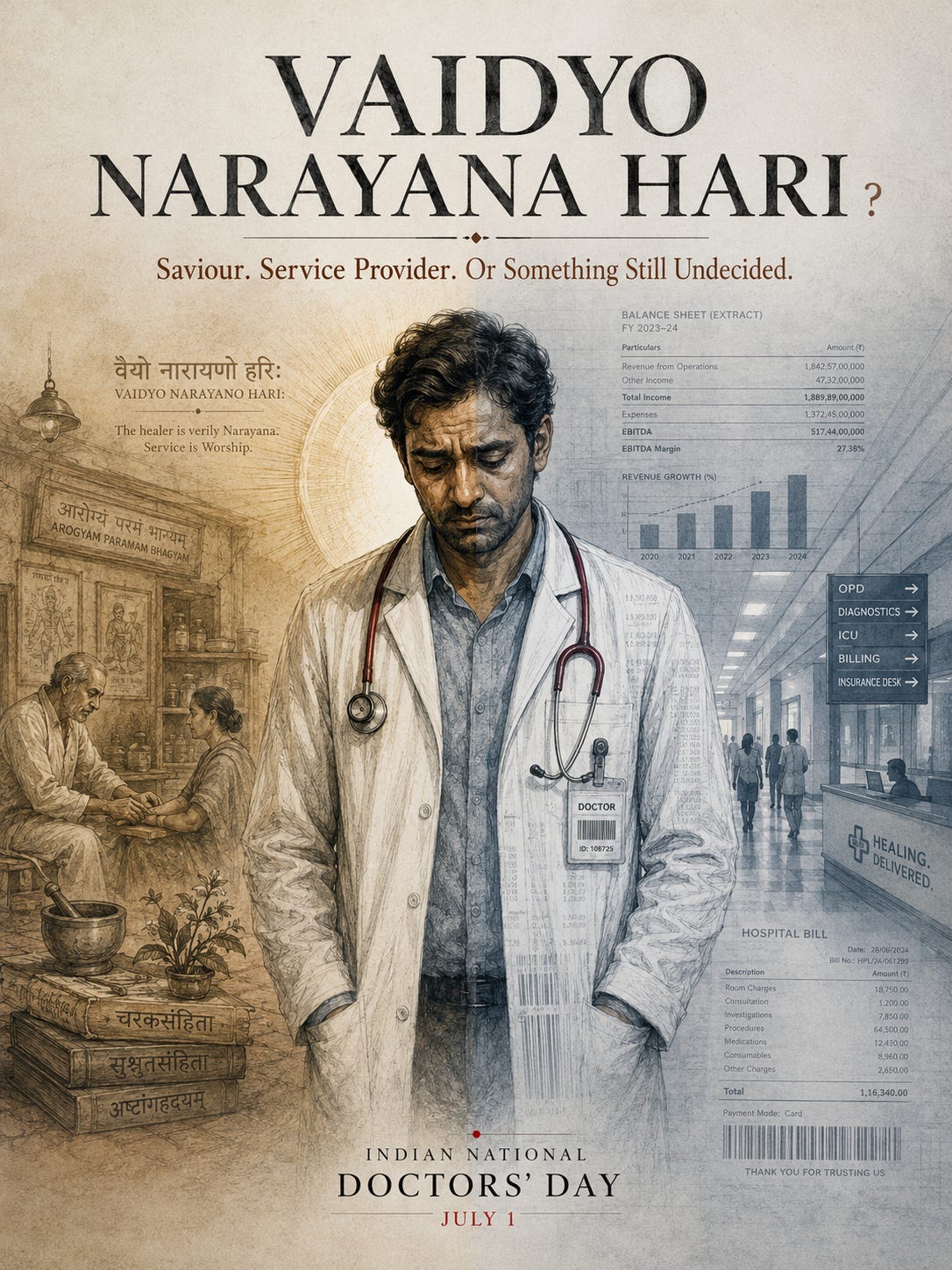
There was a time — romanticised now, perhaps, but rooted in real memory — when medicine in India carried a different weight. Doctors weren't professionals in the modern sense; they were part of the social fabric, often the first and last resort a family had. The relationship rested on trust, not timestamps, insurance pre-authorisations, or star ratings. "Vaidyo Narayana Hari" wasn't marketing. It was a society naming, out loud, the weight of holding someone's life in your hands.
Fast forward to 2026. The profession has been thoroughly industrialised. Corporate hospital chains run like efficient factories — patient throughput, revenue targets per bed, upselling of diagnostics and packages. Insurance companies and hospital administrators shape protocols as much as clinical guidelines do. The Consumer Protection Act, meant to empower patients, has also layered on defensive medicine: more tests, more documentation, more fear of litigation than of missing a diagnosis. Capitalism didn't just enter healthcare. It rewired its incentives from the inside.
I see the inequality daily. In teaching hospitals, we work with constrained resources, overstretched residents, and patients who've travelled hundreds of kilometres for basic care. A few kilometres away, private centres gleam with equipment gated by the ability to pay. The data bears this out — stark urban-rural and rich-poor divides in outcomes, year after year. And when colleagues who've trained abroad describe how an MI or a septic child is met in many high-income systems — a coordinated, resource-backed response rather than a scramble for the next ICU bed — the contrast isn't imagined. It's a difference in what the system does *automatically*, without depending on any one person's heroics. That said, it's not a clean comparison: those systems have their own well-documented strains — corridor care, ambulance delays, staffing shortfalls — and I don't want to trade one myth (the selfless Indian doctor) for another (the seamless Western system). What I mean, specifically, is this: in many HIC settings, the *infrastructure* of an emergency response — bed allocation, oxygen supply, triage protocol — doesn't depend on which hospital you happened to reach first. That specific kind of reliability is what I see missing here, more than any general claim of superiority.
India's system delivers heroic individual effort against systemic odds. But the aggregate picture is one of patchy excellence inside widespread strain. We take pride in medical tourism and the size of our doctor pool, while quietly losing people to burnout and brain drain, and losing public trust one bad headline at a time.
Picture it: a doctor moves between OPD, ward rounds, and an emergency, and is greeted at day's end with a corporate hamper and a LinkedIn post thanking "our frontline warriors." The same system, the same week, pushes them to hit targets, sit through "relationship-building" dinners with pharma reps, and justify every clinical call to a utilisation review team. Saviours? More like gladiators in an arena where the crowd cheers selectively and the organisers count the ticket sales.
The consumer lens deepens the satire. Patients — rightly more empowered than a generation ago — sometimes approach a consultation like a delivery app order: *this scan, this injection, quick relief, or a bad rating.* Defensive practice blooms in response: caesareans that weren't strictly needed, polypharmacy, referrals made to cover a file rather than treat a patient. Not out of malice. Out of survival, in a system that has made survival and integrity harder to hold at the same time. We became "service providers." The divine aura faded as the balance sheet rose — not because capitalists set out to villainise doctors, but because they commodified the encounter, and the encounter is what the aura was ever about.
Here's the raw nerve, since we're naming them today: not every doctor is a saint, and the profession carries its own rot — quackery, unnecessary procedures, people who game the system for profit. Pretending otherwise does no one any favours. But painting the whole fraternity as greedy, while ignoring the structural forces that reward exactly that behaviour, is convenient scapegoating. It's easier to run an outrage cycle about one clinician than to examine underfunding, regulatory capture by large players, or a decade of policy inertia. The Consumer Protection Act brought real accountability — and also buried clinicians in paperwork that has nothing to do with the patient in front of them.
As an educator, I watch this land on the next generation first. Bright, idealistic residents, crushed by unrealistic hours, debt, and the gap between what they were taught — patient first — and what they live — throughput first. Lifelong learning starts to feel like a luxury when survival already demands constant upskilling in medicine *and* in navigating a business you didn't choose to be part of.
This isn't a blanket case against private enterprise. Corporate hospitals have built specialties, drawn in talent, and raised the technical ceiling of Indian medicine faster than the public system alone ever could have. Plenty of ethical doctors do good work inside that system by holding their own line. And public healthcare is no utopia either — it has its own corruption, inefficiency, and political interference.
Nor is the comparison with HICs a simple one. India's scale, its epidemiological transition from infectious to lifestyle disease, its federal complexity — none of it maps cleanly onto smaller, wealthier, more centralised systems. Ayushman Bharat and similar efforts show real promise and real implementation gaps in the same breath. India's strengths show up in different places — disaster response, epidemic containment — even as its everyday reliability lags.
The cost of all this is not abstract. Eroding trust harms everyone: patients delay care because they fear the bill or the misdiagnosis; doctors wear burnout like a badge because the alternative is admitting the system is unsustainable. Medical education risks turning out graduates who are excellent at exams and starved of mentorship. The "saviour" narrative feels good for a day, but it quietly excuses the system from the work of actual reform — better-balanced regulation, fairer reimbursement, real investment in primary care and prevention, less administrative bloat, and a recalibration of what patients, providers, and policymakers each owe one another.
Maybe, too, we've over-medicalised the whole conversation, while under-investing in the things that actually determine health at scale — nutrition, sanitation, education, equity.
Doctors cannot fix what policy and economics have broken. And yet we're held to a god's standard by a system that treats us as replaceable line items.
I'm not writing this for sympathy, or for more garlands. I'm asking, as a practitioner and a teacher: what does it mean to heal inside an industrialised system? How do I teach the next generation integrity, in an environment that keeps rewarding volume instead? How do I advocate for a patient when the system I work in sometimes sets us against each other?
The profession isn't dying. It's been transformed, and pretending otherwise doesn't help anyone. The truth underneath the satire is this: we were never meant to be saviours standing alone, and we were never meant to be vendors either. Real healing has always required a partnership — between doctor and patient, profession and policymaker, ethics and economics.
Perhaps the mantra we actually need this year isn't *Vaidyo Narayana Hari*, but something closer to *Vaidya, Patient, Society — Sahakarinam*: collaborators, not saviours and customers.
To my colleagues: keep learning, keep questioning, keep resisting the burnout that gets sold to you as a badge of honour.
To patients: hold us accountable, but extend grace where the system fails an individual doctor who is fighting it too.
To the regulators and the boardrooms: healthcare is not just another industry. Commodify it past a certain point, and you erode the very trust the whole enterprise depends on.
The downfall isn't inevitable. But reflection without reform is just another performative post. On this Doctors' Day, let's aim for something harder than gratitude — an honest reckoning…!
No posts
Comments
Nothing yet. Say the first thing.
Sign in to join the conversation.