
I know, I know, getting even one investor is a lot of work, especially at an early stage. But as you are building for the next 10 years, there is a vital question to ask before onboarding someone to your cap table
The question is: who should actually be in this round, and what combination of investor types gives me the best chance of not just closing, but building something durable?
Most founders default to one path: pitch VCs until someone says yes. If a VC says no, pitch more VCs. If a VC leads, fill the rest of the round with more VCs.
That is not an ideal round design, but today we will learn how.
But before we begin,
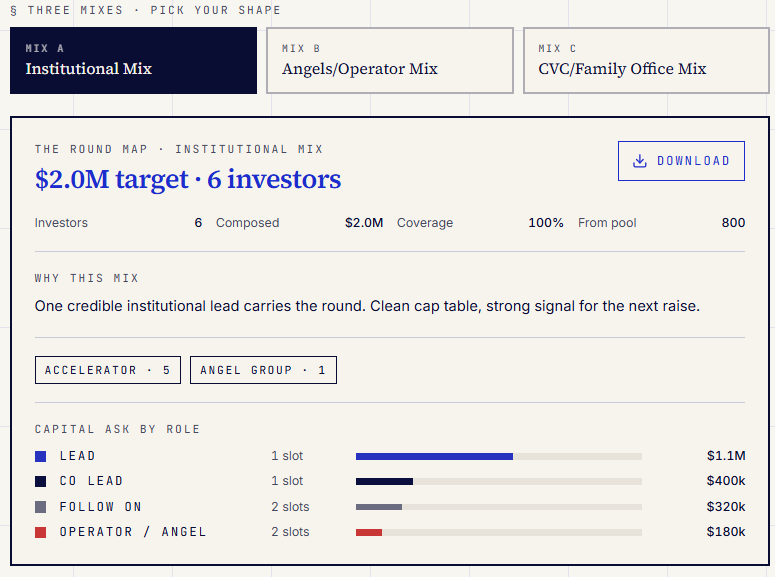
If you don’t want to understand the entire literature behind round design, use “Round Architect” by The VC Lens - simply input some data and get a round design with Investor Contacts in seconds. Customized for you, drawn from 39,000+ active VCs, angels, corporates, and family offices.
The Anatomy of a Well-Designed Round
What Each Investor Type Actually Brings (Beyond the Cheque)
Why Mixing Investor Types Is a Strategic Advantage, Not a Compromise
The Investor Mix by Stage: What Truly Works
Structuring the Round: Lead, Co-investors, and Fill
Common Round Design Mistakes (and How to Avoid Them)
Introducing the Round Architect
FAQ
A funding round is not just a financial event. It is the moment you choose the people who will sit across the table from you for the next 5 to 10 years — the voices in your ear when things go wrong, the doors that open or stay closed, and the incentive structures that will either align with your long-term vision or work against it.
In 2026, 22% of all global venture capital flows through corporate venture arms.
Family offices have accelerated their early-stage activity sharply over the last three years, with many now writing pre-seed and seed cheques directly.
Angel syndicates on platforms like AngelList have consolidated small-ticket investing into single clean SPV entries. Micro-VCs have proliferated into every niche and geography.
The investor market is more diverse than it has ever been. Founders who understand this and deliberately design their rounds around it are raising faster, closing stronger, and building more durable companies than those who just pitch VCs in sequence.
A well-designed round has three things:
A clear lead who sets terms and signals conviction to the rest of the market
Strategic co-investors who each bring something different — a customer network, operational expertise, a geography, a follow-on signal
Intentional fill that closes the round without dragging down terms or crowding the cap table
Everything else follows from these three decisions.
Most founders would think about investor types in terms of cheque size. They should think about them in terms of value architecture.
Here is what each type actually brings — and what it does not.
What they bring:
Institutional credibility that signals quality to downstream investors and enterprise customers
Larger cheques ($500K–$10M at seed/Series A), reducing the number of conversations needed
Follow-on capacity — most seed VCs reserve 2–3x their initial cheque for follow-on rounds
Structured support: talent networks, founder communities, operational playbooks, and warm introductions to Series A funds
Board-level governance experience
What they do not bring:
Speed — investment committee processes typically take 6–12 weeks at seed, longer at later stages
Flexibility — VCs operate on fund timelines and return requirements that can misalign with your company’s natural growth pace
Domain depth — generalist VCs often lack the operational expertise of someone who has built in your specific space
Best used as: Lead investor, primary governance relationship, follow-on anchor
What they bring:
Speed — a convinced angel can commit within days, no IC required
Domain expertise — the best angels are former operators who have built in your exact problem space
Founder relationships — angels often become genuine mentors and advocates, with a personal stake in your success
Flexible terms — less likely to push hard on valuation, control provisions, or governance rights
Market signals — a high-profile angel’s name on your cap table tells the next round of institutional investors something no pitch deck can
What they do not bring:
Cheque size — individual angel cheques typically range from $25K–$250K, requiring multiple angels to fill a round
Follow-on capacity — most angels invest from personal capital and cannot reliably follow on in future rounds
Structured support — relationship quality varies enormously; some angels are deeply engaged, others disappear after wiring
Best used as: Seed credibility, domain signal, quick fill for the first 20–30% of a round
What they bring:
Speed plus scale — a syndicate lead can pull together $250K–$2M from a pool of backers through a single SPV, often in 2–3 weeks
Clean cap table — instead of 15 individual angels showing up as separate entries, they consolidate into one SPV
Network multiplication — the syndicate lead’s backers often bring their own networks, customer relationships, and domain expertise
Accessibility for founders outside major hubs — syndicates democratise access to capital for founders who are not in SF or NYC
What they do not bring:
Single GP conviction — decisions depend on the lead’s ability to convince their backers, which creates execution risk
Board representation — most syndicates do not take board seats, limiting governance involvement
Follow-on certainty — SPVs are deal-by-deal; the same backers may not reconvene for your next round
Best used as: Efficient fill for $250K–$1M slots, particularly effective at pre-seed and seed
What they bring:
Patient capital — family offices operate without fund cycles or LP pressure to distribute returns on a 10-year timeline. They can hold positions longer and are comfortable with slower-burn businesses
Flexibility in deal structure — more open to unconventional terms, hybrid revenue models, international entities, and non-standard instruments
Long-term relationship orientation — decisions are made by the principal, creating a more personal and stable investor relationship
Speed — family offices can make decisions in days when conviction is high, unlike CVCs or institutional VCs
Network quality — many family offices have built wealth through specific industries (real estate, manufacturing, healthcare, finance) and bring deep domain networks in those sectors
No exit pressure — family offices do not need a liquidity event to satisfy LP timelines, which reduces the push toward premature exits or acquisitions
What they do not bring:
Institutional signalling — family office participation does not carry the same downstream credibility signal as a known VC brand
Structured portfolio support — most family offices do not have the infrastructure to provide talent networks, operational playbooks, or systematic founder support
Wide deal visibility — family offices are less visible to founders, making them harder to find without warm introductions or specialist platforms
Best used as: Patient anchor capital, particularly for founders building in sectors aligned with the family’s existing wealth (industrials, healthcare, real estate tech, fintech)
What they bring:
Strategic distribution — a CVC from a market leader can open the parent company as a customer, pilot partner, or distribution channel. This removes customer acquisition risk in a way no amount of cash can replicate
Operational resources — unlike VCs who provide capital and a board seat, CVCs can provide engineers, product managers, sales leads, and compliance experts from the parent company. This is worth $100K–$500K if hired externally
Sector credibility — CVC backing from a major player in your industry tells enterprise customers and future investors that someone with real domain knowledge has validated your approach
Longer time horizon — CVCs operate on 5+ year cycles, giving founders breathing room to build quality rather than chase early traction metrics
What they do not bring:
Speed — CVC close timelines average 18–24 weeks, nearly double traditional VC
Independence — CVCs come with strategic strings. The parent company’s priorities will influence your roadmap, your board conversations, and your exit options
Pure financial alignment — CVC investment decisions are partly strategic, which means they can defund or deprioritise your company if parent strategy shifts, regardless of your financial performance
Best used as: Strategic co-investor after lead is secured, particularly when the parent company’s distribution, domain expertise, or customer pipeline is genuinely valuable to your go-to-market.
Here is the insight that most fundraising guides miss entirely.
A round with one investor type is a round that depends on one kind of edge. A round with multiple investor types is a round that compounds multiple edges simultaneously.
Credibility stacking
When a respected VC leads and a well-known domain angel co-invests alongside a CVC from a market leader in your sector, those three names on your cap table tell a different story than any one of them would tell alone. The VC signals institutional quality. The angel signals domain conviction. The CVC signals strategic relevance. This stacking effect is real and it compounds — it affects how enterprise customers evaluate you, how the press covers you, and how the next round of investors perceive your company.
Network multiplication
Your VC’s network overlaps with your angel’s network in some places. Where they do not overlap, the gaps get filled. A CVC brings an entirely different network — the parent company’s customer relationships, supplier relationships, and executive connections. A family office with background in healthcare brings connections that no generalist VC would have. Each investor type extends your network into parts of the market that a single investor type simply cannot reach.
Risk distribution
A round dominated by one investor type is a round where your fate is highly correlated with one set of incentives and one set of timelines. When that investor’s fund dynamics change — portfolio pressure, LP demands, strategy shifts — you feel all of it. A mixed round distributes that risk. Your VC’s LP pressure does not affect your family office. Your CVC’s parent company strategy shift does not affect your lead VC. This diversification matters most in difficult markets.
Negotiating durability
Once you have a lead, additional investor types often come in without re-negotiating the lead’s terms. An angel at $100K, a family office at $250K, a syndicate at $500K — these fill the round efficiently without creating competing term demands. The result is a cleaner close, a more stable cap table, and less time in negotiation.
Round composition is not one-size-fits-all. The right mix varies meaningfully by stage.
At pre-seed, you are asking investors to bet primarily on you and the problem. Institutional VCs are rarely a fit here — most seed-stage VC funds are not structured for sub-$500K cheques, and the diligence process is disproportionate to the cheque size.
Optimal mix:
Lead: Micro-VC or experienced domain angel (sets terms, leads the round)
Co-investors: 2–4 individual angels with operational experience in your sector
Fill: Angel syndicate via SPV to consolidate remaining capital
What to avoid: Taking CVCs or large institutional VCs at pre-seed unless they explicitly have a pre-seed programme. The diligence timelines and governance expectations are mismatched with where you are.
At seed, you have evidence. The question shifts from “is this a real problem?” to “can this team build the solution?” This is where institutional credibility starts to matter — not just for its own sake, but as a signal to your Series A.
Optimal mix:
Lead: Seed-stage VC (sets terms, provides governance structure, signals Series A readiness)
Strategic co-investor: Domain angel or operator investor who adds specific expertise your VC does not have
Supplement: Family office for patient capital and sector-specific network, or CVC if strategic distribution is genuinely valuable to your GTM
Fill: Angel syndicate to close the remaining round efficiently
What to avoid: A “party round” with many small VCs and no clear lead. This creates governance confusion, signals lack of conviction, and makes Series A conversations harder because no single investor is clearly accountable.
At Series A, the round is primarily institutional. But the strategic co-investors still matter, and they matter in a different way.
Optimal mix:
Lead: Tier 1 or Tier 2 VC with sector focus (sets terms, takes board seat)
Strategic co-investor: CVC from a major player in your industry (distribution, domain credibility, long-term partnership potential)
Follow-on: Pro-rata from your best seed investors (signals continuity and conviction from those closest to the company)
Supplement: Family office for long-term stability
Understanding what role each investor plays in a round is as important as choosing the right investor types.
The lead investor
The lead sets terms, anchors the round, and signals to other investors that someone credible has done the diligence. Without a lead, you are doing 100% of the selling, and the round risks feeling like a collection of people waiting for someone else to go first. Every round needs a lead.
Co-investors
These are investors who add strategic value beyond their cheque. They do not set terms — they accept the lead’s terms — but they bring something specific: a network, a domain, a distribution channel, an operational resource. Choose co-investors based on what the lead cannot provide.
Fill investors
Fill investors complete the round without adding complexity. Syndicates and angels who are willing to come in on existing terms efficiently close the gap between your lead’s cheque and your target raise. They should be easy to close and should not create cap table fragmentation.
The cap table hygiene rule
More than 8–10 individual investors on a cap table starts to create governance complexity. If you want multiple angels and syndicates, consolidate them into SPVs wherever possible. Future investors — particularly Series A VCs — will look at your cap table before they look at your deck. A clean, consolidated cap table signals that you understood what you were doing.
Mistake 1: Pitching investor types sequentially instead of in parallel
Founders often pitch VCs first, and when those conversations stall, pivot to angels, then family offices. The problem: each cohort picks up on the hesitation of the previous one. Run parallel processes across investor types from the start. Different types move on different timelines, and parallel outreach gives you optionality.
Mistake 2: Letting one investor type dominate the round by default
If your lead VC writes 80% of your seed round, you have made a choice — but probably not intentionally. That level of concentration is fine if the VC’s value-add is genuinely exceptional across all dimensions. If it is not, you have given up the network, patience, and domain expertise that other investor types would have added.
Mistake 3: Adding CVCs without modelling the strategic implications
A CVC is not just a cheque. Before adding a CVC to your round, model what happens to your exit options, your product roadmap, and your independence if the parent company’s priorities shift. The benefits are real; so are the constraints.
Mistake 4: Ignoring geography in round design
If you are building in India, South Korea, or a European market, your lead VC’s network is strongest in their geography. Adding a family office or CVC with regional presence in your target market can open doors that your lead VC simply does not have.
Anyway, this is a long guide and can be daunting while talking rounds in the deal room. Keep the “Round Architect” handy every time you are giving a pitch or thinking about round design.
Until next time,
Sayanee Bhowmik
Ex-VC | Founder, The VC Lens
Comments
Nothing yet. Say the first thing.
Sign in to join the conversation.