
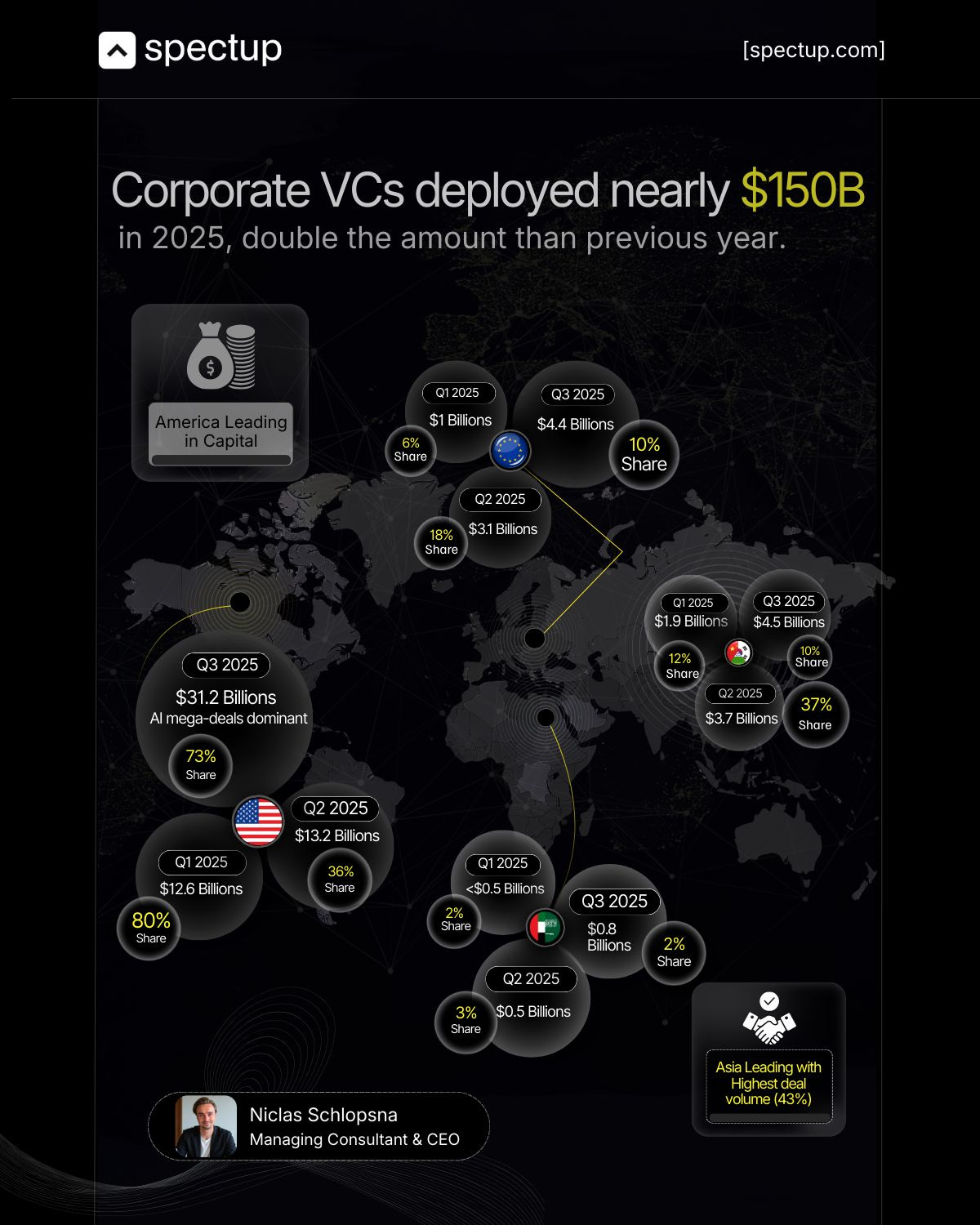
In 2025, 22% of all venture capital globally flowed through corporate venture arms. By 2026, projected CVC deployment crosses $28 billion.
That number has more than doubled in three years.
Intel, Google, Salesforce, BMW, Kaiser Permanente — all of them are writing cheques into early-stage startups. And yet most founders still treat CVC the same way they treat a traditional VC term sheet.
That is the mistake.
Corporate venture capital is not just venture capital with a different letterhead. It operates by different incentives, moves on different timelines, and comes with strategic strings that a standard VC investment simply does not. Getting this wrong can cost you your strategic independence, your exit options, or both.
This edition is a practical breakdown of what CVC actually is, how it differs from traditional VC, what the 2026 landscape looks like, and — most importantly — whether it is the right fit for your company right now.
What Corporate Venture Capital Actually Is
CVC vs Traditional VC: The Three Differences That Matter
Why Corporations Invest in Startups: 5 Real Motivations
The 2026 CVC Landscape: What Has Changed
How CVC Funds Are Structured (And Why It Affects You)
The Real Benefits of CVC for Founders
The Risks Most Founders Walk Into Blindly
Should You Pursue CVC? An 8-Point Checklist
FAQ
Before we dive in —
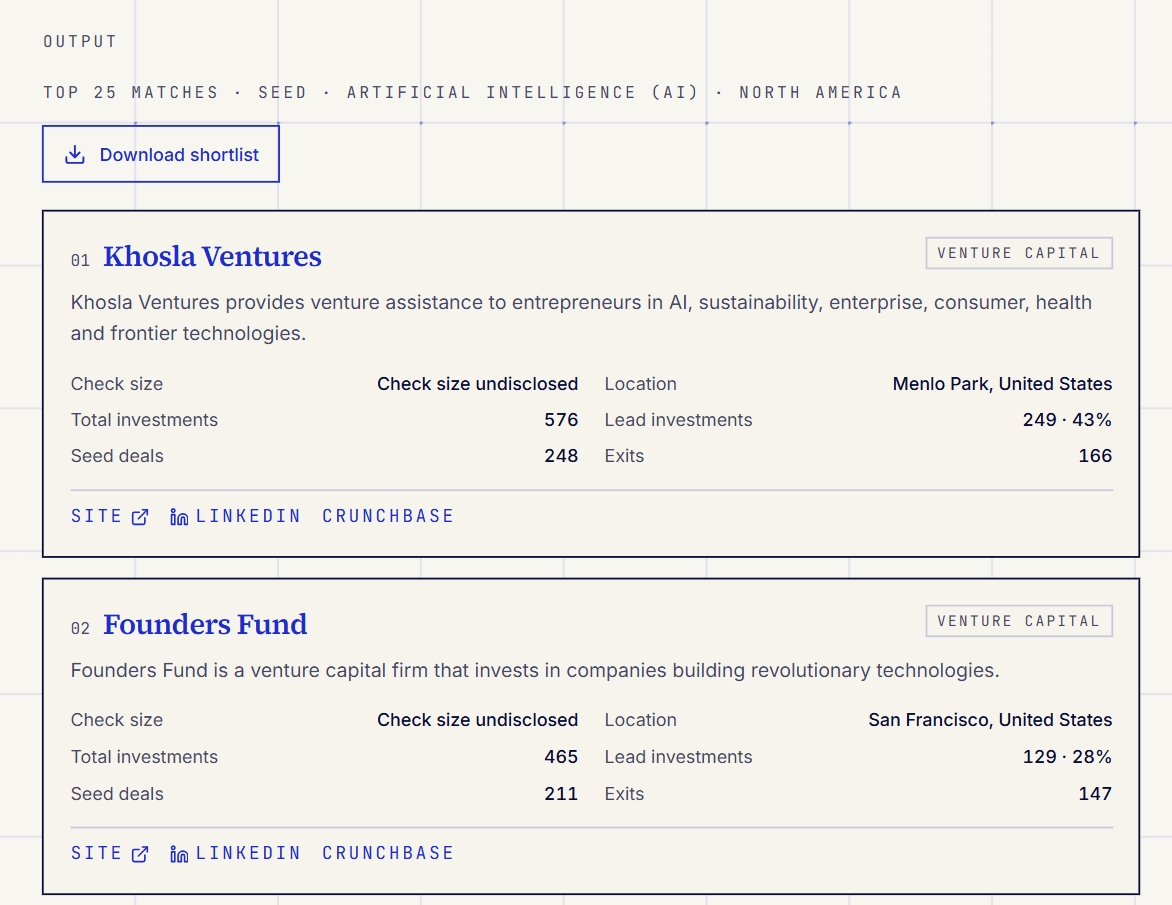
Trying to figure out which investors actually back companies at your stage, in your sector, at your cheque size?
Try the Investor Fit Finder by The VC Lens.
It pulls from a database of 40,000+ active investors and surfaces the ones most likely to take the meeting with you — filtered by stage, sector, geography, and cheque size. Ranked by who actually closes.
→ Try it now for free — use this link
Here is the simplest definition that holds up:
CVC is when a corporation invests its own capital into external startups to achieve both financial returns and strategic objectives.
That second part — strategic objectives — is what separates CVC from every other capital source you will encounter.
A traditional VC invests in a fintech startup because they believe the payment infrastructure market is large and the team can win it. A bank’s CVC arm invests in that same startup because it wants early access to payment technology, a potential acquisition target, and visibility into how the market is shifting before it has to respond.
Both wrote the same cheque. But they want completely different things from the relationship.
77% of Fortune 100 companies now engage in some form of venture investing. This is now a core business infrastructure. If you are raising a round in 2026, there is a reasonable chance a CVC will come up in your process whether you seek one out or not.
Most founders learn these differences the hard way, mid-negotiation or mid-portfolio. Here they are upfront.
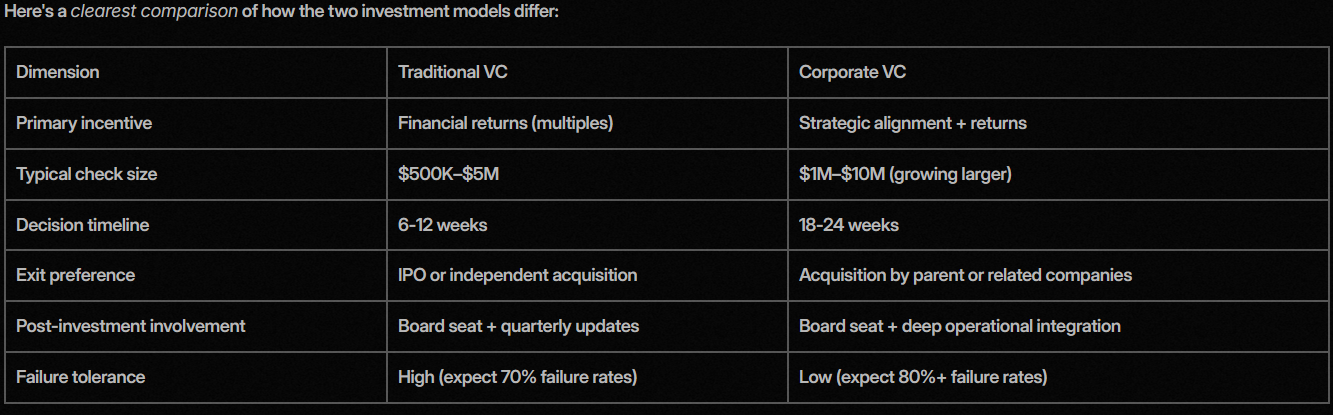
1. Incentives are different
Traditional VCs have one job: financial returns.
CVC funds have two: financial returns and strategic alignment with the parent company.
This means a CVC might stay in a deal that is underperforming financially if the strategic relationship is valuable. And it means a CVC might exit or defund a startup that is doing well financially if the parent company’s strategy shifts away from the sector.
Both of those scenarios happen more often than founders expect.
2. Decision speed is much slower
A traditional VC needs a few partner votes. Done.
A CVC needs sign-off from corporate stakeholders, legal teams, strategy departments, and often executive leadership. The average traditional VC closes in 6–12 weeks. The average CVC closes in 18–24 weeks — nearly double.
If you have 12 months of runway, CVC timelines are a real risk to your survival. If you have 24+ months, they are manageable.
3. Exit expectations diverge sharply
Traditional VCs want an IPO or independent acquisition at a 5–7 year horizon. CVCs are comfortable with 8–10 year horizons, but they tend to prefer acquisition by the parent company or a related strategic entity.
That sounds like a longer runway and more flexibility. In practice, it often means your CVC investor is quietly building a case for acquiring you rather than helping you build toward independence.
Understanding why a CVC writes a cheque tells you exactly what they want from you in return. These are not abstract strategic goals — they are negotiating positions.
1. Technology window creation: They want visibility into where a technology is heading 2–3 years before the market settles. Intel invests in chip architecture and AI acceleration startups not to acquire them, but to watch. It is R&D by observation.
2. De-risked M&A targeting: Corporations want to acquire startups, but acquiring unproven teams is expensive and risky. A 10–25% CVC stake lets them watch the team execute, validate customer demand, and negotiate acquisition at a lower valuation when the outcome becomes clear. Salesforce uses this playbook consistently.
3. Distribution channel expansion: BMW i Ventures does not invest in mobility startups purely for equity returns. It invests to explore new customer acquisition channels and distribution partnerships for its own products. The CVC stake creates alignment on go-to-market strategy.
4. Market sensing in new verticals : Kaiser Permanente Ventures invests in digital health startups because it needs to understand how the healthcare market is shifting before it has to respond operationally. Minority stakes come with board observation rights and early intelligence.
5. R&D co-development: Some CVCs invest in exchange for engineering collaboration — their operational teams work alongside the startup’s team to integrate solutions into the parent company’s platforms. The startup gets domain expertise; the corporation gets faster innovation cycles.
The takeaway: when a CVC approaches you, ask which of these five motivations is driving the interest. The answer will tell you how the relationship will actually function after the cheque clears.
Four shifts are reshaping how CVCs operate this year, and they directly affect how you should approach them.
Fewer deals, larger cheques: CVCs used to deploy small cheques ($500K–$2M) across many companies. That era is ending. The median CVC cheque size is up 35% year-on-year. Fewer companies are getting funded, but those that do are getting bigger commitments. If a CVC in your sector passes, do not expect a second look.
AI-powered diligence is raising the barCVCs are using AI tools to screen founders, validate market size, and stress-test financial models. Evaluation speed has improved by 60–70%, but the bar for getting through screening has risen sharply. Incomplete financials or unclear market positioning get filtered out faster than ever.
Climate and ESG are concentrating capitalAn estimated 35% of 2026 CVC deals are targeting climate tech, sustainability, and ESG-aligned startups. If your startup touches renewable energy, circular economy, or environmental impact, CVC interest is exceptionally high right now. If it does not, CVC competition is lower but so is the appetite.
Geography is expanding beyond the USUS-based CVCs reportedly shifted domestic concentration from 80%+ to closer to 60% in 2025. Intel Capital, Google Ventures, and Salesforce Ventures all expanded their APAC and European investment activity. For founders outside Silicon Valley, this is a genuine opening — but global competition for that capital has also increased.
Not all CVCs are built the same way, and the structure determines everything about decision speed, operational involvement, and exit pressure.
Direct corporate investment — The corporation writes cheques directly from its own balance sheet. Fast decisions, deep integration with parent company resources. The risk: if the parent company’s stock drops, investment appetite evaporates immediately. Many startups lost expected follow-on capital in 2022–2023 for exactly this reason.
Dedicated CVC subsidiary — A legally separate entity with its own board and investment team, funded by the parent. More founder-friendly decision-making, less vulnerable to quarterly earnings pressure. Slower capital deployment, but more stable.
Co-investment alongside traditional VCs — The CVC takes a minority position in a round led by a traditional VC. Faster decisions (the VC drives the timeline), less operational involvement from the corporate. Less strategic influence, but also less strategic pressure.
Accelerator and incubator arms — Small cheques ($100K–$500K) plus mentorship, corporate introductions, and demo day access. Good on-ramp for early-stage founders who want CVC visibility without a full term sheet negotiation. The risk: post-programme, acquisition pressure often intensifies.
The question to ask any CVC: “Which fund structure are you using, and who has final approval on the investment?” The answer tells you how long the close will actually take.
For the right startup, CVC provides things traditional VCs genuinely cannot.
Operational resources, not just capital. A typical VC provides a cheque and a board seat. A CVC can provide engineers, product managers, sales leads, and compliance experts from the parent company. This operational support is worth $100K–$500K if you were to hire it externally.
Corporate customer pipeline: A CVC investment often opens the door to the parent company as a pilot customer or distribution channel. Stripe gained Google as a customer after Google Ventures invested. This removes customer acquisition risk in a way no amount of VC capital can replicate.
Longer runway to profitability: Traditional VCs expect you to reach positive unit economics or Series A within 18 months. CVCs operate on 5+ year horizons and are comfortable with longer burn rates if strategic progress is evident. If you are building something complex, that time matters.
Credibility signal in your sector: A CVC from a market leader signals domain conviction. If you are a B2B SaaS company and a major enterprise software corporation backs you, that tells your next 20 enterprise sales prospects something no pitch deck can.
The downside of CVC is real, and it is under-discussed.
80% portfolio failure rate — higher than traditional VC. Traditional VC portfolios expect around 70% failure. CVC portfolios hit 80%+. The primary reason: strategic misalignment. A startup performs well financially, but the parent company’s strategy shifts. The investment becomes “no longer strategic.” The startup gets defunded not because it failed, but because the corporation changed direction.
The runway trap: 18–24–month close timelines mean you need 18–24 months of runway just to survive the process. Most founders do not plan for this. They burn cash during diligence and close the deal with their negotiating cushion already gone.
Mid-portfolio misalignment: You close the deal with clear strategic alignment. Then the corporate executive team changes. New CEO, new priorities. Your CVC partner stops showing up to board meetings. You are left with capital but no partnership — and no real leverage to push back.
IP and term sheet complexity: CVCs push harder on anti-dilution provisions, co-development carve-outs, and IP assignment clauses than traditional VCs. Founders without strong legal representation regularly get burned on downstream equity impact. Get a lawyer who has reviewed CVC term sheets before.
Exit pressure from parent company stock price: If the parent company’s stock drops 30%, the CFO starts asking why they are funding venture losses. Follow-on capital disappears within weeks. Dozens of startups lost expected Series B capital from CVCs when tech stocks collapsed in 2022–2023.
Answer these honestly before you start a CVC process.
Does your product complement the CVC’s parent company’s core strategic focus?
Do you have 24+ months of runway to survive the close timeline?
Are you comfortable with operational involvement and strategic influence from a corporate partner?
Does the CVC actively co-develop with portfolio companies, or are they passive?
What is the parent company’s exit track record — acquisitions, IPOs, or write-offs?
Is your IP protected from co-development clauses that could assign ownership?
Do you need corporate distribution or partnerships to win your market?
Is your founding team aligned with a 5+ year strategic roadmap?
How to read your score:
6 or more yes answers: CVC is worth pursuing seriously
4–5 yes answers: CVC is possible, but prioritise independent CVC structures or partnership models
Fewer than 4 yes answers: traditional VC is almost certainly a better fit at this stage
1. Should a pre-seed or seed-stage founder even approach CVCs? In most cases, no — not yet. CVC close timelines (18–24 weeks) and the level of operational due diligence they conduct are mismatched with early-stage startups that need to move fast. The exception is sector-specific CVCs running accelerator programmes, which are designed for early-stage companies and offer a structured on-ramp. At pre-seed and seed, traditional VCs, micro-VCs, and angel syndicates are faster, less complex, and better aligned with where you are.
2. How do I find CVCs that are a fit for my specific startup? Start with sector alignment, not the brand name. A healthcare startup should be looking at Kaiser Permanente Ventures, CVS Health, and UnitedHealth Ventures — not Google Ventures. A climate tech company should be looking at energy and industrial CVCs, not enterprise software funds. Use tools like the Investor Fit Finder on The VC Lens to filter by sector, stage, geography, and cheque size rather than guessing.
3. Can I take CVC and traditional VC in the same round? Yes, and many founders do. The most common structure is a traditional VC leading the round (setting terms, driving the timeline) with a CVC co-investing alongside for strategic value. This is often the cleanest way to access CVC benefits without giving the corporate a dominant seat at the table. The key is making sure the lead VC’s interests and the CVC’s strategic interests are aligned, or at least not in direct conflict.
4. What happens to my startup if the parent company’s strategy changes after they invest? This is the single biggest risk in CVC. If it happens, you are not in default — the investment is still on your cap table. But you will likely lose access to operational resources, corporate customer introductions, and follow-on capital. The practical mitigation is to negotiate clear terms around what “strategic support” actually means contractually, not just in the pitch deck. And to always be running your traditional fundraising process in parallel so you are never dependent on a single CVC for your next round.
5. Is a CVC investment a signal that the parent company wants to acquire you? Not automatically — but it is a signal that they are considering it as a possibility. Around 80% of CVC exits end in acquisition by the parent or a related company, based on portfolio data from major corporate venture funds. If you are comfortable with that outcome in 5–7 years and the terms are right, that alignment can work in your favour. If you are building for an IPO or an independent exit, be explicit about that in term sheet negotiations and make sure your exit rights reflect it.
Until next time,
Sayanee Bhowmik
Ex-VC | Founder, The VC Lens
Comments
Nothing yet. Say the first thing.
Sign in to join the conversation.