
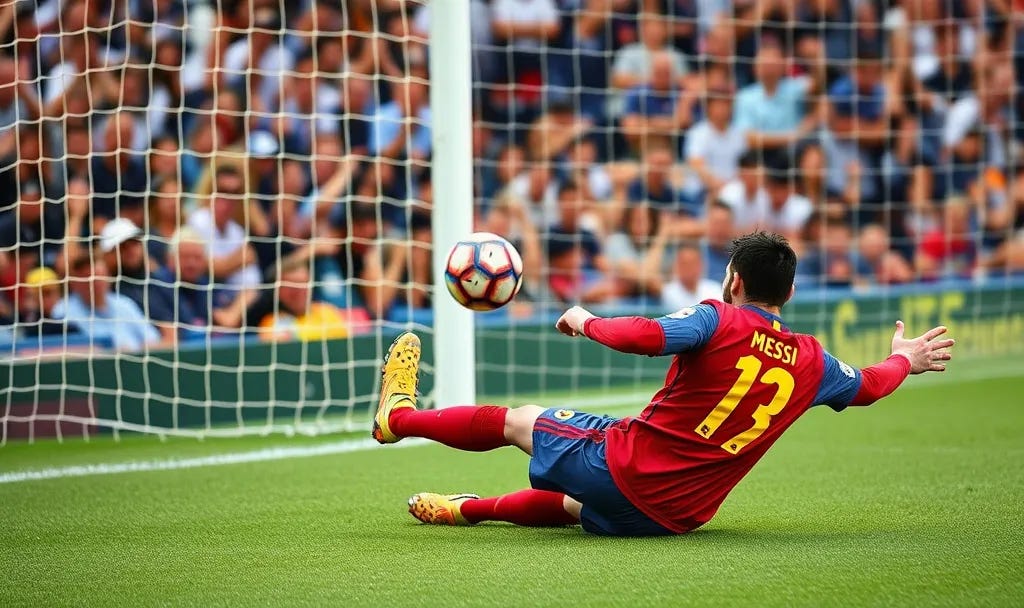
“Every penalty taker faces a decision before the referee blows the whistle. Should I react to the goalkeeper, or should I trust the plan I made before I started my run? That single decision has shaped World Cup finals, Champions League triumphs, and countless domestic championships.”
In Part 1, we explored how implicit perception influences a player’s ability to process information under pressure and how goalkeepers use psychological tactics to create uncertainty. In this second installment, we shift our focus to the decision-making process itself. How do elite penalty takers decide where to place the ball? Does the run-up influence the goalkeeper? Is it better to commit to a target before the whistle or adjust at the last moment? And why are more players beginning to aim straight down the middle?
Modern sports science offers fascinating answers that challenge many long-held coaching beliefs.
Elite penalty takers generally adopt one of two broad strategies:
The player decides where to place the ball before beginning the run-up and commits fully to that decision regardless of what the goalkeeper does.
The objective is simple:
Execute a technically perfect strike into a predetermined location.
The player focuses on:
Ball contact
Body alignment
Timing
Balance
Accuracy
The goalkeeper becomes largely irrelevant.
Many of the world’s most consistent penalty takers favour this approach because it reduces cognitive load. There is no need to make a last-second decision while already executing a complex motor skill.
In this approach, the player deliberately waits for the goalkeeper’s movement before selecting the final direction of the shot.
The objective becomes:
“If the goalkeeper moves left, I shoot right.”
This requires exceptional perceptual skills.
The player must:
Read body cues quickly.
Delay commitment.
Maintain balance.
Execute an accurate strike within fractions of a second.
While this strategy can be highly effective, it also increases mental and technical demands.
Penalty taking is a perfect example of what motor learning researchers call perception-action coupling.
Perception and movement are not separate processes.
They occur simultaneously.
As the player approaches the ball, the brain is constantly updating information:
Has the goalkeeper moved?
Is the goalkeeper delaying?
Is my body balanced?
Is my approach still controlled?
Every new piece of information influences movement.
If perception becomes overloaded by uncertainty or distraction, execution often deteriorates.
Many coaches focus almost exclusively on the strike itself, yet the run-up plays a significant role in shaping both the kicker’s rhythm and the goalkeeper’s expectations.
Elite players use a variety of approaches.
This is perhaps the simplest and most traditional method.
The player approaches the ball almost directly.
Advantages include:
Consistent body mechanics.
Better rhythm.
Easier repetition in training.
Reduced complexity under pressure.
Many players who use a predetermined target favour this style because it promotes automatic execution.
Its greatest weakness is predictability. A straight approach may reveal body shape earlier, allowing experienced goalkeepers to make educated guesses.
A diagonal approach provides greater flexibility in body positioning.
Benefits include:
Better disguise of the intended direction.
Increased ability to open or close the hips.
More options to strike across or through the ball.
Many elite players prefer this style because it delays the goalkeeper’s ability to interpret body language.
However, if poorly executed, the angled approach may compromise balance and consistency.
Some players adopt a curved or arcing approach, making it more difficult for goalkeepers to anticipate body orientation.
This technique often allows players to maintain visual contact with the goalkeeper for longer while keeping multiple shooting options available.
It demands excellent coordination and body control, making it less suitable for younger or less experienced players.
Few techniques divide opinion more than the stutter step.
Popularised by players such as Neymar, Bruno Fernandes, and Jorginho, the approach involves slowing or briefly pausing during the run-up before completing the strike.
The purpose is straightforward:
Force the goalkeeper to move first.
If successful, the player simply places the ball into the opposite side of the goal.
When executed well, the goalkeeper loses the advantage of timing.
When executed poorly, however, the player loses momentum, rhythm, and balance.
This increases the likelihood of technical errors.
For this reason, the stutter step demands exceptional confidence and thousands of repetitions under realistic pressure.
It should never be viewed as a trick, it is a highly refined skill.
Research suggests that experienced goalkeepers pay close attention to several cues during the approach:
Running angle
Final stride length
Speed changes
Hip orientation
Plant foot position
Shoulder alignment
These cues often become more reliable than eye direction.
Interestingly, studies have shown that penalty takers who attempt to deceive using exaggerated head movements frequently fail because goalkeepers rely more heavily on lower-body mechanics than facial direction.
The feet often tell the truth before the eyes do.
This remains one of football’s most debated questions.
The answer depends largely on the player’s chosen strategy.
They benefit from maintaining visual awareness of the goalkeeper’s movement for as long as possible.
However, this increases attentional demands.
If the goalkeeper delays movement longer than expected, panic can develop.
The result may be:
A rushed strike.
Poor contact.
Hesitation.
Loss of balance.
These players often shift their visual attention earlier toward their intended target.
Once the decision has been made, they avoid unnecessary visual distractions.
The goalkeeper’s movement becomes irrelevant.
This simplicity often explains why elite penalty specialists remain remarkably consistent over many years.
Perhaps the most surprising finding from penalty research concerns the centre of the goal.
Many coaches instinctively encourage players to avoid the goalkeeper by aiming for the corners.
Yet statistics reveal an interesting pattern.
Because goalkeepers know that most penalties are directed toward either corner, they frequently commit early to diving left or right.
This leaves the middle of the goal temporarily unprotected.
Studies of elite competitions have consistently shown that penalties struck confidently down the centre often achieve very high success rates, provided the goalkeeper has already initiated a dive.
The key phrase is “struck confidently.”
A hesitant shot down the middle usually results in an easy save.
A firm strike into the central third, however, often becomes unstoppable because the goalkeeper has already moved away from it.
The answer lies in psychology rather than probability.
Missing into the corner is generally viewed as an acceptable footballing mistake.
Shooting directly at the goalkeeper feels embarrassing.
Players fear appearing foolish.
Behavioural economists describe this as anticipated regret.
Athletes often avoid statistically favourable decisions if those decisions carry greater social embarrassment when unsuccessful.
Consequently, many players choose lower-risk reputational options rather than higher-probability scoring options.
Elite performers learn to separate probability from emotion.
Across virtually every research study on penalty taking, one conclusion appears repeatedly:
Indecision is the greatest enemy of successful execution.
Whether players:
choose a corner,
wait for the goalkeeper,
or aim down the middle,
success depends on committing fully to the chosen strategy.
Changing the plan halfway through the run-up frequently produces:
Poor body alignment.
Reduced striking quality.
Slower ball speed.
Increased likelihood of missing the target.
Confidence is not simply believing you will score.
Confidence is trusting your decision enough to execute it without hesitation.
Penalty practice should not consist of players casually taking ten shots after training.
Instead, coaches should deliberately train different decision-making strategies.
Rotate activities such as:
Predetermined target penalties.
Goalkeeper-dependent penalties.
Delayed goalkeeper movement.
Goalkeepers attempting psychological distractions.
Different run-up styles.
Time-pressure penalties.
Tournament-style shootouts.
Encourage players to discover which strategy best matches their personality and technical profile.
Not every player should take penalties the same way.
The objective is not to copy elite players but to develop an approach that remains reliable under pressure.
There is no universally perfect penalty technique. The most effective strategy is the one a player can reproduce consistently when the pressure is at its highest.
Some players thrive by reacting to the goalkeeper. Others perform best by committing to a predetermined target. Likewise, while a confident strike down the middle can be highly effective, it succeeds only when backed by conviction and flawless execution.
As coaches, our role is not to prescribe a single method but to expose players to different strategies, helping them discover the approach that best suits their technical strengths, perceptual skills, and psychological makeup. In the end, success from the penalty spot is less about deception and more about commitment.
The final installment explores the mental routines used by elite penalty takers, the science of Quiet Eye training, practical methods for developing composure under pressure, and how coaches can design realistic, game-like penalty practices that prepare players for football’s most demanding moment.
Thank you for reading Game Changer. Elevate your coaching with our eBooks full of innovative strategies and practical tips. Click below to explore more and start your journey to smarter coaching.
Click HERE to access Game Changer ebooks


No posts
Comments
Nothing yet. Say the first thing.
Sign in to join the conversation.