
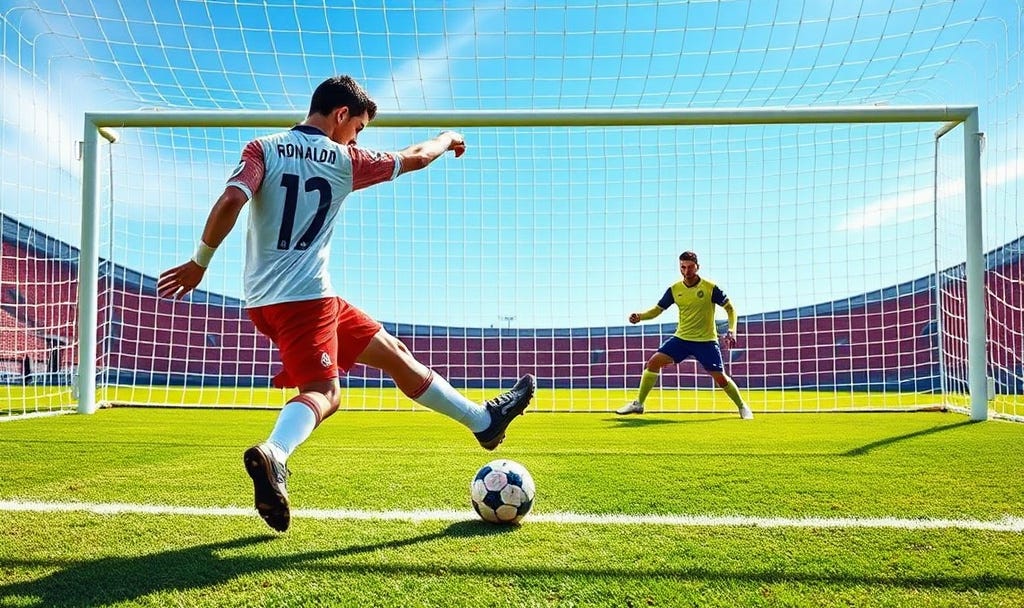
“A penalty kick is often described as football’s simplest task; one player, one goalkeeper, one shot from twelve yards. Yet history repeatedly reminds us that some of the world’s greatest players have failed from the spot in the biggest moments. Why? Because penalties are won or lost long before the foot strikes the ball.”
When Roberto Baggio sent his penalty over the crossbar in the 1994 FIFA World Cup Final, the image became one of football’s defining moments. Years later, Lionel Messi missed in the Copa América final, Harry Kane fired over the bar against France in the 2022 FIFA World Cup, and numerous elite players have experienced similar heartbreak. None of these players lacked technical ability. They simply encountered one of football’s greatest psychological challenges.
The penalty kick represents a fascinating contest between perception, decision-making, emotional regulation, and technical execution. While coaches often spend hours perfecting striking technique, relatively little attention is given to the invisible processes occurring inside the player’s brain.
Modern research suggests that success from the penalty spot depends not only on where a player chooses to shoot, but also on how effectively they perceive information, ignore distractions, regulate emotions, and execute an already-learned movement under extreme pressure.
This is where the concept of implicit perception becomes critically important.
Implicit perception refers to the brain’s ability to process environmental information without conscious awareness. Rather than deliberately analysing every movement around them, skilled athletes automatically detect subtle visual cues that influence decision-making.
Elite footballers rarely think consciously about every movement of a goalkeeper.
Instead, years of experience allow their perceptual system to rapidly process information such as:
Goalkeeper body position
Foot placement
Weight distribution
Movement timing
Peripheral distractions
Crowd noise
Referee positioning
Distance and angle to goal
All of this information is processed within fractions of a second.
The best penalty takers do not necessarily “see more.”
They simply filter information more efficiently.
The human brain constantly predicts what is likely to happen next.
Under normal circumstances, these predictions improve performance.
Under pressure, however, anxiety interferes with this predictive system.
Heart rate increases.
Muscles become tense.
Vision narrows.
Attention shifts from external information to internal thoughts.
Instead of focusing on the target, players begin thinking:
“Don’t miss.”
“The goalkeeper knows where I’m going.”
“If I fail, I’ll let everyone down.”
This internal dialogue disrupts automatic movement patterns.
Sports psychologists refer to this phenomenon as reinvestment; when athletes consciously control movements that normally occur automatically.
Ironically, the harder players try to execute perfect technique, the more likely they are to interfere with movements that have been rehearsed thousands of times.
No other restart in football creates such a unique contest.
The goalkeeper has relatively little chance of saving a well-struck penalty.
Statistically, the penalty taker begins with a considerable advantage.
Yet goalkeepers have learned that they do not need to improve their physical chances dramatically.
Instead, they simply need to influence the penalty taker’s perception.
The battle begins long before the whistle.
Elite goalkeepers are experts at manipulating attention.
Every action has one objective:
Increase uncertainty.
Some of the most common psychological strategies include:
Goalkeepers often take longer than necessary to prepare.
They adjust their gloves.
Walk slowly across the goal line.
Speak to the referee.
Touch the posts.
These behaviours increase waiting time, allowing anxiety to build.
The longer the player waits, the greater the opportunity for negative thoughts to emerge.
Many goalkeepers spread their arms wide.
Stand tall.
Move laterally.
Bounce repeatedly.
Although these actions rarely increase actual save percentage by themselves, they create the illusion that less goal space is available.
Perception, not reality, is what matters.
Remaining perfectly still provides visual certainty.
Movement creates visual noise.
Small side steps.
Hand movements.
Body swaying.
These actions subtly interfere with the penalty taker’s visual focus.
The brain now has additional information to process.
Some goalkeepers maintain prolonged eye contact.
Others smile.
Some laugh.
Others point to one side of the goal.
Each behaviour is designed to trigger conscious thinking.
Once the player’s attention shifts away from the intended target, performance becomes more vulnerable.
Occasionally goalkeepers visibly point towards one corner before the kick.
Sometimes they even tell the player:
“I know where you’re going.”
Whether true or not is irrelevant.
The objective is doubt.
Even one second of hesitation can alter motor execution.
The psychological battle extends beyond the goalkeeper.
Opposing players frequently attempt to influence the penalty taker before the whistle.
Common tactics include:
Standing unusually close
Delaying their retreat
Verbal comments
Smiling sarcastically
Pointing towards the goalkeeper
Touching the penalty spot
Pretending to know the intended direction
Again, the objective is not physical interference.
It is attentional disruption.
Every additional stimulus competes for the player’s limited attentional resources.
Crowds provide another powerful source of implicit information.
Thousands of supporters waving flags.
Whistles.
Laser-like noise.
Chants.
Boos.
Phones recording.
None of these directly affect the ball.
Yet they influence perception.
Research has shown that anxious performers become increasingly sensitive to irrelevant environmental stimuli.
Instead of filtering distractions, they begin processing them.
This overload reduces decision quality.
Elite performers demonstrate the opposite.
They selectively attend to only the information that matters.
Experience does not simply improve technical execution.
It improves perceptual efficiency.
Experienced penalty takers have encountered:
Different goalkeepers
Different stadiums
Shootouts
VAR delays
Crowd pressure
Match-winning penalties
Match-saving penalties
Each experience expands the athlete’s library of perceptual information.
Eventually, situations that overwhelm younger players become familiar.
Familiarity reduces uncertainty.
Reduced uncertainty improves confidence.
Confidence supports automatic execution.
Researchers studying elite performers consistently identify one important characteristic.
Experts look at fewer things.
Beginners look at everything.
Experienced penalty takers focus on highly relevant cues while ignoring irrelevant ones.
This efficient allocation of attention allows faster, more accurate decisions.
Rather than becoming distracted by goalkeeper antics, elite players maintain attention on:
Ball placement
Chosen target
Timing of the run-up
Contact point
Rhythm
Everything else becomes background noise.
Many coaches practice penalties only after training when players are physically fatigued.
Unfortunately, this often trains technique rather than decision-making.
If coaches wish to improve penalty performance, they must also train perception.
Consider introducing controlled distractions:
Teammates creating crowd noise
Goalkeepers using realistic movement
Delayed whistles
Simulated tournament pressure
Scoreboard consequences
Time limits
Competitive shootouts
The objective is not merely to practice striking the ball.
It is to develop the player’s ability to maintain attentional control under realistic psychological conditions.
The most successful penalty takers are not those who ignore pressure, they are those who have learned to perform despite it.
Every penalty kick is a battle between attention and distraction.
While technique remains essential, the outcome is often determined by what the player notices, and what they successfully ignore.
As coaches, our responsibility extends beyond teaching players how to strike the ball. We must also prepare them to manage the psychological noise surrounding one of football’s most demanding moments.
The invisible game begins before the whistle. The players who master it give themselves the greatest chance of hearing the sound they are waiting for, the ball hitting the back of the net.
Coming in Part 2: Reading the Goalkeeper or Trusting the Plan? We will explore the science behind different run-up strategies, whether penalty takers should react to the goalkeeper or commit to a predetermined target, why some players deliberately shoot down the middle, and what current research reveals about the most effective approaches under pressure.
Thank you for reading Game Changer. Elevate your coaching with our eBooks full of innovative strategies and practical tips. Click below to explore more and start your journey to smarter coaching.
Click Here to access Game Changer eBooks

No posts
Comments
Nothing yet. Say the first thing.
Sign in to join the conversation.