
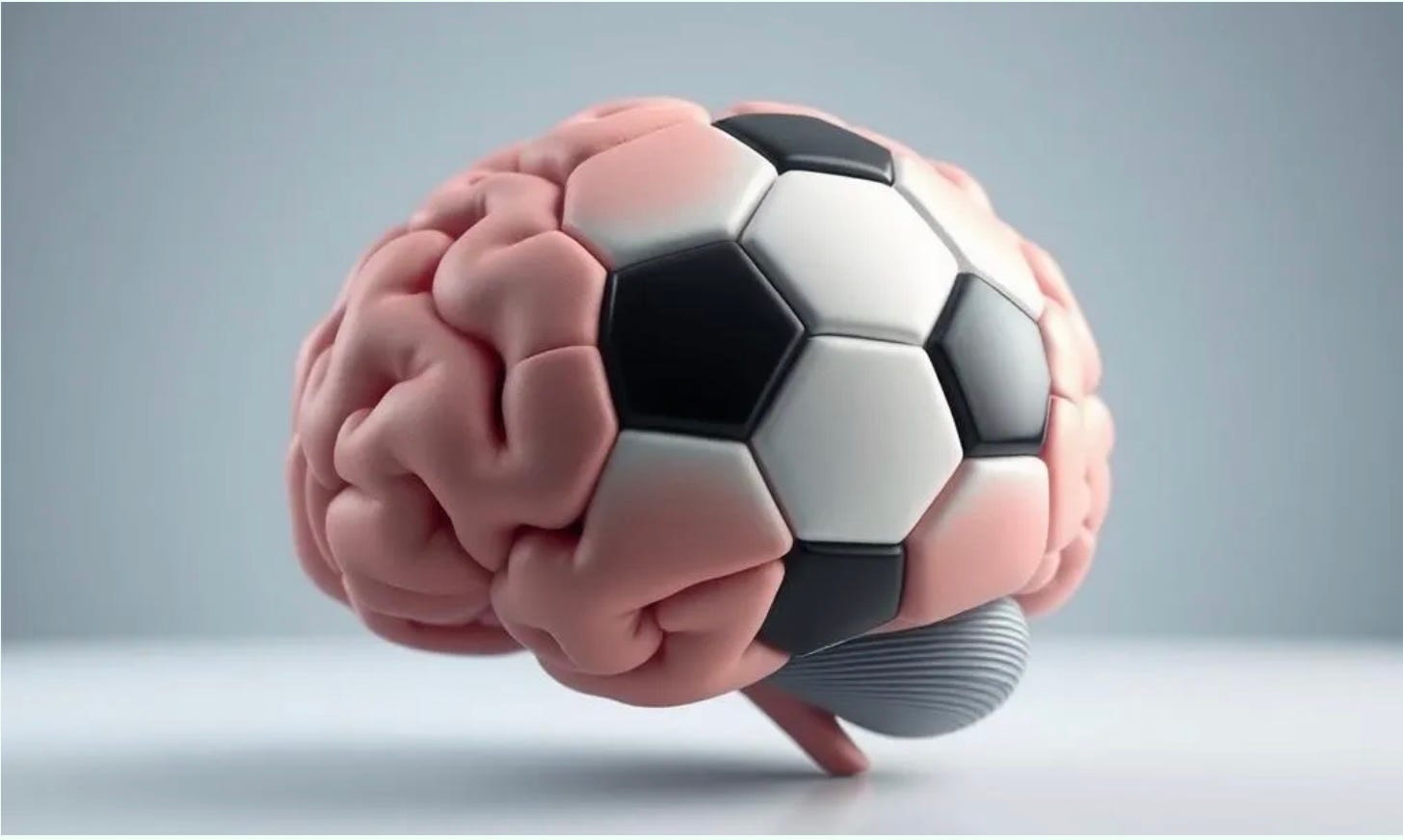
“Champions are not created in the penalty shootout; they reveal the habits they have built long before the whistle blows.”
The image of a player standing alone on the penalty spot often creates the illusion that success depends on courage. While bravery certainly plays a role, decades of research in sport psychology, neuroscience and motor learning suggest something different. Elite penalty takers succeed because they have developed routines that allow them to remain calm, perceive the right information, and execute a movement they have rehearsed thousands of times.
In the first two parts of this series, we explored how implicit perception influences decision-making and how different penalty-taking strategies affect performance. We also examined the psychological battle between the penalty taker and the goalkeeper, the role of deception, and why commitment to a chosen strategy is often more important than the strategy itself.
The final piece of the puzzle is learning how coaches can prepare players to perform under pressure, not just physically, but mentally.
One of the biggest myths in football is that players “choke” because they lack confidence.
More often, pressure exposes the quality of a player’s preparation.
Under stress, the brain naturally seeks familiar patterns. If those patterns have been built through high-quality, representative practice, performance remains relatively stable. If practice has been unrealistic or repetitive without pressure, the player has little experience to rely on when anxiety rises.
This is why players who score dozens of penalties in training sometimes fail during competition.
They have practiced the technique but not the environment.
One of the most influential discoveries in sports psychology over the past two decades is the concept of the Quiet Eye, pioneered by Professor Joan Vickers.
Quiet Eye refers to the final visual fixation on a relevant target before movement begins.
In penalty taking, this usually involves the player fixing their gaze on the intended contact point or target area immediately before striking the ball.
Research consistently shows that expert performers display:
Longer Quiet Eye durations.
More stable gaze behaviour.
Less visual searching.
Greater consistency under pressure.
Less experienced players demonstrate the opposite.
Their eyes move frequently.
They scan the goalkeeper repeatedly.
They look at the crowd.
They glance at teammates.
They continuously search for additional information.
Ironically, this increased searching reduces performance.
Elite players understand that once the decision has been made, more information is not necessarily better information.
This appears counterintuitive.
Surely gathering more information should improve decisions?
Not under pressure.
Experienced performers become remarkably selective.
Instead of processing everything, they process only what matters.
Sports scientists describe this as attentional control.
The world’s best penalty takers simplify the task.
They trust their preparation.
They avoid unnecessary adjustments.
They execute.
One characteristic shared by many elite penalty takers is the presence of a consistent routine.
Watch players such as Cristiano Ronaldo, Harry Kane, Alex Morgan, or Cole Palmer, and you’ll notice that although their routines differ, each follows a repeatable sequence before every penalty.
The purpose of a routine is not superstition.
It is psychological regulation.
A well-established routine provides familiarity in unfamiliar situations.
It reduces anxiety by directing attention toward controllable actions rather than uncontrollable outcomes.
An effective routine may include:
Placing the ball carefully.
Taking the same number of steps backwards.
Taking one slow breath.
Looking at the target.
Using a cue word such as “compose,” “strike,” or “through.”
Beginning the run-up with the same rhythm every time.
The routine becomes an anchor.
When emotions rise, the routine remains constant.
The conversation inside a player’s mind can either support or sabotage performance.
Negative thoughts often appear automatically under pressure:
“Don’t miss.”
“The goalkeeper knows where I’m going.”
“Everyone is watching.”
“What if I fail?”
These thoughts focus attention on consequences rather than execution.
Elite performers deliberately replace them with instructional or performance-focused cues.
Examples include:
“Pick the spot.”
“Smooth rhythm.”
“Stay balanced.”
“Strike through the ball.”
Notice that each phrase directs attention toward the process rather than the result.
The brain performs best when focused on actions it can control.
Pressure activates the sympathetic nervous system.
Heart rate rises.
Muscle tension increases.
Breathing becomes shallow and rapid.
One slow diaphragmatic breath before beginning the run-up can help regulate physiological arousal.
The objective is not to eliminate nerves.
Some level of arousal improves performance.
The goal is to remain within an optimal emotional zone where the player feels alert but in control.
Elite performers recognise nerves as a sign that the moment matters—not as evidence that they are unprepared.
Many coaches finish training with:
“Let’s take five penalties before we go home.”
While enjoyable, this approach rarely prepares players for competitive pressure.
Consider the typical training environment.
Players know:
There are no real consequences.
Missing has little impact.
Teammates are relaxed.
Fatigue may be present, but emotional pressure is absent.
Competition looks very different.
The score matters.
The crowd reacts.
Opponents attempt distraction.
Teammates watch anxiously.
Time seems to slow.
Unless practice reflects these conditions, transfer to competition remains limited.
Modern coaching encourages representative learning design; creating training environments that closely resemble the demands of competition.
Instead of simply repeating technical actions, coaches should recreate the psychological and perceptual challenges players will face in matches.
Examples include:
Create knockout competitions where every penalty has consequences.
Players quickly experience emotional pressure similar to real football.
Ask the referee (or coach) to delay the whistle unpredictably.
Players learn to maintain concentration despite uncertainty.
Encourage goalkeepers to:
Move along the line.
Delay preparation.
Talk to the penalty taker.
Use realistic psychological tactics.
Players gradually learn to ignore distractions.
Have teammates watch silently.
Award points.
Track statistics over the season.
Create meaningful consequences without creating fear.
Pressure should challenge learning, not damage confidence.
Occasionally perform penalties after high-intensity football actions, not simply after running laps.
Players should experience the physiological demands that often precede penalties during matches.
Young players require a different approach.
Coaches should avoid placing excessive importance on penalty outcomes.
Instead, emphasise:
Routine.
Technique.
Confidence.
Enjoyment.
Decision-making.
Allow children to experiment with different strategies.
Avoid criticising misses.
Every missed penalty provides valuable information about learning.
The objective is long-term development rather than short-term success.
Many coaches choose penalty takers based solely on technical ability.
Technical skill is important, but it is only one part of the equation.
An effective penalty taker also demonstrates:
Emotional control.
Consistent routines.
Good decision-making.
Confidence without arrogance.
Ability to recover from mistakes.
Strong attentional focus.
Some of the hardest strikers of the ball struggle from the penalty spot because they cannot regulate pressure.
Others with less spectacular technique become remarkably reliable because they excel psychologically.
Language matters.
Avoid comments such as:
“Don’t miss.”
“Just relax.”
“This should be easy.”
“Don’t let us down.”
These statements unintentionally increase pressure.
Instead, reinforce controllable behaviours:
“Trust your routine.”
“Commit to your decision.”
“Focus on your target.”
“Strike it with conviction.”
Good coaching language directs attention toward action, not fear.
As football continues to embrace performance science, penalty preparation is evolving.
Elite clubs increasingly integrate:
Eye-tracking technology.
Virtual reality simulations.
Pressure-based training environments.
Psychological skills coaching.
Data analysis of goalkeeper tendencies.
Representative learning design.
Despite these advances, one principle remains unchanged.
The penalty taker who best manages perception, attention and emotion will usually outperform the player who relies solely on technique.
Football is becoming increasingly sophisticated.
Penalty preparation must evolve alongside it.
A penalty kick is often described as an individual contest.
In reality, it represents the interaction of perception, psychology, decision-making and technical execution.
The goalkeeper attempts to create doubt.
The crowd creates noise.
Opponents create distraction.
Pressure creates uncertainty.
The successful penalty taker responds not by fighting these influences, but by focusing on what truly matters.
The best penalty takers do not possess stronger nerves than everyone else.
They possess stronger habits.
Their routines are consistent.
Their attention is disciplined.
Their decisions are committed.
Their movements remain automatic because they have learned to trust their preparation.
For coaches, the lesson is equally clear. We should not teach penalties as isolated technical exercises but as complete performance tasks that integrate perception, emotion, decision-making and execution. The closer our training resembles the realities of competition, the more likely our players are to perform when the stakes are highest.
The next time your team is awarded a penalty, remember that the outcome will depend on far more than striking technique. Long before the player’s foot meets the ball, an invisible game has already begun, and the player who wins that battle of the mind is often the one who celebrates moments later.
At your next training session, redesign how your team practises penalties.
Instead of asking players to simply take ten shots, create a realistic penalty environment that includes:
A consistent pre-kick routine.
Goalkeeper distraction tactics.
Teammates creating realistic crowd noise.
Tournament-style consequences.
Reflection after every attempt.
Discussion about the player’s decision-making process, not just whether they scored.
Remember, coaches are not simply training players to kick a ball. We are developing footballers who can think clearly, perceive accurately, and perform confidently when the pressure is at its greatest.
Because in football, the penalty is never just about the kick, it is about winning the invisible battle that takes place before the ball ever leaves the foot.
Thank you for reading Game Changer. Elevate your coaching with our eBooks full of innovative strategies and practical tips. Click below to explore more and start your journey to smarter coaching
Click HERE to access Game Changer ebooks

No posts
Comments
Nothing yet. Say the first thing.
Sign in to join the conversation.