
There has always been something magical about football.
It is a game built on creativity, intelligence, technical excellence, improvisation, and moments of brilliance that can unite millions of people across cultures and continents. For decades, FIFA has proudly referred to football as “The Beautiful Game.” It is a description that celebrates artistry over aggression, skill over force, and intelligence over intimidation.
Yet, as I have watched the current FIFA Club World Cup unfold, I have become increasingly concerned.
What I am seeing on the field is beginning to resemble something very different.
Far too often, matches have looked like a cross between football and wrestling.
That may sound dramatic, but if you have watched the tournament carefully, you have probably noticed many of the same trends.
Holding opponents has become an accepted defensive technique.
Pressing has evolved into running directly into players rather than intelligently closing space.
Tackles are increasingly arriving high above the ankle.
Players are being grabbed, pulled, wrestled, and impeded throughout matches, while referees often wave play on.
If these trends continue unchecked, we may be witnessing the gradual erosion of the very qualities that made football the world’s most loved sport.
This is not simply a referee problem.
It is a coaching problem.
It is an education problem.
And ultimately, it becomes a player development problem.
Every generation sees tactical evolution.
We have watched the emergence of Total Football, Tiki-Taka, Gegenpressing, positional play, low blocks, false nines, inverted fullbacks, and numerous other innovations.
Tactics should evolve.
Football should evolve.
But somewhere along the way, another trend has quietly become accepted.
Holding.
Watch almost any attacking set piece.
Watch transitions.
Watch wide players attempting to beat defenders.
The first defensive action is often no longer positioning.
It is grabbing.
Shirts are pulled.
Arms wrap around waists.
Attackers are physically restrained.
Defenders often hold first and defend second.
Even more concerning is that this behaviour is no longer isolated, it has become systematic. Many teams now appear to coach physical restraint as part of their defensive organization.
If referees tolerate it consistently, players naturally continue doing it. Why wouldn’t they?
The risk is low.
The reward is high.
Eventually, it simply becomes another defensive fundamental. But should it?
Football was never intended to reward the player who can wrestle best.
Modern football has embraced pressing.
When executed properly, pressing is one of the game’s most beautiful collective actions.
It demands communication.
Coordination.
Fitness.
Reading cues.
Timing.
Angles.
Team cohesion.
Great pressing traps opponents into making mistakes. It wins possession through intelligence.
Unfortunately, what we are increasingly seeing is something very different.
Many pressing actions now consist of players sprinting directly into opponents.
There is little control.
Little balance.
Little attempt to guide play.
Instead, we increasingly witness collisions.
Late contact.
Studs catching ankles.
Shoulder charges delivered with excessive force.
This is no longer intelligent pressing. It is controlled chaos, and sometimes not even controlled.
Young coaches watching these matches may begin believing this is what effective pressing looks like. It is not.
The world’s best pressing teams win the ball because they out-think opponents; not because they overpower them.
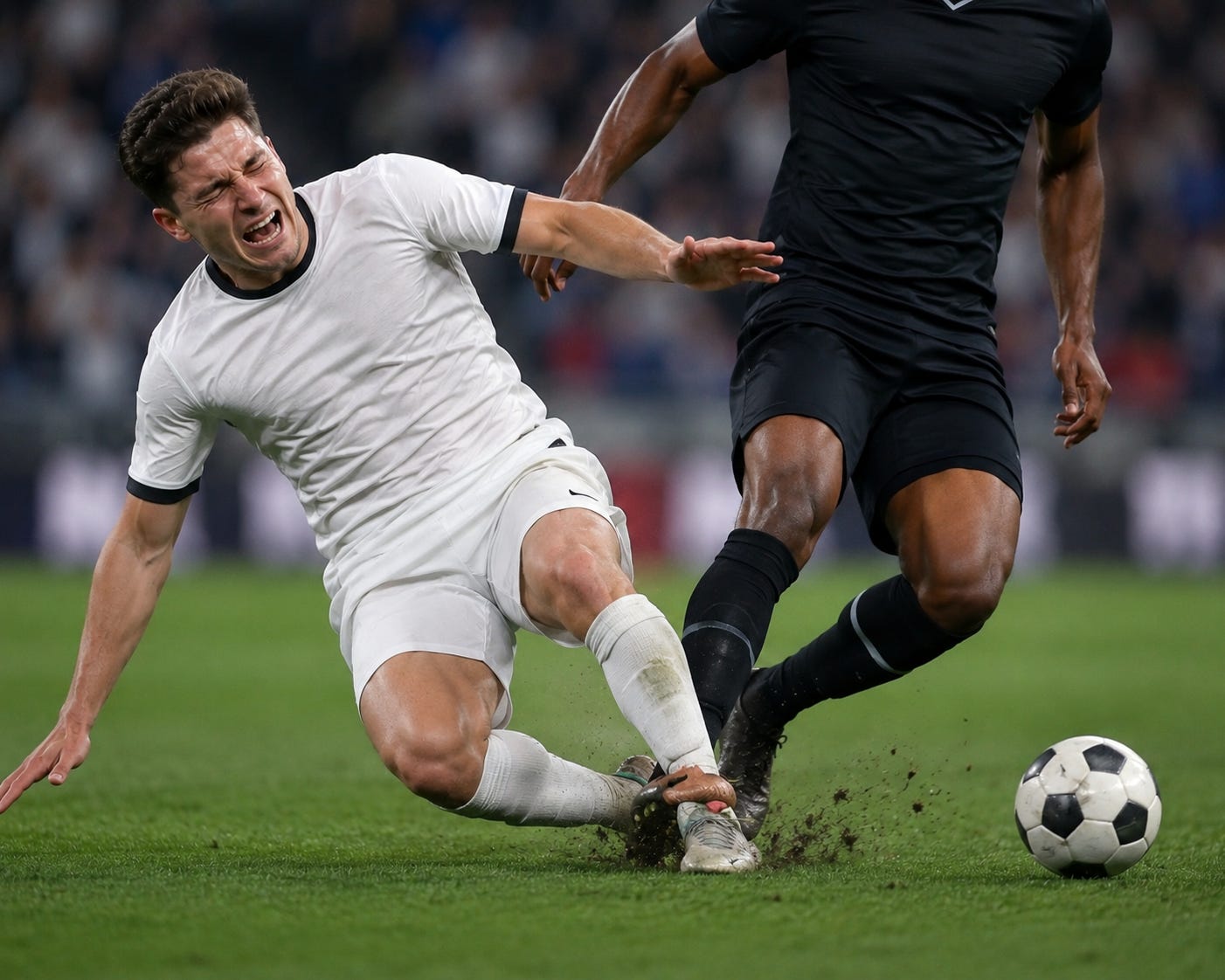
Perhaps the most worrying trend has been the increase in dangerous tackles.
Far too many challenges are arriving above the ankle; players are leaving the ground; studs are exposed; speed increases the force of contact.
The result?
Injuries.
Lost playing time.
Reduced careers.
And completely unnecessary risks.
One of the tournament’s most discussed incidents involved USA’s Folarin Balogun, who was shown a red card following a challenge that caught his opponent on the ankle.
The decision immediately sparked comparisons with an earlier challenge involving Lionel Messi that many observers felt was similarly dangerous but resulted in a different disciplinary outcome.
Whether one agrees with either decision is almost secondary; the greater issue is consistency.
Players, coaches, and supporters deserve to understand what constitutes serious foul play.
If one high challenge is judged worthy of dismissal, then similar actions should be judged by the same standard.
Consistency builds trust. Inconsistency creates confusion.
And confusion encourages players to push the boundaries further.
Every major tournament becomes a classroom.
Millions of young players watch every movement.
Every celebration.
Every tackle.
Every confrontation.
Children rarely copy tactical diagrams, they copy behaviours.
If elite players spend ninety minutes grabbing shirts, holding opponents, diving into dangerous tackles, and arguing every decision, young players naturally assume these behaviours are part of modern football.
Grassroots coaches then spend years trying to remove habits that were learned simply by watching television.
The professional game carries enormous responsibility. Whether players realize it or not, they are role models.
Every action teaches.
Every action normalizes behaviour.
That responsibility extends well beyond winning the next match.
It is easy to criticize referees, but referees only manage the game. They do not create player behaviours; coaches do.
Players repeatedly perform what they are encouraged, rewarded, or permitted to perform during training.
If a player constantly grabs opponents during training without correction, that habit appears in matches.
If coaches celebrate cynical fouls because they stop counterattacks, players learn that tactical fouling is acceptable.
If dangerous tackles receive applause rather than correction, players quickly understand the message.
Perhaps even more disappointing is watching some coaches react when these fouls are penalized.
Television cameras regularly capture technical areas erupting in disagreement.
Arms are raised.
Officials are confronted.
Every foul against their team is viewed as unjustified.
Imagine the message this sends.
Instead of teaching accountability, we reinforce denial.
Instead of promoting player safety, we defend dangerous behaviour.
Winning should never come at the expense of the game’s integrity.
Football’s Laws of the Game exist for two reasons.
To ensure fairness.
To ensure safety.
When persistent holding goes unpunished, fairness disappears.
When dangerous tackles are inconsistently sanctioned, safety disappears.
Referees operate under tremendous pressure. Their decisions are analysed from every possible angle.
VAR has only intensified scrutiny.
No official will ever satisfy everyone.
However, there must be consistency in protecting the spirit of the game.
If holding clearly prevents movement, it should be penalized.
If tackles endanger opponents, they should be punished regardless of reputation, scoreline, or minute of the match.
The game’s identity depends upon it.
Some will argue that football has always been physical.
They are correct; physicality is part of football.
Strong shoulder challenges.
Competing fairly for aerial balls.
Protecting possession.
Using body position.
These are all legitimate, but there is an important distinction between physical football and reckless football.
One celebrates strength; the other celebrates violence.
One rewards timing; the other rewards intimidation.
Football should never confuse the two.
The greatest defenders in history rarely relied on fouling.
They anticipated.
They intercepted.
They delayed.
They controlled space.
Their positioning often eliminated the need for desperate tackles altogether.
That remains the highest level of defending.
Good defenders solve problems before emergencies develop.
As coaches, this is the message we should continue teaching.
Read the game.
Arrive early.
Control angles.
Force predictable decisions.
Recover intelligently.
Win possession cleanly.
Those principles remain timeless.
Perhaps my greatest concern lies not with today’s professionals but with tomorrow’s players.
Youth football constantly imitates elite football.
If professional matches continue rewarding holding and reckless challenges, those behaviours will quickly appear in academies and school competitions.
Referees at youth level already struggle.
Volunteer coaches already face enough challenges.
Introducing greater levels of unnecessary physicality only makes development more difficult.
Young players should learn:
Defend with positioning.
Press with intelligence.
Win tackles cleanly.
Respect opponents.
Respect officials.
Protect the game.
These values matter just as much as tactical systems.
Football has become increasingly obsessed with results.
Every statistic is measured.
Every mistake is criticised.
Every coach feels pressure to win.
In that environment, it becomes tempting to justify almost anything that increases competitive advantage.
But football has always represented more than winning.
It teaches discipline.
Respect.
Creativity.
Teamwork.
Decision-making.
Character.
When those qualities become secondary to physical intimidation, everyone loses.
Despite these concerns, I remain optimistic.
Football has repeatedly shown its ability to correct itself.
Referees often become more consistent as tournaments progress.
Players adjust.
Coaches adapt.
The latter stages frequently produce matches where technical quality rises and unnecessary aggression declines.
That is my hope for the remainder of this tournament.
I hope we begin to see football that rewards:
Movement rather than holding.
Passing rather than pushing.
Defending rather than wrestling.
Pressing rather than charging.
Creativity rather than confrontation.
The world’s greatest players deserve to express themselves without constant physical restraint.
Supporters deserve to watch football decided by skill rather than survival.
Young players deserve better role models.
And football deserves to remain the beautiful game that has inspired generations.
Every World Cup leaves a legacy:
Some tournaments are remembered for unforgettable goals; others for remarkable tactical innovations.
Some are remembered for extraordinary individual performances.
My hope is that this tournament is not remembered as the competition where football drifted closer to wrestling than artistry.
The responsibility belongs to everyone.
Referees must enforce the Laws consistently.
Coaches must teach players to compete fairly.
Players must understand that aggression is not the same as competitiveness.
Administrators must continue emphasizing player welfare.
Above all, we must protect the essence of football, because once the beauty disappears, replacing it will be far more difficult than preserving it.
The game belongs to future generations as much as it belongs to us.
Let us ensure they inherit a sport where intelligence triumphs over intimidation, where skill overcomes force, and where football once again earns the title it has proudly carried for generations:
The Beautiful Game.
Thank you for reading Game Changer. Elevate your coaching with our eBooks full of innovative strategies and practical tips. Click below to explore more and start your journey to smarter coaching.
Click HERE to access Game Changer eBooks


No posts
Comments
Nothing yet. Say the first thing.
Sign in to join the conversation.