
Practice often focuses on overcoming the weaknesses in one’s playing or singing. For me, this might be getting my fingers to coordinate more precisely or getting the right amount of breath. If one is solely focused on leveling up the weakness without considering the foundation of movements, improvement may be a never-ending struggle.
Stability allows us to control and manage both small movement like the fingers and large movements like breathing. Stability in certain parts of the body, for instance the core, allows for movement precision and efficiency in other parts, say, the fingers and hands.
Excess Tension in finger/hand movements is the body’s effort to create stability. It may show up as gripping the instrument, tightening the shoulders, or gripping elsewhere in the body. This is the body’s natural instinct to create stability. But these attempts to create stability are misplaced and compromise the efficiency and precision we seek.
The solution to these challenges (and many others) is organizing stability through the core and grounding.
The core is the dynamic network of muscles that stabilize the spine, pelvis & rib cage. They offer a range of engagement levels, from no engagement (collapsed on the couch) to total engagement (pulling in the belly button as much as you can and holding it.)
In music-making, access to the range of core engagements supports the range of intensities in expression. More intense sound qualities and busier technique may need more support, i.e. increased core engagement. Think of this as appropriate effort.
The core muscles are meant to be a part of walking, running, standing & sitting, everything we do. They are more than just a six-pack!
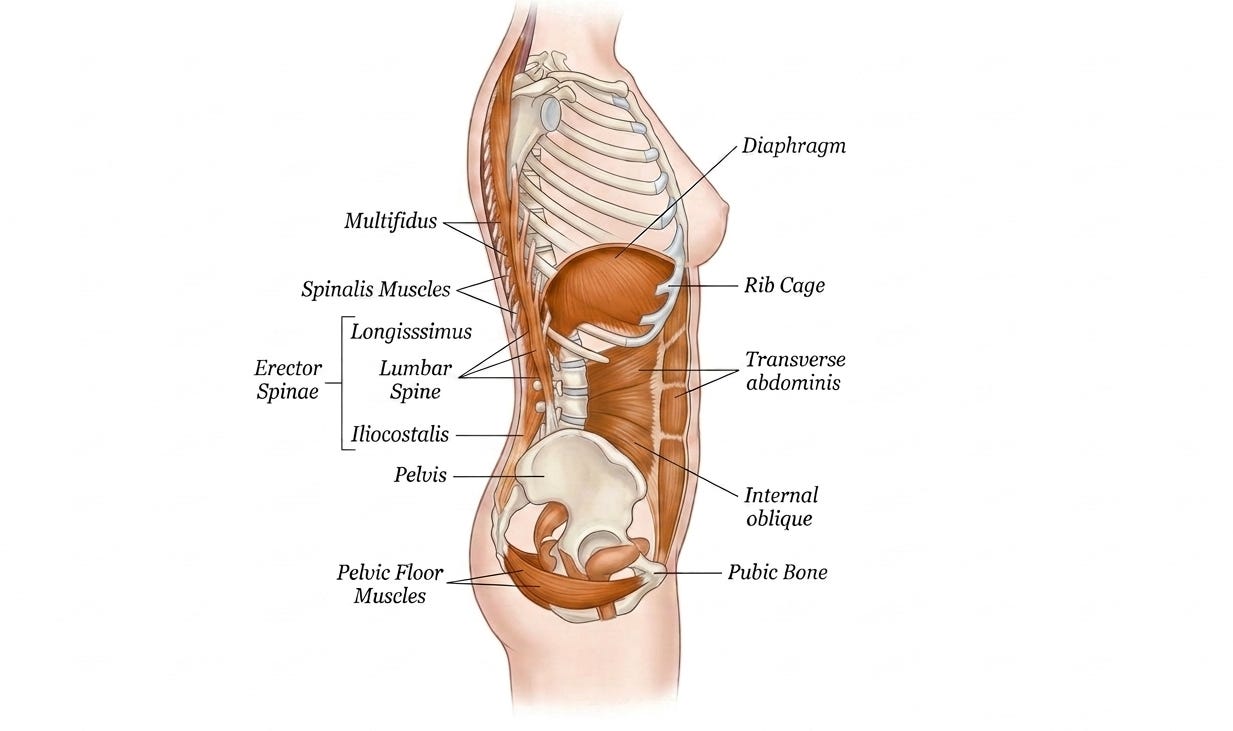
The above image shows the core muscles (the orangey - red areas) and how they surround the abdomen and spine.
An easy way to activate the core muscles is to exhale. As you do, your core muscles help to bring the rib cage down and in and move the air out of the lungs. Maintaining the resulting tension in the core muscles as you inhale, biases the rib cage to make its full excursion up and out drawing the air into the lungs. Without core engagement, you will experience a lot of movement in the abdomen and not so much in the chest.
Let’s take what we learned and integrate it into music-making. One way to do this is to exhale as you prepare to perform. You will experience activation of the abdominal muscles as you exhale. Maintain this tension as you proceed.
Exhale as you deliver your arms to the instrument or the instrument to your body.
There is so much time to practice this away from music that will benefit our learning and playing. Here are a few
Waiting in line at the grocery store - Place your hands on the cart and press down slightly to active your core. Practice breathing with this core engagement.
Exercising - do you deadlift? run? cycle? For virtually any athletic activity the core and breathing are integral. Play around with too much and too little activation to find the ‘just right” activation. Notice how it effects your movement.
Be Curious! and let me know what you discover.
Comments
Nothing yet. Say the first thing.
Sign in to join the conversation.