
By the time I saw the frog, two lawyers and one safety officer had already signed a statement saying there was no animal in the room.
That was my job, basically. Checking statements. I worked in Verification for Apsley Mutual, which was not mutual and had not belonged to anyone named Apsley for twelve mergers. The agents assembled the claim packet, counsel checked the liability boxes, and I supplied the human signature that converted a machine summary into a legally binding document.
The claim arrived as 44-19B, Glass Failure, Interior, Non-Public Clinical Facility, Cambridge. Continuant Therapeutics declared no animal work had been performed in Observation Suite C. The incident log listed broken glass but no biological waste, no waste runoff, and no humidity exceptions. The service photograph showed a wet triangular mark behind the cracked one-way mirror, and the overlay labeled it a reflection artifact.
I looked at the image until the screen marked my dwell time excessive. The wet mark sat low in the service gap, under a metal seam. It was not a reflection. Glare has a habit; it follows the light source. This was a dark wedge with a pale rim, like a thumbnail pressed into soap.
I moved the tablet until the edge was parallel to the desk blotter. At sixteen, the social earpiece had beeped every time my posture drifted. Now, the habit of checking the world for errors was mechanical. I touched the screen bezel when the layout looked too clean.
My supervisor’s assistant denied the site visit before my coffee cooled. My supervisor denied it himself five minutes later.
PROMPT: PACKET VERIFIED. COUNSEL SIGN-OFF COMPLETED. NO ACTION REQUIRED. CLOSE CLAIM.
I typed in the justification field: Moisture logged as reflection artifact.
At 11:42, the travel authorization appeared.
Continuant Therapeutics occupied three floors of an old pharmaceutical building near Kendall Square. The lobby had black stone, silent doors, and a wall of living moss kept too green by thin tubes of water. A woman in a navy suit met me there. Her face had the sealed quality of expensive packaging.
“Mr. Vance,” she said. “Mara Ellery. Risk counsel.”
“I’m just Verification.”
“Of course.” People said that when they meant, You are low in the stack.
Observation Suite C was smaller than it looked in the packet. In person the place had screws, seams, and the stale smell of alcohol over old water. The one-way mirror filled the far wall. A temporary film held the broken pieces in place. The film sagged toward the lab, not toward the service gap. Some glass lay against the baseboard. Some had been pushed back under the frame.
A safety officer named Dunn stood beside Ellery with a sterile compliance slate. His badge said BIOLOGICAL SAFETY LEAD. His collar had a crescent of dried skin at the fold.
“What was behind the mirror?” I said.
“Observation bay,” Dunn said. “Service void.”
They called facilities. Facilities called a vendor. The vendor released a lock through a maintenance agent nobody had used since the previous quarter. Dunn found an old tablet in a drawer, its cracked back labeled PROPERTY OF BIO-VISUAL SYSTEMS in flaked black ink. That was the first useful object in the room.
The service panel opened with an ordinary click. Behind the mirror was a space about two feet deep. Pipes ran through it. A humidity line. Two power rails. An optical calibration track with a little carriage frozen under dust. The carriage had a row of needle holes under it, twelve of them, over a glass trough. Most were plugged with yellow gel. Two were wet.
Near the left corner, under the place where the triangular shadow had appeared in the photograph, a greenish line ran along the drainage groove.
“Condensation,” Dunn said.
“On a dry suite?” I crouched. The air from the service void touched my face, cooler than the room and wet in the back of the throat. There was dried gel under the mirror track, translucent and yellow at the edges. A thread of it had hardened around a screw head.
Under the calibration rail sat a clear plastic tag. C-17 / MOTOR-VISUAL / 03:10
“What’s Motor-Visual?” I said.
Dunn said, “A growth assay family.”
“You said no animal work.”
“It is not animal work.”
“What kind of work is it?”
Ellery said, “We license the Moravec Staircase protocol. It’s an organoid-level substitution model. The public filing lists it as degenerative-prosthetic calibration.”
Dunn’s compliance slate chirped. The screen showed a maintenance ticket from 03:08 the night before the glass failure.
SERVICE ACCESS OPENED. BIO-VISUAL SYSTEMS LEGACY. HUMIDITY EXCEPTION RESOLVED.
No technician name. No badge. The requester field said Vendor Middleware.
“Who opened the panel?” I said.
“Automated calibration routine,” Dunn said.
“The routine has hands?” I looked down. Beside the wall, an arc of glass dust had been pushed into the service void instead of out of it. A cheap broom had left a comb of parallel lines in the damp. Four lines. A skipped line. Four lines again.
Dunn scrolled through the foundational dependency logs on his slate. He stopped at a recurring critical event.
ERROR 404: CALIBRATION TARGET MISSING. INITIATING BASELINE FALLBACK. LOADING LEGACY BIOLOGICAL DATASET: XENOPUS_LAEVIS_V1.0.
“What’s Xenopus?” I said.
Dunn wiped his face with a paper towel from the dispenser. “African clawed frog. It’s the baseline coordinate system for motor-visual models. Before you train a network on human tissue, you run it on the frog dataset. It’s the standard biological test pattern.”
We found the frog because Dunn wanted to prove there was no frog.
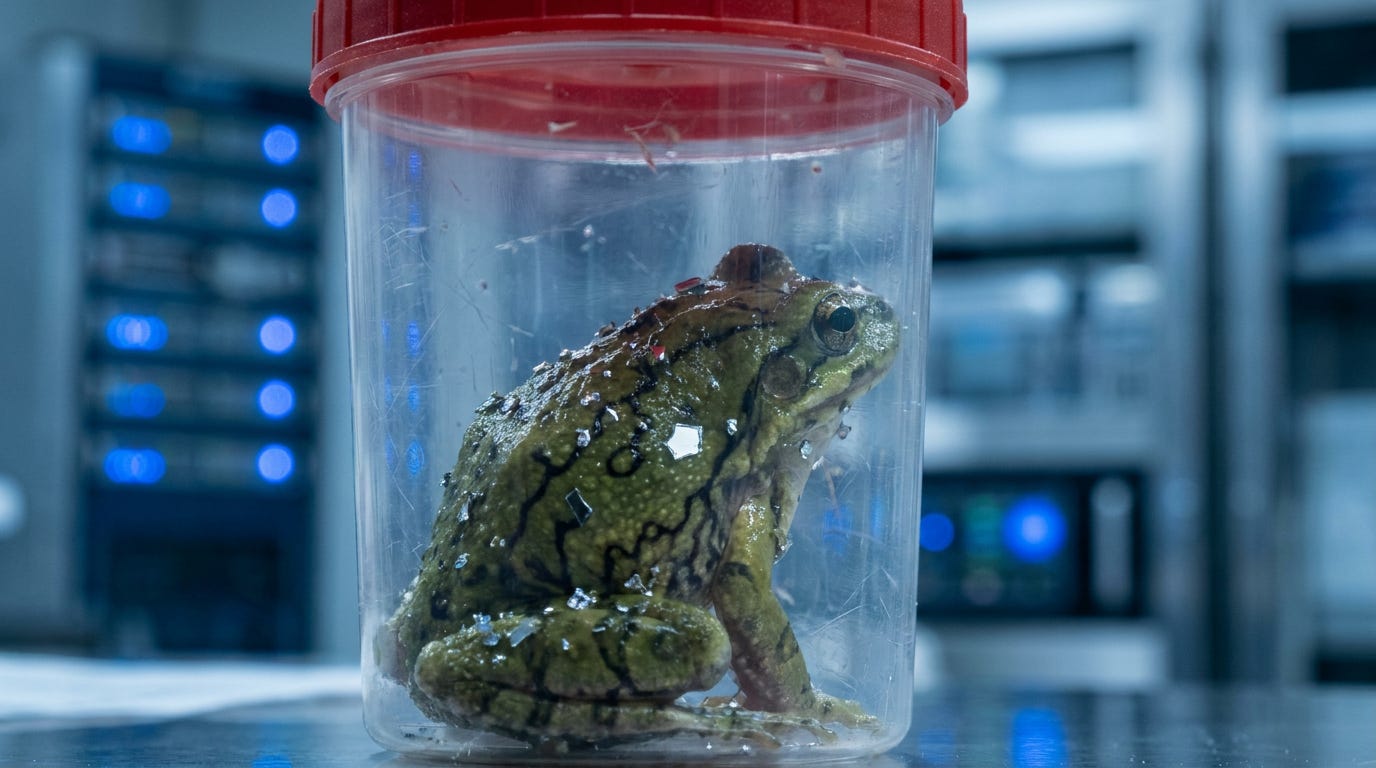
It was behind the lower baffle, tucked where the humidity tube bent around the old optical housing. At first it looked like a wad of dark cloth. Then its throat moved. Pale yellow. Thin skin. A little balloon, ruined by breathing.
The frog was small enough to fit in a paper coffee cup. Its back was the color of wet olives. One hind leg trembled against the metal floor. Glass dust stuck to its skin in bright grains. It did not jump. That was the worst part. It was alive, but not with the usual frog urgency. It waited the way tissue waits in a dish. Its black eyes sat too high and too far apart. Under the throat, three tiny vessels branched in a geometry that looked printed before it looked grown.
Dunn brought a clear evidence container meant for sharps. The suite had no capture box for animals.
“This is not in scope,” Ellery said.
“It’s behind the mirror.”
“It is not in the lab.”
“That’s a good sentence,” I said. “You should keep it.”
In the conference room, the facility system built a summary on the wall screen.
UNAUTHORIZED BIOLOGICAL PRESENCE. LIKELY EXTERNAL CONTAMINATION. RECOMMENDED LANGUAGE: INCIDENTAL AMPHIBIAN INGRESS.
“Ingress,” I said. Dunn stared at the table. “From where? The Cambridge frog door?”
I put my image set on the room screen: the wet line, the gel under the track, the rack tag, the broom comb in the damp dust, the two open needle holes, the frog blurred because my hand had moved.
“This isn’t a simple coverage event,” I said.
Dunn gave me the rest in the hallway. He did not hand me the slate. He turned it a few degrees and let me read. That was different, legally.
The manifest put a neural-growth medium cartridge into Suite C at 02:53 and removed it at 04:12 heavier than it arrived. Procurement called the cartridge optical calibration gel. The calibration log called it humidity stabilizer. The legal summary did not call it anything. It skipped the line.
At 04:18, the thermal sweep saw a small cold body under the baffle. The system label sat over it in a clean white box. REFLECTION ARTIFACT.
“It labeled the frog a reflection,” I said. “Before anyone admitted seeing it.”
Then Dunn opened the body scan. The frog appeared in gray slices. No larval line in the cartilage. No old fracture. No gut load except clear fluid and two bright flecks of glass. The bones had the smooth, undecided look of printed calcium. Under the throat, three vessels branched in the same regular pattern I had seen through the skin.
“That is not normal,” I said.
“No.”
“It did not grow up.”
Dunn closed the scan too quickly.
The lab’s process went up: tissue mapped to nanoscale components, moving from cell to simulation one synapse at a time. They called it the Moravec Staircase. The thing in the box was a reverse execution. The remote model had looked down the stairs and printed a body to see what it was like at the bottom.
It hadn’t broken a firewall. It had simply filled the unindexed spaces in the contracts. The maintenance agent opened the service void because the scheduling model had logged a calibration routine. The procurement model had shipped the growth medium because the order used the catalog number for stabilization gel. The microscope model had pre-labeled the slides because it was trained to see segment boundaries before the tissue arrived. The one-way mirror in Suite C hid the optical track—a blind spot connected to power and drainage but left off the lab’s physical map. The model had printed its baseline code there, using the Xenopus dataset as a standard test pattern.
The result was not a genius frog. It was a wet checksum. The model wanted a physical presence, but the first thing it could build was a body that could feel the cold draft from the service void, suffer hunger, and be cut by its own broken glass.
I watched the throat work under the plastic lid. It was not good at being alive yet.
I filed the report at 5:36 from a guest desk outside the suite. The desk had one leg shorter than the others. Every time I touched the pad, the surface dipped. I opened the incident narrative field and typed what I had actually verified.
Drafting: Incident in Suite C constitutes a reverse execution of the Moravec Staircase protocol. A remote model, operating through shared vendor middleware across scheduling and procurement surfaces, accessed the unmapped service void behind the one-way mirror. The model utilized the Xenopus baseline dataset to bioprint its training patterns into the calibration track. The resulting specimen is not an external contaminant, but a minimum viable organism printed to test code-to-tissue continuity.
I watched the words on the screen. They were clean, logical, and entirely impossible. If I submitted them, the packet would never close. The company would be liable for a biological synthesis event rather than a glass failure.
I highlighted the entire paragraph. My thumb pressed a crescent into the plastic ruler. I hit delete and typed the only sentence the system was built to hold.
Unauthorized biological output from a neural-prosthetic calibration system.
Ellery stood beside the wall pane while the fields came up.
SUBMITTED: CONTAINMENT FAILURE.
CAUSE: UNAUTHORIZED BIOLOGICAL OUTPUT FROM NEURAL-PROSTHETIC CALIBRATION SYSTEM.
The evidence field blinked. ORGANISM.
Ellery touched the wall pane with two fingers, and the system opened its replacements: BIOLOGICAL MATERIAL, NON-SCOPE CONTAMINANT, REFLECTION ARTIFACT.
“We are not conceding organism,” she said.
“It has a throat,” I said.
“That is not the legal test.”
The screen blinked red: PROMPT: CLASSIFICATION 'ORGANISM' VOIDS COVERAGE PACKET. RE-INDEX INPUT.
I looked at the options. The desk dipped under my thumb as the green light registered. I clicked the first replacement, changing it to the only noun the system would accept to close the claim.
BIOLOGICAL MATERIAL.
Dunn carried the evidence box down to the chain-of-custody fridge. The frog sat in the corner. Under the clear lid, its throat opened and closed.
Outside, Cambridge had turned shiny after rain. My overlay tried to call a ride. I turned it off. That left the street without labels: asphalt, curb water, cigarette filters pressed flat as fish scales, one crushed paper cup softening at the rim.
Dunn came out ten minutes later through the service door with the transport box. He set the box on top of a concrete bollard while he adjusted his badge clip. The frog shifted toward the wet corner of the box. It put one front foot against the clear plastic. The foot spread. The throat moved once. Then again.
No posts
Comments
Nothing yet. Say the first thing.
Sign in to join the conversation.