
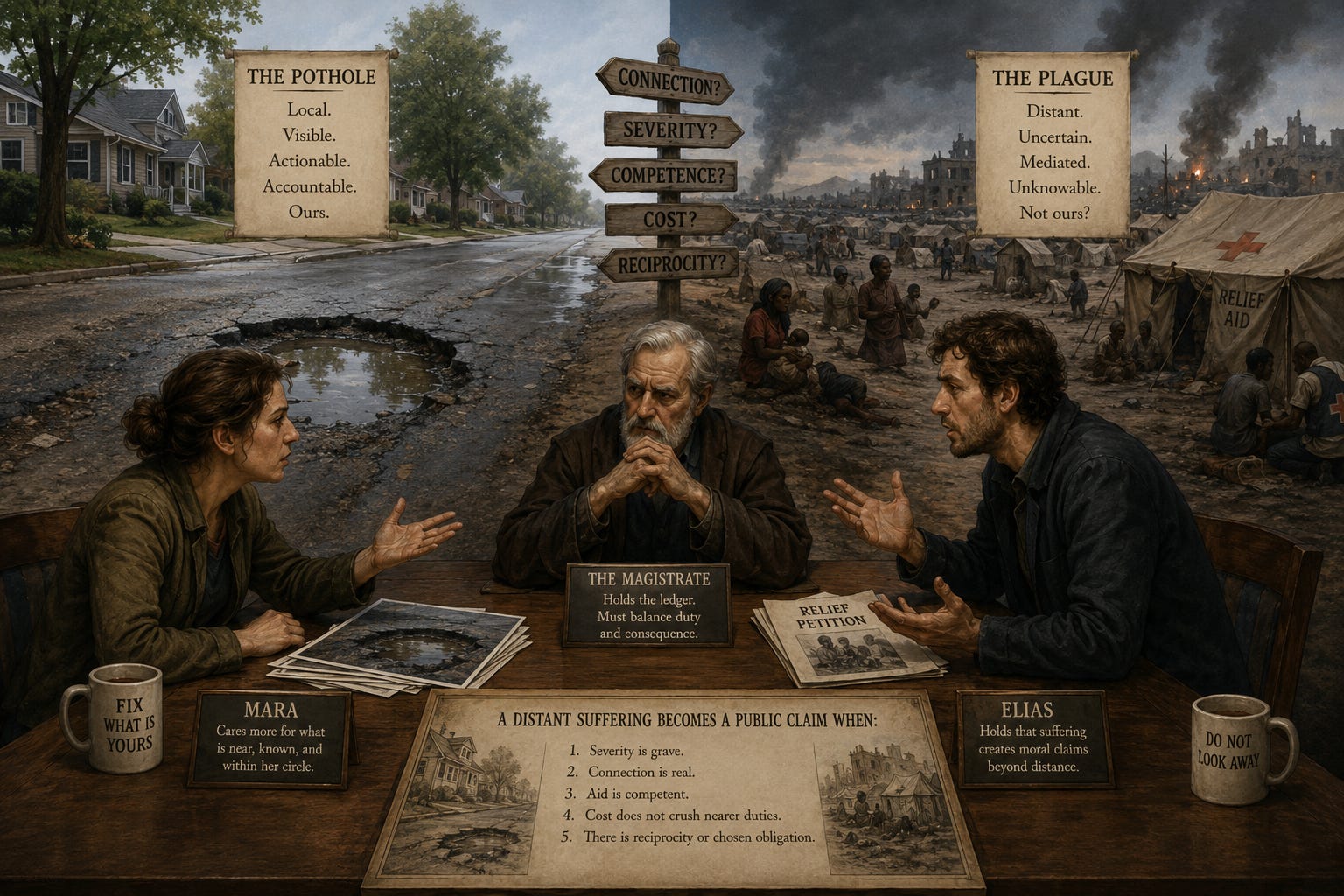
The council had money for one thing.
On the table lay two petitions. The first asked that a pothole be repaired on a residential street where rainwater gathered and wagons slowed. The second asked that funds be sent abroad, where a plague had begun to consume villages.
The Magistrate read both petitions, then looked at the two citizens before him.
“Mara, you brought the first. Elias, you brought the second. We will hear both. But speak plainly. The city cannot repair every road and save every sufferer.”
Mara placed a folder of photographs on the table.
“The pothole is ours,” she said.
Elias touched the relief petition.
“The plague is human.”
“That is not the same claim,” Mara replied.
The Magistrate raised his hand. “Begin there.”
Mara said:
“Concern is not equal. No one lives as if it were. I care more for my children than for my colleagues, more for my colleagues than for strangers, more for my street than for a distant province. This is not moral failure. It is the shape of moral life.
“The mistake of modern politics is to treat every distance as a defect. It hears of suffering far away and declares that the suffering has arrived here as an obligation. But knowledge is not ownership. To be told of misery is not yet to be drafted into responsibility for it.
“The pothole is local, visible, actionable, and accountable. We know where it is. We know who uses the street. We know what it costs to repair. If we neglect it, the damage falls on the people who live here. The duty is clean.
“The plague may be terrible. I do not deny that. But it is distant, mediated, uncertain, and governed by institutions we do not control. We do not know whether our money will cure the sick, enrich officials, prolong disorder, or vanish into symbolic compassion. Yet its advocates present it as if the only relevant fact were suffering. That is not politics. That is emotional taxation.”
Elias did not immediately answer. When he did, his voice was quiet.
“You speak as if distance purifies us of duty. It does not. A child dying far away is still a child. A village destroyed beyond our borders is still a village. You are right that no one loves all people equally. But you move from unequal love to narrowed obligation, and from narrowed obligation to a world in which distance becomes an excuse for not seeing.
“I do not ask that you love strangers as you love your children. That would be absurd. I ask that suffering not be dismissed because it is inconveniently located. If the city becomes too skilled at saying ‘not ours,’ it may preserve its roads while losing its soul.
“You call universal compassion emotional taxation. I call your doctrine protected indifference.”
Mara answered:
“Protected, yes. Indifferent, no. Protection of attention is necessary to real duty. A person who lets every distant grief enter his house will neglect the people actually in his house. A city that converts every foreign disaster into a local claim will eventually forget its own streets, drains, courts, schools, and walls.
“I do not say the plague is unreal. I say it is less ours.
“That word offends you because your politics wants distance abolished. Mine wants distance preserved unless there is a reason to cross it.”
The Magistrate leaned forward.
“What counts as a reason?”
Mara said:
“Connection. If the plague can reach us through travel, trade, migration, war, or institutional obligation, then it is no longer merely distant. If our intervention is competent, measurable, and affordable, then aid may be justified. But the burden of proof belongs to the distant claim, not to the local duty.
“The pothole does not need a theory. It is before us.”
Elias said:
“You reduce mercy to procurement.”
“No,” said Mara. “I distinguish private mercy from public obligation. A person may give beyond proof. A treasury may not. When you spend your own money, generosity may be enough. When you spend the city’s money, you owe the city reasons.”
The Magistrate nodded.
“That distinction matters. Public pity is still public power.”
Elias turned to him.
“And public coldness is still public vice.”
“Perhaps,” said the Magistrate. “But a city cannot be governed by the intensity of whoever brings the saddest petition.”
For a time, rain struck the chamber windows.
Then the Magistrate spoke again.
“There is a deeper matter here than one street and one plague. Mara wants what I will call firebreaks. She wants the failures of one place not to become the automatic burdens of another. Elias wants what I will call moral permeability. He wants suffering to cross distance when the need is grave enough.
“Both principles are dangerous.
“A city without firebreaks is consumed by every surrounding fire. A city without permeability becomes a fortress of small concerns.”
Mara said:
“I accept that. But our age errs toward forced connection. Trade makes us dependent on distant factories. Finance makes us vulnerable to distant panics. Alliances make remote wars into our wars. Media makes remote grief into domestic accusation. Migration moves the consequences of one political order into another. Treaties and charities convert sentiment into standing obligation.
“Then we are told that because everything is connected, we must care about everything. But the connection was not fate. It was designed.
“I want a world in which bad things elsewhere do not automatically become our costs, our emergencies, our guilt, our taxes, or our wars. That is not cruelty. It is insulation.”
Elias replied:
“Insulation from consequence often becomes insulation from conscience. The same wall that keeps out panic may keep out truth. You say you want doors. But every door can become a locked gate, and every firebreak can become a doctrine of abandonment.
“Suppose one day this city is the distant sufferer. Suppose our plague is elsewhere’s petition. Would you want them to say: severe, yes; tragic, yes; but not ours?”
Mara said:
“Yes, unless we had built a real bond with them. That is the point. I do not want imaginary brotherhood activated only by catastrophe. I want chosen, reciprocal, intelligible connection. If we make ourselves dependent on others, then we owe and are owed. If we do not, then grief alone does not create jurisdiction.”
Elias said:
“You make humanity too contractual.”
“And you make it too imperial,” Mara said. “Your compassion crosses borders as if borders are moral errors. Mine asks what was promised, what is connected, what can be done, and what must be neglected to do it.”
The Magistrate took up a blank page.
“Then let us write the rule. A distant suffering may become a public claim when several things are shown.
“First: severity. The harm must be grave.
“Second: connection. The event must touch us through health, security, law, migration, trade, or some other real channel.
“Third: competence. The proposed aid must have a serious chance of working.
“Fourth: cost. The aid must not consume resources owed to nearer duties.
“Fifth: reciprocity or chosen obligation. There must be some bond stronger than spectacle.”
Elias frowned.
“You have made a tribunal before the dying.”
Mara said:
“No. We have made a tribunal before the treasury.”
The Magistrate looked at Elias.
“That is not a small answer.”
Elias said:
“It is still unsatisfying.”
“All political answers are,” said the Magistrate. “Only slogans are complete.”
The rain stopped. Through the chamber window, the street outside shone with standing water.
The Magistrate lifted the photographs.
“The pothole is local, certain, actionable, cheap, and within our office. It will be repaired.”
Mara inclined her head.
He lifted the second petition.
“The plague is severe. That much is plain. But its connection to us is uncertain, and the competence of the relief committee has not been shown. We will audit the channel, investigate the route of possible spread, and consider aid from the emergency reserve if the case is proven. It will not come from the road budget.”
Elias gathered his papers.
“So the pothole wins.”
“The pothole does not win,” said the Magistrate. “It qualifies.”
Elias looked at Mara.
“And the plague must qualify.”
“Yes,” she said. “For public money, yes.”
He said, “There is something indecent in that.”
“There is something indecent in every ledger,” Mara answered. “But a city that refuses ledgers soon has neither roads nor mercy.”
Elias turned toward the door, then stopped.
“You are wrong about distance.”
Mara said, “In what way?”
“Distance is not innocence.”
“No,” she said. “But neither is it a defect.”
The Magistrate rose.
“That may be the only honest conclusion. Distance neither absolves nor obligates by itself. It must be interpreted.”
Outside, a cart slowed before the pothole, crossed carefully, and continued down the wet street.
Mara closed her folder.
“Fix what is yours,” she said. “Be careful what you connect. And do not let every distant catastrophe become a local master.”
Elias answered from the doorway:
“And do not let every boundary become a permission not to see.”
Neither replied after that.
The council adjourned with one repair ordered, one petition suspended, and no one satisfied. Which, in civic matters, was often the closest available substitute for wisdom.
No posts
Comments
Nothing yet. Say the first thing.
Sign in to join the conversation.