
A large part of human ambition fails because of a category error: we confuse the desire for a condition with the work required to produce it.
We say we want wealth, autonomy, true love, respect, happiness, or freedom. These are real desires, but they are often fake goals. They describe conditions we want to inhabit, not actions we can execute.
A real goal points to controllable action. A fake goal points to an emergent result.
The core flaw of a fake goal is that it treats an outcome as if it were a lever. Wealth, autonomy, love, and respect are not levers; they are downstream effects of systems that run well over time.
You cannot execute an outcome directly. You must manage the inputs that create it:
You cannot execute “wealth.” You can create value, sell it, retain ownership, control expenses, and compound capital.
You cannot execute “respect.” You can become competent, keep your word, make good judgments, and show up reliably.
You cannot execute “true love.” You can become honest, emotionally regulated, selective, loyal, and capable of building trust with another person over time.
You cannot execute “independence.” “Never working for someone else” is not a task. It is the byproduct of accumulating enough skill, leverage, ownership, and financial runway that selling your time becomes optional.
The problem is not that these desires are wrong. The problem is that they are positioned at the wrong level of abstraction. They are outcomes, not instructions. When you target the condition instead of the process, you try to control variables that do not obey you directly.
Outcomes are influenced indirectly. Inputs are managed directly.
Fake goals persist because they are emotionally useful. They allow us to enjoy the fantasy of the prize without exposing ourselves to the discomfort of the work.
The idea of becoming a great novelist is pleasant. It gives a person an identity; it allows him to imagine admiration, mastery, and a finished book. But “write four bad pages before 8:00 AM every day” is much less romantic. It introduces boredom, friction, repetition, and evidence. It forces immediate contact with reality.
That is why fake goals are so durable: they protect the ego.
A person can say he wants independence for ten years while avoiding sales, risk, discipline, and customer rejection.
He can say he wants wealth while refusing to build anything valuable.
He can say he wants love while avoiding honesty, vulnerability, and commitment.
The fake goal preserves the self-image. The real process threatens it. The fantasy asks nothing. The process asks for payment immediately.
Fake goals are not useless; they contain information. They reveal desire. The mistake is treating that desire as a plan. To make a fake goal useful, it must be translated down the abstraction gradient from vague condition to localized execution.
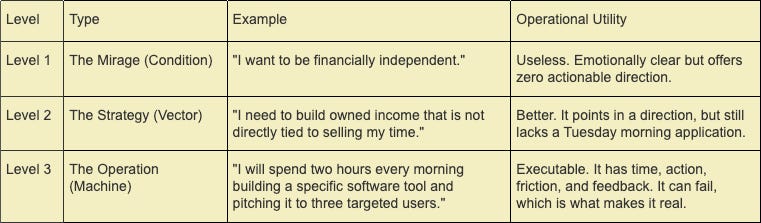
A real goal must be able to collide with reality.
If you want a specific outcome, staring at the prize is mostly wasted effort. The useful work is to build the machine that produces it. That machine requires three distinct parts:
Clear Inputs: The variables you actually control. This means hours focused, calls made, code written, pages drafted, capital saved, and promises kept.
A Friction-Based Feedback Loop: A good process forces early contact with reality. Customers say no, readers lose interest, the market ignores the product, or the relationship becomes strained. This feedback is not an insult; it is information. It tells you exactly where the machine is broken.
Low-Dependency Design: Fragile goals depend too much on luck, permission, mood, or external approval. Strong systems reduce those variables. They rely on owned assets, rare skills, accumulated trust, disciplined habits, and repeated contact with reality.
Freedom is produced by skill, assets, low debt, and discipline.
Wealth is produced by value creation, ownership, patience, and judgment.
Love is produced by character, honesty, attention, and time.
Respect is produced by competence, reliability, and restraint.
The real work is not to stare at the prize. The real work is to build the causes.

No posts
Comments
Nothing yet. Say the first thing.
Sign in to join the conversation.