
Where is everybody?
The Fermi paradox is the tension between two observations: the Galaxy is ancient and enormous, with hundreds of billions of stars and likely many planets, yet we see no clear evidence of other technological civilizations. If life and intelligence are not extremely rare, then some civilizations should have had enough time to spread, signal, build large structures, or otherwise become visible. But the sky appears silent.
A possible partial answer to the Fermi paradox is that the Galaxy may not be equally friendly to long-lived technological life. The inner Galaxy has many more stars, more planets, shorter distances between systems, and a richer supply of heavy elements. At first glance, that should make it the obvious place for civilizations to arise and find each other. But the same density that makes the center attractive also makes it dangerous.
Closer to the Galactic center, planetary systems face a harsher long-term environment. There are more nearby stars, more massive stars, more supernovae, more radiation events, more orbital disturbances, and more chances for a planetary system to be disrupted before complex life has enough uninterrupted time to evolve. A planet does not merely need to exist in the habitable zone of its star. It needs billions of relatively quiet years. The inner Galaxy may offer more opportunities, but also more resets.
The outer disk has the opposite character. It has fewer stars and fewer nearby systems, but it is quieter. A planet in a region like the Sun’s neighborhood is less likely to be sterilized by nearby explosions, less likely to suffer severe gravitational disturbances, and farther from the dangerous activity of the central black hole. The price of safety is isolation. If technological civilizations arise mainly in these quieter outskirts, then they may be sparse, separated by large distances, and unlikely to overlap in time.
This creates a simple tradeoff. The inner Galaxy may be rich but unstable. The outer Galaxy may be stable but lonely. Civilizations may preferentially emerge in safer regions, yet those same safer regions make communication, travel, and detection harder. The silence of the sky would not mean that life is absent. It may mean that advanced life emerges mostly in quiet places, far from one another.
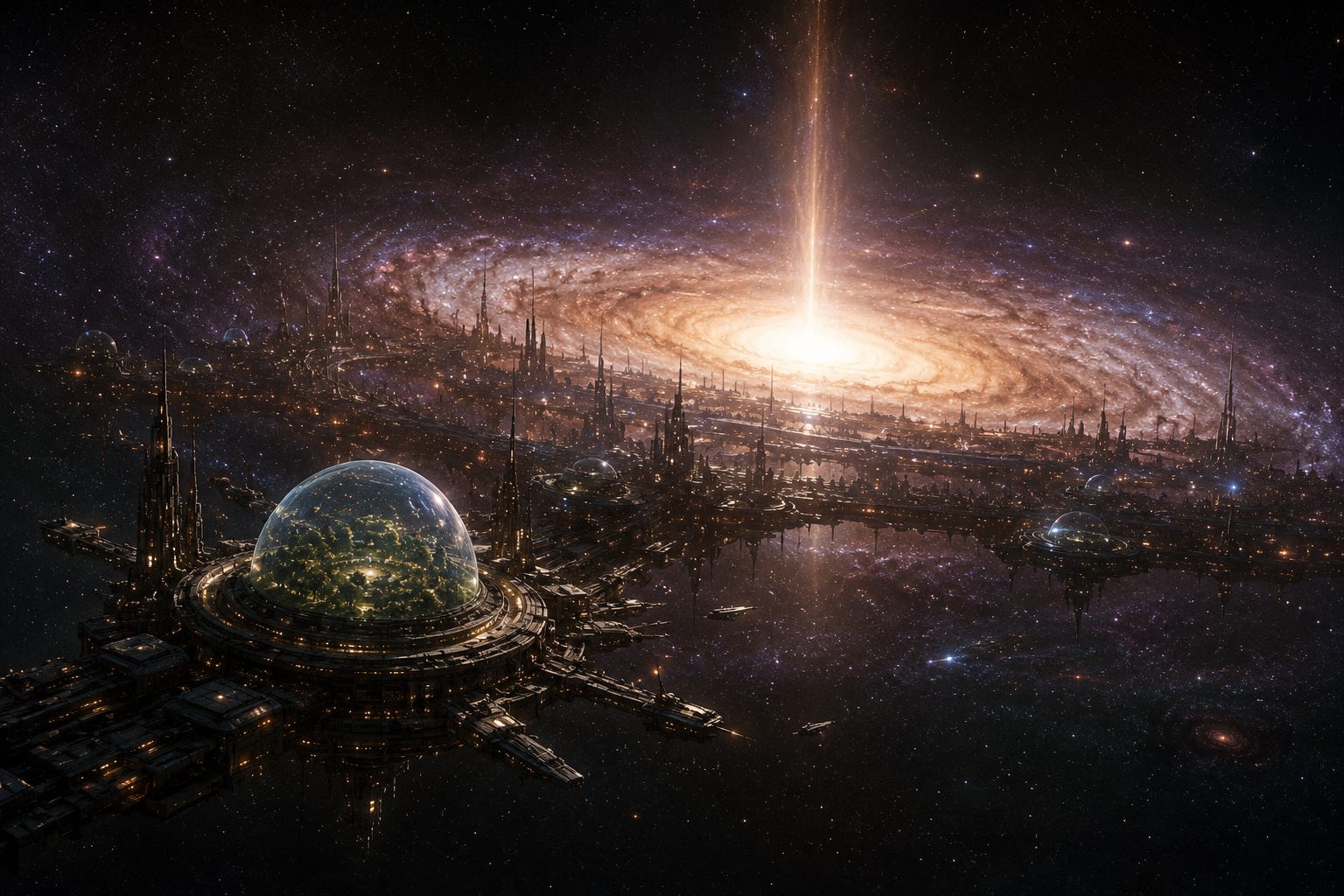
There is also an interesting strategic implication. If a civilization becomes advanced enough to shield itself from supernovae, gamma-ray bursts, black-hole radiation, and other Galactic-center hazards, then moving inward could become rational. The inner Galaxy would offer denser infrastructure opportunities, more stars, more matter, more heavy elements, and shorter travel times between neighboring systems. For early biological life, the center may be too dangerous. For mature technological life, the center may become valuable territory.
Such a move would also have a security advantage. A civilization could expand toward the richer inner Galaxy without revealing the location of its original home world. The center could become a meeting ground or industrial zone for civilizations that began elsewhere. They would not need to expose their birth systems in order to trade, cooperate, observe, or coordinate. If many advanced civilizations independently reach the same conclusion, the Galactic center could become more attractive not as a cradle of life, but as a later-stage convergence zone.
In this view, the Galaxy separates the problem into stages. Quiet outskirts are better nurseries. Dense inner regions are better hubs. Young civilizations may need distance from danger. Old civilizations may seek proximity to resources and to each other. The Fermi paradox may partly arise because we are looking from a nursery, not from the marketplace.
No posts
Comments
Nothing yet. Say the first thing.
Sign in to join the conversation.