
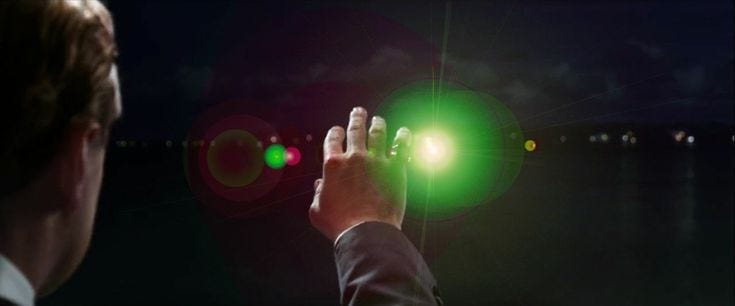
I thought of Gatsby’s wonder when he first picked out the green light at the end of Daisy’s dock. He had come such a long way to this blue lawn, and his dream must have seemed so close he could hardly fail to grasp it.
– F. Scott Fitzgerald
In The Great Gatsby, the green light across the water represents, among other things, Gatsby’s longing for Daisy. In the end, Gatsby’s dream of perfect love led to (spoiler alert) nothing but torment and death. So, is wistfully thinking about partnership the ominous green light in the lives of single people?
Thinking about the path not taken is something everyone does. What if you’d taken that other job, what if you’d moved to that other town, what if you hadn’t eaten that past-due yogurt? This is, of course, just as true with relationship status as with anything else. If you spend as much time as I do monitoring online singlehood discourse, you’ll know that a regular theme in singlehood spaces is how singlehood compares to being partnered.
It was with some surprise, then, that I read a recent critique suggesting that singlehood research was dominated by perspectives that center partnership. At least in the area of well-being research, the kinds of factors that researchers (my lab included) have focused on have almost always been factors that aren’t really about committed partnership - gender, age, family and friend relationships, casual sex, those sorts of things. There is a little research on the influence of desire for partnership, but that’s about it.
So we actually know very little about what single people think being partnered is like and what effect those beliefs have on their experience of singlehood (one exception is this fun study where, among other things, married people mistakenly believe that singlehood is some sort of sexual cornucopia). Well, I’m happy to say thanks to a new publication by up-and-coming graduate student Tayler Wells (along with Elaine Hoan and me), we now know a little more than we used to.
The questions we provided provisional answers for in this paper fall into three categories. First, just in general, what do single people think partnership is like? Second, do single men and women have different expectations about what partnership is like? And third, do single people’s expectations about partnership influence their feelings about singlehood, their likelihood of partnering, and maybe even the quality of any romantic relationships they eventually get into?
To assess single people’s expectations about what partnership is like, we turned to an old friend – the pairfam data set. This is a data set collected by the German government which is used in a lot of singlehood research because the sample is large, they have a wave of data collection every year (so you can do longitudinal analyses), and they are about the only big data set like this to have included measures specifically about singlehood. They let pretty much any researcher who asks use the data. It took me a few years to realize what a genius move it is to just give the data away because it means there are now researchers around the world providing analysis on the German populace for free.
So there’s a lot of win-win when it comes to using these data, but a big downside is that you don’t get to create your own measures, so the measurement instruments available are a definite “you get what you get” situation. In this case, we were able to use a measure of relationship expectations that had been included in pairfam. Not all of the items in this measure are what we would have developed ourselves, but in the end we think they are decently informative.
The pairfam researchers had intended for their expectations of relationships scale to consist of two subscales, negative and positive expectations. But to make sure that structure checked out, Tayler did some analyses and found the scale was actually better described as having three subscales. The first subscale was negative expectations of relationships just as the designers of pairfam had intended, including items like being concerned about “experiencing stress related to a relationship.” The second subscale was a derivative of the positive expectations scale which we called intimacy expectations, with items like expectations that participants would, “receive affection and have a feeling of security in a relationship.” The final subscale was what we called status expectations, which was two items about expecting a relationship to boost your social status and financial prospects.
So this was what we had to work with. What, then, do (German) single people think relationships will bring in terms of negativity, intimacy, and status? In terms of negativity, the average participant fell around the midpoint of the scale, meaning they expected relationships to bring a moderate amount of negativity. It’s good to know single people aren’t naïve on this front – particularly once couples enter the accommodation stage of a relationship, conflicting needs between partners is a structural part of partnership that people need to work out.
In terms of intimacy, the average participant had expectations that were near the top of the scale. That is, the average sinlge person expected fairly high degrees of intimacy from partnership. But, single people didn’t expect much of a status boost from being partnered, that average score was near the bottom of the scale.
There’s a lot that can be drawn from these findings, but for me I think they can be helpful in resolving perhaps the biggest debate in singlehood studies, why do people partner? One camp suggests that the biggest draw to partnership is that people just inherently enjoy romantic connection. Another camp suggests that social structural forces provide social rewards for partnering and social punishments for staying single. Both camps are of course right to some degree (it’s always both!), but what is the relative contribution of these two forces?
One problem in resolving this issue is that the people advocating these two perspectives come from two different academic cultures. If you work primarily in evolutionary psychology, for example, basically everyone around you assumes inherent reward is more powerful (or at least that some evolved mechanism is the ultimate explanation) and you don’t have to prove that to anybody. If you work primarily in sociology, basically everyone around you assumes that social structural forces are more powerful, and you don’t have to prove that to anybody. But here in interdisciplinary space, you’re confronted with conflicting assumptions, and the important thing becomes not what explanation you prefer but what explanation has the best evidence behind it.
I don’t think our data fully resolve the debate by any means (no single piece of evidence can do that), but it does seem clear that when single people in our study think about what partnership is like, they see it as something that brings the personal reward of relational intimacy, but not much in the way of a social status gain. And you can add to that our past research showing that single people agree that they are motivated to partner because they enjoy romantic relationships and see partnering as an important personal goal, and that they disagree that they are motivated to partner to please other people. Overall, the evidence so far to me seems consistent with a bigger role for inherent reward than social structural advantage. At the very least, I think we can’t think exclusively in social structural terms.
One thing that our lab and others has shown is that women seem to be happier in singlehood than men. This leads to the rather straightforward prediction that men’s expectations for what partnership is like should be rosier than those of women. The data on this prediction weren’t entirely straightforward.
First, it is true that women had more negative expectations of partnership than men. As we discuss in the paper, there could be a lot of reasons for that. For example, in heterosexual relationships, women often have an unfair share of the household labour thrust upon them. So the negative expectations finding seemed pretty straightforwardly consistent with previous research on gender and singlehood.
But what was a bit of a surprise to us was that women did have more positive expectations about partnership than men when it came to intimacy; women expected higher levels of intimacy from partnership than men. I think this is useful for understanding part of what might motivate women to partner even in the face of some of the gendered challenges that come with partnership. Our data suggest that women are particularly likely to see partnership as a venue for something that most people want in their lives, intimacy. And women may not be wrong that they can expect intimacy in a romantic partnership given that women on average experience higher levels of intimacy across all different types of relationships than men.
The area in which men expected more of a boost than women was status. Again, most participants expected little in the way of a status boost from partnership, but to the extent that a boost was expected it was more likely to be men who thought they would benefit. And again, men may not be wrong here. For example, married men have been shown to have higher incomes than single men, so they may be right that partnership affords some degree of status advantage.
One thing you see semi-regularly in online singlehood spaces is people discussing how the disadvantages and problems associated with being coupled make them happier about being single. But does using relationships as a downward comparison actually make single people feel better?
Our data say mostly no. Our analyses showed that if you’re the kind of person who sees relationships more negatively, that’s actually unrelated to how happy you are about being single. Another way we analyzed this was to see if, in a year you perceived relationships as particularly negative, you tended to see singlehood as particularly enjoyable. We did find an effect here, but it was pretty small.
So dragging relationships doesn’t seem to be associated with feeling that much better about singlehood if there’s an effect at all. Why would that be? Our guess is that there might be two effects cancelling each other out here. In general, research on social comparison says that making a downward comparison – like seeing relationships as worse than singlehood – helps people feel better. That might well be true. But, the kind of person who chronically drags relationships might be the kind of person who is themselves a drag, that is, someone with the sort of consistently negative outlook (e.g., high neuroticism) that makes it harder to enjoy singlehood or anything else. So there’s probably better ways to improve your outlook on singlehood than being strongly focused on how bad people in relationships have it.
What was true for people with negative expectations for relationships was that they were less likely to partner. And this seems to be a good call on their part, since people with more negative expectations of relationships – if they do actually partner – tend to feel less happy in those relationships. So these negative expectations of relationships do seem to be grounded in reality, it’s just that using them as your primary strategy to feel better about being single may not be particularly effective.
If anything is the green light on the dock in singles’ lives, it’s the belief that partnership is saturated with intimacy, so does that belief bring torment to singles’ lives? On one hand, our data say yes. Singles with stronger perceptions that romantic relationships offer high levels of intimacy felt less satisfied about being single. But the question of whether that’s a bad thing opens up a whole can of worms about doing well-being research in general. Well-being research often has this very hedonistic approach, where feeling good is taken as positive and feeling bad is taken as negative. So in the usual reading of well-being research, this would suggest that intimacy expectations are bad for singles.
But is feeling bad always a bad thing? If you didn’t feel hunger, you would die. If you didn’t feel unhappy in an abusive relationship, you wouldn’t leave. And if you didn’t feel unhappy in singlehood, you might not be motivated to find a romantic partner. Indeed, singles who saw partnership as bringing higher levels of intimacy were more likely to transition to partnership.
The key of course is whether these singles with stronger perceptions that romantic partnership brings intimacy are right, or if their itch to leave singlehood was motivated by a destructive fantasy of perfect love, just like with Jay Gatsby. Our data suggest they were right, a little bit. It wasn’t a huge effect, but stronger intimacy perceptions were related to being more satisfied in new romantic relationships.
And I do think there’s a more general case to be made that singlehood researchers should not reflexively interpret dissatisfaction with singlehood as problematic. Findings like this should be put in the context of people’s relationship goals and their ability to sit with discomfort and use it productively. Similarly, relationship researchers should not reflexively interpret dissatisfaction with relationships as a negative as such dissatisfaction can be a healthy response to unhealthy relationships or perhaps reflects an unrealized desire for singlehood. Satisfaction with relationship status should be understood in the broader context of an individual’s particular situation.
Indeed, if one’s goal is to stay committed to singlehood, these data seem to suggest that although seeing romantic relationships as being highly negative largely doesn’t pay off with singlehood satisfaction, it may be seeing romantic relationships as relatively low in intimacy that does the trick. Maybe an attitude of “I don’t feel much draw,” works better than an attitude of, “It would be horrible.”
Expectations that romantic partnership would increase social status generally showed weak effects in our analyses, so this section should be taken with a grain of salt. But to the extent that a pattern was there, it seemed to be that people with higher status expectations wanted a partner more, but were actually less likely to partner. You can read the paper for a longer explanation, but one thought is that maybe when you want a romantic relationship for the “wrong reasons,” you get in your own way because there is some part of you that doesn’t actually want it. Food for thought.
One thing I think this paper demonstrates is that you can’t really have a singlehood studies that is divorced from relationship science. There have been recent calls that singlehood should only be studied from “singles-centred” perspectives, but singlehood does not exist in an alternate universe from partnership. As people do in all domains in their lives, single people think through “what ifs,” and our research suggests that these daydreams (and nightmares) may have important implications for their lives as single people.
No posts
Comments
Nothing yet. Say the first thing.
Sign in to join the conversation.