
I am very proud to be able to say that this week the first batch of chapters from the Oxford Handbook of Singlehood was released. This handbook is something that Yuthika Girme and I edited, and it was a real passion project for both of us. Unfortunately, copyright rules work differently for this kind of book, so I can’t post an open access link to the chapters. But I do want to talk about our philosophy in putting this book together, and some ways it reflects the values I bring to my work in general.
I love the word that one of our chapter authors used to describe the collection, “eclectic.” That sounds right to me. Our authors include scholars of public policy, developmental psychology, law, evolutionary psychology, economics, clinical psychology, family studies, social psychology, gender studies, communication, and even a nun. And still, we weren’t able to get all the disciplines represented that we wanted; for example, we really wanted someone in urban planning but we just weren’t able to find the right person.
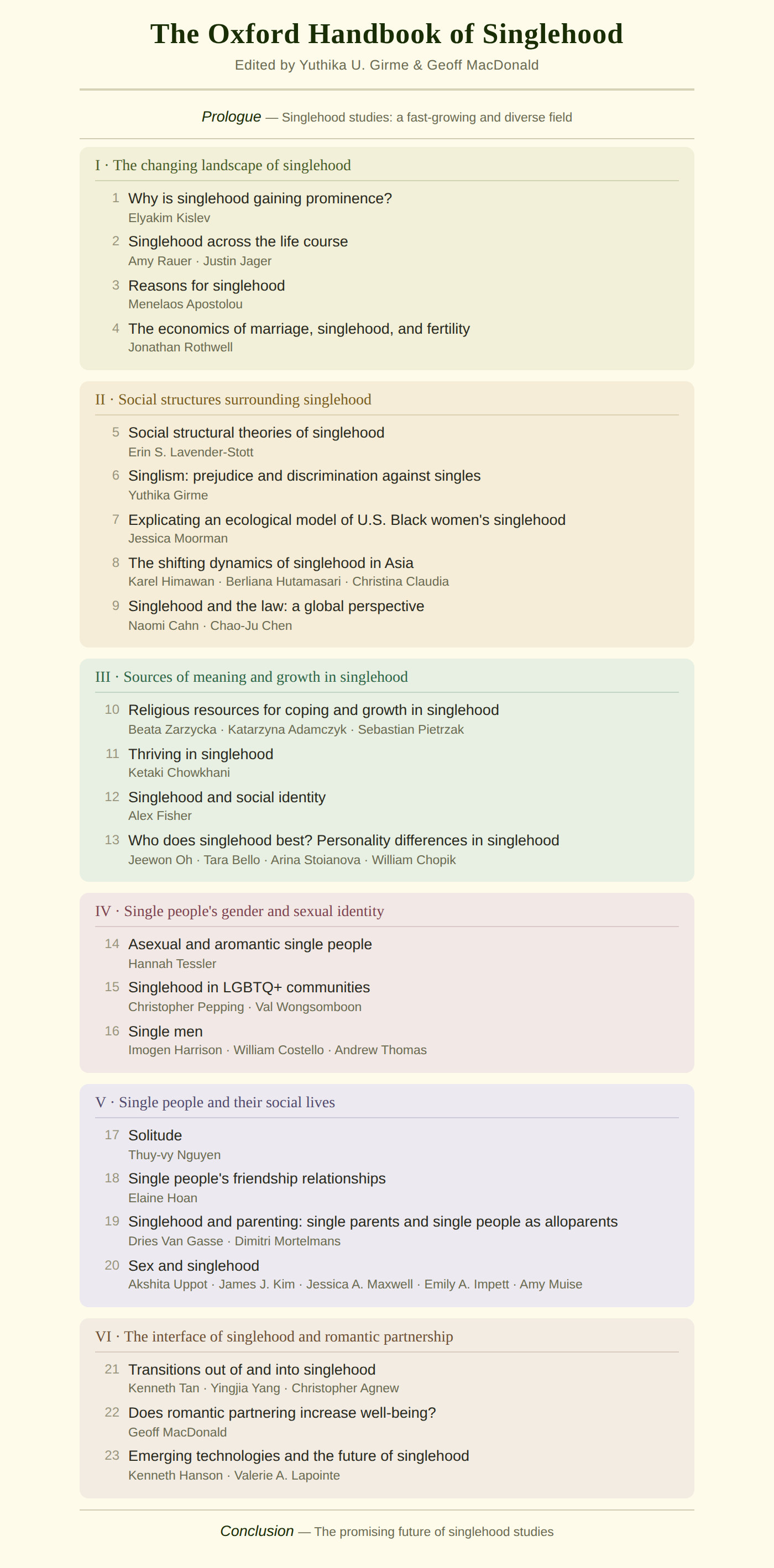
Yuthika and I believe that there is a unique opportunity in Singlehood Studies to build a truly interdisciplinary field of research. This is in part because of the nature of singlehood itself but also because of where we are at in the history of singlehood research. On the one hand, I have a hard time thinking of aspects of life that do not intersect with a person’s relationship status (in fact, if you can think of one then post it in the comments and I’ll see if I can convince you of its links to relationship status). On the other hand, in almost every academic discipline, singlehood as a subject of study is either newly on the radar or not on the radar at all. This was why, for example, we had such a hard time finding someone to discuss the repercussions of increasing rates of singlehood for urban design despite what seems to us like obvious and serious implications.
The core principle at work in selecting such a broad array of topics for chapters was that the kinds of norms you establish early in a field’s development can create a lasting culture for how future work unfolds. In the case of Singlehood Studies, we believe that we know so little about singlehood that the most important thing to do right now is approach the work with openness. We need all of the voices we can find, and nobody should be acting as if any question is settled. We especially need people from different intellectual traditions coming together, since not only do individual researchers have blind spots, so do the disciplines in which they have had their training.
But if you’ve ever done research in an interdisciplinary area, you know that making it work is harder than it sounds. In practice, working across disciplines doesn’t just mean challenging people’s ideas, but challenging deeply held values. As such, we think something that is crucial for the growth of Singlehood Studies is a culture of what Amy Edmondson calls psychological safety. Edmondson defines psychological safety in organizations as, “a shared belief that the team is safe for interpersonal risk taking.” She goes on to say:
“The term is meant to suggest…a sense of confidence that the team will not embarrass, reject, or punish someone for speaking up. This confidence stems from mutual respect and trust among team members.”
And psychological safety isn’t just about feeling good or even doing what is morally right. The research of Edmondson and others shows that when groups have a culture of psychological safety, they produce better work because people feel safe to take risks.
Importantly, this kind of culture isn’t about avoiding conflict. Instead, it raises the the quality of debate by separating interpersonal threat from intellectual disagreement (you can be wrong without feeling dumb or immoral), which encourages lower status group members (like students) to voice their ideas. Indeed, five of our chapters are first-authored by Ph.D. students or post-doctoral researchers and the book is so much better for their contributions.
Fortunately, almost everyone I’ve met in Singlehood Studies seems to share this value. The good spirit among our chapter authors was evident in both the enthusiasm for the project overall and their good nature in dealing with what was, at times, challenging feedback from me and Yuthika. I’m really proud of what our team has put together here. We hope for the reader that these chapters offer a sort of one-stop-shop entry into understanding what the field of Singlehood Studies can tell us so far. We also hope this volume will encourage more people to bring their talents to understanding singlehood.
In the coming weeks, some of the chapter authors will be writing guest posts here at The Unromantic to introduce you to their perspective on singlehood. As I said, this is a field where multiple voices and perspectives are needed, and frankly I’m a little over reading my own writing here. So please stay tuned as we walk you through parts of the new Oxford Handbook of Singlehood!
No posts
Comments
Nothing yet. Say the first thing.
Sign in to join the conversation.