
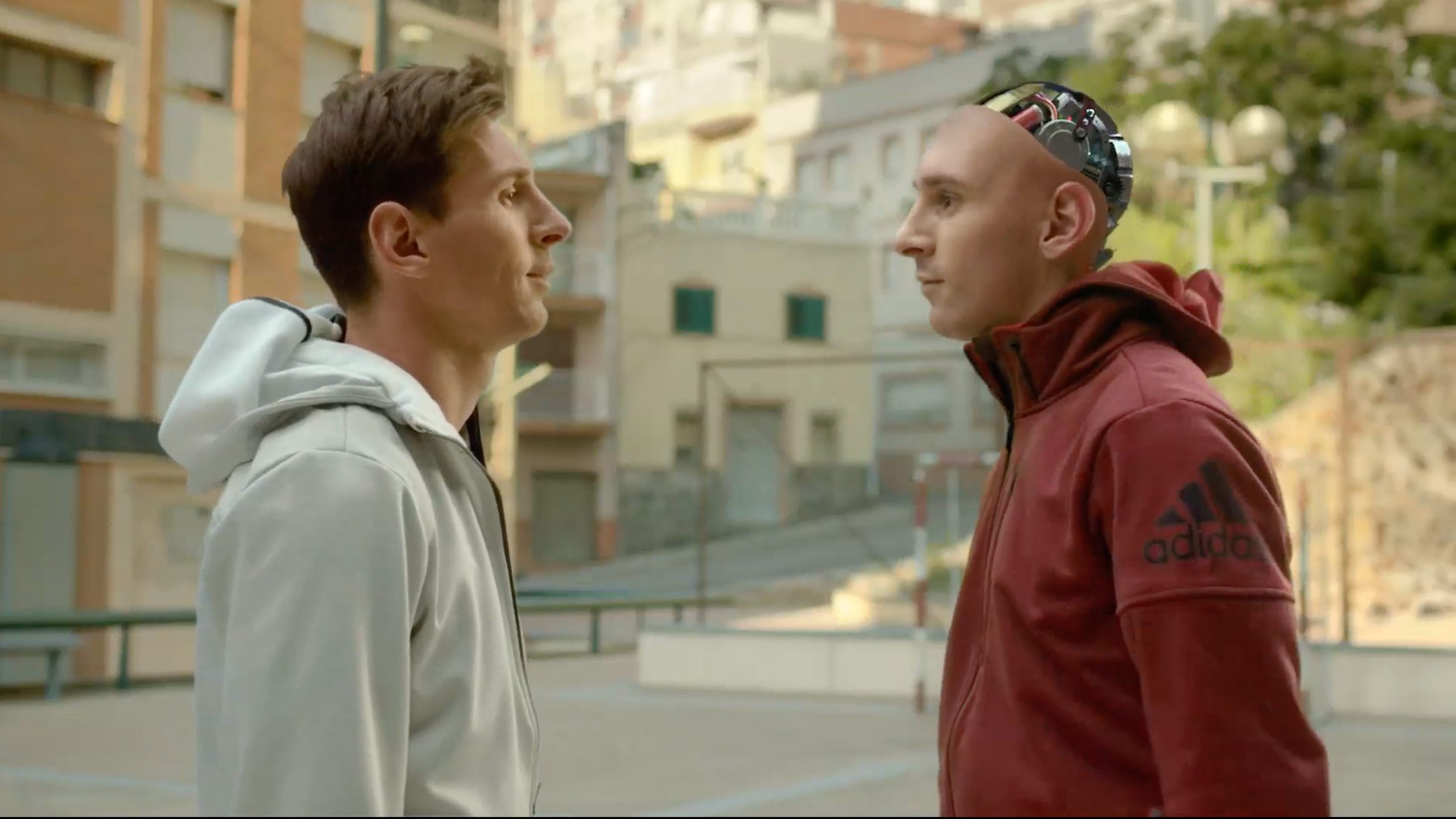
I love Lionel Messi. My brother and I grew up with him as a sort of demigod flitting across our televisions, video game consoles, recess scrimmages, and daydreams. I also love reading essays about Lionel Messi: it’s nice to see your feelings reflected in someone else’s mind, especially if they’re expressed in words better than the ones you would’ve chosen.
Messi is playing in the World Cup final on Sunday — it is likely the last major game of his career. So, feeling nostalgic, I was excited to see this piece published in the New York Times.
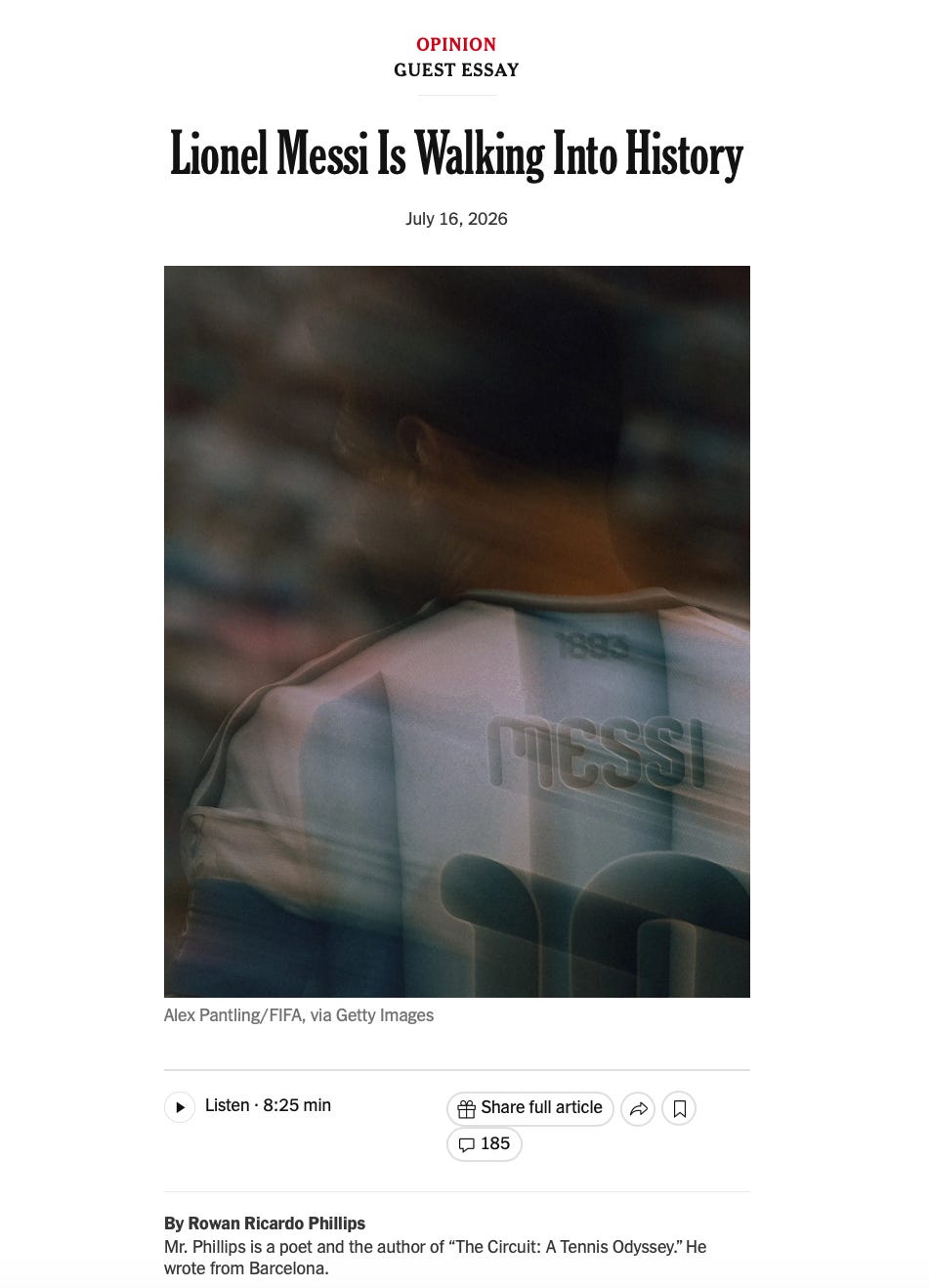
A Guest Essay written by a sports writer and poet about the legacy of Lionel Messi? Shove it directly into my eyes. What does Rowan Ricardo Phillips want to tell me about La Pulga?
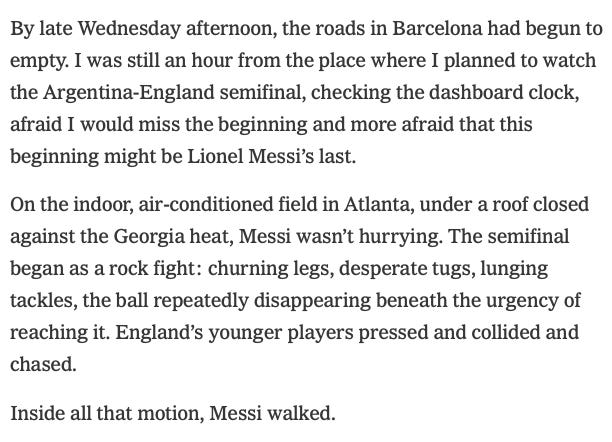
Huh. His style seems so familiar . . .
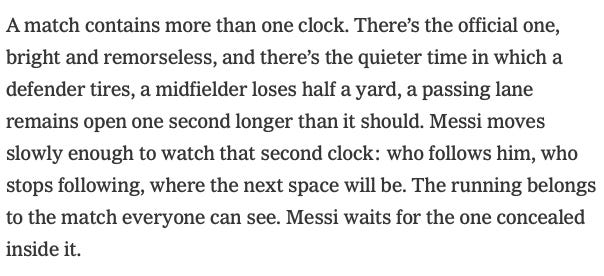
If you’re skimming, the metaphor almost makes sense, maybe? But you’d expect something more coherent from an author whose work has been longlisted for the National Book Award.
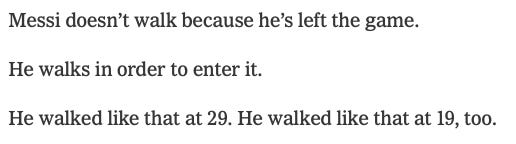
Ah. There it is.
Surely, you see now what the editors of the most important newspaper in the world missed. Here’s the score from Pangram for the first half of the article. If you’re unfamiliar, Pangram is the only reliable way to check if something is written by AI. It preferentially assumes that words were written by humans. False positives are a bigger problem than false negatives, according to its philosophy. So if Pangram says that a piece is written by or with AI, then it almost definitely was.
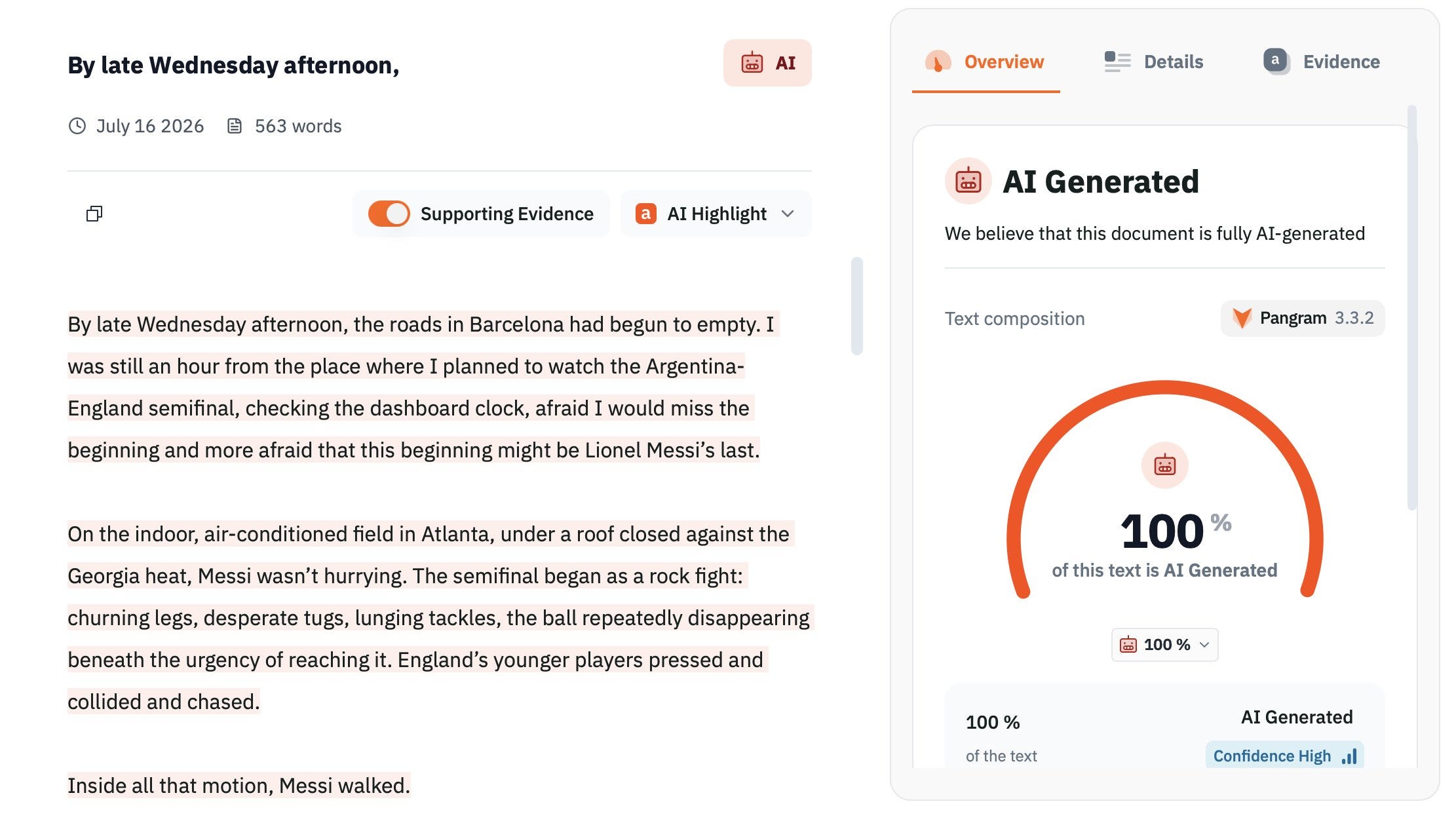
But you don’t really need Pangram to tell what Phillips is doing. His essay abounds with tripartite structures, fuzzy metaphors about quietness and concealment, and big paragraph breaks that set up quips so blasé you might as well just douse your phone screen in tapioca.
Maybe I’m overestimating how obvious the cues are if you don’t spend lots of time reading words generated through linear algebra. But come on — who writes like THIS about Messi’s sudden retirement from the national team?
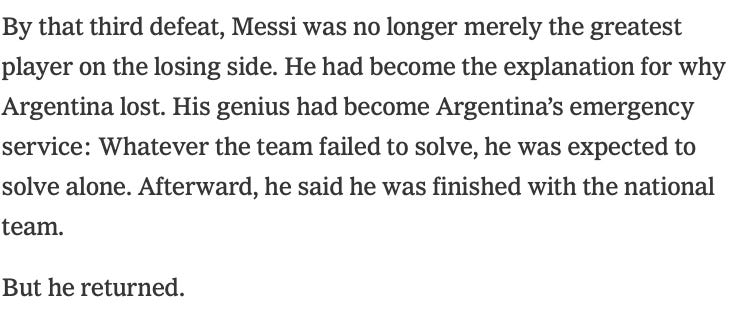
How moving. No interest in writing about the Argentines who burned Messi’s jersey in the streets, his empty stare as he announced his retirement to the world, or the subsequent nationwide exhortations for him to return (including one from his future teammate, a then-15-year-old Enzo Fernández)? Evidently not. He said he was finished . . . and then . . .
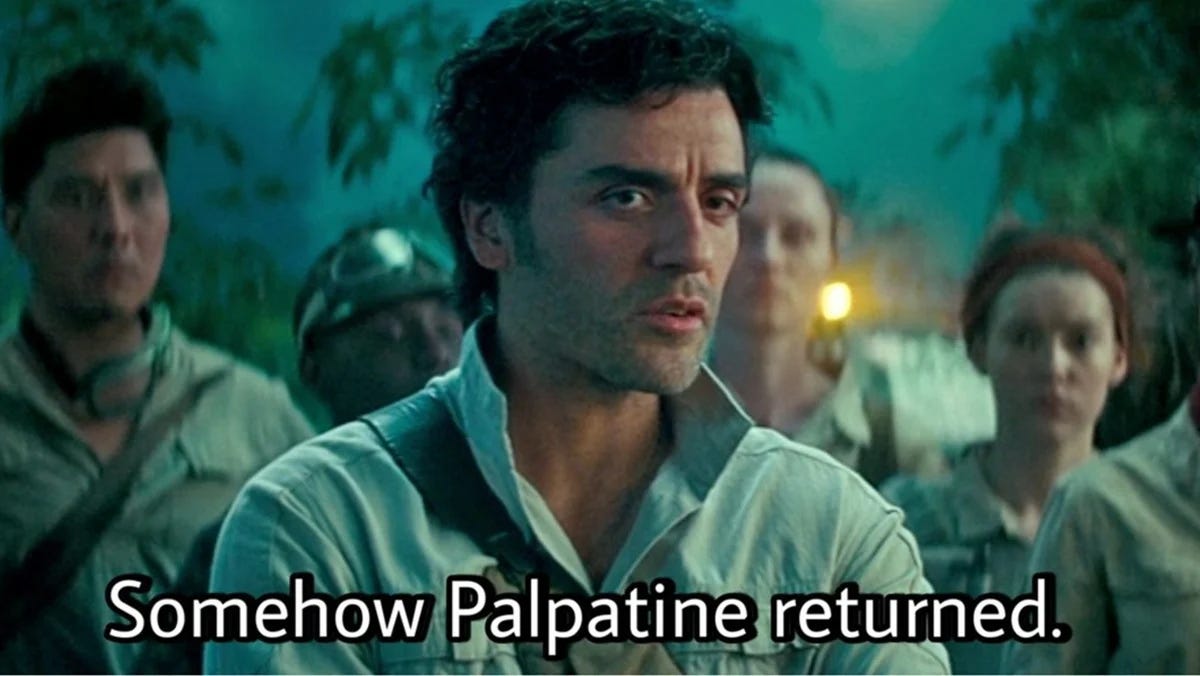
Bravo, Rowan.
In principle, I’m actually not opposed to AI-generated journalism. Major outlets publish lots of articles that ChatGPT could write already: for instance, the standard “New study says X, and it means Y” content that passes for most of modern science writing. I don’t care whether humans take charge of articles that mainly exist to transport information — the job of the author, in these cases, is spiritually akin to the job of an old-timey telephone operator. In the next ten years, perhaps much sooner, even the esteemed Gray Lady will automate those segments of her production.
But as Sasha Chapin has discussed, information transfer is not the only reason for us to write, or even the most important reason! Long-form text is not an efficient way to move information from one brain to another: that is not the medium’s comparative advantage. Instead, text is near-optimal for mind-merging. There is no other medium equally good (for now) at simulating someone else’s experiences in your head. We write to share our souls; we read to receive the souls of others.
Of course, I often do read for the sake of transferring information. But increasingly, I rely on AIs to generate the text — you can ask follow-up questions, ask for different analogies, create questions to test your knowledge, and so on. In that writerly province, they are already as good as or better than most human beings.
So if I clicked on an article announcing the results of a new scientific study and then realized it was written by ChatGPT, I wouldn’t care. I want all societal functions executed as well as possible. If AI executes some of them better, great. I can live with that, just as I can live with the fact that we no longer have telephone operators.
But I didn’t click on this essay about Lionel Messi so I could learn something new. I know everything about his career — there is simply no statistic, factoid, or anecdote the NYT could publish about him that I haven’t already memorized and debated with my brother. I clicked on the essay because I wanted to experience Messi through the eyes of another human being, one who (being a poet and award-winning author) should be uniquely equipped to scaffold that simulation. Even when we reach the point where AI writing can bring us to tears, an essay about the shared joy of watching great athletes will still need a human author.
The entire purpose of such an article is to bring a few members of Homo sapiens together. This is a domain where AI shouldn’t trespass — not because it can’t write well enough (it can’t yet, but it will), but because the function of the writing literally cannot be fulfilled by artificial intelligence. Nevertheless, Phillips persisted.
“Thank you for your beautiful essay,” says one commenter. “Watching Messi play was like watching poetry in motion. And reading your words put that poetry in motion on paper. Thank you for sharing.” I imagine an old man tapping out his gratitude with two fingers. Maybe he sends the article to his grandchildren. Maybe the grandchildren, better versed in this new world, explain to him that he is communing with no one at all. The old man feels embarrassed. He tries to remember when it became so hard to tell real from fake, or when that even became a meaningful question.
Do the editors of the New York Times disagree with this analysis? I doubt it. They probably just haven’t figured out how to make sure they aren’t being deceived.
Which is a bit surprising, given this whole debacle, in which essays published in the paper’s “Modern Love” column (pieces about relationships, feelings, betrayals, and revelations — you know, human experiences) were clearly written by AI.
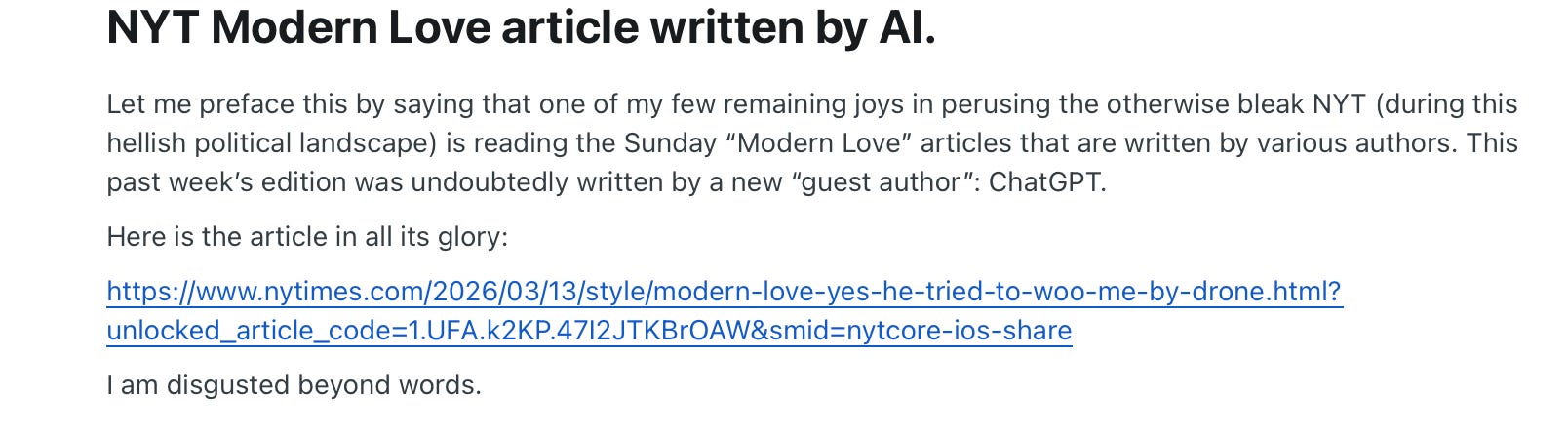
Not to mention the Times’ various articles and wacky games crusading against AI-written slop:

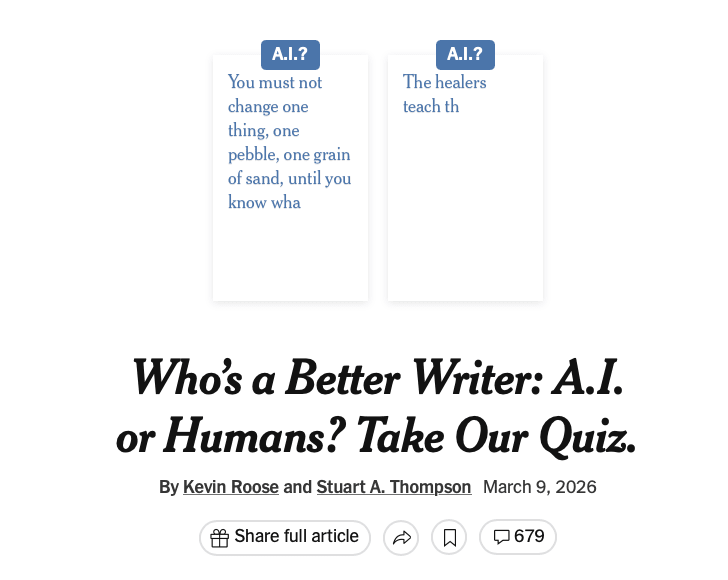
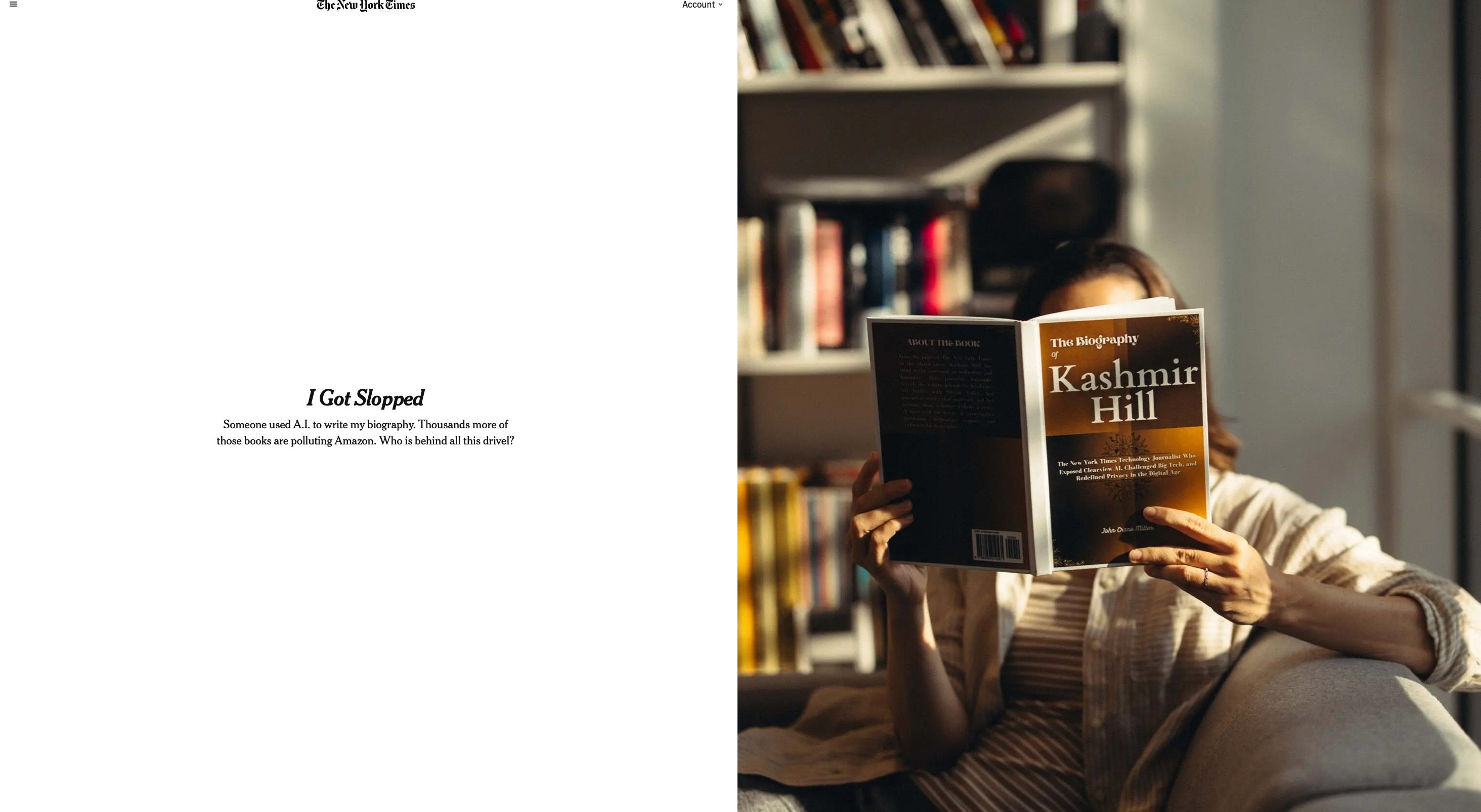
Perhaps the New York Times would like to avoid these situations in the future. I’ve heard that the editors take themselves pretty seriously. So, in case any of them happen to see this — here’s one simple way you can make sure you’re not scamming your readers into merging with matrix multiplication. It takes about ten seconds.
In 2019, before ChatGPT, Phillips wrote an essay about Messi called “They Think They Know You, Lionel Messi.” I read it in the Paris Review. It was beautiful. It made me feel like I knew him.
No posts
Comments
Nothing yet. Say the first thing.
Sign in to join the conversation.