
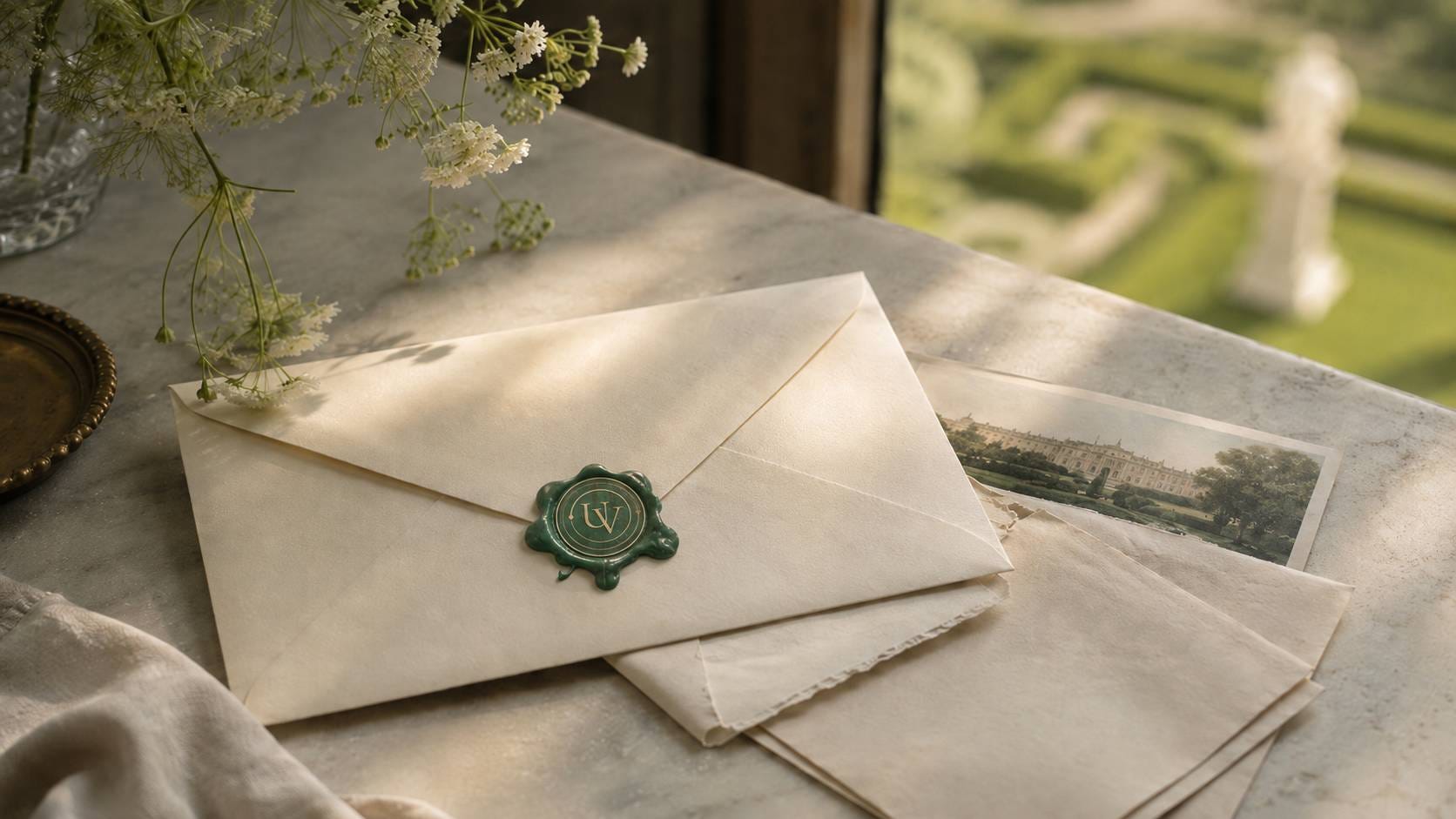
A letter changes the pace of the story before it is even opened.
There are messages that are improved by speed.
A train delay, a changed meeting place, a line from someone we love, sent quickly because the moment requires urgency. Much of ordinary life depends on this kind of immediacy, and there is a real mercy in being able to reach someone almost at once.
But not every form of communication is strengthened by arriving instantly.
Some things lose vitality when they appear too quickly, too brightly, too surrounded by other messages. A story can become another notification. An invitation can become another item in an inbox. Even beauty can be tarnished when it arrives in the same stream as reminders, receipts, headlines, confirmations, advertisements, and all the small demands that gather around modern attention.
A physical letter interrupts that stream differently.
It does not appear while you are doing something else. It waits patiently. It’s content has actual physical weight. It passes through hands, machines, bags, doors, buildings, weather, and distance before it reaches you. It arrives not as information alone, but as an event.
This is why I have been thinking about letters.
And this is why Post from Hidden Vienna exists.
A letter changes the relationship between writer and reader before the first sentence is read.
It asks for a different posture. You do not scroll a letter. You open it. You unfold it. You notice the paper, the spacing, the mark of the seal, the slight resistance of the envelope, perhaps even the place where it has been bent or handled on its way to you.
These are not decorative details. They are part of the reading.
The body understands that something has crossed a distance. The eye understands that this object is not endlessly reproducible in the same way a digital message feels reproducible. Even when a letter has been printed, it still becomes singular through its journey. It has come to this address, this table, this pair of hands.
A letter makes room around itself.
It does not demand the speed of reaction that a message often demands. It can be placed beside a cup of coffee, opened in the morning, returned to later, kept between pages, tucked into a drawer, or found again after the reason for receiving it has changed, or the intensity of emotions has faded.
This matters for a project like Understanding Vienna, because the work has always been concerned with attention. A city is not understood by speed alone. A story is not always best entered through announcement. Sometimes the threshold has to be physical.
Sometimes the first door is an envelope.
Vienna has always been a city of surfaces and interiors.
It knows the importance of façades, doors, courtyards, staircases, salons, cafés, passages, waiting rooms, writing desks, official papers, private notes, and the quiet choreography of who may enter where. It is a city where public beauty often stands beside hidden systems, and where a great deal happens in the space between display and privacy.
A letter belongs naturally to that kind of city.
It is both public and private. It travels through an official system, marked, sorted, stamped, and carried. Yet its meaning remains enclosed until the right person opens it. It has a visible outside and a hidden inside. It can be delayed, misdirected, preserved, damaged, treasured, forgotten, or rediscovered.
In that sense, the letter is not only a delivery method. It is a small architectural form.
It has an exterior and an interior. It has a threshold. It has a ritual of entry.
That is why a physical letter from Vienna feels different from an email about Vienna. An email can tell you that something exists. A letter can make the act of receiving part of the story.
Post from Hidden Vienna is not meant to be a souvenir from a pretty city.
Vienna has enough souvenirs.
This is something quieter: a literary correspondence series from within the world of Understanding Vienna. The first version will likely be Post from Hidden Vienna: The First Whisper Letters, a twelve-month sequence of physical letters connected to the world of The First Whisper.
The idea is simple in shape, but not simple in feeling.
Each month, a letter would arrive from a different voice inside or near the story world. The first may come from Christoph, a fifteen-year-old apprentice gardener at Schönbrunn in 1777. Other voices may follow from the garden, the household, the court, the archive, or the edges of history where the official record grows thin.
The envelope may carry more than the letter itself: perhaps a postcard or visual companion, a small insert connected to the character or season, a QR code leading to sound, music, atmosphere, or a hidden digital page, and a seal that makes the opening feel deliberate.
But the point is not to fill the envelope with things.
The point is to let the story arrive in a form that changes how it is received.
A book is usually imagined as the beginning.
One waits for the publication date, the cover, the announcement, the launch. Then the story begins.
But some stories begin earlier than that. They gather themselves through fragments, voices, objects, traces, and small acts of attention. They begin when a reader encounters something that does not yet explain itself completely.
Before the book opens, a letter may arrive.
That sentence has stayed with me because it changes the order of entry. It allows the reader to come toward the story not through summary, but through correspondence. Not through a marketing description, but through a voice. Not all at once, but month by month.
There is trust in that slowness.
A letter does not need to reveal the whole world immediately. It can suggest, intimate, misdirect, remember, conceal, or confess. It can leave something unsaid and allow the reader to carry the silence until the next envelope comes.
That feels right for The First Whisper, because the story itself is shaped by things half-heard, half-hidden, inherited, lost, and found again.
It also feels right for Vienna.
Waiting is often treated as an inconvenience. In many parts of life, it is.
But waiting can also create meaning.
A monthly letter gives the reader time to live with one voice before another arrives. It allows the imagination to continue between installments. It makes absence part of the structure. The next letter is not simply more content. It is a return.
This is very different from bingeing a story. It is closer to older rhythms of correspondence, serial reading, seasonal observance, and anticipation. The reader does not merely consume the whole thing. The reader keeps company with it.
That is the atmosphere I want Post from Hidden Vienna to hold.
Not urgency.
Not scarcity for its own sake.
Not the pressure to keep up.
But a slower exchange between place, story, paper, and reader.
Because Post from Hidden Vienna will be physical, it will also be practical.
Paper has to be chosen. Printing has to be tested. Envelopes have to survive the post. International postage has to be calculated. The seal must be beautiful without causing problems in delivery. The object must feel intimate, but still be possible to produce and send with care.
That is one reason this project will not be handled as an ordinary Substack paid tier.
The Salon will remain the digital essay home of Understanding Vienna. It is where the reflections, notes, and invitations gather. Post from Hidden Vienna will be a separate paid physical correspondence subscription, with its own waitlist and, when ready, its own checkout.
The distinction matters.
The Salon is the room.
The letter is the thing that travels from it.
For now, Post from Hidden Vienna is gathering its first circle of interested readers.
The letters are not yet traveling. The details are still being shaped. But the direction is clear: a paid physical literary correspondence series from Vienna, beginning with letters from the world of The First Whisper.
Twelve months.
Twelve voices.
One story arriving slowly from Vienna.
Not because slowness is quaint.
Because some forms of attention can only be protected by changing the pace of arrival.
A physical letter does that.
It gives the story a threshold.
It asks the reader to open the door.
Join the Post from Hidden Vienna waitlist
Receive slow essays, field notes, and cultural fragments from Vienna.
If this reminds you of someone who still loves letters, paper, Vienna, or stories that unfold slowly, you are warmly invited to share it.
Share Understanding Vienna: The Salon
You are reading The Salon from Understanding Vienna, a place for slow essays, hidden places, visual memory, and cultural storytelling from Vienna.
Post from Hidden Vienna is a future paid physical letter subscription from the quieter rooms of Vienna. The waiting list is open.
Comments
Nothing yet. Say the first thing.
Sign in to join the conversation.