
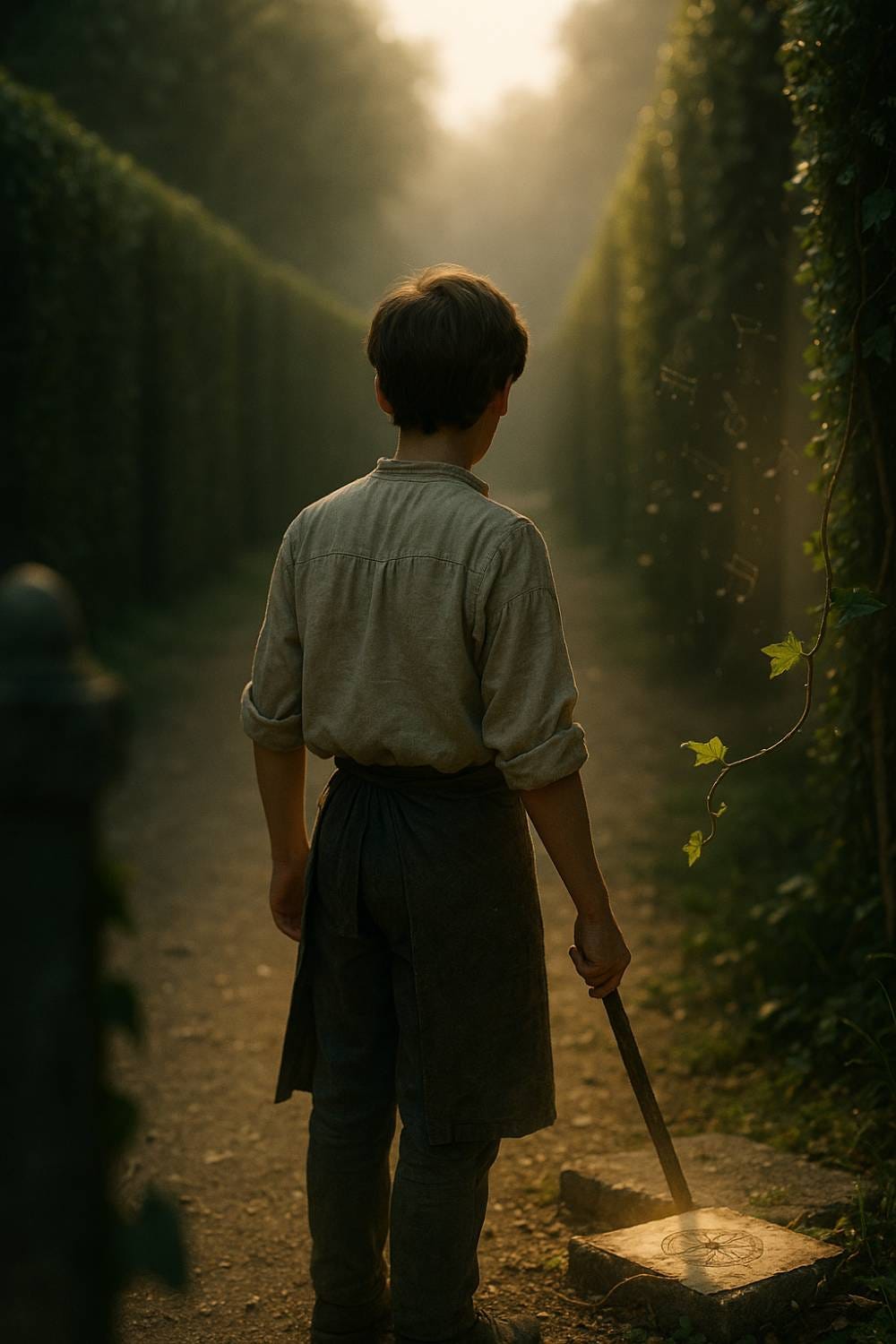
Before the book opens, the first voice may come from the garden.
There is a cover, a publication date, a description, perhaps a first chapter, perhaps a glimpse of the world to come. The book arrives as a completed threshold. We open it, and only then do we enter.
But I have begun to wonder whether some stories ask for a different kind of entrance.
Not because the book matters less, but because the world around the book has already begun to gather. A place, a voice, an object, a season, a room, a garden path, a half-remembered name. These things can begin to call before the story has been bound between covers.
That is the idea behind the first Post from Hidden Vienna series.
Before the book opens, the first letter may arrive.
Join the Post from Hidden Vienna waitlist
The first letter may come from Christoph.
He is fifteen years old in 1777, an apprentice gardener at Schönbrunn. He belongs to the working life of the palace gardens, not to the glittering rooms that visitors usually imagine first. His world is one of tools, weather, discipline, hedges, gravel, early mornings, inspections, and the quiet knowledge that comes from noticing what others pass without seeing.
This matters.
A story set near Schönbrunn could begin with grandeur. It could begin with the palace façade, with ceremony, with a court figure entering a room full of polished surfaces and guarded speech. Those things belong to the world, of course. They have their place.
But Christoph stands closer to the ground.
He sees the garden not as a picturesque view, but as a living system. He knows where the paths turn, where the hedges thicken, where a tool has been moved, where a voice should not have been heard, where an instruction seems ordinary until later it does not.
A letter from him would not explain everything.
It would not announce the whole story.
It would arrive as a fragment from inside the world before the reader has been given a map.
That is why he feels like the right first voice.
A book can carry a reader into a world with great force. It can gather chapters, characters, places, tensions, and revelations into a shape that holds.
A letter does something else.
A letter is partial by nature. It belongs to a moment. It may be written before the writer understands what is happening. It may reveal more than it intends. It may conceal something out of fear, loyalty, confusion, or habit. It may carry the tone of a person who is not narrating history, but simply trying to speak across distance.
That incompleteness is part of its power.
When a reader receives a letter before the book, the relationship to the story changes. The reader is not only being told about a fictional world. The reader has been addressed by it.
There is a difference between reading a description of Christoph and receiving a letter that seems to have crossed time from his hand to yours. The second form asks the imagination to participate differently. It allows the story to begin not as summary, but as correspondence.
It also protects mystery.
The first letter should not tell too much. It should let the reader feel the world before understanding its full design. It should give enough to awaken attention, but not enough to close the question.
A rustle in the hedge. A name spoken too quietly. A mark on paper. A warning disguised as an ordinary instruction. A boy who has learned to notice because noticing is sometimes the only power available to him.
The story begins there.
Enter the world of The First Whisper
Schönbrunn is one of those places that risks being known too quickly.
The name arrives already polished by expectation: palace, empress, gardens, yellow walls, imperial rooms, grand alleys, fountains, tour groups, photographs, memory cards, postcards, souvenirs. It is easy to believe the place has already explained itself because it has been so often described.
But Schönbrunn was never only a view.
It was a working environment, a stage of power, a household, a system of rank, a designed landscape, a place of beauty, discipline, maintenance, display, and hidden labor. Its gardens did not simply exist to be admired. They were planned, planted, clipped, watered, repaired, guarded, and read by people whose names rarely remain in the foreground.
Christoph belongs to that quieter Schönbrunn.
To enter through his letter is to enter the palace world from the side, through the garden, through work, through attention. The reader does not begin as a tourist looking at the palace from the outside. The reader begins closer to the ground, where the gravel shifts underfoot and the day is measured by tasks.
This is one reason the physical letter form matters.
An email about Christoph would still be an email. It would arrive in the same place as appointments, receipts, advertisements, reminders, and obligations. A physical letter changes the threshold. It asks the reader to pause before entering.
For a story shaped by hidden voices, delayed knowledge, memory, and misread signs, that pause is not decorative.
It is part of the form.
The first Post from Hidden Vienna series is imagined as a year of letters from the world of The First Whisper.
Not a box of merchandise. Not a souvenir packet. Not a random assortment of pretty things from Vienna.
A correspondence.
Each month would bring one voice closer. The phrase I keep returning to is simple: twelve months, twelve voices, one story arriving slowly from Vienna.
Christoph may open the door. Others may follow from the garden, the household, the court, the archive, or the edges of history. Some voices may be intimate. Some may be guarded. Some may know more than they say. Some may misunderstand what they have seen. Some may believe they are writing about one thing while revealing another.
That is how correspondence works.
A letter is never only the message it intends to send. It also carries the limits, fears, loyalties, habits, and blind spots of the person writing it. It carries the moment of its making.
This is especially important for a historical story-world. History is not experienced by the people inside it as “history.” It is weather, duty, gossip, hunger, fatigue, ambition, rumor, obedience, prayer, affection, danger, and the next task that must be done before evening.
A letter can hold that immediacy.
It can let a character speak from within the uncertainty of the moment.
There is another reason I am drawn to this form.
A book has readers.
A letter has recipients.
The difference is subtle, but it changes the emotional contract. A reader may admire, interpret, analyze, or consume. A recipient has been chosen by the letter’s arrival. The object has crossed distance and come to rest in their hands. It creates a small fiction of address, and sometimes that fiction is enough to alter the way a story is received.
This is not about pretending the boundary between fiction and life has disappeared. The boundary matters. The reader knows the letter belongs to a literary project.
But within that frame, the letter can still create a more intimate kind of entry. It can say: you are not outside the world looking in. For a moment, the world has written to you.
That is the experience I want Post from Hidden Vienna to make possible.
Not immersion as spectacle.
Immersion as attention.
The first letter comes before the book because the story itself is concerned with things that arrive out of order.
Whispers before explanations.
Fragments before maps.
Objects before certainty.
Memories before proof.
A child notices something before an adult has decided whether it matters. A garden holds a pattern before anyone knows how to read it. A place keeps speaking long after the official story has moved on.
It would feel wrong to introduce that world only through announcement.
A letter is gentler and more unsettling. It can arrive as if it has slipped loose from the story before the story is fully open. It can give the reader one voice, one moment, one trace, and then ask them to wait.
Waiting is part of the design.
The space between letters lets the world breathe. It gives each voice time to echo. It allows the reader to wonder what connects them, and what has not yet been said.
In a culture of instant arrival, that kind of waiting is not a weakness.
It is a literary choice.
There will be time later to explain more.
There will be time for the book, for the larger story-world, for the archive layer, for the visual clues, for the historical threads, for the figures who stand at the edge of the garden and do not yet know they are being watched.
But the first letter should not carry all of that.
It should carry enough.
Enough atmosphere to open the door. Enough voice to make the reader lean closer. Enough uncertainty to make the next month matter. Enough Schönbrunn to place the story, but not enough explanation to flatten it.
Perhaps that is what I want most from the first envelope: not completeness, but arrival.
The feeling that something has begun.
The sense that the story has crossed a distance before the book is in your hands.
Before the book opens, the first letter arrives.
And perhaps, if it does its work properly, it leaves the reader listening for the next one.
If this reminds you of someone who loves Vienna, letters, story worlds, hidden places, or historical fiction, you are warmly invited to share it.
Share Understanding Vienna: The Salon
You are reading The Salon from Understanding Vienna, a place for slow essays, hidden places, visual memory, and cultural storytelling from Vienna.
Post from Hidden Vienna is a future paid physical letter subscription from the quieter rooms of Vienna. The first series is imagined as The First Whisper Letters, beginning with a voice from the garden.
Comments
Nothing yet. Say the first thing.
Sign in to join the conversation.