
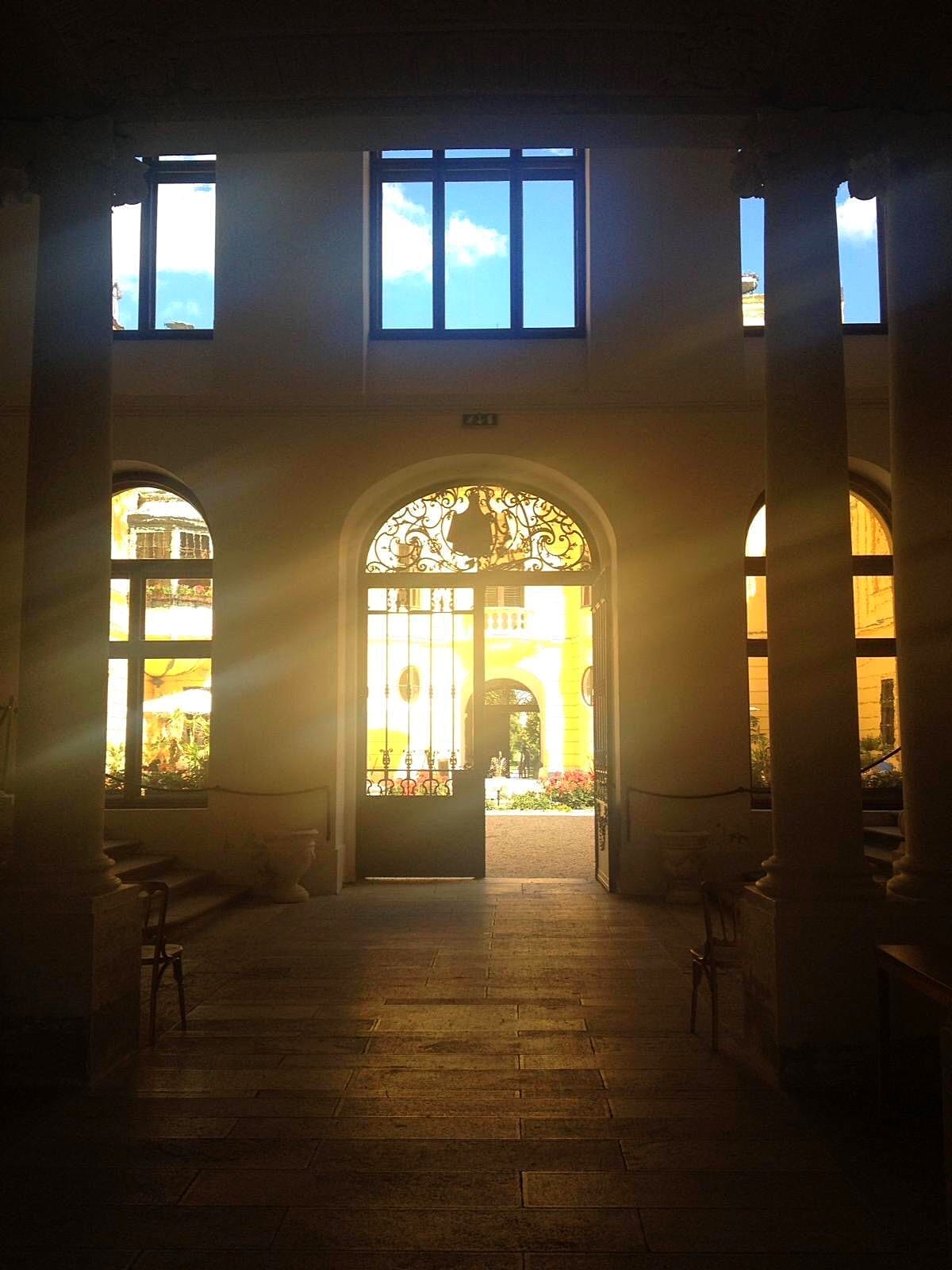
The deeper city often begins at a threshold.
That is part of its power. The city knows how to arrange a first impression. A palace façade catches the light. A dome lifts itself above the street. A café table waits beside a window. A garden path seems to know exactly where the eye should travel. Even a brief visitor can leave with images that feel complete.
But admiration is not the same as understanding.
A city can be beautiful before it is legible.
To read Vienna slowly means to stay with the city after the first impression has done its work. It means allowing the surface to become more than surface. It means looking again at what seemed obvious, and asking why it was made to appear that way.
A doorway is rarely only a doorway. It decides who enters, who waits, who is received, and who slips through unnoticed. A garden is rarely only a garden. It can be an argument about order, power, leisure, season, and control, softened by leaves and flowers until the argument almost disappears. A façade is rarely only a façade. It is a public face, carefully composed, while other stories continue behind it.
Vienna is full of such arrangements.
The city does not reveal itself by withholding beauty. It reveals itself by placing beauty in layers.
There are cities that explain themselves through spectacle. Vienna is more complicated than that. It can be spectacular, certainly, but its deeper meanings often gather in quieter places: the threshold between public and private, the side entrance beside the ceremonial one, the worn step, the courtyard glimpsed through an open gate, the change in paving stones, the figure carved above a window whose name no one remembers.
To read Vienna slowly is not to reject the grand view. The grand view matters. Schönbrunn matters. The Ringstraße matters. The museums, churches, theatres, cafés, gardens, and imperial rooms all belong to the city’s visible language.
But the visible language is not only decorative. It is structured. It tells us what a society wished to display, what it wished to discipline, what it hoped to preserve, and what it allowed to fade into the background.
A palace is not merely a beautiful building. It is a system of movement. Certain bodies moved through certain doors. Certain voices were heard in certain rooms. Certain forms of labor were hidden so that ceremony could appear effortless. The polished surface depended on countless acts of maintenance, repetition, timing, and obedience.
A garden, too, can be read this way. From above, it may appear harmonious and still. From within, it begins to ask different questions. Who designed the path? Who trimmed the hedges? Who carried water? Who knew the rhythm of the seasons not as scenery, but as work? What kind of world is being imagined when nature is made to stand in rows?
The city becomes more interesting when beauty is not treated as the end of thought, but as its beginning.
Reading Vienna slowly does not mean longing for an invented past.
It does not mean placing the city under glass, or asking it to remain imperial, picturesque, and undisturbed. It does not mean pretending that older forms were gentler because they were ornamented, or that ceremony was harmless because it was graceful.
Slowness is not nostalgia.
It is a method of attention.
It allows contradiction to remain visible. Vienna can be beautiful and uneasy at the same time. It can be elegant and hierarchical, intimate and theatrical, generous and guarded. It can invite admiration while also asking difficult questions about power, class, empire, language, belonging, and memory.
A hurried gaze often turns complexity into atmosphere.
A slower gaze lets atmosphere lead back toward history.
This matters because Vienna is very good at charm. It knows how to soften its own edges. Gold leaf, garden gravel, coffee cups, music, pastry, and winter light can create the impression that history has become gentle with age. But history does not become gentle simply because it has acquired patina.
The task is not to strip away the charm. That would be too easy, and also untrue.
The task is to let charm become more intelligent.
Some of the most revealing parts of Vienna do not announce themselves as important.
They wait at the edge of the official view.
A service door beside a grand entrance. A narrow passage behind a polished room. A courtyard where the sound changes. A modest sign with language from another time. A stone worn down by use rather than ceremony. A photograph where the most interesting thing is not the building itself, but the small detail almost outside the frame.
These fragments matter because they resist being consumed quickly. They do not perform importance in the obvious way. They ask the viewer to become a different kind of reader.
This is why visual attention is central to Understanding Vienna.
A photograph is not only a record of what was there. It is a form of asking. Why this surface? Why this threshold? Why this trace of use, this hinge, this shadow, this window, this interruption? What happens when the eye is allowed to rest on something that would normally be passed over?
This is also why the Field Guide became one of the first doorways into the project.
In Vienna, small evidence often leads toward larger structures.
A door may lead to a hierarchy. A garden detail may lead to a philosophy of order. A café ritual may lead to questions of time, habit, class, and belonging. A decorative figure may open onto mythology, empire, education, or forgotten systems of meaning.
The city is not only read through monuments.
It is read through traces.
To read Vienna slowly is not only to look more carefully. It is also to listen for the atmosphere of a place before translating it into facts.
Atmosphere is often the first way a place begins to instruct us.
Long before we can explain why a room feels ceremonial, why a courtyard seems private, why a path encourages us to slow down, or why a façade draws the eye upward before allowing it to rest, the body has already understood something. It has registered scale, shadow, distance, sound, proportion, and the quiet discipline of arrangement.
Vienna is especially skilled at this form of instruction.
The city often teaches without announcing that it is teaching. A grand entrance tells one story, while a side passage tells another. A palace garden may appear serene because every trace of effort has been carefully absorbed into order. A café may seem informal, yet still preserve a ritual of time, posture, repetition, and belonging. Even a street corner can hold a subtle lesson in hierarchy: what was meant to be seen, what was meant to be used, and what was expected to remain almost invisible.
To read Vienna slowly is to become attentive to these arrangements.
Not only to what stands before us, but to the way it asks us to move, pause, look, enter, wait, remember, or pass by.
We live in a time that encourages places to become content.
A city is photographed before it is encountered. A room is filmed before it is felt. A journey becomes a sequence of proof: I was here, I saw this, I captured it, I moved on.
There is nothing wrong with images. Understanding Vienna depends on them. But an image can either deepen attention or replace it.
The difference lies in the quality of looking.
When we move too quickly, places flatten. They become backdrops for our own passage through them. The city becomes a collection of signs already translated for us: palace, café, museum, market, view. We stop asking what those words contain.
Slow looking is a way of refusing that flattening.
It allows a place to regain its depth. It gives the city time to become strange again, even if we thought we knew it. Especially if we thought we knew it.
There is a particular danger in familiar beauty. The more often we pass something beautiful, the more easily it disappears. Not because it has lost meaning, but because we have stopped allowing it to surprise us.
Reading Vienna slowly means restoring the possibility of surprise.
It means standing before something familiar and asking, with genuine patience: what have I not yet seen?
This is why Understanding Vienna cannot live in only one form.
Some observations need the spaciousness of an essay. Others arrive as field notes, brief but precise. Some require photographs, because the evidence is visual before it is verbal. Some belong in a guide, where a reader can be invited to practice a way of seeing. Some may become letters, because correspondence has its own patience. Some may enter story, because fiction can sometimes approach truths that direct explanation cannot hold.
The form matters because pace changes perception:
A checklist is useful when the purpose is efficiency, but it rarely allows a place to thicken in the mind.
An essay offers a different kind of attention. It gives the reader time to remain with an image, to test an interpretation, to feel how a visible detail might lead toward a hidden structure.
A photograph can do something similar when it is not treated as decoration, but as evidence. It allows the eye to return to a surface, a threshold, a shadow, a trace of use.
A letter slows the exchange even further. It carries distance, anticipation, and the intimacy of being addressed.
A walk teaches through the body, through hesitation, fatigue, weather, rhythm, and the small corrections of direction that no map can fully replace.patient.
Understanding Vienna is built around these slower forms because Vienna itself rewards them. The city is not a single subject. It is an accumulation of surfaces, memories, designs, absences, rituals, voices, and inherited ways of seeing.
No single form can hold all of that.
But each form can open one door.
To read Vienna slowly, you do not need to begin with the whole city.
The whole city is too much.
Begin with one thing.
A doorway you pass often. A garden path. A window. A café table. A figure on a façade. A street corner where the light changes. A staircase whose curve seems more deliberate than necessary. A sign whose wording belongs to another era. A place that has become so familiar that you no longer really see it.
Stay with it a little longer than usual. Not in order to force meaning from it, but to let the first certainty soften. A doorway, for example, may begin as an architectural detail and then become a question of access. Who was expected to enter through it? Who used another door? Who kept it polished, repaired, opened, guarded, or passed through without being seen? A garden path may first appear graceful, then slowly reveal how carefully it directs the body and the eye. Even beauty begins to change when one asks what kind of order made it possible.
Not because the city has become new, but because your attention has become more patient.
Vienna reveals itself slowly.
The deeper city begins when attention slows down.
New readers can begin with Welcome to The Salon.
You are reading The Salon from Understanding Vienna, a place for slow essays, hidden places, visual memory, and cultural storytelling from Vienna.
Subscribe free to receive the next note.
If this essay reminds you of someone who loves Vienna, hidden places, visual memory, or slow cultural travel, you are warmly invited to share it.
Share Understanding Vienna: The Salon
Comments
Nothing yet. Say the first thing.
Sign in to join the conversation.