
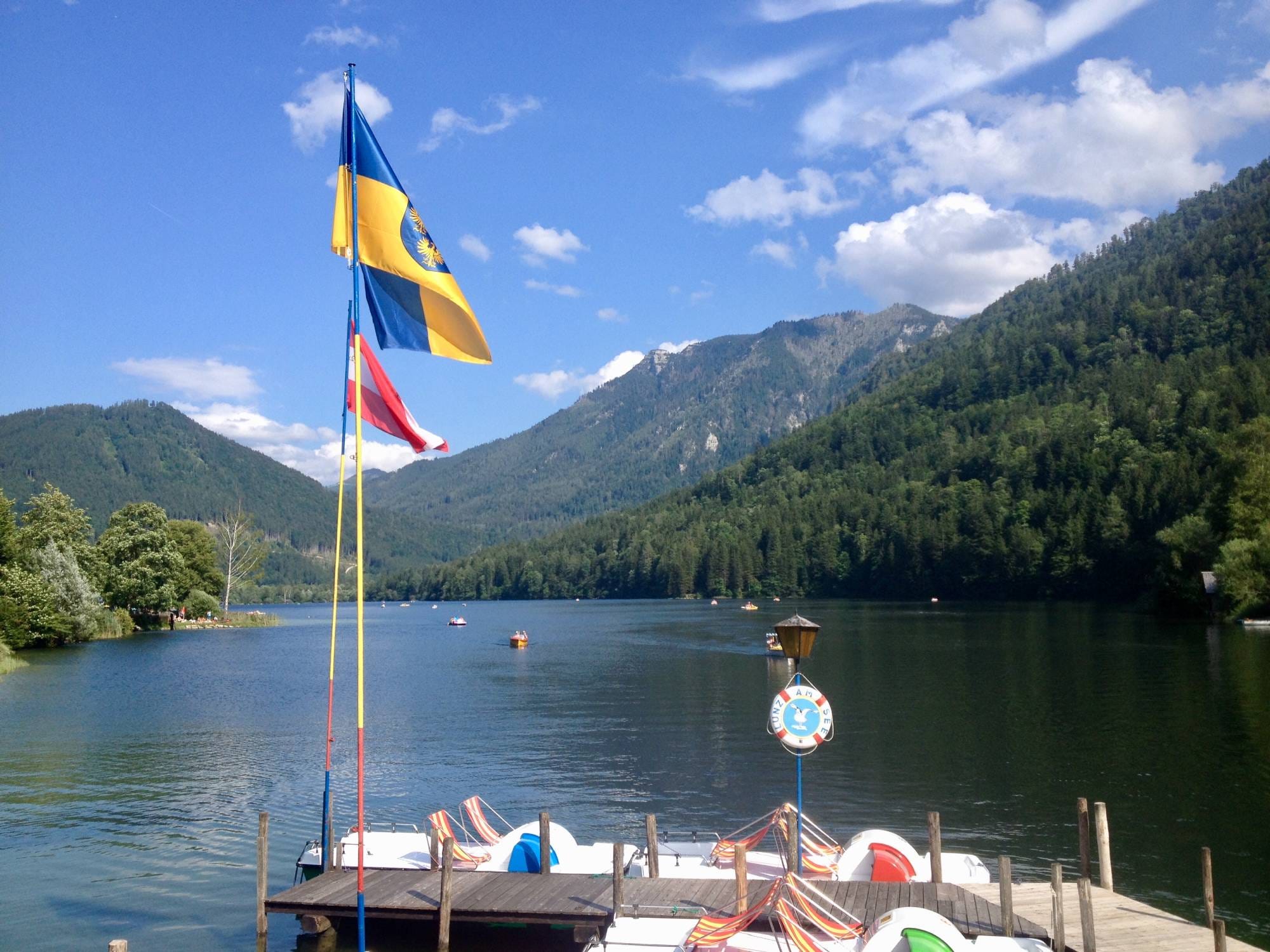
A summer occasion begins before we enter it. Lunz am See offers water, mountain landscape, and the possibility of allowing the lake to become the day.
Summer can feel as though it never truly began when logistics replace anticipation, every week is scheduled, and we move from one experience to the next before any of them can settle. Sommerfrische offers another rhythm: something to look forward to, a threshold into a different way of living, time to receive what happens, and something to carry home.
While researching Sommerfrische, I kept encountering a curious contradiction.
Many adults could describe their summers with considerable precision: where they’d gone, how long they’d stayed, what they’d booked, and which activities they’d managed to fit in. Yet when they tried to explain whether those weeks had restored or enriched them, certainty often gave way.
They didn’t necessarily sound unhappy. Their lives were moving and often contained rewarding activities. They were working, seeing friends, raising families, taking holidays, attending concerts, and keeping full calendars. What seemed to have weakened was harder to name: excitement and the joy of anticipation.
A holiday had become something to organize, an outing another calendar entry. Even an experience they genuinely wanted could arrive already crowded with responsibilities, expectations, and decisions. Summer was happening, but it didn’t always feel fully inhabited.
Childhood memories arrived differently. People recalled wet hair after swimming, freshly cut grass, chalk on warm asphalt, evenings with cousins, and whole days spent riding bicycles with friends. These weren’t necessarily elaborate experiences. They were ordinary, sensory, and shared.
None of these comments amounted to a scientific survey, of course. What caught my attention was how often the same difficulty appeared, and how vividly people described summers they had truly received.
That stood out because my own experience has often been different. Even summers interrupted by work have left me with remarkably precise memories: the pink batik Indian cotton dress I changed into before driving to the Alte Donau, Sade’s “Kiss of Life” playing through the open windows, the wooden dock beneath the weeping willow in front of the Naturfreunde, and the first shock of the blue-green water.
I remember looking forward to those afternoons before they began. The swimsuit waiting in my bag altered the shape of the working day. The dress, the drive, and the music created a sense that I was approaching a threshold. By the time I reached the water, some part of me had already begun moving toward it.
How would you answer this question: What has summer given you so far? Would you begin with the places you’ve been, what you saw, and how long you stayed? Or would the answer arrive through a concrete sensory memory of a moment that enriched you?
My next questions are: What did you look forward to before those moments happened? Did you leave enough space around them, for each one to become emotionally distinct from the days around it?
That leads me to a more unsettling question:
When did we stop looking forward to our own lives?
The question sounds more dramatic than the condition it describes. We may not be unhappy, and nothing may be obviously wrong. Our lives may be busy, responsible, and even full. Yet perhaps fewer things call us forward than they once did. We participate in what has been arranged, but anticipation has weakened, and even good experiences are quickly absorbed into obligations, photographs, updates, and plans for what must happen afterward.
Why do some summers restore us and become part of us, while others, sometimes fuller and more expensive, leave very little behind? And if summer has already begun to disappear into work, logistics, heat, and ordinary responsibilities, can we still change what remains of it without turning the season into one more project?
It would be easy to conclude that adult summers disappear because they’re too short, and there’s some truth in that. School calendars once protected childhood summers in a way that working life rarely protects adulthood.
I’m no longer certain, however, that today’s school calendar automatically gives children the spaciousness we remember. I see in my own circle how thoroughly a child’s summer can now be scheduled.
One friend’s daughter has a week in the Salzburg region with a friend, another week in Apulia with her mother, a family friend, and their daughters, another week hiking in the mountains with her parents and two sisters, and three weeks in Lithuania, where she travels by car with her parents and dog to stay with her grandparents. In between, she has at least five weekends of equestrian competitions and rides on most other days.
These are all valuable experiences. Her summer contains travel, family, friendship, sport, animals, time outdoors, and time with her grandparents. Her parents know her well, involve her in many decisions, and choose activities they know she enjoys. Riding and equestrian competitions may be among the places where she feels most alive.
The problem isn’t activity itself, nor is it that the child has no say. Our parents also decided where and how we spent many of our summers. Within those arrangements, however, we often had large stretches of unscheduled time that we could fill, or not fill, as we pleased.
This example shows how completely the rhythm of school and work can continue into summer. The destinations change, but the structure remains. One organized week follows another, while competitions, travel, and regular commitments fill the intervals.
What disappears isn’t necessarily choice. It’s unclaimed time.
There’s little room for doing nothing, hanging around, becoming absorbed in something unexpected, or experiencing what German expresses so well as Muße: free time and inner quiet in which we can follow our own interests. Italian offers another beautiful expression, il dolce far niente, the sweetness of doing nothing.
Both describe something more meaningful than idleness. They suggest open time in which nothing has to be achieved, yet attention, imagination, and pleasure can develop.
The difficulty lies not only in how full summer becomes, but also in how quickly one thing replaces another. Before one journey has settled, our attention has already moved toward the next.
When does anticipation have time to gather? When does the pleasure of the previous week settle into memory? When do we have time to feel what an experience gave us before the next departure demands our attention?
The rhythm can begin to resemble scrolling. One attractive experience follows another, just as one post replaces the previous one before we have fully received it. The experiences themselves may be meaningful, but too little space separates them. Anticipation, participation, and remembrance begin to collapse into one continuous flow.
Adult summers face another version of the same pressure. Work continues, homes require attention, children need organizing, and journeys involve planning, packing, and paying. Even a holiday may mean transferring an entire household’s needs from one place to another.
I won’t pretend that an evening walk or a thoughtful ritual can compensate for inadequate leave, financial pressure, chronic exhaustion, caregiving responsibilities, grief, poor health, loneliness, or a life that offers too little freedom. Attention doesn’t remove structural limits, and Sommerfrische can’t replace the support, treatment, rest, or material change someone may genuinely need.
I don’t want to dismiss holidays either. Of course getting away can help. A different landscape, room, or daily rhythm may be exactly what we need. But we can still arrive carrying the urgency, expectations, and habits we hoped to leave behind.
Sometimes logistics consume an experience before it begins. We compare hotels, coordinate dates, reserve tables, plan routes, and decide what everyone should see. We may read so many reviews and study so many photographs that the destination feels oddly familiar before we arrive.
The future occasion exists, but mostly as a task under management, with little room left for longing. Anticipation isn’t the same as planning. Planning arranges what will happen. Anticipation changes the emotional atmosphere of the days before it happens. We may need both, but they aren’t interchangeable.
Departure isn’t the same as arrival either. We may reach the lake while continuing an argument from the office in our heads, arrive at the hotel and immediately begin organizing the following morning, or photograph the sunset while answering a message we’d promised ourselves not to open.
The body has changed location, but the mind still carries the previous day. We can bring the same urgency, comparisons, checklists, phone habits, and productivity mindset into the most beautiful destination.
A holiday can therefore happen without becoming fully ours. We may appear in the photographs while remaining partly absent from the experience. That doesn’t mean we’ve failed to appreciate where we are. It means that changing location hasn’t necessarily interrupted the way our lives are running.
The deeper questions aren’t only where we went, what we saw, and how long we stayed. They are also how we arrived, what we allowed ourselves to anticipate, what we noticed while we were there, what didn’t need to become useful, and what returned home with us.
That interruption, and everything that grows around it, is where Sommerfrische begins.
Sommerfrische is one of those German words that loses something in translation.
Historically, it described leaving the city for a recreational summer stay in the countryside, mountains, or beside water. Some families used their own summer houses, but ownership wasn’t essential. People also rented rooms or stayed in inns, pensions, and hotels.
Access was never equal. Money, time, working conditions, health, and family circumstances shaped who could leave, where they could go, and how long they could remain.
Nor was Sommerfrische necessarily silent or slow. It could be sociable, eventful, and carefully scheduled. Historical accounts describe summer life filled with visits, outings, bathing, entertainment, and anticipation of returning to familiar people and places.
English often translates the word as a summer retreat or a summer stay in the countryside, but neither phrase quite expresses what I hear in it.
I’ve come to think of Sommerfrische as a personal summer refresh.
Think of the way you refresh the screen of a mobile phone. You don’t erase the page or replace it with something unrelated. You pause what’s running, allow it to reconnect, and bring it back into view renewed and current.
Sommerfrische asks us to do something similar with our lives. We interrupt the way they’ve been running, change place or rhythm, and reconnect with something that ordinary life may have pushed into the background. Then we return, not to an entirely different life, but to our own life seen through fresher eyes.
That’s why I prefer refresh to reset. A reset can imply wiping everything clean and beginning again. A refresh preserves what’s already present and renews our contact with it.
Historical Sommerfrische created another seasonal life outside the city, with its own routines, relationships, bathing places, excursions, social calls, and cultural events. It could be busy, sociable, and full of expectations.
Yet it also placed something on the horizon. There were rooms to arrange, familiar places to return to, people one expected to see, and another version of daily life waiting elsewhere. The season began partly through anticipation.
The practice couldn’t guarantee that every participant felt joyful, restored, or fully alive, but it gave summer a recognizable form. People prepared to leave, entered another place and rhythm, and later returned to Vienna.
Today, we may have more reservations in our calendars but fewer occasions that alter the emotional texture of the days leading toward them. We know what we booked, but we don’t always feel ourselves looking forward to it.
What this older rhythm makes visible is an assumption we rarely question: that summer becomes meaningful simply because we fill it with recognizably summery things. Sommerfrische suggests that a season can acquire its character just as much through anticipation, repeated places, changes of rhythm, and the return home.
My own Sommerfrische is usually much shorter than its historical form. It may last several days, a single day, or one evening after work. The scale has changed, but the essential movement remains: I leave the habitual, place something meaningful on the horizon, enter another rhythm deliberately, reconnect with something essential, and carry part of it home.
A richly lived experience therefore has more than one moment. It begins through anticipation, deepens through participation, and continues through integration, through what we remember, revisit, create, share, value differently, or keep entirely to ourselves.
I’ve explored the full historical development of Sommerfrische separately in the Understanding Vienna Archive, including where Viennese families went, how railways changed the geography of summer, and how seasonal life outside the city became part of Vienna’s cultural history.
Read: The History of Sommerfrische: How Vienna Learned to Leave the City for Summer
History can show us the form, but it can’t tell you what kind of refresh you need now. For that, we have to begin somewhere more personal.
Finding where you radiate means noticing the places, activities, and relationships in which your energy, curiosity, or sense of capacity returns.
I once visited friends who live on a lake. They’re extremely sporty people, both former ski instructors, internationally active in business, and accustomed to lives that demand considerable energy.
I’ve never thought of myself as exceptionally sporty. I swim, cycle, and hike, but I wouldn’t describe myself as particularly athletic. That made what happened at the lake all the more striking.
When I began swimming farther out, my friends became concerned. From the shallows, they watched me move toward deeper water and wondered whether I understood how far I’d gone.
Then they saw me swim.
They saw that I felt comfortable, strong, and completely at ease. I continued through the water without the hesitation they’d expected. When I came out, my friend looked at me and said:
“You have to do this. This is medicine.”
She told me that I seemed to radiate when I emerged from the water, as though the sun had risen with me. Her observation helped me recognize something that had been present for most of my life.
As a child, I prayed that I’d wake up with a mermaid’s tail. When this failed to happen, I didn’t immediately abandon the possibility. I assumed I needed more practice and returned to the swimming pool.
The wish was childish, but the attraction was not. Water is one of the places where my energy returns.
I’d thought of restoration mainly as the absence of strain: lying down, stopping work, doing less. The lake showed me that restoration can also mean the return of capacity. It can be the place where the body becomes stronger, the mind becomes quieter, and energy that seemed unavailable begins moving again.
I no longer want to ask only what relaxes us. Another question may reveal more:
Where do you radiate?
Radiance doesn’t have to look like outward excitement. It may appear as warmth, energy, strength, confidence, curiosity, joy, ease, or an unusual depth of presence. It’s the visible sign that some part of us has returned.
This isn’t the same as asking whether you’re happy. You may love your family, appreciate your life, and still notice that your curiosity has gone quiet. You may function well while feeling that very little calls you forward.
Aliveness isn’t permanent excitement, nor does it require every day to be exceptional. It means emotional involvement. You aren’t merely managing life from the outside. You’re participating in it from within.
This is what I mean by a richly lived life. Not a life in which every day is happy or extraordinary, but one in which we can still notice, anticipate, care about, and participate in what is ours.
I wonder what you loved before you learned what leisure was supposed to look like. Where do you become more capable or more fully present than expected? When do people close to you notice that your energy changes?
One simple way to begin is to ask someone you trust:
When do you see me become most alive?
Their answer isn’t a diagnosis, and they may misunderstand you just as you may misunderstand yourself. But someone close to you may recognize something you’ve treated as incidental simply because it comes naturally.
My friend saw medicine where I’d seen only swimming.
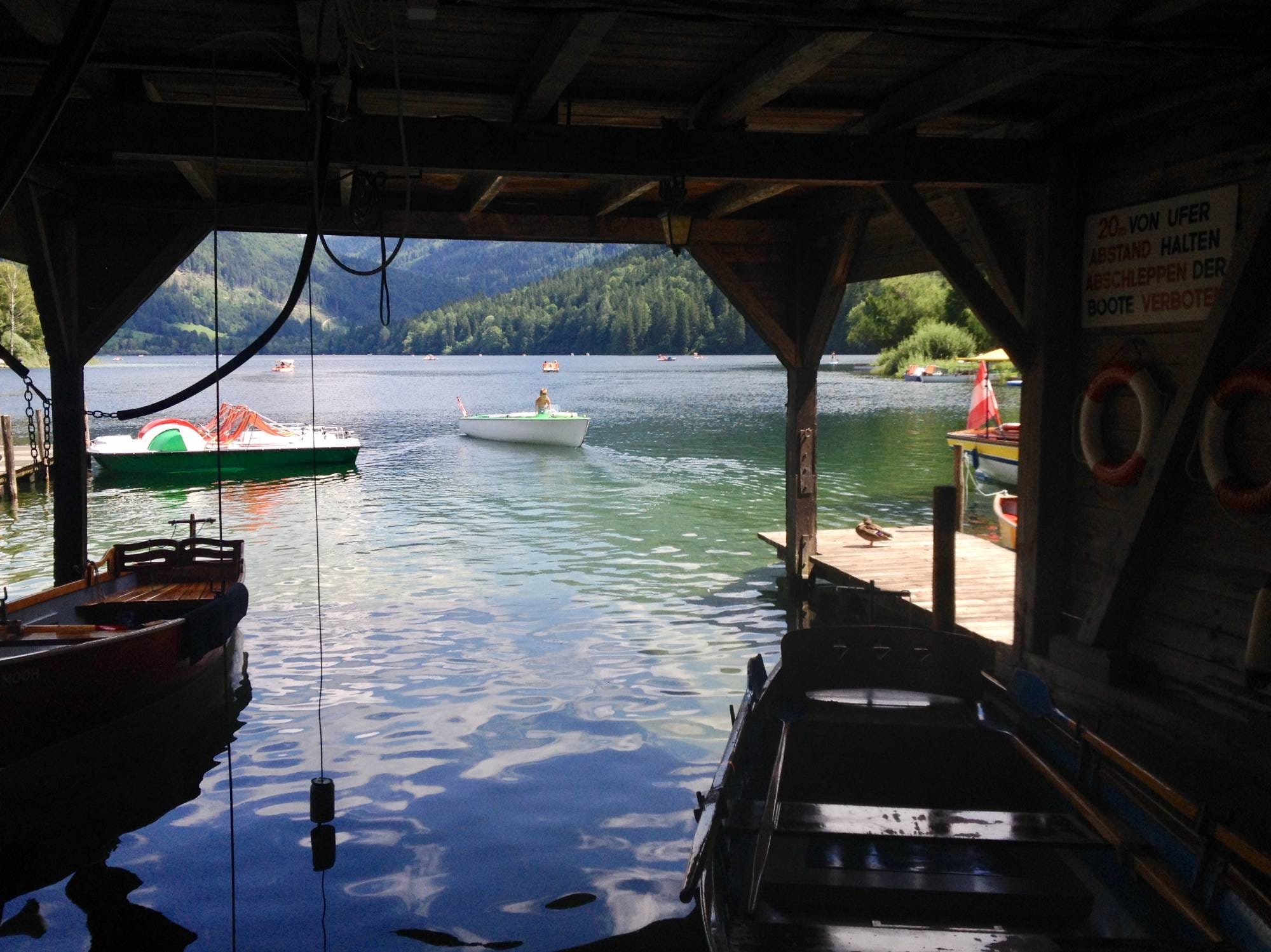
Sometimes another person recognizes the place where we come back to life before we understand it ourselves. For me, that place has often been water.
For me, that feeling might return while entering the water, walking through the Lainzer Tiergarten in the cool morning, or allowing music at Klosterneuburg or Grafenegg to take over an evening. Your answer may be entirely different.
Sommerfrische begins before the journey. It begins when you recognize what part of yourself you’re trying to recover.
Giving the refresh a place means turning a general longing into one specific occasion you can anticipate and enter.
Knowing that water restored me didn’t mean I could disappear to a lake whenever I needed it. I had to make room for water in the rhythm of my days.
For many years, I worked in adult education and drove throughout Vienna to teach at different companies. My working day didn’t stop because the afternoon was warm or because the light over the Danube had changed.
Some routes, however, took me across the river or past the Alte Donau, a long, calm body of water within Vienna, particularly when I traveled toward Siemens.
I began preparing before I became tired enough to talk myself out of going. I brought a swimsuit, the pink batik dress, a straw basket, and water.
The Alte Donau didn’t give me several weeks away or reproduce an entire summer beside a mountain lake. It gave water, solitude, and a clear ending to the working day somewhere to exist.
My circumstances have changed since then. I no longer live close to the Alte Donau, so I don’t try to force the old ritual into my present routine.
Now I may spend a morning, half a day, or an entire day at the Schönbrunner Bad in Schönbrunn. The place and rhythm are different, but it still gives me something I know I need: swimming, physical movement, summer heat, and several hours away from ordinary responsibilities.
The Schönbrunner Bad lies within the palace park and includes a 50-meter sports pool, along with separate pools for non-swimmers and children.
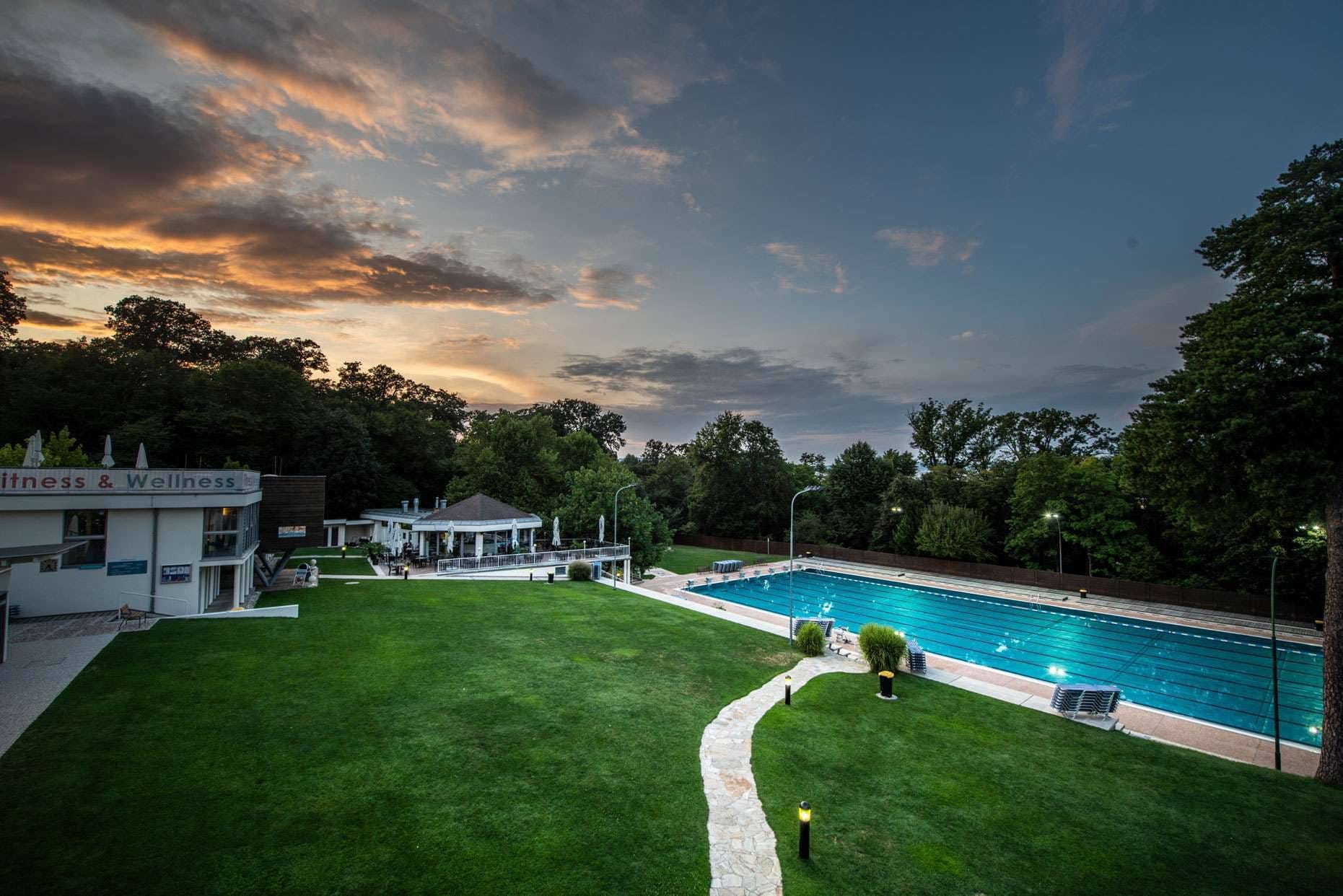
The place can change while the need remains. Now, a morning or afternoon at the Schönbrunner Bad gives water, movement, and summer a place within my week.
That’s what I mean by giving the refresh a place. You aren’t trying to reproduce an ideal holiday in miniature or pretending that a morning at a swimming pool equals several weeks beside a lake.
You’re asking what you’re truly longing for inside the larger image. Is it water, silence, a wider horizon, freedom from decisions, time alone, or the relief of returning to a place where you already know how everything works?
Perhaps you want a week beside a lake, and that simply isn’t possible this summer. But if you’re missing water, sunlight, and a few hours in which nothing is required of you, a morning at a city pool may answer part of that need honestly.
It doesn’t replace the longer holiday. It gives one part of the longing a real place in your week.
Once you know where that place might be, make the occasion specific. Instead of telling yourself, “I should swim more this summer,” decide that you’re going to the pool on Wednesday morning or taking your swimsuit to work on Thursday.
Anticipation needs something definite enough to approach: a time, a place, and one detail that already makes you glad it’s coming. It might be the swimsuit waiting by the door, breakfast beforehand, the book in your bag, or simply the knowledge that you’ve protected several hours for water.
Create one small occasion worth looking forward to. Give it a time, a place, and one detail that makes it feel like summer before it begins.
My parents understood the power of creating a distinct interval long before I understood what they were doing.
When we returned to California after a year in Europe, we had to rebuild the practical structure of our lives. My parents needed work, my brother and I needed schools, and all of us had to readjust to a culture and daily rhythm we had left behind.
Money was limited, so we moved temporarily into a small one-bedroom apartment with a den. My brother and I slept in the den, while my parents used the bedroom.
Instead of beginning work immediately, my parents made an unusual decision. They waited until September, when school would begin.
That summer gave us time to rearrange our lives, reconnect with California, and prepare for a more structured rhythm after a year in which we’d experienced a remarkable degree of freedom and independence.
My father still calls it “the summer we took off.”
We didn’t travel to an extraordinary destination. We used what the apartment complex offered: the swimming pool, courtyard, recreation room, barbecue area, and long corridor.
My father opened bottles of sparkling wine for the adults or sparkling apple cider for us, and we measured how far the corks flew.
I don’t remember the distances. I remember the game.
The arrangement was temporary, and that helped make the summer possible. My parents didn’t treat the weeks before work and school as empty time to rush through. They turned them into a period of transition, helping us leave one life behind, settle into another, and prepare for what would come next.
They gave summer a place, but they also gave it boundaries. It had a beginning, a character of its own, and an ending.
Sometimes the place is physical: a lake, swimming pool, mountain hotel, or familiar garden. Sometimes it’s a protected interval in time. What matters is that the refresh has enough shape for you to anticipate and enter it.
I’m developing a free practical guide called Turn Your Summer into a Sommerfrische. It will help you recognize the kind of refresh you need, create something worth anticipating, choose how you want to receive the experience, protect part of it from usefulness, and notice what you carry home.
I want to give the guide enough time to become genuinely useful rather than rushing it into the world. I’ll share it here in The Salon when it’s ready.
Giving the refresh a place, however, is only the beginning. I could have carried the swimsuit in my bag for weeks without entering the water. A protected morning can remain an intention unless something helps us move from ordinary time into it.
I needed a threshold.
A threshold is a physical or sensory act that tells us ordinary time has ended and another rhythm has begun.
When I knew I’d pass the Alte Donau, I changed into my swimsuit in the company’s ladies’ room before leaving work. Then I pulled the pink batik Indian cotton dress over it.
I called that dress my uniform for fun and relaxation.
The phrase may sound playful, but the clothing mattered. I no longer wore the clothes of the woman who had entered the building to teach. I’d made the first visible change before reaching the car.
The car was a little Cinquecento Abarth, one of my favorite cars. I opened the windows and chose music that changed the atmosphere immediately.
One memory remains especially precise: Sade’s “Kiss of Life” playing through the open windows as I drove toward the water.
I parked near the Naturfreunde and walked for about five minutes toward the dock. A wooden platform stood beneath a weeping willow in front of the Naturfreunde, and I often found it empty.
I left my telephone in the car.
That decision protected the interval. I didn’t ask the water to compete with every message, request, and piece of information that might arrive. I removed the competition.
When I reached the dock, I took off my dress and entered the water immediately. I didn’t sit on the edge and negotiate with myself about whether I felt too tired or whether I should go home.
The moment I hit the blue-green water, everything went whoosh. The working day disappeared.
Swimming on my back, I felt myself become one with the water and everything around it. Fish moved beneath me, clouds passed overhead, and the willow shifted in the wind along the shore. I soaked in the energy of water, trees, sky, and light until work loosened its hold.
Afterward, I lay on the wooden boards and felt the warmth of the sun and wood beneath me while dragonflies passed above the surface.
The swimming refreshed me, but so did the feeling of becoming absorbed into the place and allowing it to become part of me.
I still remember those afternoons vividly and bodily: the temperature of the water, the warmth of the wood, the movement of the sky above me, and the sense of my whole body settling into another rhythm.
I have almost no photographs of those afternoons because I left my phone in the car.
For those hours, I wasn’t collecting evidence of summer. I was living it.
Sometimes I drew. I didn’t talk.
This wasn’t because company would have ruined the evening. On other days and in other places, company made summer. This practice restored me through solitude, water, and the absence of conversation.
When it was time to leave, I put the dress back on and changed beneath it. I collected my basket, drank the water I’d brought, and drove home slowly.
The ritual began before the swim and continued afterward. I’d reduced the friction that might stop me, changed my clothing, altered the sound of the journey, entered a different physical setting, protected the interval from interruption, and allowed the return to remain unhurried.
I didn’t simply finish work and hope relaxation would begin. I gave the working day an ending and summer a recognizable entrance.
Historical Sommerfrische involved a physical departure from the city. A contemporary Sommerfrische may need a smaller but equally deliberate boundary.
Modern life has a way of turning almost every pleasure into output. Exercise becomes numbers, reading becomes self-improvement, holidays become content, photography becomes engagement, and writing begins serving an algorithm.
Even a hobby can start asking whether it might become a business.
Rest itself can acquire a performance target: recover quickly enough to become productive again.
Not everything meaningful needs to become useful.
I don’t think presence requires us to reject devices, photography, ambition, or creative work. Sometimes my phone is simply the camera I have with me. I use it to notice and preserve the light, atmosphere, composition, or feeling of a place, not merely to prove that I was there.
A photograph may later become part of a Field Diary or the beginning of a painting. At other times, I sketch, write in my journal, record an audio reflection, or simply sit and look at the sky.
Your own way of receiving a moment may differ. You might write music, collect sounds, make a scrapbook, cook something inspired by the place, tell the story to someone you love, or choose not to record anything.
What matters is that I choose how I want to experience it and decide when the documentation ends.
If I’m creating a Field Diary, I take the photographs, video, or notes I need. Then the camera goes away, and the remaining time belongs to the experience itself.
That’s often when I notice what’s happening inside me. Has my breathing changed? Do I want movement or stillness, company or silence? Is the place genuinely restoring me, or am I standing partly outside the moment and thinking about how I might use it later?
Documentation can deepen attention, but it can also replace it.
Not every impression needs saving, publishing, or turning into material. We may receive an experience through images, words, sound, movement, or memory. Some of it may remain private.
Some of it has to remain life.
The questions are simple:
How do I want to receive this moment? When will I stop recording it? What part of it doesn’t need to become useful?
A threshold protects the passage into another kind of attention.
The Knappenhof at the foot of the Rax shows what a short Sommerfrische can look like today.
The Semmering Railway, built between 1848 and 1854, made areas of the mountain region easier to reach. In the following decades, villas, hotels, and recreational buildings transformed the Semmering into one of the early purpose-built Alpine resort landscapes.
Camillo Kronich, who had served for years as the keeper of the Otto-Schutzhaus, opened the smaller and more intimate Knappenhof above Reichenau in 1908.
That same principle remains available to us. Instead of waiting for a long holiday or traveling so far that the journey consumes much of the break, you can take two or three weekdays off and choose somewhere relatively close.
A short midweek Sommerfrische might begin on Wednesday. You leave after the working week has already begun, stay for three nights, and return on Saturday. The break sits inside the week rather than being compressed into the same crowded weekend as everyone else.
This is the rhythm we chose at the Knappenhof. Knowing that Wednesday would lead us to the Rax changed the emotional shape of the days before we left. We had something specific to anticipate, and the relatively short journey left enough time for the place to begin working on us.
The rocks rise directly behind the Knappenhof. You sleep at the foot of the Rax and wake with the mountain already around you.
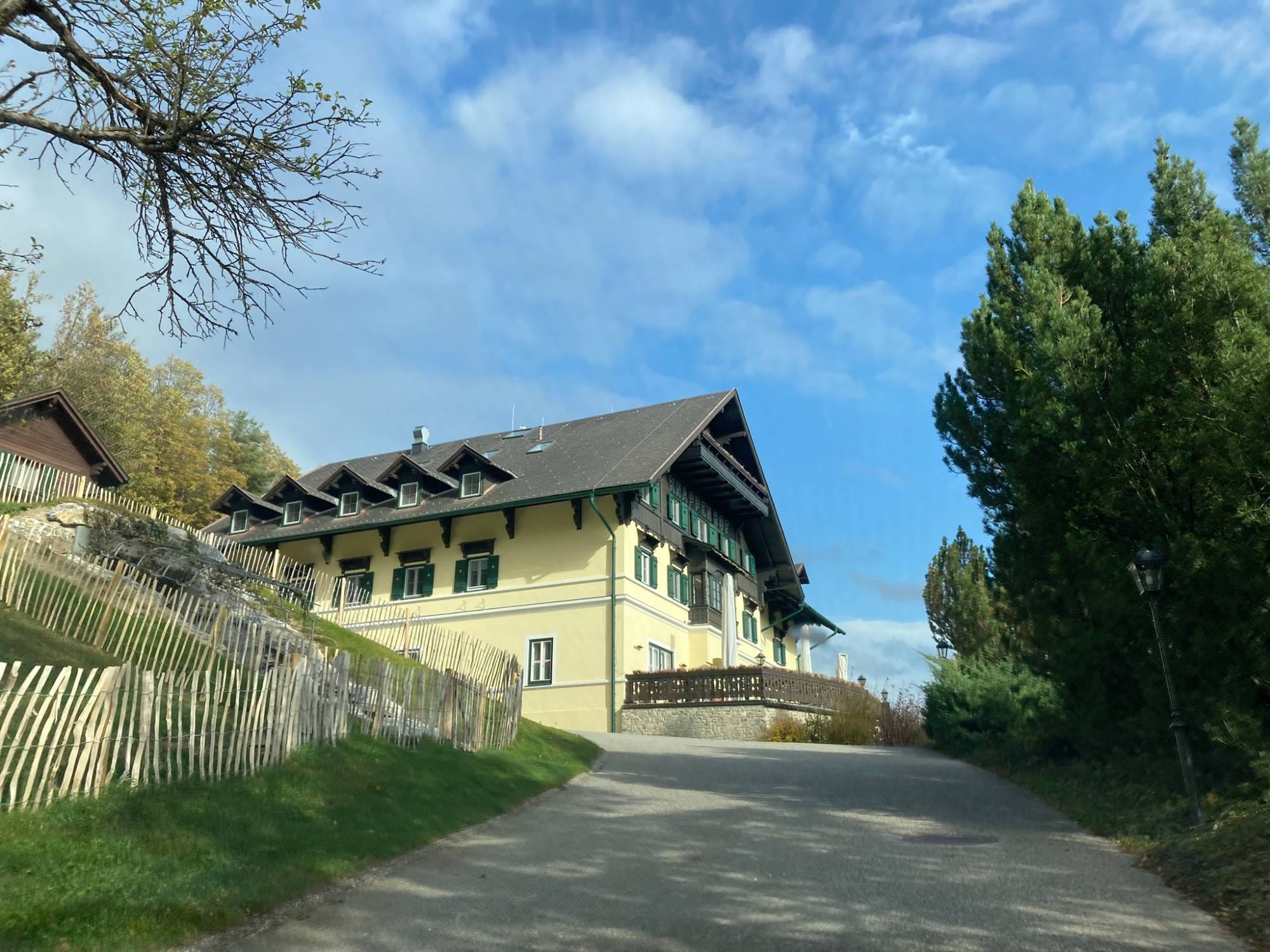
Arriving at the Knappenhof places you immediately inside another rhythm. A few midweek days close to Vienna can become a short Sommerfrische at the foot of the Rax.
By the second and third mornings, you’re no longer simply visiting the landscape. You’ve begun living inside another rhythm.
You can walk, sit outside, read, draw, or do very little.
When a demanding ascent doesn’t suit you, the Rax cable car offers another way into the high mountain landscape.
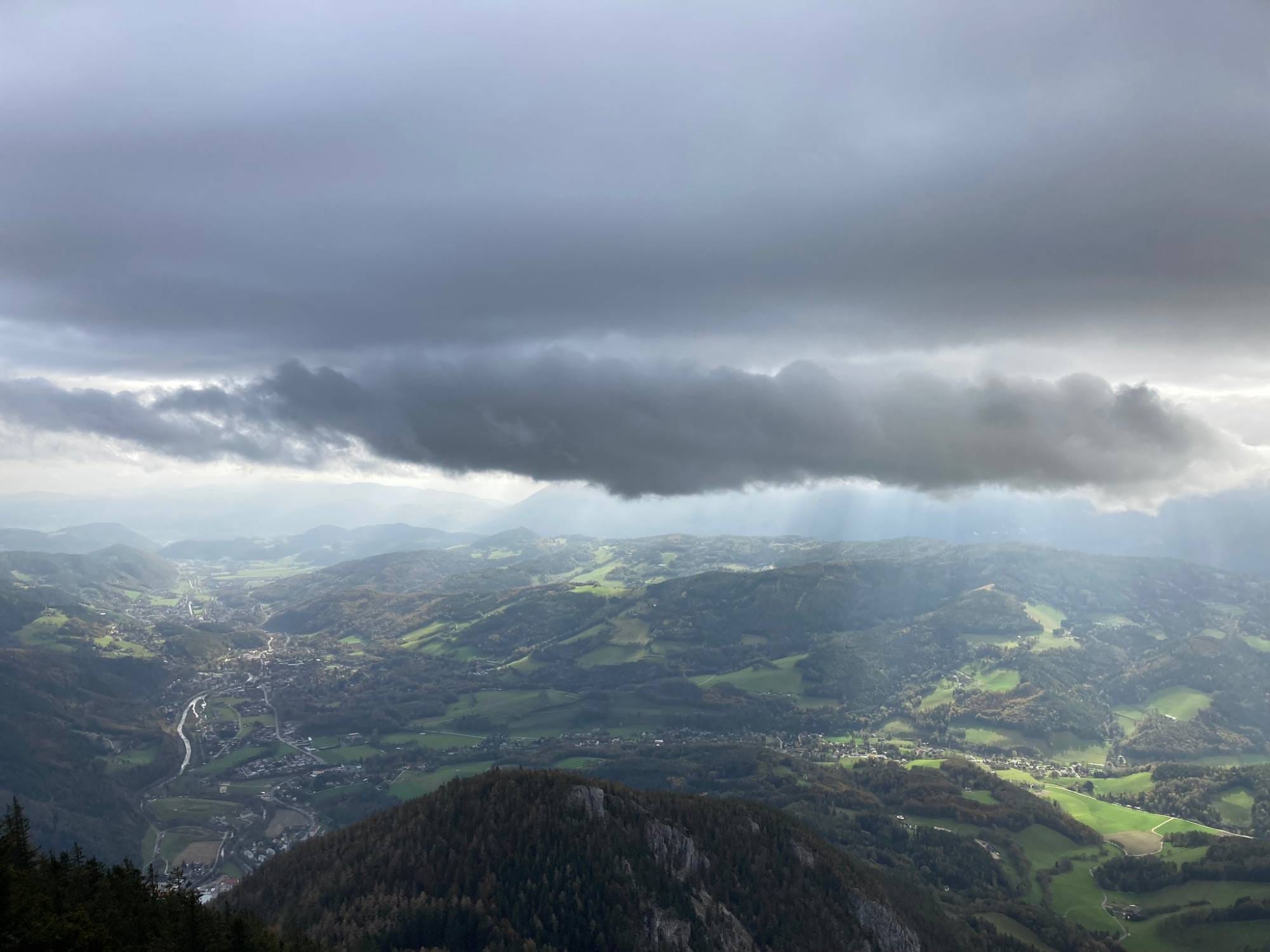
The cable car allows more people to enter the high mountain landscape without turning the day into a test of endurance. Sommerfrische should meet us where we are, not ask us to prove ourselves first.
The Rax cable car opened on 9 June 1926 as Austria’s first passenger aerial cableway. Today, the journey to the plateau takes about eight minutes.
There’s no need to turn the stay into a fitness test or fill every day with activities. The point isn’t how much of the mountain you complete. It’s what happens when you wake there more than once and allow the place to become familiar.
I’m not telling you about one exceptional stay that can never be repeated. I’m showing you a form you can adapt.
The place might be the Knappenhof, another small hotel near Vienna, a pension beside a lake, a room in a wine-growing village, or somewhere entirely different where you live.
The structure matters.
Choose somewhere close enough that travel doesn’t consume the break. Stay long enough to wake there more than once. Step outside the usual weekend rhythm when you can. Leave part of the time unplanned, and resist turning the stay into a list of everything you ought to see.
A short Sommerfrische doesn’t need to reproduce a long summer holiday. It creates a distinct interval, something to anticipate before leaving, another rhythm while you’re there, and a different way of seeing ordinary life when you return.
Of course, even a short stay requires time and money, and not everyone can take several weekdays away from work.
That’s why family-holiday initiatives such as the program run by the Vereinigte Altösterreichische Militärstiftungen matter.
VAM offers qualifying larger families free holiday stays in foundation accommodation, including houses in Reichenau an der Rax. The program covers accommodation and half board and allows families to shape their stay themselves.
Such a program recognizes, at least in practice, that time away can offer more than entertainment. It can give a family room to reconnect, settle into another rhythm, and return refreshed.
A contemporary Sommerfrische can remain modest in distance and duration while still feeling substantial. You don’t have to travel far. You need enough separation from the usual week for another way of living to begin.
Sommerfrische doesn’t happen only through water, woodland, or mountains. Sometimes music reaches a part of us that ordinary life has left untouched.
A concert can remain a two-hour appointment. We drive there, take our seats, listen, and return home.
There’s nothing wrong with that. Sometimes it’s exactly what our time, energy, or budget allows.
But the same concert can become the center of a longer summer occasion.
We did this on a smaller scale when we went to Klosterneuburg for Samson et Dalila. Instead of arriving just before the performance, we came almost two hours early.
We sat beneath the trees in front of the monastery courtyard, had Sekt or Frizzante and something small to eat, and allowed the place to change the rhythm of the evening before the opera began.
I’ll take you more fully into that experience in next week’s Field Diary.
Grafenegg shows how many forms the same idea can take. You might arrive shortly before an evening concert, walk through the grounds, and have a drink or snack.
You could bring the family, spread a blanket on the lawn, and turn the music into a picnic beneath the summer sky.
Grafenegg currently offers lawn seating for €15. Children up to their twelfth birthday may attend Grafenegg’s own concerts on the lawn free of charge, although policies can vary for events organized by others.
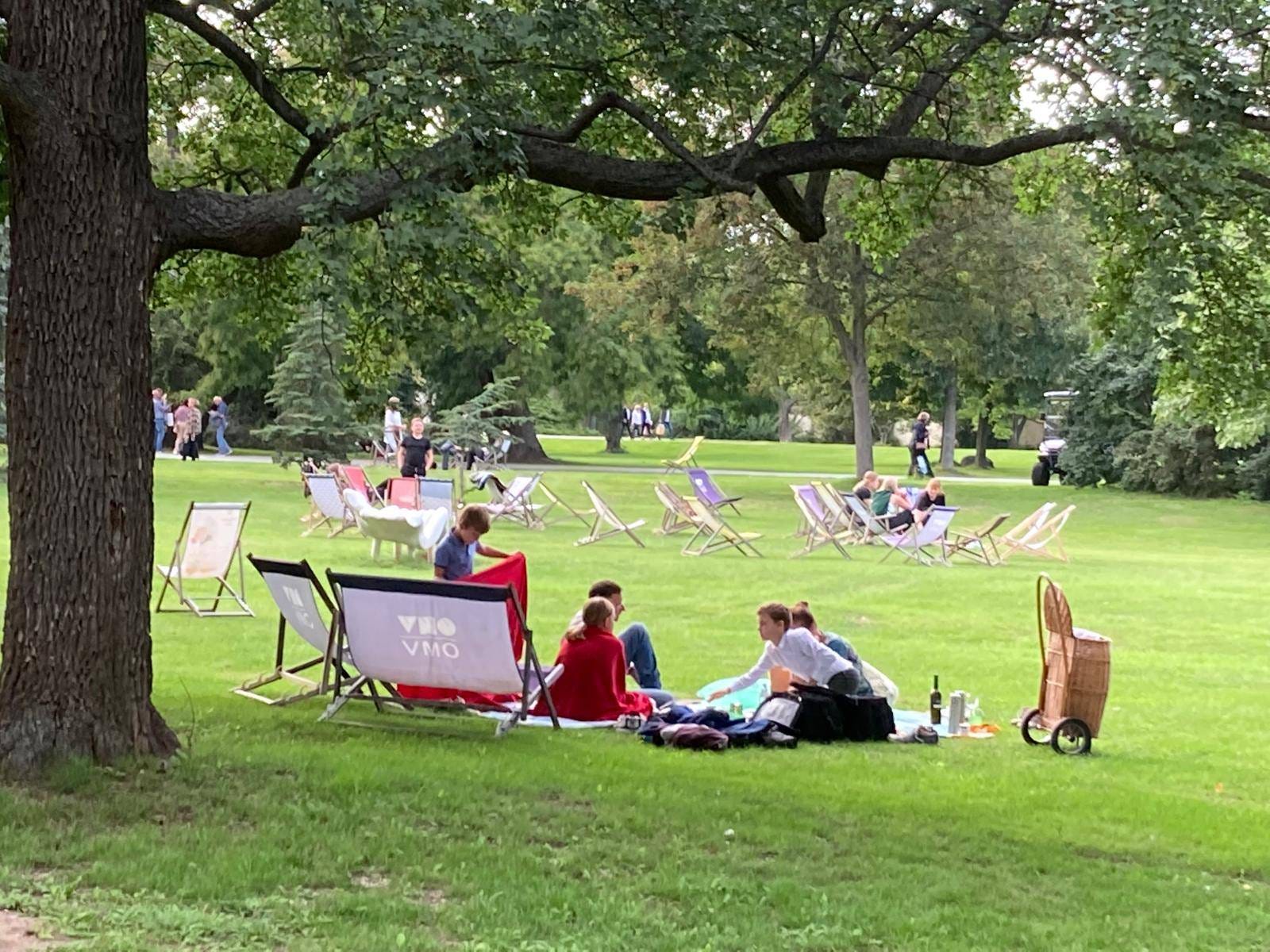
At Grafenegg, the concert can become the center of a longer summer occasion: a picnic beneath the trees, time in the park, and music waiting later in the evening.
With more time, you could arrive for lunch, explore the park, attend a Prélude or introduction before the main performance, and allow the day to gather around the music.
You could stay overnight in one of the cottages within the castle grounds and turn a concert into a short cultural holiday. Grafenegg’s cottages sit within its 32-hectare park, within walking distance of the main venues.
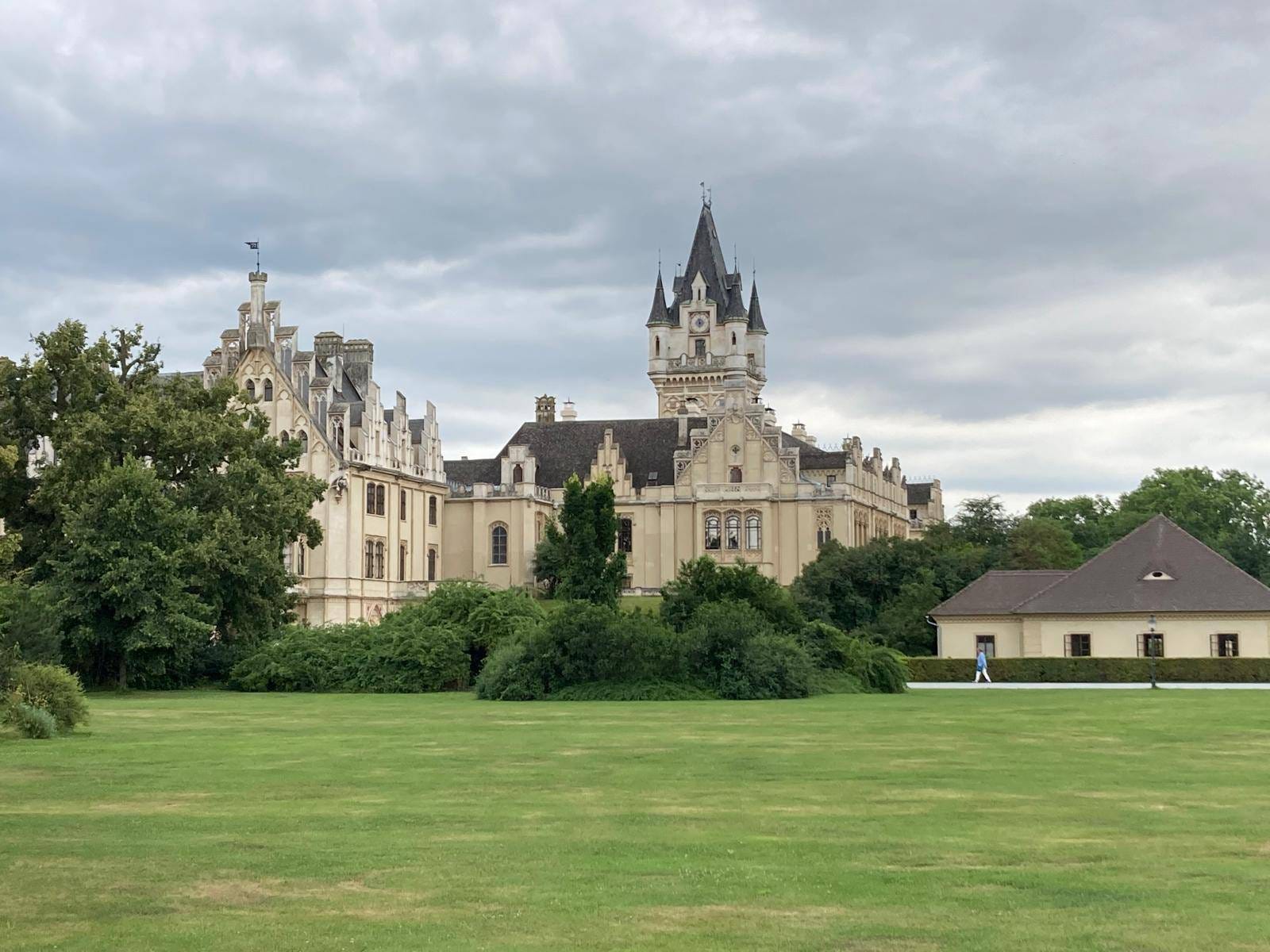
A single performance can remain an evening appointment or become the center of a full cultural day. The scale depends on the time, energy, and means available.
The point isn’t to choose the most elaborate version. It’s to ask what kind of occasion you can create with the time, energy, interests, and money available.
We’re working through that question ourselves as we plan to attend Grafenegg on 30 August 2026.
The day’s program includes an 11 a.m. Schubert matinee with Rudolf Buchbinder, Nikolaj Szeps-Znaider, and Gautier Capuçon, followed in the evening by a concert performance of Korngold’s Die tote Stadt.
Our first idea was to make a complete day of it, beginning with the morning concert, continuing with lunch and the afternoon program, and ending with Die tote Stadt.
We began planning too late for that version. We couldn’t get the morning tickets we wanted, and the earliest restaurant reservation available to us was at four in the afternoon.
So we adapted the day instead of abandoning it.
We’ll have an early dinner, walk through the grounds, and decide whether to attend some of the supporting program or simply move slowly toward the evening concert.
We’re already looking forward to this version, and we’re also anticipating another one next year.
If we plan earlier, we may attend both concerts, spend the full day there, and stay overnight rather than driving home. The version we couldn’t arrange this year hasn’t become a disappointment. It has placed another possibility on the horizon.
That’s what interests me about Grafenegg. One event can become several different kinds of Sommerfrische.
You can keep it simple, extend it by a few hours, make a full day of it, or build a short stay around it. The concert remains the center, but you decide how much space to give it.
You can use the same principle wherever you live. Look at a concert, performance, exhibition, or festival already available to you and ask whether it has to remain an isolated appointment.
Could you arrive earlier, bring a picnic, walk through the surrounding landscape, share a meal, remain afterward, or stay for the night?
We don’t only attend a performance.
We can create summer around it.
EXPLORE THE CURRENT GRAFENEGG PROGRAM AND VISITOR POSSIBILITIES
A summer becomes more vivid when at least one ordinary day has a marker, something we can anticipate, receive, and later recognize as belonging to this particular season.
When I was six years old, I realized that the day before my birthday was the last day I’d ever be five. I walked around announcing this with all the seriousness the discovery deserved.
It wasn’t simply the day before my birthday. It was the final appearance of an entire age.
Over time, this became a personal tradition. I began noticing the last Monday at one age and the first Tuesday at the next. Eventually, I extended the celebration to the week before my birthday, the birthday itself, and the week afterward.
Later, I began to understand summer in much the same way.
I might receive another August the following year, but never this August again. Not at this age, with exactly these people, and in this particular version of my life.
That didn’t make me want to fill every day. It made me want to recognize it.
Recently, on a summer day when nothing special was planned, I decided that ice cream would become the day’s marker.
Once I’d made the decision, I had something small to anticipate.
I walked around the corner to the local shop where they make their own ice cream. A long queue had formed, but instead of treating the wait as an obstacle, I watched children choose their flavors and eat them with the seriousness and pleasure children bring to ice cream.
When my turn came, I chose two of my favorite flavors, carried them home, and sat on the balcony eating them in the summer heat.
Nothing else had to happen.
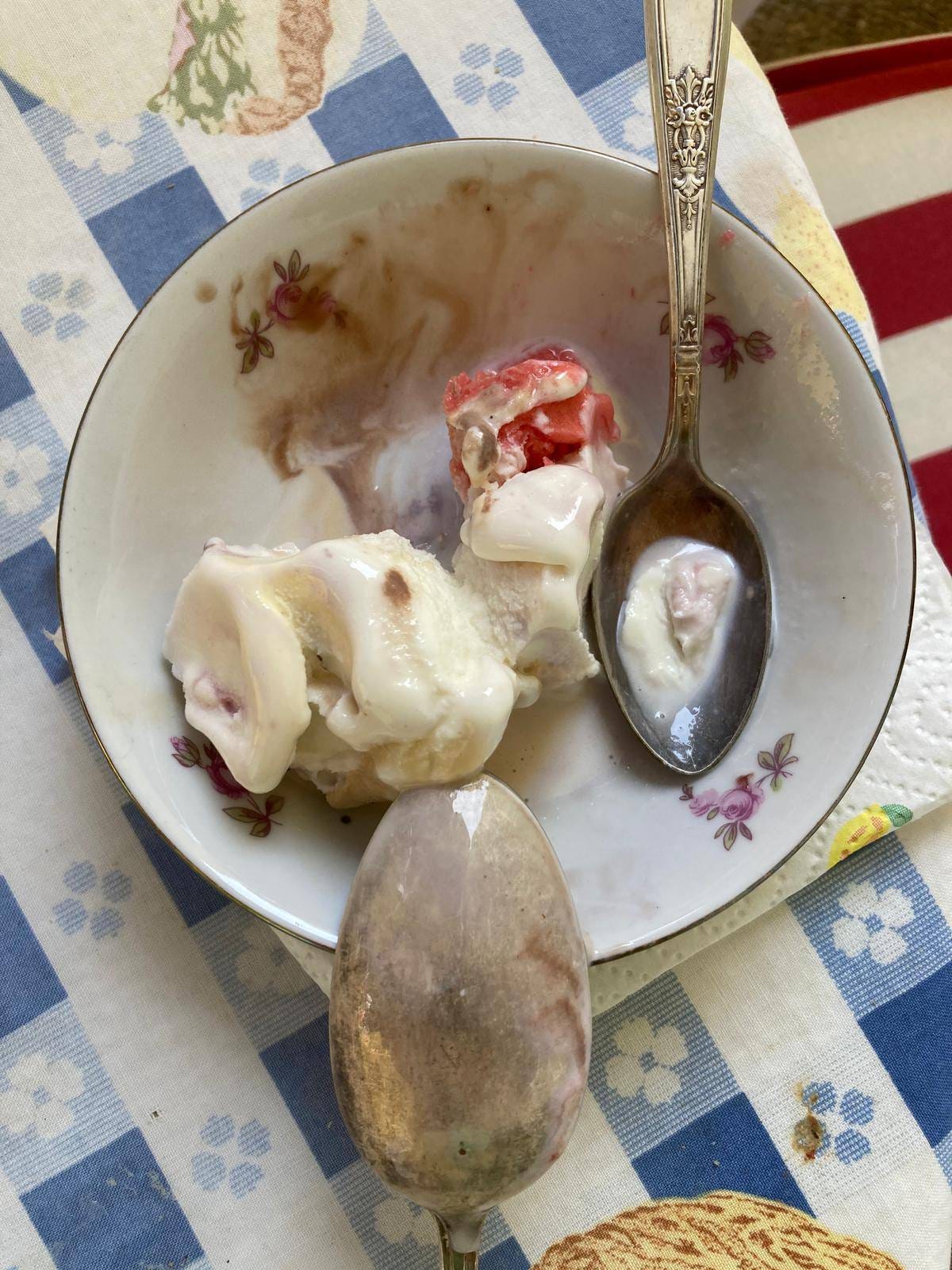
An ordinary summer day doesn’t need to become extraordinary. Sometimes one anticipated pleasure is enough to give the day a character of its own.
I looked forward to the ice cream, received the occasion while it was happening, and carried it forward as the day’s marker.
I don’t try to make every summer day extraordinary. I give an ordinary day one reason to remain.
Filling a day asks how much we can place inside it. Marking a day asks what will allow us to recognize it.
What one thing will let you recognize that you lived this day?
One marker distinguishes a day. Repetition allows an entire summer rhythm to deepen.
Returning to the same place can deepen anticipation rather than diminish it.
A first visit offers novelty, but repeated return gives us comparison, relationship, and the pleasure of wondering what will have changed.
My parents practiced their own form of Sommerfrische with us long before I understood the word.
They sent my brother and me from California to Mala Nedelja in Prlekija so that we could live with our family, know our roots, and experience another way of seeing the world.
This wasn’t Sommerfrische in the narrow sense of a Viennese family taking rooms in Reichenau or traveling to the Semmering.
But it followed the same deeper movement: leaving the habitual, entering another rhythm, and returning changed by the life we’d joined.
I was about eleven when I spent an entire summer there for the first time on my own. After that, my brother and I returned almost every other summer. Later, once I lived in Vienna, I continued returning during summer.
The first visit showed me a place. Return allowed the place to become another life.
Because we returned, summer began before arrival. I could wonder what had changed in Aunt Marica’s garden, which crop would grow in the field, and whom I would see again.
Familiarity didn’t remove anticipation. It deepened it.
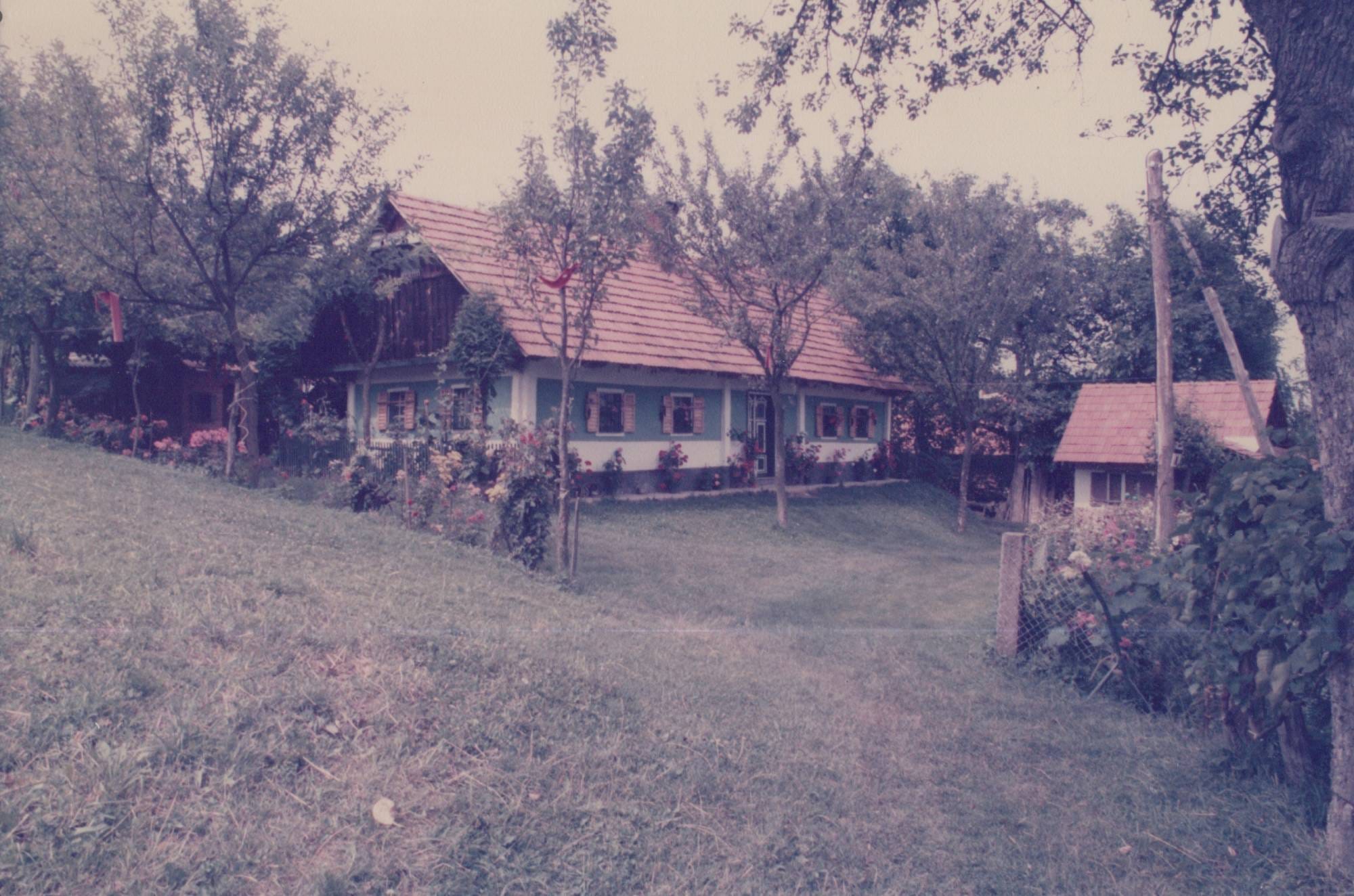
A first visit gives an impression. Returning allows a place, its people, gardens, fields, and changing seasons to become part of another life.
Aunt Marica’s house originally had a thatched roof. Later, she replaced it. The house appeared smaller as I became older, but it never became less magical.
I watched the garden change. Geraniums and bleeding hearts appeared. A garden hut became a room. One year the field contained wheat; another year it became a sea of poppies.
I witnessed a manual harvest without knowing it would be the last one I saw carried out that way.
People from the hamlet gathered together, passed bundles from hand to hand, and fed them into the machine. Hay emerged, and we lay upon it.
I photographed the scene because it interested me. Only later did I understand that attention had preserved something before knowledge caught up with it.
Repeated return also changed my relationships with people.
Anton Ritonje had fought in the First World War with my grandfather and received few visitors. I began visiting him when I was eleven, and later we corresponded through letters.
He carried parts of my family’s history that a single visit could never have revealed.
A first visit gives an impression. Return gives comparison. Repeated return gives relationship.
My parents hadn’t sent us away simply to entertain us. They had sent us into another life, and that life altered the one we returned to.
A refresh continues after we return when another place changes what we notice, value, or choose at home.
Aunt Marica’s house didn’t have an indoor toilet or bathroom. There was no shower or bathtub, so we washed with a basin and pitcher.
Once a week, we went to Aunt Angela’s house for a bath or shower. Even there, people used water carefully and filled the bathtub to well below halfway.
In California, water had always seemed readily available in my daily life. I might shower in the morning and again before bed. After swimming, I showered to remove the chlorine.
Food availability also differed. In Mala Nedelja, we sometimes waited in line for bread. Brown bread might remain when the white baker’s bread had already sold out. Sometimes we reached the shop and found empty shelves.
California offered reliability and convenience. Shelves remained stocked, and buying bread didn’t require waiting or wondering whether anything would remain.
That contrast helped me recognize the material abundance and convenience of my California life more clearly.
But the comparison moved in the other direction too.
Life in Mala Nedelja was no less rich. My brother and I could walk from one hamlet to another as long as we returned before dark.
We ran barefoot, learned to gather mushrooms, had cake fights, and got caught in thunderstorms. We rose with the sun and went to bed when it did.
I took rabbits from their enclosure, placed them in a basket, and went for long walks with them. I sat in fields for hours.
Once, I even let the pigs out of their pen because I swore to Aunt Marica that they needed a day off and, anyway, they’d promised to return before sunset.
You should’ve seen Uncle Tonček’s face.
But return they did.
Hunger does that.
We had a freedom of movement in Mala Nedelja that we didn’t possess in Pasadena. California offered comfort and material abundance, but it also contained cars, roads, and urban restrictions. We couldn’t simply disappear across fields until sunset.
Mala Nedelja offered fewer conveniences and another kind of wealth: independence, land, animals, family, trust, and the ability to become part of a rhythm larger than our own plans.
I don’t want to romanticize what was genuinely difficult. An absent bathroom remained an absent bathroom. Limited water and uncertain supplies in the shops imposed real restrictions. Freedom in the fields didn’t cancel them.
The lesson wasn’t that scarcity was secretly better. It was that richness could take different forms.
California and Mala Nedelja made one another more visible.
Because I’d known limited water, I could appreciate the abundance of turning on a tap at home. Because I’d known the freedom of moving barefoot between hamlets, I could recognize a form of wealth that California didn’t provide.
The comparison enlarged both lives.
This is one of the most important things Sommerfrische can give us. Another place, rhythm, or inherited life can reveal forms of abundance that familiarity has hidden, while also showing us what ordinary life lacks.
The refresh isn’t complete when we arrive home. It becomes meaningful through what we now see, value, or choose differently.
Carrying something home doesn’t require us to turn the experience into a lesson, improvement program, or new task. Sometimes it simply changes what we notice. Sometimes a relationship, value, or way of living becomes harder to ignore.
The final question isn’t how to recreate the other place artificially. It is:
What quality from that life should I allow to change this one?
We’re not importing the scenery.
We’re carrying home a value.
By taking part in another life, we enrich both the life we live there and the life to which we return.
This is what Sommerfrische has come to mean to me. Not simply leaving the city, but leaving the habitual long enough to return to myself, then seeing more clearly what a rich life can contain.
When I placed these experiences beside one another, I realized that I’d repeated the same movements for years without naming them.
I learned where my energy returned. I found ways to give that refresh a place without waiting for a completely different summer. I placed something on the horizon and allowed myself to anticipate it.
I created a threshold, protected part of the experience from usefulness and interruption, and allowed summer to gather through markers and return.
Then I paid attention to what another rhythm taught me when I came home.
I’ve begun calling this The Gathered Summer Practice. It has five movements: Find Where You Radiate, Give the Refresh a Place, Cross the Threshold, Let the Summer Gather, and Bring the Richness Home.
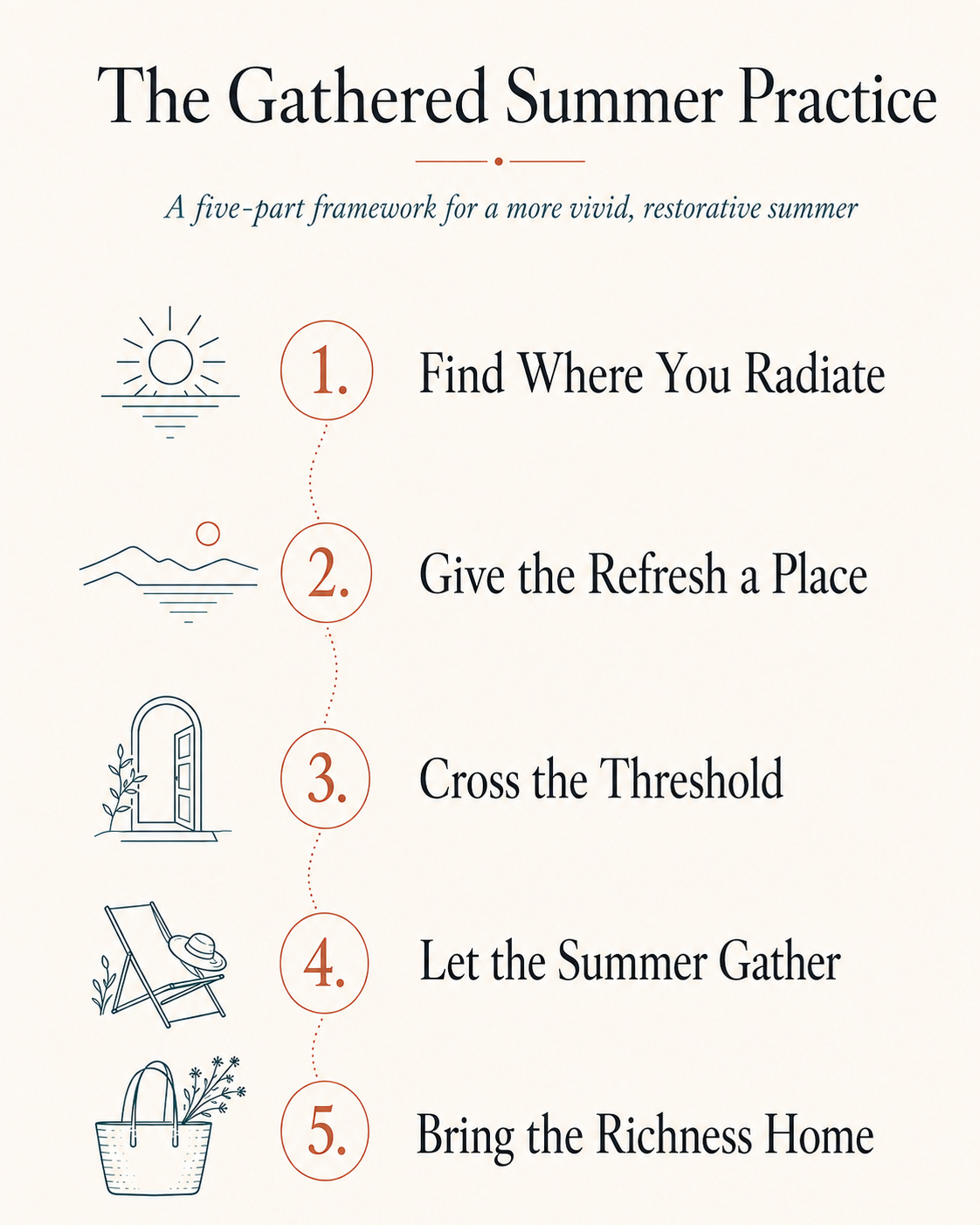
The Gathered Summer Practice brings five movements together: recognize where your energy returns, give the refresh a place, cross into another rhythm, let the summer gather, and carry its richness home.
This is the first working version, and I’m sharing it while summer remains because I want to know what happens when other people try it.
Notice where warmth, energy, strength, curiosity, or ease returns.
Begin with: When do people close to me see me become most alive?
Identify the quality beneath your ideal summer and find a real place where it can take form. Create a specific occasion you can begin anticipating.
Begin with: What am I truly longing for, and where might one part of it become possible?
Create a recognizable passage from obligation into another rhythm. Decide how you want to receive the experience, what doesn’t need to become useful, and when documentation will stop.
Begin with: What physical or sensory act will tell me that ordinary time has ended?
Mark one day and return often enough for anticipation, meaning, and relationship to deepen.
Begin with: What will let me recognize that I lived this particular summer?
Notice what another place or rhythm revealed and carry one value into the life to which you return.
Begin with: What should this refresh change when I come home?
You don’t need to complete all five movements. That would turn the practice into exactly the kind of summer project it’s meant to resist.
Begin with the part that names your present difficulty.
When you don’t know what restores you, ask where you radiate.
When the summer you want feels inaccessible, give one desired quality a place.
When very little calls you forward, create one small occasion worth anticipating.
When work follows you into every free evening, create a threshold.
When every pleasure begins to resemble output, protect something from usefulness.
When the days disappear, give one of them a marker.
When you’ve already been away, ask what form of richness you brought home.
I also want to know where the practice doesn’t work. Which parts feel freeing, and which become another demand? What financial, physical, professional, or family limits make them difficult? What have I failed to notice because my experience differs from yours?
A useful practice should become more honest when it meets other lives.
The five-part practice describes a larger seasonal rhythm, but you can begin much more simply.
Choose one small occasion for the coming week and give it four things.
Choose a specific future occasion. Give it a date, place, and one detail that already makes it desirable.
Choose one question, detail, or mode of noticing.
Watch how the light changes, look for an older layer of the place, listen to its sounds, or notice what has changed since your last visit.
Protect part of the experience from productivity, improvement, performance, or public display.
Swim without counting. Read without extracting lessons. Take a photograph because the light moves you. Or record nothing.
Decide whether anything should continue afterward.
You might remember it, return to the place, print one photograph, make a sketch, alter one small habit, share the story privately, or keep what happened entirely to yourself.
This isn’t a checklist for manufacturing meaning.
One small occasion is enough.
You may be planning a summer visit to Vienna or Austria. Or you may live here and feel that familiar places have disappeared into the ordinary background of your life.
You don’t need several uninterrupted weeks to practice Sommerfrische. Choose a place, create space around the experience, and allow it to reorganize part of your day.
Don’t treat it as another attraction to complete.
Before you go, decide what you’re looking forward to. While you’re there, choose how you want to receive the place. Protect part of it from output, and when you return, notice what remains.
Enter through the Lainzer Tor early, while the air is still cool. Walk through trees and open ground toward the Hermesvilla, then have breakfast or something to drink when the restaurant is open before returning through the Tiergarten.
Look forward to breakfast after the walk. Notice the movement from city street into enclosed landscape. Protect part of the route from conversation, audio, or photography, then carry home the feeling of beginning the day before demands take possession of it.
The Lainzer Tiergarten is free to enter, although its gates follow seasonal opening hours. The route from Lainzer Tor to the Hermesvilla is approximately 1.1 kilometers. Check current visitor and restaurant information before going.
LAINZER TIERGARTEN VISITOR INFORMATION
Spend the day swimming and resting beside the water.
You might use the Naturfreunde center and continue for lunch or dinner nearby, or rent a boat and take a picnic.
Look forward to entering the water. Pay attention to how Vienna appears from lake level, and protect one stretch of swimming, resting, or boating from documentation.
You haven’t left Vienna, but for several hours the city has reorganized itself around water.
The Naturfreunde center sits directly on the lower Alte Donau and offers a bathing shore, shaded and sunny lawns, sports facilities, and a seasonal buffet. Check current opening times and entry information before visiting.
NATURFREUNDE ALTE DONAU VISITOR INFORMATION
Go directly to the lake and leave most of the day unplanned.
Swim, lie beside the water, return to the lake, and have an ice cream or something simple from the buffet.
End with dinner beside the lake before returning home.
The point isn’t to fit in another attraction.
The lake is the day.
The public bathing area at Lunzer See includes a large lawn, diving tower, and buffet. Check current opening information before traveling.
SEEBAD LUNZ AM SEE VISITOR INFORMATION
Take a few weekdays off and choose somewhere close enough that travel doesn’t consume the break.
Stay for several nights, wake within the Rax landscape, and use the cable car when a demanding ascent doesn’t suit you.
Look forward to leaving in the middle of an ordinary working week. Notice how the landscape changes between your first and third mornings, and leave part of each day unplanned.
KNAPPENHOF HISTORY AND VISITOR INFORMATION
Choose a summer performance, but don’t arrive only in time for the curtain.
Go earlier, walk through the grounds, sit beneath the trees, and have something to eat or drink.
Look forward to the whole occasion, not only the performance. Notice how place, weather, audience, and music alter one another.
Once you’ve taken the photographs or notes you need, put the camera away and allow part of the evening to remain private.
Choose the refresh you need, not simply the destination that appears most impressive.
Do you need water, movement, music, solitude, perspective, family time, or the experience of waking somewhere else?
Begin there.
I’m gathering a fuller selection of these possibilities into a free practical guide for people visiting Austria and for those of us who live here but want to experience familiar places differently.
Turn Your Summer into a Sommerfrische won’t simply tell you where to go. It will help you decide what kind of refresh you need, shape something worth anticipating, choose how you want to receive the experience, and carry something meaningful home.
I’m working on it now, and I’ll share it with Salon readers when it’s ready.
Next week, I’ll take you into one of these experiences through The Field Diaries.
I’ll show you how we turned an evening performance of Samson et Dalila in Klosterneuburg into a short Sommerfrische by arriving early, sitting beneath the trees, sharing food and wine, speaking with the people around us, and allowing the place to change the rhythm of the evening before the opera began.
I’ll also show you where I documented the experience and where I stopped.
The camera went away, and part of the evening became private again.
Some summers remain because they contain a great journey.
Others remain because of a pink batik cotton dress, a song heard through open windows, a wooden dock beneath a weeping willow, and the first shock of blue-green water.
They remain because a child understood that this was the last day she’d ever be five, because we measured how far the corks flew, because a field contained wheat one year and poppies the next, or because the pigs received a day off and, despite Uncle Tonček’s expression, returned before sunset.
They remain because we visited a place often enough for it to become another life, and because leaving home revealed a form of richness we couldn’t have understood from only one side.
A richly lived summer isn’t one in which every day feels happy, remarkable, or perfectly received.
It’s one in which something still calls us forward, we allow something to matter while it happens, and something returns with us afterward.
Sommerfrische doesn’t ask us to abandon our lives. It asks us to interrupt the way we’ve been living them long enough to reconnect.
We don’t need to rescue the whole summer, fill every remaining day, or create an experience impressive enough to compensate for the weeks already gone.
Perhaps the question isn’t only where you’ll go next.
It’s what you’re willing to begin looking forward to again.
Begin with one honest question:
Where does your life become more alive, and what would help you return there?
Then give the answer a place.
Put one occasion on the horizon, give it an entrance, allow yourself to receive it, and protect part of it from usefulness.
Let this particular summer become recognizable.
When you return, notice what the experience has taught you to see.
Which part of the Gathered Summer Practice speaks most directly to the summer you’re living now, and what will you try first?
Read the definitive Understanding Vienna Archive article on the history, places, households, transport, and cultural life of Sommerfrische.
Read: The History of Sommerfrische: How Vienna Learned to Leave the City for Summer
Use the free Understanding Vienna Field Guide to begin reading a city beneath the surface and noticing what familiarity has concealed.
Download the free Understanding Vienna Field Guide
Subscribe free to The Salon for next week’s Klosterneuburg Field Diary, the remaining Sommerfrische articles, the continuing development of the Gathered Summer Practice, and the new practical guide when it’s ready.
Comments
Nothing yet. Say the first thing.
Sign in to join the conversation.