
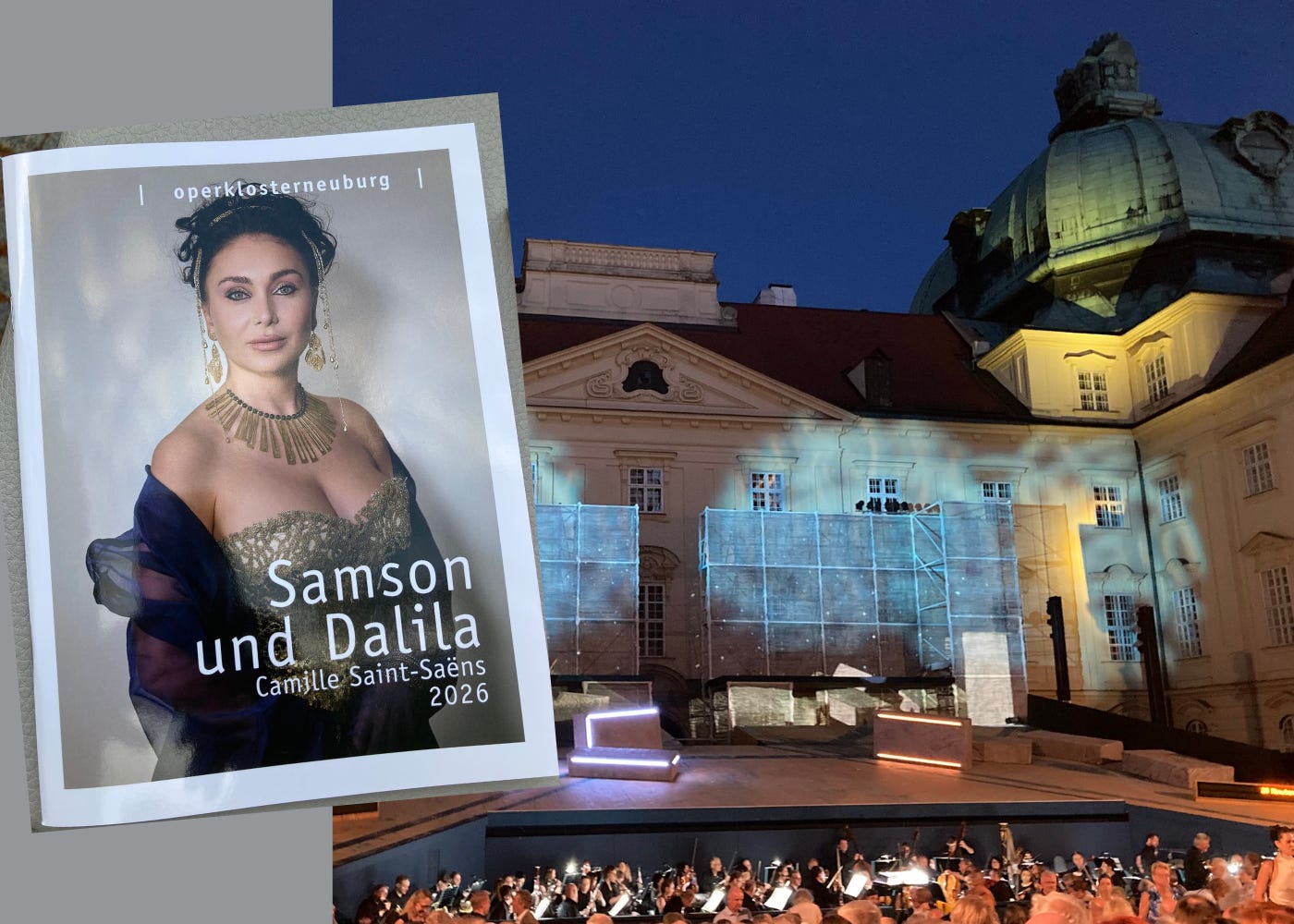
This is the August Field Diary, following The Summer You Are Still Waiting For, this month’s Monthly Lens on Sommerfrische.
On Friday evening, July 17, my husband and I packed two gel cushions into my felt bag and drove to Klosterneuburg to see Samson et Dalila.
The cushions were not an aesthetic choice. They were an act of self-preservation.
Almost everything about the summer opera at Klosterneuburg is wonderful: the setting, the singers, the acoustics, the atmosphere. The chairs are another matter. By the interval, they usually feel less like seats than instruments of torture. After noticing experienced audience members arriving with their own various forms of padding, I ordered two gel cushions for us this year.
Into the bag they went, along with water and a jacket. The day had been sweltering and thick with rain. Because the performance takes place outdoors, there was every possibility that we might lose an evening we had been anticipating.
I hoped the downpour would exhaust itself and move on.
That was more or less what happened.
We reached Klosterneuburg with nearly two hours to spare, early enough to park easily and let the evening begin before the performance did. The rain had cleared, the sun had returned, and above the abbey stretched an intensely blue sky filled with what I immediately thought of as Baroque clouds, those enormous cushioned masses of light and shadow that seem almost too theatrical to be real.
I’ve been fascinated by those clouds since I was a teenager in Pasadena, long before I’d ever been to Austria. I used to look at Baroque paintings and wonder where the artists had found such extraordinary skies. When I finally came here, I understood: they were painting reality. After rain, the clouds can rise like mountains, and suddenly the whole sky seems to belong to a ceiling fresco. Austria is Baroque not only in its churches and palaces, but sometimes in its weather.
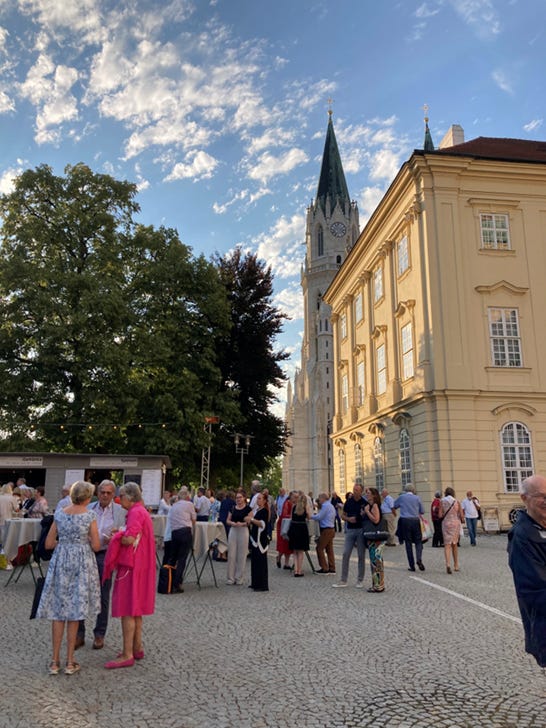
I began taking photographs while the light was still strong. The abbey seemed to hover above us, dwarfing everything around it. Since our previous visits, the hospitality area had grown considerably, with two rows of small food and wine stands beneath the trees, almost like little mountain huts. We found a quiet place to sit, put down our bags, and ordered something to eat.
My husband chose Sacherwürstel. I had a small Wiener schnitzel in a Semmel with avocado cream, an unexpected meeting between Austria and Mexico that was all right, though I may have chosen differently in hindsight. We drank Muskateller and later a rosé Sekt from the abbey’s own vineyards while a breeze moved beneath the trees despite the heat.
From where we sat, the abbey dominated one side of the view. On the other were older monastery remains and smaller working buildings. Between them, the vineyards appeared in the distance.
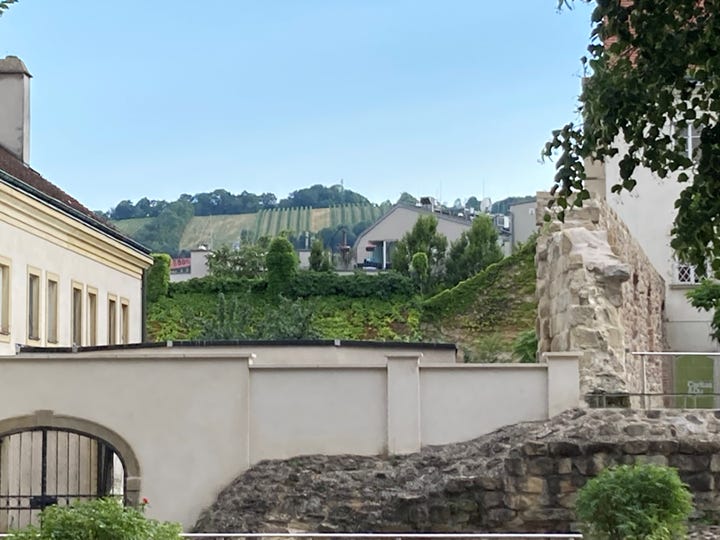
One of my photographs immediately made me think of Christoph, a character in The First Whisper, and of his father working among the abbey vineyards. I began wondering what it would have felt like for a boy to grow up there, moving between cultivated land, medieval stones, working buildings and the monastery itself. That thought didn’t arrive as research. It was simply what the landscape placed in front of me.
The audience at Klosterneuburg is predominantly older, but otherwise remarkably varied, and you could see it immediately in the way people dressed. One gentleman arrived in cargo shorts, a T-shirt and open running sandals. At the other end of the spectrum, a young lady wore a long white gown with a small gold clutch and long black hair, looking almost like a modern high priestess herself. Between those two extremes was almost everything else. The atmosphere is casual because it’s summer and outdoors, but it’s still opera, so the audience seems to occupy both worlds at once. Even beneath the same trees, waiting for the same performance, you could already sense different Viennas sitting beside one another.
My husband and I looked through the program together, reading about the singers and production before walking toward the courtyard.
We passed into the performance space directly beside the orchestra, where the musicians were already tuning, so close that the front players seemed almost within reach. We crossed to the tiered wooden seating and climbed to row 15, seats 13 and 14, stage right. I had the aisle, and from that height we had an excellent view. The gel cushions helped. The chairs remained what they were.
Before the light disappeared, I took photographs of the courtyard and stage. The modern construction sat inside the historic architecture, with the Roman imperial crown rising above us on the far-left side from where we were sitting. It was impossible to treat the courtyard as a neutral container. This wasn’t a black-box theater from which history had been removed. It was an ecclesiastical and imperial place, and crown, monastery and accumulated authority were already part of the experience before the first note.
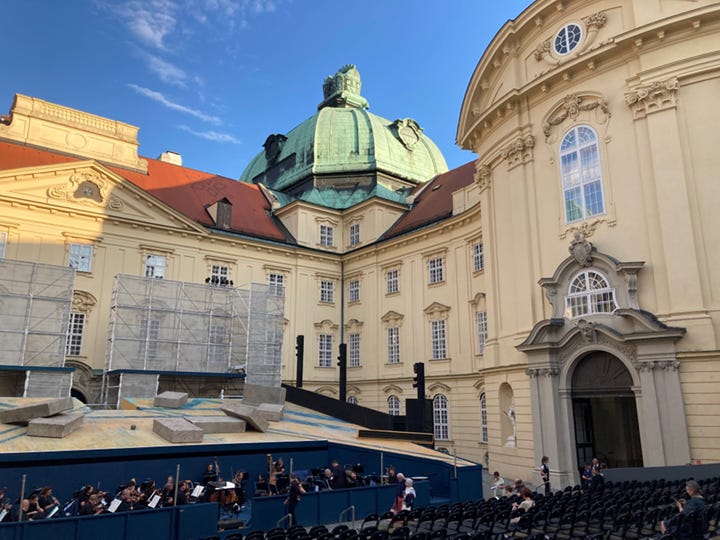
In the middle stood the raked stage, something my husband and I noticed immediately, with enormous stone-like forms arranged across it like dominoes. My first thought was simply: what are they going to do with those? Then came another association: dominoes, dominance, who dominates whom? I didn’t know whether there was any etymological relationship between the words, and I could research that later. What mattered was that the forms had already stopped seeming abstract. They had become part of the opera’s struggle over power, resistance, seduction, betrayal and collapse.
Oper Klosterneuburg is particularly good at creating a great deal with comparatively restrained means. Light, movement, color and intelligent staging do much of the work. The opera began in its original French, with German surtitles appearing on screens to either side of the stage. In the opening, the Israelites were under Philistine control, with children among them, including two who seemed to oppose one of the guards. I read them as more than children caught inside the conflict. They seemed to represent the children of God resisting those who held them captive. My first response was curiosity: This is interesting. Let’s see what they do with it.
Samson entered with the scale the role required, larger than life, physically powerful, with a voice that suited him. The production had found the right person for the part. But what gripped me most strongly was the way the music expressed what the characters couldn’t separate inside themselves.
In one scene, Delilah stood beside the High Priest. The words spoke of love, but beneath them sexual desire served hatred and revenge. She would use seduction to strengthen vengeance against Samson and his people. The music didn’t merely accompany that intention. The singers’ articulation, phrasing and use of the voice made the hatred tangible. You didn’t simply understand what they felt. You could almost feel its physical presence. That is what I respond to in opera. It isn’t heaviness for its own sake. It’s the moment when language, music, voice and dramatic action become one emotional force.
As the first half continued, darkness settled over the courtyard. During the scene in which Delilah was trying to seduce Samson, the great domino-like forms were illuminated from within. Samson was still resisting her, pushing her away and calling upon God for help, when something bright suddenly crossed the sky behind the main building beyond the stage. I didn’t know what it was, a falling star, perhaps a meteor, something comet-like, but my immediate reaction was, “Oh my gosh, look, a comet, and in this very moment.”
What struck me was the coincidence of it. The only time the domino-like forms were illuminated, the night sky seemed to light up in perfect synchrony. My husband didn’t notice it, and I don’t think most of the audience did either because they were absorbed in the music. But I happened to be looking at the relationship among stage, architecture and sky, and so the event entered the performance I experienced. My first thought was almost playful: “Nature participating in the production!”
I didn’t think the universe was sending a sign, nor did I imagine the production had somehow summoned the sky. What fascinated me was that, for a few seconds, the world beyond the stage seemed to become another performer. The audience was watching the opera onstage, but I was suddenly experiencing something larger: a dialogue among singer, scenery, monastery and night.
During the interval, we stayed inside the courtyard and stood at the rear of the wooden seating structure, grateful to be off the chairs for a while. I told my husband about the comet-like object he’d missed, and we compared our impressions of the first half. He was particularly curious to see how the production would handle the bacchanal, one of the opera’s great theatrical set pieces, so when we returned to our seats there was already a sense of anticipation about what would come next.
The bacchanal didn’t disappoint. The scene affected me more intensely than I’d expected. There was sacrifice, worship of another god, projected imagery and dance suggesting sexual orgies. At moments, it felt almost too much, bordering on menacing.
Part of that response came from the production itself. Part came from the place.
Aesthetically, there was something almost harmonious about the excess. Delilah and the Philistines were surrounded by gold. Her clothing was extravagant, almost opulent, and against the richness of the Baroque courtyard it made visual sense. The Israelites appeared restrained by comparison, dressed in sleeker, simpler, almost peasant-like clothing that suggested austerity and suppression.
But watching human sacrifice, hedonistic worship and sexual excess inside an ecclesiastical courtyard changed the experience for me. The monastery didn’t disappear because the opera had begun. The imperial crowns remained firmly in place. The Catholic history of the place persisted.
The architecture acted on what I was seeing.
At the end, the enormous blocks finally fulfilled the possibility that had been present in them from the beginning. Arranged like falling dominoes, they became Samson’s destruction of the temple. The solution was excellent. The forms that had first made me think about dominance ended, quite literally, in collapse.
As the temple came down and the final music filled the courtyard, the production moved toward its close. The last notes faded into the night.
The audience rose into prolonged applause and a standing ovation. There were calls of “Bravo,” but also yowling catcalls that my husband and I found surprising. He remarked that we never used to hear that at the opera. There might have been cries of “Bravo” or “Bravissimo,” but not this newer form of enthusiasm.
Some people left almost immediately, apparently hoping to reach their cars before the crowd. I found that unfortunate because the applause is part of what the performers receive after giving everything they have to the performance.
We walked slowly back through the grounds. I took more photographs because the abbey looked strikingly different at night. In the darkness and selective illumination, the place felt more ecclesiastical and emotionally weightier.
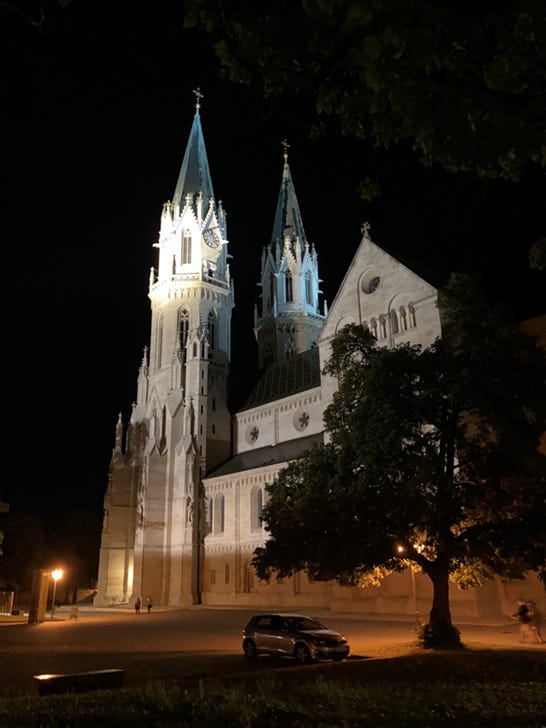
Looking at it, I suddenly thought of Pater Gregor, a priest in The First Whisper, the novel I’m developing. Until then I’d known him primarily as a character, but in the darker, more ecclesiastical Klosterneuburg of that night, I could suddenly see the atmosphere and geography in which he belonged.
This was his world.
Then we returned to the car and began the journey home.
Roadwork forced us to take a detour along the Gürtel.
It had been an intensely hot summer day, somewhere in the low-to-mid 30s. By the time we were driving away from Klosterneuburg and passing the Kahlenberg, the temperature had fallen by more than ten degrees, to around 22°C. You could feel the difference in the air. The hills, vineyards and greenery around us held a completely different night from the heat of the day. As we descended toward the Gürtel, the temperature rose again.
Vineyards gave way to concrete, traffic and graffiti. We drove along the outer Gürtel past buildings in various stages of repair or decay that housed Turkish and Middle Eastern markets, bakeries and kebab shops. What also struck me that night was how overwhelmingly male the street scene appeared. I saw very few ladies, if any, and the image brought back evenings I’d experienced in Saudi Arabia, where the public streets at night had often presented that same strongly male face.
The Gürtel was teeming with life, but its face belonged to a more recent Vienna. A cultural layer of Vienna that I’d become increasingly aware of in recent years was now unmistakably visible, and the speed of that change astonished me.
The juxtaposition with the opera we’d just left was difficult to miss. We’d spent the evening inside a Baroque ecclesiastical and imperial courtyard watching a story rooted in the biblical Middle East, and shortly afterward we were driving through a contemporary Vienna in which Middle Eastern and other migrant cultures had become visibly part of the city itself.
Earlier, beneath the trees at Klosterneuburg, I’d noticed different social Viennas sitting beside one another before the same performance. On the drive home, those layers became geographic. By the time we reached Schönbrunn, another change was already beginning.
As soon as we took the curve into Hietzing, the atmosphere changed almost immediately. Traffic ceased. Streets emptied. Trees lined the roads and the air cooled.
Hietzing carries imperial history too, but not in the same way as Klosterneuburg. Klosterneuburg is dominated by the abbey, Catholic and monastic history, vineyards and imperial ambition. Hietzing is shaped by Schönbrunn, by the former court, villa culture, gardens and an extraordinarily green urban landscape.
By the time we passed through Hietzinger Platz at approximately 11:30, the shops were closed and the restaurants were finishing for the night. Lights remained on at Dommayer and Plachutta while staff cleaned behind shut doors. At Mario’s, the rubbish was already being taken outside.
What struck me was how much could change within less than an hour: the people around us, the cultural references, the architecture, the density of the streets, the amount of greenery, even the temperature of the air. Klosterneuburg, the Gürtel and Hietzing didn’t simply look different. They seemed to belong to different historical and cultural Viennas, each with its own geography, atmosphere and even its own microclimate.
Driving through those changing temperatures made the old rhythm of Sommerfrische unexpectedly physical. Part of the old Sommerfrische impulse had been to move outward from the dense city toward greener landscapes, gardens, hills and better air. That night we seemed to feel the same geography in reverse: cool as we passed Klosterneuburg and the Kahlenberg, warmer again in the densely built Gürtel, then cooler once more among the trees and gardens of Hietzing.
What stunned me wasn’t simply that Vienna had changed. Cities always change. It was how quickly this particular change had become visible. Vienna so often seems to alter itself slowly, layer by layer, almost reluctantly. Here, within only a few years, another cultural face of the city had become unmistakable to me. And yet none of the others had disappeared. They were all there, only minutes apart.
At home, we opened a bottle of wine. I prepared a few small canapés, and we sat on the balcony with a glass and continued talking about the performance, including the strange moment in the sky.
My husband remarked that I was “quite a phenomenon” to him because some of the operas I love, including Ariadne auf Naxos and now Samson et Dalila, seem especially heavy to him. I didn’t experience them that way. What I love is the moment when music carries the emotional movement so completely that it becomes almost physical. In Ariadne, the music spirals upward with the transformation taking place. In Samson et Dalila, the voices didn’t simply describe hatred, desire, faith and resistance. They embodied them.
The next morning, the music was still resonating in me. I could hear it, but more than that, I could still feel its emotional weight, as though the sound hadn’t quite finished moving through me.
I began going through the photographs for practical reasons, looking at what I’d caught, what was good, what wasn’t and what I could delete. But almost immediately, the evening began opening another line of thought.
A rainy summer day, an opera, a courtyard, a bright object in the sky, a drive through several Viennas and a group of photographs had begun forming something I hadn’t gone there expecting to find.
What those photographs began to change belongs to next week’s Building Understanding Vienna.
• • •
Begin with The Summer You Are Still Waiting For, or go deeper into the history with The History of Sommerfrische.
The Summer You Are Still Waiting For
·
Aug 7
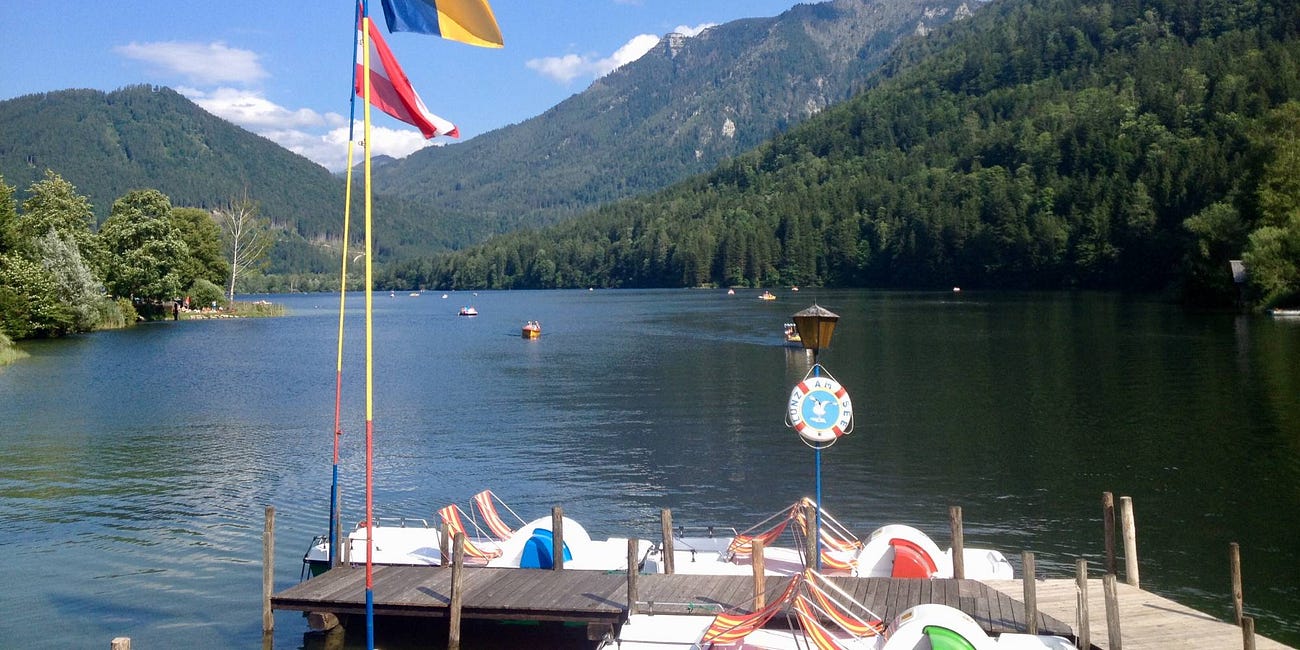
A summer occasion begins before we enter it. Lunz am See offers water, mountain landscape, and the possibility of allowing the lake to become the day.
Next week, we’ll follow what these photographs began to change in Building Understanding Vienna.
Comments
Nothing yet. Say the first thing.
Sign in to join the conversation.