
First, the necessary follow-up to my last post: That was a brief note about the National Institutes of Health Scientific Freedom lecture that I presented on June 12th. My subject was the history of obesity science: Why we came to believe that obesity is an energy-balance disorder—caused, in effect, by overeating—despite the fact that it had been dismissed as a failed hypothesis by the world’s leading medical scientists before World War II. One of them called it “the dead end of the energetics view.”
NIH, which is apparently a bit slow with these things, finally posted the video on Thursday. You can watch it here.
Now, on with today’s post.
I’m glad The Atlantic printed this and supports the food industry’s campaign to seed doubt. The capital reaped from junk-food deserts in impoverished communities — where the only foods available are mostly upf [ultra-processed foods] — is absolutely critical to my investment portfolio. If upf’s were regulated I am terrified that my expenses from Whole Foods would go up substantially. Thanks to Taubes for helping to increase my bottom line at the expense of the poor, and excellent work in replicating Big Tobacco’s campaign to seed doubts. You’d make them proud.
“Kildare,” on “A Fancy Name for Junk Food,” The Atlantic, June 23, 2026
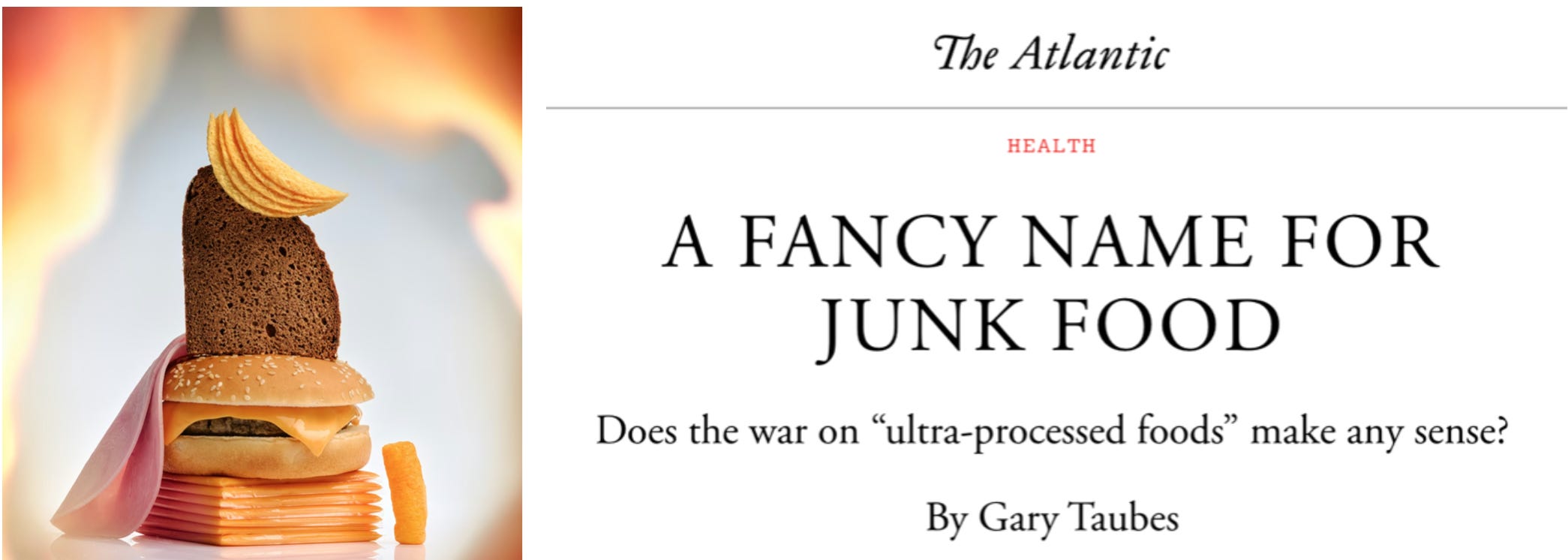
Kildare was commenting sarcastically on an article that I had written about the ultra-processed food controversy and that The Atlantic had posted online earlier in the day. The comment reaffirmed a point I had raised in the article. To criticize the UPF conception—to suggest, as I did, that embracing the UPF logic will do more harm than good—is to be accused of defending the food industry: seeding (or manufacturing) doubt, as Kildare said, or “playing by the tobacco industry playbook,” as the sociologists in this business like to phrase it.
The gist of this accusation is that public health authorities were right about the harms of tobacco and, well, about the venality of the tobacco industry executives, and so we can assume they’re right about similar public health issues in which industry is involved, and about the venality of those executives. We should behave accordingly.
The problem is that these nutrition-environment-disease relationships are scientific issues, and science relies on skepticism to function. Skepticism seeds doubt, or at least it should. (”Most institutions demand unqualified faith,” as the sociologist Robert Merton put it, “but the institution of science makes skepticism a virtue.”) Science ceases to function when its practitioners decide the goal—saving lives, in this case—is so important that they can’t afford to be critical of their own beliefs. By this thinking, anyone who is critical must have an ulterior motive, and if industry stands to gain from either action or inaction—bingo—there it is.
I’ve been thinking about this industry-conflict issue since the late 1990s, when it came up in the very first investigative article I wrote on a nutrition controversy—“The (Political) Science of Salt” for the journal Science.
As I learned from my research, the evidence suggesting that salt consumption causes hypertension is exceedingly weak, and always has been. It was a plausible hypothesis, but numerous clinical trials had failed to confirm it. Nonetheless, once raised, it took on a life of its own. The nutrition researchers developed tunnel vision and never bothered to consider competing hypotheses. And the only researchers who cared enough to review the evidence and test it in clinical trials were those invested in its being right.
That created an anti-salt bias in the published research1 and left the food industry having to find disinterested researchers willing to examine the evidence without bias. But those researchers expected to be paid for their time. (Can you blame them?) And for the reputational hit they will take if they conclude that the industry is not to blame. And their research had to be funded. If they then report that the evidence was weak, as it was with salt, their work could be easily dismissed because it was funded by industry. That they were seeding doubt was true, as well. But that doubt should have been there all along.
Comments
Nothing yet. Say the first thing.
Sign in to join the conversation.