
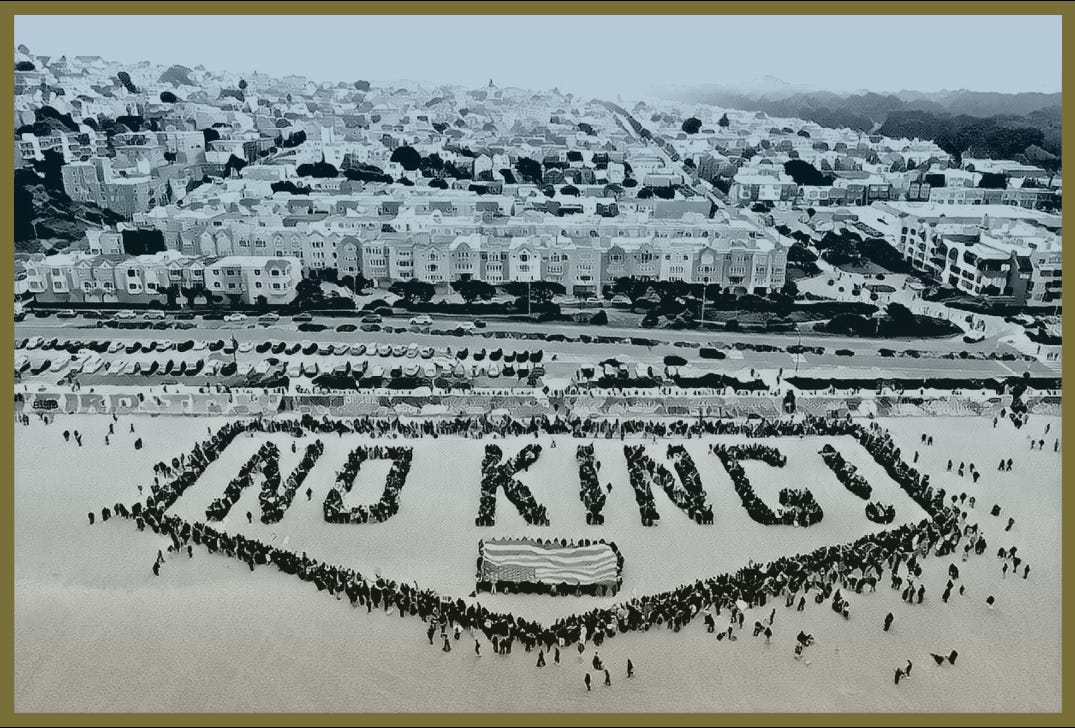
After five months into Trump’s second term, the American experiment is in freefall.
The time for comforting equivocation is over. Trump’s vengeance sits at the center of a “competitive authoritarian” regime, backed by a pack of oligarchs and sycophants, dead set on dismantling self-government in America. The institutions designed to check extreme power and uphold our distinct ‘No Kings’ policy are unraveling.
The Democratic Party, the often-empty vehicle for defending working people, has failed to meet this moment. Instead of wielding power with the ruthlessness required to counter the New Right, it has been trapped in a cycle of caution and complacency.
Too many Democratic leaders, media outlets, and even progressives still act as if the old rules apply; that enough norms will hold, institutions will self-correct, and a patient response will prevail. That world is gone. The rule of law, a free press, the integrity of elections — this administration has declared open war on all of them.
And, yet, a deeper force is stirring. An anti-oligarchy populist revolt is rising. Bernie Sanders’ Fighting Oligarchy rallies, drawing thousands in blue-collar battlegrounds, are a flashing warning light to the political class: everyday Americans are beyond fed up. They are starved for a movement that speaks to their economic pain, their stolen future, and their desire for a government that fights for them, not the ultra-rich.
The nation stands at a waystation between an irreversible descent into madness, or a renewed commitment to that long American tradition of finding our way out of hell.
The battle for our future is already here.
And right now, the pro-democracy movement lacks the coordinated force to win it.
For the last half-century, the American right has built a vast machine. Not a party, not a movement, but an entire, unified system designed for permanent political power.
It has the scale of an empire, the discipline of a military, and the patience of war. It doesn’t rely on elections; it engineers them. It doesn’t accept culture; it reshapes it.
This machine spans six interconnected domains: media, policy, the courts, grassroots mobilization, state legislatures, and elite institutions. It forms a singular ecosystem:
Right-wing think tanks write the laws.
Conservative media primes the base.
Billionaires fund the machine.
The courts lock in the victories.
State legislatures cement the agenda for decades.
This self-reinforcing creation is how they win, even when they lose elections.
And the left?
The left mobilizes in bursts, fights in silos, and then watches as its momentum dissipates. It has no equivalent machine (not even close), no sustained operation designed to win the long war. It remains scattered across thousands of groups.
Defeating an empire requires more than resistance. It demands lasting infrastructure that organizes, recruits, funds, and enforces. It requires an American Popular Front.
Popular Fronts have long arisen as defenses against autocratic threats, uniting labor, working-class movements, and pro-democracy forces. In 1936, France’s Popular Front mobilized workers to win power and new reforms, holding off fascists until the 1940 occupation. Spain’s Popular Front, formed in the same year, united a diverse coalition to resist Franco, fighting fiercely despite its eventual defeat in the civil war. Though tested by brutal setbacks, these alliances showed the strength of collective defiance.
In the U.S., labor has played a similar role in shaping American history. The industrial union movement of the 1930s, led by the Congress of Industrial Organizations (CIO), forced the Roosevelt administration to strengthen the New Deal. It was not simply the benevolence of FDR’s government that delivered major pro-worker reforms; it was the militant labor organizing that created the political conditions for their passage.
More recently, in 2024, France’s left faced a moment of crisis as Marine Le Pen’s far-right National Rally surged toward power. Recognizing the stakes, the rival left-wing factions set aside their differences and formed Le Nouveau Front Populaire. In a matter of weeks, they coordinated an electoral coalition, standing behind a single candidate per district. They successfully denied Le Pen a governing majority. The lesson was clear: a collective front in the face of authoritarianism isn’t optional — it’s survival.
When democracy is on the line, fragmentation is a death sentence.
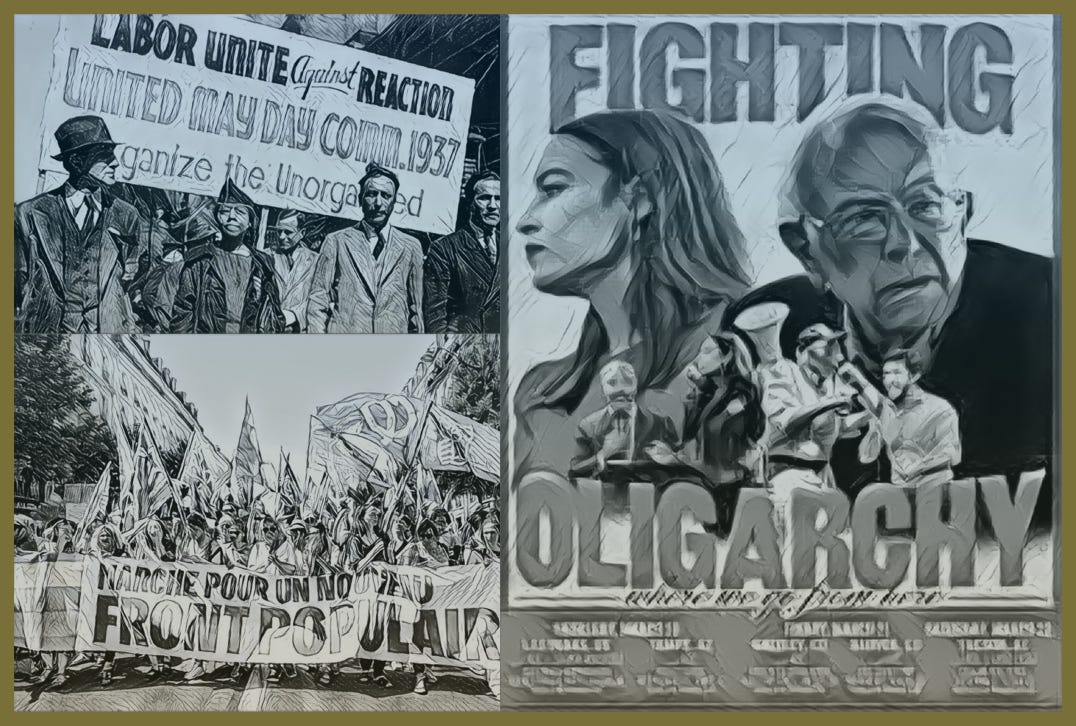
The right has built its empire. The left has not yet built its counterforce.
An American Popular Front is the missing foundation. A strategic accelerator. A force multiplier. The backbone to unite, scale, and sustain the fight for a generation.
This is what an American Popular Front must build:
A Unifying Political Identity + Vision: A shared fabric that unites everyday Americans and the pro-democracy movement, with economic dignity, national development, democratic renewal, and anti-corruption as among its principles.
A Backbone Organization: The coordinating force that aligns labor, leaders, funders, movements, and the public behind a shared generational strategy.
A Scalable Funding Engine: A strategic financing model to pool resources, fund infrastructure, and break the reliance on election-cycle fundraising. (A future article will outline ‘100 from 10,’ one envisioned framework for scaling buy-in.)
A Mass Electoral Pipeline: A system to recruit, train, and support working-class candidates at vast scale, running serious campaigns in every winnable district.
Policy Research + Legislative Writing: A unified core to drive legislation at every level. Groups like Roosevelt and EPI have laid the groundwork, but the left still lacks the infrastructure to rival Heritage and ALEC. An American Popular Front must coordinate and expand these efforts into a force that shapes the next era.
A Media + Messaging Machine: The right has dominated media for decades — radio, cable, and now social media. A 2025 study by Media Matters analyzed 320 ideologically-driven online shows. They found 9 of the top 10 are right-leaning, collectively amassing nearly five times the following of left-leaning content.
Legal + Judicial Infrastructure: A left powerhouse to counter voter suppression, challenge monopolies, and overcome the Federalist Society’s grip on the courts.
A Strategic Operations Hub: The left’s parallel to the Conservative Partnership Institute (CPI), a war room for training and deploying political operatives, improving internal coordination, and keeping progressive forces on offense.
Public Education + Cultural Influence: The right built an effective, ideological pipeline through Hillsdale College, PragerU, and other conservative outlets. The left must invest, at scale, in its own intellectual and cultural infrastructure, shaping narratives, training leaders, and forging an influential worldview.
State Legislative Strategy + Organizing: A full-spectrum strategy to win state legislatures and drive progressive policy, building lasting power to counter the Heritage Foundation and ALEC’s decades-long hold on state lawmaking.
The task ahead is clear: construct the infrastructure to wage and win a long-term battle against rising autocracy and oligarchy, and their attendant immiseration.
Two areas stand out for urgent investment: the left’s weak electoral pipeline and its outgunned digital ecosystem. A rapid scaling of both is essential for the midterms. Progressives have existing capacity in each, but they require serious investment.
In the coming year, On the Brink’s conversations will encompass the following:
Exploring a “Counter-Powell Memo”: A blueprint to unite pro-democracy, labor, and progressive movements around a vision and path for 2026, 2028, and beyond.
Mapping the potential design of a backbone organization — a central force to hold the line, drive alignment, and sustain coordination across the entire front.
Learning from the wins and losses of Brand New Congress, Justice Democrats et al., and examining what it would actually take to realize their original mission.
Shaping a modern economic populism — rooted in economic rights, a Marshall Plan for America, democratic power, and reweaving our civic fabric — that can broadly resonate today and navigate the existential transformations ahead.
Leaders, organizers, funders, and all people of good heart must come together to build the counterforce, an American Popular Front, that can sustain this generational fight.
Without coordination, no counterforce. Without a counterforce, no democracy.
Instead of proposing an extensive reading list, I want to highlight someone whose recent work remarkably aligns with and reinforces the Popular Front framework.
Over the last six months, Waleed Shahid has produced a series of strategic pieces that complement and deepen many of the themes explored here. His work offers incredible depth on movement infrastructure, media ecosystems, populist organizing, and more:
No posts
Comments
Nothing yet. Say the first thing.
Sign in to join the conversation.