
What follows is a strategic case for national development as the engine of a Fourth American Founding: coordinated investment, public leadership, and mission-driven government capable of solving national challenges. Written for organizers, funders, policymakers, and builders; for anyone connecting capacity to the common good.
A nation must deliberately and consistently invest in its means of making a living — its industries, its workforce, its infrastructure, and its productive capacity. This is a simple truth, yet one that has been abandoned by much of America’s leadership.
For decades, policymakers have treated the economy as something that simply happens, left to the whims of the market, rather than something that must be built.
Half a century of neglect has cost us dearly. Entire industries offshored. Towns and cities decimated. Supply chains left fragile and vulnerable. A generational cost-of-living crisis, while corporate profits soared. The belief that economic development happens without public leadership has led to a weakened, unstable, and deeply unequal American economy; one that bleeds the public to feed the powerful.
Most successful economies — throughout history, across the world — were shaped by deliberate public investment, industrial strategy, and long-term national planning.
Nations that thrive tend to be nations that make foundational, strategic investments in their own productive capabilities. We see this confirmed throughout U.S. history:
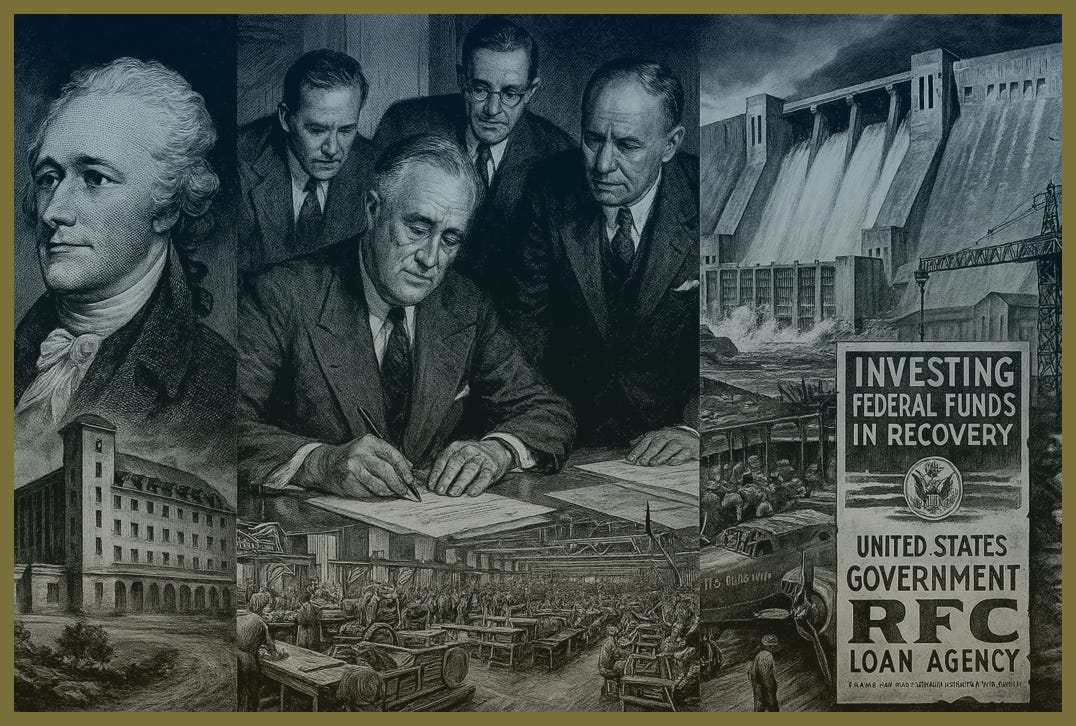
Alexander Hamilton was America’s first great industrial policy leader, laying the foundation for a nation that could stand on its own economically, developing domestic strength rather than remaining dependent on foreign powers.
The Reconstruction Finance Corporation (RFC) helped mobilize America’s industrial might to create FDR’s Arsenal of Democracy, proving that public institutions could play a decisive role in economic transformation.
The postwar economy was shaped by government investments in infrastructure, research, and industry, spurring broad prosperity and a rising middle class.
The technology revolutions of the late 20th and early 21st century, from the internet and GPS to clean energy and mRNA vaccines, were fueled by decades of state-backed research, investment, and procurement, not just private ingenuity.
Yet despite this rich legacy, America abandoned its own proven playbook. Over the last fifty years, a new economic consensus took hold, one that told government to step back, let markets lead, and leave national development to chance. Industrial strategy was sidelined. Public planning was dismissed as outdated. Instead of a smarter, stronger economy, we witnessed disinvestment, decline, and deepening inequality.
For fifty years, both parties bought into the illusion that our country could simply outsource its productive foundations and thrive off design, finance, and consulting. We were told it didn’t matter who made the machines, mined the copper, processed the medicine, or fabricated the chips — as long as someone did it, somewhere.
Nations that forget how to build often forget how to survive.
Today, we rely on rivals for basic pharmaceutical ingredients, rare earth minerals, and critical components for our power grid and military. We can’t resupply our hospitals, rebuild our capacity, or defend our country without fragile supply chains that stretch across oceans. Under the banner of globalization, we have engineered national frailty.
And while America’s capacity was being bled dry, someone did get rich. From NAFTA to China’s WTO entry, from offshoring to union-busting, the winners weren’t U.S. workers or communities — they were the top 1% who siphoned $79 trillion in stolen productivity from 90% of us. Market efficiency became the cover for organized looting.
It was a choice masquerading as an “inevitability.” A deliberate dismantling of our industrial base by corporate and political leaders who believed labor was outdated and real production could be outsourced without consequence. We were told we didn’t need to build anymore. And now we barely can. No serious national development strategy can ignore that reality, or the scale of reconstruction required to fix it.

We know what it looks like for a country to create shared prosperity. America has done it for centuries through public institutions coordinating industry and capital.
In 1932, in the depths of the Great Depression, the U.S. government created the Reconstruction Finance Corporation (RFC), an institution unlike any before it. Distinct from a regulator or grant program, it was a public investment engine.
When FDR took office in 1933, he expanded the RFC and reshaped it into a powerful engine of economic recovery: financing housing, utilities, railroads, manufacturing, and banking. It later became a key tool in mobilizing the Arsenal of Democracy that defeated Nazism in WWII, all while turning a profit nearly every year it operated.
The RFC became a leading model of effective public investment, demonstrating how government can act as a lender, investor, and strategic actor. It traded command-and-control for coordination and courage. Independent, public. Ran by business leaders. Structured to move quickly. Accountable to mission. Instead of replacing the private sector, the RFC directed it. It filled market gaps. It connected ambition to action.
In the end, the RFC didn’t fail. It was dismantled as postwar America drifted toward a new orthodoxy: that markets, not public institutions, should marshal the economy.
Far from an outlier, the RFC exemplified a tradition that made the modern world.
As economist Ha-Joon Chang has shown, free markets alone never create wealthy nations. The tools of collective prosperity are coordinating investment, protecting sectors, and mission-driven planning — strategic statecraft, not the invisible hand.
Japan’s MITI. South Korea’s Economic Planning Board. Germany’s public banks. Singapore’s state investment arms. The Finnish Innovation Fund Sitra. The shared playbook is clear: steer the economy with direction, discipline, and national missions.
Mariana Mazzucato calls it the entrepreneurial state, where the public sector, no longer a passive funder, actively shapes markets and drives economic transformation. Her work re-centers the importance of public return on the value the state helps create.
This long tradition of governments that build never died.
Now, we must revive it in America.
An entire generation has lived with no generational mission.
For millions, there’s been no shared project to belong to. No clear path to a good life. No invitation to participate in something that matters, and be paid well to do it. No moonshot. No New Deal. No Marshall Plan. Nothing that asked us to rise to the moment, create something beyond ourselves, or build a country worth passing on.
That ends when enough of us decide it does.
The work that needs doing is everywhere. The climate is collapsing. The economy is unstable and rigged. Infrastructure is crumbling. Care systems are overwhelmed. Whole regions are gone. China is racing ahead. Our very security and sovereignty are on the line. The problems are evident; the public power to solve them remains scarce.
The United States could launch a World War II–scale mobilization to meet this moment. Not as metaphor — mobilization in the literal sense: coordinated national investment, millions of new jobs, and a rebuilt public sector capable of brilliance.
The nation is ready for that kind of calling. Americans love work. We want to work. We want purpose. We want security. We want to build something real, and live well doing it. What’s missing is a state with mission, direction, and the capacity to deliver.
One of the most serious blueprints for how to make that possible already exists.

Mission for America is a strategy for full national mobilization. It was developed by New Consensus, the team that shaped the original Green New Deal. It’s one of the only existing plans that treats climate breakdown, economic stagnation, and public collapse as a single intertwined crisis, and lays out a comprehensive way to respond.
The central insight is simple: America has the resources, the talent, the wealth. What it lacks is coordination. What it lacks is a public engine with enough force to lead.
The plan begins by reviving one of the most effective institutions in American history: the aforementioned Reconstruction Finance Corporation, rebuilt for our current era.
This modern RFC would be the backbone of a new economy. It would invest in clean energy, housing, supply chains, industrial capacity, and key infrastructure. It would seed new industries, finance large-scale public procurement, and take equity stakes so the public shares in the upside. Today, we do the opposite: the government bears the risk; private actors reap the reward. DARPA helped invent the internet and GPS, yet the public owns none of it. As the saying goes: socialized investment, privatized gains.
Breaking the mold of a regulatory agency, the RFC would operate like a builder. Fast. Strategic. Mission-focused. Accountable. And it wouldn’t act alone. It would sit at the heart of a full national strategy, one that marshals investment, coordinates across sectors, and puts government back in the role of leading transformation.
Beyond a policy set, Mission for America is a playbook for getting our shit together.
No serious marshaling happens without a president willing to lead it directly. That means defining the vision, setting the missions, igniting public support, naming the leaders, and holding them accountable. The president would need to campaign on the project constantly, treating it as a national cause, and then moving fast to execute.
This requires direct leadership rather than simple management. The president would recruit talent from across the country. They would name the heads of each mission. Use the full force of the executive branch to cut through stagnation. Go to the public often. And make clear what’s being built, what’s being blocked, and who’s blocking it.
Only three U.S. presidents have led full-scale national mobilizations: Lincoln, Wilson, and FDR. Now, the enemy isn’t an army; it’s collapse. It calls for profound response.
The RFC would serve as America’s investment backbone.
It would direct public capital where needed most, and build what private markets neglect, because the margins are thin, risks too high, or the rewards take too long.
A reconstructed RFC would function as:
An investor in new industries.
A strategic planner for industrial ecosystems.
A lender and owner of last resort.
A coordinator across public and private sectors.
It would spin off permanent institutions. Build GOCO facilities (government-owned, contractor-operated). Launch stockpiles and procurement efforts to drive demand and production. And shift talent from Wall Street and Silicon Valley into public service.
Each national mission directed by the RFC would be shaped by a common set of tools:
Spending: Direct public investment in infrastructure and services.
Public ROI: The public would hold stakes and earn returns through the RFC.
Carrots and mandates: Tax credits, regulations, grants, and strategic restrictions.
Scoreboards: Public-facing dashboards to track progress on the missions.
Leadership: Named leaders publicly accountable for delivery.
Add it all up…it’s the kind of public capacity we have been missing for half a century.

We’ve talked a lot about building. Let’s now talk about what was taken.
The ultimate test for our country’s development is whether ordinary Americans can afford a home, raise a family, live a decent life, and retire without fear.
On that score, middle-class American life has turned into a luxury product.
At A Fight Worth Having, Corbin Trent’s “Years of Work” analysis lays it bare. He ran the raw math, with no inflation tricks. No distorted housing estimates. Simply:
How many years of median income does it take to afford the basics of a middle-class life — housing, healthcare, college, childcare, transportation, food, and retirement?
The answer: We’re beyond treading water. We’re drowning.
Here’s the difference between 1950 and today:
Healthcare: 1 week of work in 1950 → 12 weeks today
College: A summer job → more than a year
Childcare: 2 months → 6 months
Housing: 2 years of wages → 10 years
These numbers aren’t tracking prices. They track the tax on your time. They show how much more of your life you have to trade to afford stable, middle-class America.
And here’s the kicker:
The government says real wages have risen 252% since 1950.
But in terms of actual purchasing power? We’ve lost 61%.
In 2023, the U.S. median income was $42,220. If we wanted to match what our grandparents could purchase in 1950, today we would need to make…$109,072.
The Ludwig Institute's 2025 analysis confirms this brutal reality. Their Minimal Quality of Life Index reveals that from 2001 to 2023, the cost of basic economic security doubled, increasing 99.5%, far outpacing traditional inflation measures.
Now think about the lives of millennials and Gen Z. Work harder than their parents and inherit less. Get a degree and take on huge debt. Rent indefinitely. Delay having kids. Run full-speed on a treadmill going nowhere. And then get told: you’re lazy.
The truth is that young people understand the deal being offered to them. They can do the math. Why sell your life to a company when you’ll never afford a home? Why grind for decades for what your grandparents acquired on one income?
The American Dream has been quietly dismantled. The social contract, broken.
The next generation is past apathy. They are pissed off. And they are right to be.
National development must deliver a life that actually works.
For decades, the United States has kept the wrong score. GDP, the stock market, corporate earnings, productivity — metrics that reflect growth, not well-being. Metrics that track profit and concentration, not dignity. We call it progress, even as child poverty spikes, life expectancy falls, and despair spreads across our nation.
That’s not a scorecard. It’s how a country loses, and calls it winning. Across nearly every meaningful measure of national strength, America is getting outcompeted:
We lead the developed world in child poverty, housing insecurity, student debt, maternal mortality, gun deaths, medical bankruptcies, suicide, and incarceration.
We lag behind in economic mobility, infant and maternal health, life expectancy, access to mental health care, union density, and public trust in institutions.
And when it comes to quality of life? Childcare. Housing affordability. Transit. Schools. The glue that holds a society together. We’re losing ground on all of it.
This is America’s real report card. And every one of these realities is a choice.
The data cuts deeper than left or right. It's life and death. It's whether a 20-year-old sees a future. Whether a single mom can make rent. Whether a factory town can recover. Whether a democracy can work when no one believes it's working for them.
We mobilized to win wars and reach the moon. We can mobilize to make life livable.
We should already have an American Scorecard — a public-facing, widely accepted, rigorously maintained national dashboard of our real condition. One that sets targets. Tracks progress. Forces accountability. And resets our view on what winning means.
Andrew Yang made this idea central to his 2020 presidential campaign. Others, like the U.S. Social Progress Index and Measure of America, have started to create similar tools. Nothing has broken through yet as the defining scoreboard for success.
A baseline of shared reality is required. Fixes can compete; the facts should not.

America faces four converging crises that any serious political project must address:
A collapsing climate.
A rising authoritarian threat.
A geopolitical race with China.
And a brutal dispossession at home, on the precipice of a Great Displacement.
Four symptoms of the same failure: A government that no longer works. An economy that no longer delivers real security. A ruling class that extracts rather than builds.
Marc Andreessen, in “It’s Time to Build,” wrote something of broad relevance:
“The left starts out with a stronger bias toward the public sector in many of these areas. To which I say, prove the superior model! Demonstrate that the public sector can build better hospitals, better schools, better transportation, better cities, better housing. Stop trying to protect the old, the entrenched, the irrelevant; commit the public sector fully to the future.”
On this point, he’s exactly right.
Let the models and ecosystems compete — on the results where it counts.
You can be a conservative populist. An abundance liberal. An institutional reformer. A social democrat or socialist. A Silicon Valley dynamist. An anti-monopolist.
Whatever banner you fly, America’s actual scorecard is the terrain we share.
The test for every ideology, party, person, and institution is the same today:
Can you deliver care, safety, and economic security?
Can you reduce despair?
Can you raise life expectancy?
Can you enable families to afford homes again, without drowning in debt?
Can you create broad prosperity without plundering the planet?
Can you rebuild trust in institutions, by making them worth trusting again?
Want to prove your model works? Prove it where it actually matters.
Rebuild a broken economy. Deliver a thriving future. Beat back authoritarianism, at home and abroad. Compete with China. Restore trust in democracy. And do it all within the boundaries of a planet that will break under another century of extraction.
That’s the builder’s challenge.
It is the purpose of national development, the engine for renewing our nation. A real strategy to meet the stakes. To rebuild capacity. To channel our patriotism where it counts. To give a generation the means of winning a shared mission for their future.
We have the tools.
We have the people.
We’ve even written the damn playbook before.
The next American era is now ours to build.
Prove the better model.
Let the scoreboard be reality.
And let the builders lead.
No posts
Comments
Nothing yet. Say the first thing.
Sign in to join the conversation.