
America made a promise it has never truly kept.
Every schoolchild learns the words: life, liberty, and the pursuit of happiness. Unalienable rights. Government of, by, and for the people. A more perfect union.
Beautiful words... but often betrayed.
Today, the American Dream is dead for six out of ten of our families.
Not struggling. Not deferred. Dead.
Research from the Ludwig Institute shows that 60% of Americans earn too little to afford the essentials of economic security: housing, food, healthcare, childcare, and transportation. The median household makes $38,000. A basic life costs $67,000.
This was not inevitable. It was broadly intentional.
For thirty years after World War II, the bargain held (though not for all). Workers built wealth and shared in it. A single paycheck supported a family. Each generation lived better than the last. America led the world in wages, productivity, and innovation.
Capital, however, enabled by government, was about to declare open season on labor.
Beginning in the 1970s, the wealthy launched a multifront campaign to break the postwar compact. Unions were shattered. Jobs were shipped overseas. Industries were deregulated. Housing became a speculation game. Healthcare became a profit center.
The result: productivity doubled while wages rose slightly. Corporate profits soared while worker power collapsed. Billionaires multiplied while poverty deepened.
RAND calculated the damage: $79 trillion transferred from working families to the top 1% from 1975 to 2023. That is $32,000 less earned annually per full-time worker.
That transfer still continues today.
Historian Gary Gerstle contends that American life has been shaped by a series of dominant political orders — frameworks of power, ideology, and institutions that structure how government works, what the economy rewards, and who gets to thrive.
Over the past century, two orders have defined the arc of American politics.
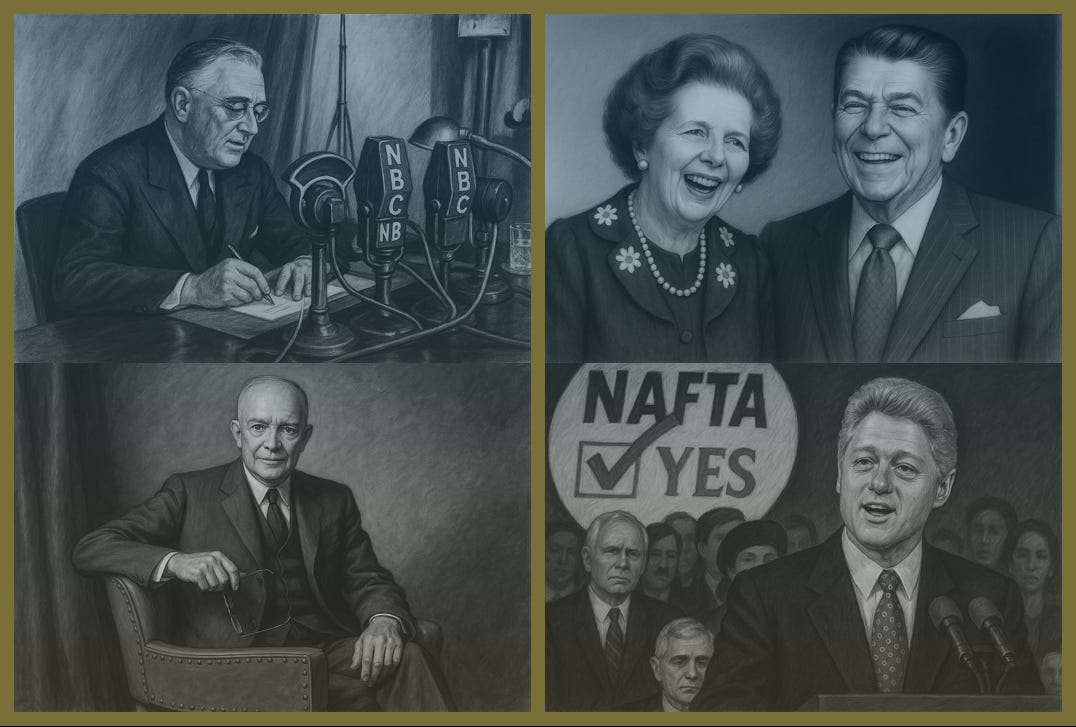
From 1933 to the late 1970s, the New Deal order organized the American economy around state-led growth, labor rights, and universal public goods. It rested on a simple idea: government could be a force for economic security and democratic inclusion. It wasn’t perfect, but it created the most broadly shared prosperity in U.S. history.
From roughly 1980 to 2016, the neoliberal order reversed course. Deregulation, tax cuts, deunionization, and privatization became the new gospel. Markets were framed as efficient, government as bloated, and public purpose as suspect. This order gutted the middle class and concentrated power in the hands of global finance and corporate monopolies. Its architects promised that wealth would trickle down. It never did.
The Market God order is now breaking apart.
“The old world is dying, and the new world struggles to be born: now is the time of monsters.”
Gramsci’s quote is playing out in front of our eyes. Today, the vacuum fills with rising authoritarianism, corruption, and chaos. History offers no guarantee that democracy finds its way out of such moments. Republics crumble more readily than they endure.
In moments of transition, victory belongs not to the righteous, but to the organized.
American history contains a draft of social democracy; unfinished, but instructive.
Most people forget this history because powerful interests have spent billions to erase it. They want us to believe that collective action is mob rule, public investment is Marxism, worker power is un-American, and economic rights undermine liberty.
In reality, American radicals invented the modern blueprint for shared prosperity.
Thomas Paine called for universal inheritance and wealth taxes. Alexander Hamilton designed the first national industrial policy. Lincoln established land-grant colleges to uplift the common man. The Reconstruction Amendments wrote racial equality into the Constitution. The Populists united workers against predatory capitalism. The Progressives curbed monopolies and championed consumers and conservation.
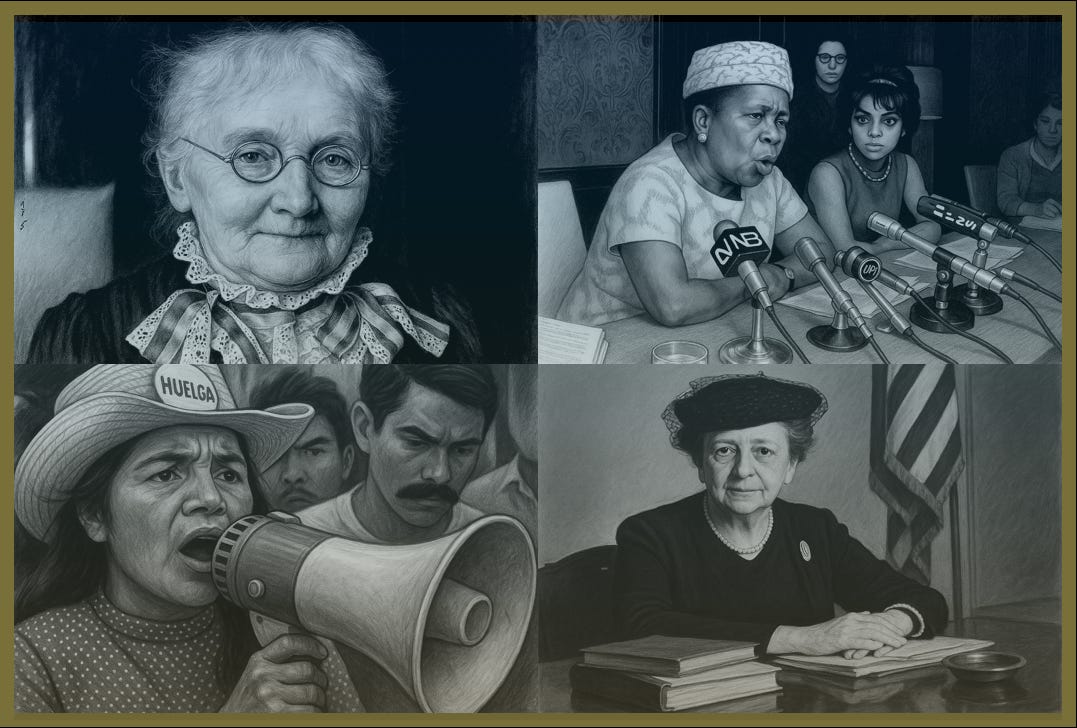
FDR and labor went even further with Social Security, the GI Bill, and public works employing millions. LBJ's Great Society added Medicare, Medicaid, and voting rights. MLK and his allies demanded the next step: jobs, housing, and healthcare as rights.
Each victory was won by multiracial coalitions of working Americans, refusing to accept that the sun of their country’s promise cast light only upon the pre-approved.
That same radical tradition built the Reconstruction Finance Corporation, Tennessee Valley Authority, Interstate Highway System, and the R&D that became the internet.
Our nation pioneered this kind of national development for over 150 years.
And then those in power decided to forget our legacy.
In the last half-century, both the GOP and the Democratic Party have embraced the delusion that markets could replace government, that private greed could deliver public goods, that wealth would trickle down rather than accumulate upward.
In that time, the Nordic countries learned from our successes while we abandoned them. They built universal healthcare, free education, free childcare, strong unions, sectoral bargaining, and generous public investment. Today their citizens live longer, work less, and trust their institutions — and each other — more than Americans do.
They chose social democracy. We chose the neoliberal consensus.
In 1930, as the Great Depression deepened, FDR declared, “There is no question in my mind that it is time for the country to become fairly radical for a generation.”
After half a century of drift, there is no question now: The generational project to reconstruct America’s revolutionary purpose and promise lies before us.
On the Brink is working to catalyze the Fourth Founding Project as our main contribution toward that cause, organized around the following cornerstones:
American Universalism: The moral bedrock. American Universalism recognizes the core principle of our democracy: that we are all created equal, and that from this equality flows the universal right to be free. Its vision rests on three inseparable pillars — equality, freedom, opportunity — and holds that when any one is denied, the others collapse with it. Most of the great movements in U.S. history have been driven by the universalist principle, insisting the promise applies to everyone. That tradition is the foundation for everything else here.
The Unfinished Work: Four domains and missions of reconstruction. It means securing economic rights as the prerequisite for meaningful freedom, rebuilding the nation’s public production, cleansing democracy of corruption, and renewing the bonds of civic faith. It’s how a divided, drifting country becomes whole again.
Toward Union: The plan to move as one. The talent, energy, and ideas are there, but far too scattered. Toward Union means linking every level of the rebuild —creators, candidates, organizers, voters — through shared pledges, common goals, and real coordination. It’s how we turn a message into critical mass and critical mass into a governing supermajority. The right built its machine; now we must.
Before Superintelligence: Today's AI arms race will test whether humanity can stay in control of what it creates. Advanced AI and biotech could erase scarcity, or erase agency. The task is to build post-labor economies that protect dignity, and governance capable of directing superintelligence toward human purpose.
The New Right’s coalition of the few has begun enacting its plan for the many of us.
Will we succumb to this new era of fear, mass surveillance, and tech oligarchy — or mobilize a new American founding that rewrites the social contract with an Economic Bill of Rights, rebuilds prosperity with a Marshall Plan for America, reclaims democracy with a True Democratic Republic, and reweaves civic life with a New Birth of Union?
The next American order awaits its builders.
On the Brink aims to help equip them.
No posts
Comments
Nothing yet. Say the first thing.
Sign in to join the conversation.