
If you’ve followed the health and nutrition press over the past few years, you might have noticed that a lot of attention has been paid to “ultraprocessed food” (UPF). Much of this attention stems from a 2019 nutritional experiment that showed that UPF causes people to eat more and gain weight. Popular explanations for the phenomenon are that such food is “hyperpalatable” and “energy dense.”1
While we now have good evidence that UPF causes weight gain, several open questions remain. Why does it have this effect? Why isn’t all food created equal when it comes to our health? What exactly makes UPF hyperpalatable? Why are energy-dense foods per se problematic for human health?2 For that matter, what exactly do the terms hyperpalatable and energy dense even mean? These questions are extremely important for the simple reason that everyone must eat to stay alive.
A recent book by Julia Belluz and Kevin Hall, called Food Intelligence, answers some of these but leaves many others unaddressed.3 The premise of the book is that the modern food environment (dominated by all of this ultraprocessed, hyperpalatable, and energy-dense food) is the primary driver of rising worldwide rates of chronic disease and obesity, and that most people lack the economic and social resources to escape it. Given that the problem is systemic, the authors then propose solutions focused on structural reforms. These include things like stronger regulation of food marketing, stiffer standards for food safety, “sin” taxes on harmful foods, and a more environmentally sustainable way of producing food, which they call “Food 2.0.” The book ends by emphasizing that all of these efforts should be guided by rigorous science rather than simple heuristics like “natural is better,” which mentality the book labels as “food reductionism.”
While there is much to like in it,4 the book also has several weak spots.5 That said, my objective in writing this post is to trace the through-line of the authors’ primary argument and see where it takes us when we add some details that the book seems to have missed. In doing so, I think we’ll make progress on some of the questions the book leaves open.
In setting the stage for investigating what ails our food environment today, the book gives a brief history of major nutritional science discoveries. These include the efforts of Harvey Washington Wiley, who was the original FDA commissioner in the early 1900s under Presidents Teddy Roosevelt and Taft. Wiley ran human challenge trials to establish toxicity thresholds for common food additives of the time. The book also covers major vitamin discoveries and emphasizes the critical role that animal experiments played in helping to establish the existence and essentiality of vitamins.
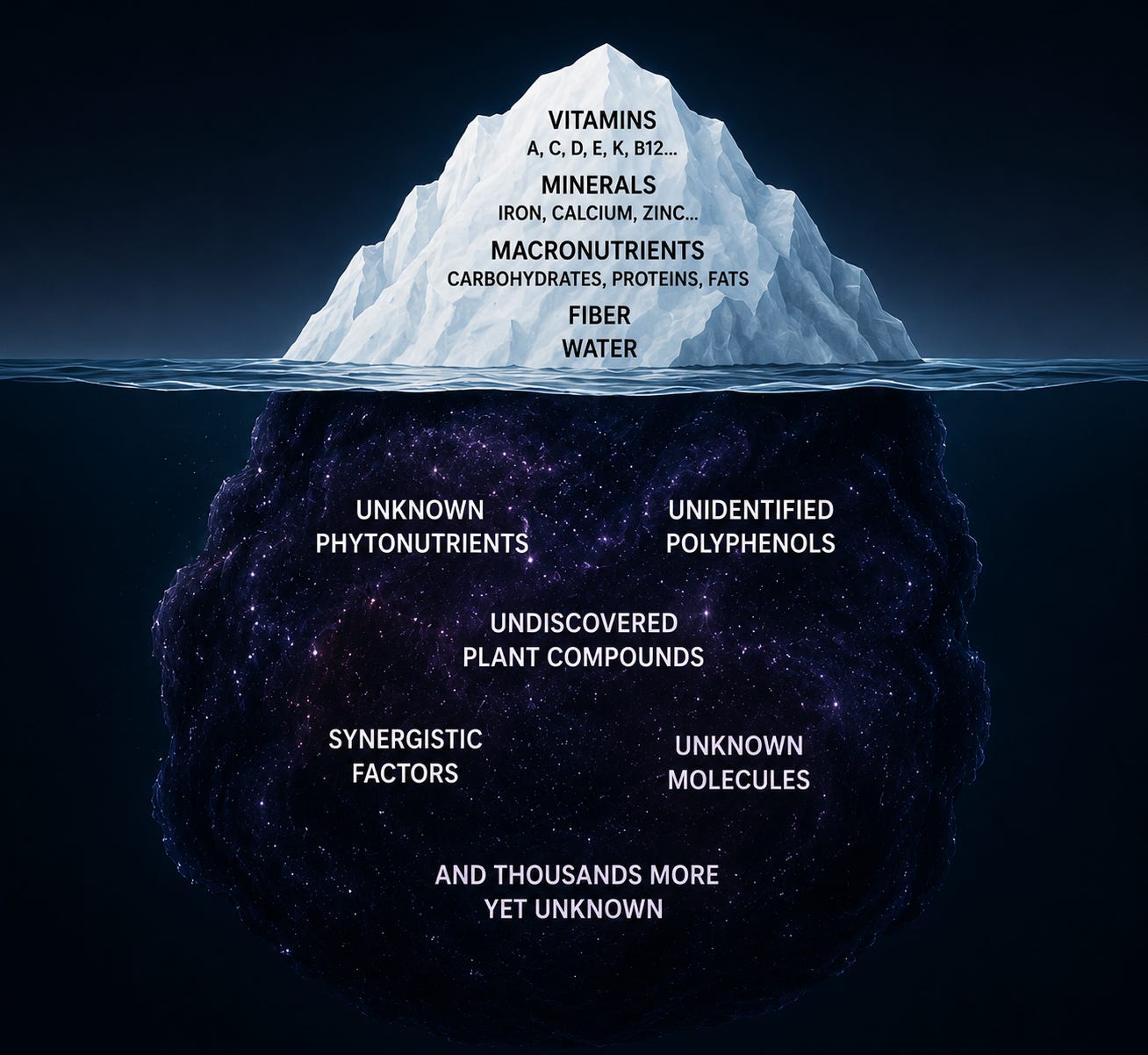
The authors then home in on the concept of nutritional “dark matter,” which is the idea that there continue to be missing ingredients or substances in our food that are causing health problems (or preventing healing). The parallel to vitamins is apt, although the book specifically mentions things like polyphenols, terpenes and phytochemicals when discussing nutritional dark matter; it does not go as far as to say that there are yet-to-be-found substances that are as consequential as vitamins.
The implicit argument of the book goes as follows: If we can figure out what exactly is in this dark matter, then we’ll be able to engineer our food to eliminate it (or encourage it, if dark matter substances are health-positive), and that will solve all of our health problems.
What are some likely candidates for health-consequential dark matter? The authors identify substances with the following combination of properties:
fat-soluble
and
dose-dependent
and
chronically eaten
Why these three properties? On the first point, fat-soluble substances are more likely to have long-term health effects because they accumulate in body tissues.6 Regarding dose-dependence, the idea here, in the authors’ words, is that “not all chemicals are bad, but of the ones that are, it’s the dose that makes the poison.” On the final point, the authors wonder, “what happens if we eat the same foods every day and the chemicals persist in our bodies?” The implicit logic here is that chronic ingestion of the wrong (fat-soluble) substances leads to chronic disease.
So now that we’re settled on a particular profile of harmful substance, we at least know where to look. I’m going to offer up my own candidate for a dark matter substance: linoleic acid, which is an omega-6 polyunsaturated fatty acid that is a major component of all seed oils (soybean, corn, canola, sunflower, safflower, cottonseed, grapeseed and rice bran oils, among others) and monogastric animal fat (pork, chicken). Let’s cross-check linoleic acid against the criteria that the authors have established.
What if I told you that there already exist dozens of experiments on animals, and that these collectively show that linoleic acid causally affects metabolic health in the following ways:7
activates the endocannabinoid system (which is known to disrupt appetite and fat storage, i.e. causes food to be “hyperpalatable” [by some definition of that word])
reliably induces obesity, type 2 diabetes, and fatty liver (latter two sourced here)
takes the human-equivalent of years to manifest (hat tip: Nick Jikomes, PhD)
shows up even in iso-caloric conditions (i.e. animals are fed exactly identical diets except for a small number of substances, with macronutrient levels exactly matching; see here, here, here, and here)
Then, what if we also knew that linoleic acid:
is required for critical human body operations (meaning there’s a threshold between essential and harmful; what Chris Masterjohn calls “precious yet perilous”)8
is abundantly found (in seed-oil form) in nearly every food that is universally recognized to be “unhealthy”
was only available to humans in ancestral quantities before 1860 (i.e. before seed oils were manufactured and when chronic diseases were much less common)
has been steadily increasing in the American food supply, alongside chronic disease rates, since then
now makes up about 10% of a typical American’s caloric intake (that’s linoleic acid, not seed oils) [source, with my own conservative extrapolation to today]
is by far the most inexpensive source of calories (again, in seed-oil form) in the modern food environment
can be titrated and formulated by food scientists to be useful in nearly every post-industrial mass-distributed food
Then, what if, additionally, linoleic acid had hundreds (if not thousands) of documented N=1 anecdotes of people quitting it and reporting (sometimes dramatic) improvements in their obesity, type 2 diabetes, dyslipidemia,9 low testosterone, irritable bowel syndrome, acid reflux, distended belly, gas/bloating, migraines, sunburn sensitivity, pain, arthritis, sleep disorders, immune system weakness, macular degeneration, and more? Yes, it could be the simultaneous removal of UPF that drives these, but there is a biochemistry foundation for why linoleic acid per se would plausibly affect many of these conditions. And while anecdotes don’t constitute proof (I propose a proper randomized experiment below), a list this long should at least be a signal worth taking seriously, especially since the ideal randomized experiment is infeasible to run (again, details below).
The book itself further provides several points of indirect evidence in favor of my argument. First, it spends an entire chapter discussing “the calorie glut” and pins the origins of modern obesity on the food abundance brought on by the Green Revolution. But it barely mentions vegetable oils in its discussion, even though these oils directly came out of the improved crop yields (especially soybeans).10 Second, Belluz notes in passing that she “lost weight effortlessly” after moving to Europe and quitting UPF “just like she had gained weight effortlessly in the UPF-heavy American food environment.” This, of course, could also be her getting a lower dose of linoleic acid when she moved to Europe after a higher exposure when she lived in the States. Third, the authors describe the work of Carlos A. Monteiro, principal scientist behind the NOVA classification system that defines UPF. In noting the rising obesity in his home country of Brazil, the authors explain that “Monteiro noticed that fat and sugar consumption was declining in Brazil but more and more Brazilians were eating processed food.” This trend of declining fat and sugar alongside rising obesity is wholly consistent with greater and greater doses of linoleic acid finding their way into the processed Brazilian food supply, especially because animal experiments emphasize that fat composition matters even more than fat quantity.
Given this body of evidence and its consistency with the authors’ criteria, should we maybe start more seriously considering whether an excess of linoleic acid itself could be a major driver of many of these health problems? Or should we rather look past it and instead focus on trace components like polyphenols that collectively amount to something like 5% of the mass of everything we eat, of which most aren’t fat-soluble, and so don’t satisfy all three criteria above?
If we go back in time to the mid-1800s when chronic disease was much rarer (even after adjusting for shorter lifespans), then we can identify other potential problematic ingredients by comparing what’s in our food today with what was in our food back then.11
Aside from liquid seed oils, these include trans fats (derived from seed oils), high fructose corn syrup, flavor enhancers like MSG or yeast extract, petroleum-based food dyes, artificial sweeteners, modern preservatives (BHA, BHT, nitrites), modern emulsifiers (lecithins, polysorbates, carrageenan, etc.), and gums (xanthan, guar, gellan, etc.). There are also differences in agricultural practices (widespread use of glyphosate to kill weeds; antibiotic residues in meat) and pollutants in the environment (PFAS; BPA and phthalates in packaging).12
Do these other substances check the authors’ listed items? Not really if we enforce all three conditions. Trans fats are, but they are vanishing out of the food supply (and being replaced with more liquid seed oils). BHA/BHT are plausible, but they aren’t in as widespread of circulation as liquid seed oils are. PFAS are very bad and could be a candidate, but they’re only really incidentally in food. There are definitely downsides to many of the other substances listed above, but they don’t fit as neatly into the three criteria outlined by the book.
The book ends with its vision of a utopian future it calls “Food 2.0.” I’ll call the book’s vision “Option A” and contrast it with my vision, which I’ll call “Option B.”
In this future, the book argues, we subject food to stricter safety standards, we “mak[e] sure products are healthy, both microbiologically and from a chronic disease perspective,” and we do it before putting food on the market. The book then says that we should “avoid simple heuristics like ‘natural is better’ or ‘processed is bad’” because these “miss the big picture” and might come with unintended negative consequences.
I am definitely on board with this vision, but the authors’ further discussion on the matter seems unlikely to get us there and seems to come with several unintended consequences (foremost of which is greater levels of linoleic acid consumption). For example, their dream is one in which “the developing world could jump directly to Food 2.0 without the environmentally disastrous expansion of animal agriculture.” In keeping with this vision, they also spend a while discussing how we can produce plant-based substitutes for animal products. The plant-based “meat” experiment lost its momentum several years ago, so I was surprised to see it being revived here. But it makes sense given the authors’ strong opinions about the environment and animal welfare.
In considering this climactic part of the book, the authors’ plant-based vision for the future might explain why linoleic acid goes unmentioned. That’s because it is difficult, if not impossible, to simultaneously hold the following three positions:
UPF is bad for our health
excess linoleic acid (in seed oils) is bad for our health
we should all be eating whole-food plant-based diets
Why is this difficult? Because most (all?) humans enjoy eating fat, and the cheapest and most scalable form of fat is seed oils. My stance is that (2) is correct (and is the primary reason (1) is correct), but those who put a lot of stock in (3) must throw out (2) because (2) is the primary source of fat in a plant-based world.13 To embrace (3) and throw out (2), you must advocate for an extremely low-fat diet that resembles John McDougall’s Starch Solution.14
So what’s the other option for Food 2.0? To borrow the slogan of one of my favorite food companies (Ice Cream For Bears, with whom I have no partnership): “the future of food is in the past.” I call this “The 1860 Diet,” which I’ve recently written about. The diet is as follows: only eat food that contains ingredients that could have been had in the 1860s, allowing for today’s levels of infectious disease prevention and international trade. (So, foods that didn’t exist in 1860 but could have been based on their ingredients are fine. The point is to restrict the ingredients, not the final product. Of course, a gray area how to treat plants and animal products that do not closely resemble their 1860 counterparts.)
This means we go back to the time before chronic disease rates skyrocketed, and we make food with only those ingredients. The major problem with the 1860 Diet is that it is un-economical. Seed oils come with lots of what economists call “economies of scale and scope,” which is what drives their price down, even if there weren’t any subsidies on seed oil crops. The book correctly points out that animals are an (economically and possibly environmentally) inefficient intermediary to supply us with energy. However, it neglects the importance of animal products for human health, such as unparalleled nutrient bioavailability and vitamins like B12 that can’t be had from plants. It’s true that people can survive and even thrive on “starch solution” diets for an extended period of time, but it’s not clear to me that doing so is optimal for everyone on the planet. It seems that we are doomed to perpetual diet wars.
The major conundrum with food policy is that, unlike space travel, we always need to be eating. We can’t sit around not-eating while we wait for experiments to be run or for the food environment to be optimized for long-term health. So, until we can all agree on the definition of “unhealthy food,” we’re going to have to do something in the meantime. That’s what makes this book so important right now.
There are two interconnected reasons for why getting that agreement has proven difficult. The first is structural: chronic diseases take years or even decades to develop, which makes it nearly impossible to discover “the truth” regarding their ultimate causes. (Economists call this an “identification problem” because “the truth” can’t be found with available data.) This is exactly why animal experiments are so valuable. Animals have much shorter lifespans, can be forced to eat the same food pellets day after day, and won’t know which experimental group they’re in.15 Of course, the trade-off is that humans are not animals, so some extrapolation will be required to apply the animal results to humans.
The second reason is institutional, and it leverages the structural reason. Science is produced by scientists. Scientists are humans. Humans (and, especially, groups of humans who have built their careers on particular ideas) don’t like to admit when they’re wrong. The extrapolation gap that is created by the structural identification problem provides an opportunity for scientists to obscure their opinions under the guise of fact. So, the book’s closing line that “we need to follow the science with as little bias as humanly possible” is 100 percent correct but is much more difficult than it sounds when we can’t easily distinguish honest judgment from bias.
One idea that seems to hold a modicum of consensus is that the Standard American Diet (or UPF, if you like the NOVA classification system) is bad for our health.16 The disagreement lies in why. And to know why, we have to either run an experiment or validate a mechanistic model. The book advocates for the former: “Just because something seems painfully obvious doesn’t make it true. You have to design an experiment and test it.”
The animal experimental evidence seems to point in a particular direction that also agrees with the ecological (i.e. aggregate, population-level) evidence and biochemistry mechanisms. Yet many people will want to see the same results in humans before they become convinced. And to be clear, the human evidence on linoleic acid is genuinely mixed, and some of it goes against my argument. I put more weight on the animal, mechanistic, and ecological lines precisely because chronic disease takes so long to develop and understanding its causes requires equally long-running experiments that won’t be confounded by short-run countervailing forces. So, for those who want that experimental evidence, I’ll outline a hypothetical series of experiments that would test my explanation for why UPF/SAD is bad for us. I’ll call it “The 1860 Diet Trial.”
It’s a pretty simple experiment, but it’s not feasible (for reasons I will further explain). Come up with a set of meals drawn from the ultraprocessed-laden, junky, Standard American Diet. The control group eats whatever you can buy at the supermarket today. The treatment group eats the exact same foods as the control group, except those foods are prepared using only pre-1860 ingredients. Both diets have the same amount of UPF and similar macronutrient profiles but might have different caloric values. Regardless, all participants should be allowed to eat until they’re no longer hungry (ad libitum, as they say) with caloric intake measured. And if you don’t like the idea of varying everything all at once, it would be straightforward to do incremental versions where you remove the seed oils but keep all the other post-1860 bad ingredients we use today, etc.
Why would this sort of experiment be so difficult? Several reasons:
It would require food company cooperation and special formulation. For example, we would need “status-quo” Oreos for the control group, but then cookies that exactly resemble Oreos in the treatment group, but which are made with unenriched flour, butter/tallow/low-linoleic-acid-lard (instead of canola oil), sugar (instead of HFCS), and no soy lecithin, red dye 40, or “natural and artificial flavors.”
We would need to ensure perfect compliance between the treatment and control groups for many years, and probably at least a decade.
Ideally, the set of participants in the trial would not be metabolically compromised at the outset. To ensure this, we would need an 8-10 year “washout period” where people restored their metabolic health to what would have been existent around 1860.
But then, maybe that washout period would reveal the cause of the metabolic dysfunction in the first place, just like my friend Experimental Fat Loss is doing. And any kind of broad benefit to the entire washout group might render the trial unethical due to dramatic expected benefits accruing to the treatment group.
Ultimately, I don’t see much changing in our food environment or health outcomes (absent pharmaceutical interventions like GLP-1 drugs) until stakeholders like scientists and government grant makers take more seriously the question of what specific components of ultraprocessed food make it so bad in the first place. The book correctly identifies “sin” taxes as a viable policy lever. But in order to use that lever properly, we first have to correctly identify the “sin.” Simply taxing UPF will not be sufficient because its definition is so shaky.
Even if we all agreed tomorrow that excess linoleic acid is universally bad and a root cause of many chronic health conditions, the economic forces of the market that I mentioned above, combined with political economy issues like lobbying and special interests, would still push it into many foods.
In the meantime, I might recommend self-experimentation to find out what works for you.
Maybe energy density is actually a good thing if someone can get the same nutrients from a smaller quantity of food?
Hall is the principal author of the above-referenced influential study and Belluz is a journalist who has worked with Hall several times in the past.
Here’s a brief list of the things I liked in the book and largely agreed with:
It’s fine to eat either high-carb/low-fat or low-carb/high-fat
Solid coverage of the protein leverage hypothesis, and the idea that protein isn’t going to solve people’s problems (I am thoroughly confused at the current protein-rage in the food market … protein soda? protein pop tarts? protein … water? seriously?)
Animal experiments are useful tools for understanding human nutrition
The food environment is the main driver of chronic disease
We need to test hypotheses using experiments (although we also need what economists would call a “structural model”; i.e. an understanding of which directions causality runs)
Discussion of “sin” (Pigouvian) taxes as a policy lever (the problem the book misses is that we first need to correctly identify what the “sin” is)
The Standard American Diet would not be possible if not for synthetic vitamins and fortification because otherwise people would waste away
Excellent coverage of the FDA’s GRAS (Generally Recognized as Safe) provision and its consequences for how the American food supply became so contaminated.
The idealistic premise that food science innovation can deliver us food that won’t kill us (I agree with this but take the opposite extreme; the book ignores the main problem with this ideal: profit incentives usually [always?] undercut it!)
Discussion of Hall’s own (in-progress) experiment that apparently is finding that ultraprocessed foods do not drive excess intake or weight gain if they are a part of meals that aren’t “too hyperpalatable” and if the meal’s calorie density is lowered by adding fruits and vegetables. I still am not sure how to interpret this, and I’m not sure these research questions are the most important that we should be investigating.
A brief list of the things in the book that I strongly disagreed with:
The implicit claim that obesity is not a signal of metabolic dysfunction, therefore we shouldn’t fat-shame (I agree with the no-fat-shaming, but we shouldn’t claim that being obese is healthy)
A lot of stock being put in the NOVA classification system that defines UPF; this weakness is shown when they mention, “while hyperpalatable, Lay’s potato chips are not actually UPF” and further illustrated by their concession that “healthy” foods like hummus and whole-grain bread do qualify as UPF. So, the errors go in both directions. (I’d also like to point out that the common ingredient in Lay’s potato chips and Sabra hummus is soybean/sunflower oil.)
No real definition was ever given of what is meant by hyperpalatable or energy dense, which shows that they can’t really do any explanatory work (“hyperpalatable” is a circular definition and “energy dense” presupposes that obesity is about calories)
Their definition of “unhealthy food” is as follows: “we settle on energy-dense and hyperpalatable UPF but which also fail to meet the new FDA definition of healthy … as well as foods which aren’t necessarily all of the above that have been consistently linked to serious health harms [like sugar-sweetened beverages or processed meats].”
Confusion about supply and demand side of the market when wondering, “Is it the UPFs themselves [that cause health problems]? Or is it their marketing, convenience, ubiquity, and affordability?” (Clearly, it’s consumption of them that is bad for health, but additional visibility and convenience could cause increased consumption.)
Additional bad economics: “we tell people to eat more vegetables but don’t grow enough to feed them.” (This would be easily solved if people wanted to eat more vegetables, so it’s not the constraint that the authors think it is)
Implicit embracing of the diet-heart hypothesis when discussing that a diet of butter and cheese might be bad for one’s heart
Arguing that food should be 100% safe before entering the market without recognizing that there are tradeoffs in terms of experimental time and portability of animal experiments (i.e., we could do extensive testing in animals to ensure food is safe for animals, but that would not perfectly port over to humans)
Not really mentioning seed oils anywhere except in passing in two places: 1) when pointing out that food science innovation has created demand for them through food formulation; and 2) that they are a key part of baked and fried goods these days
Omega-6 was only mentioned once when describing the adequate daily intakes of omega-6 and omega-3 PUFAs; it gave 10g-20g/day for omega-6 and 2g/day of omega-3. On a 2,500 kcal diet, that would put omega-6 at 3.6%-7.2% of calories (compared to ancestral levels below 2%). Needless to say, I don’t agree with the nutrition guidelines on this point, although the book is just reproducing those.
For example, you never hear of anyone getting Vitamin C poisoning, but you hear plenty of cases of Vitamin D or Vitamin A poisoning. That’s because Vitamin C is water-soluble, so any excess can easily leave the body. Vitamins A, D, E, and K are the major fat-soluble vitamins.
I recommend Tucker Goodrich’s posts on linoleic acid and obesity if you want to go further into this topic.
Dyslipidemia is any abnormal blood lipid (cholesterol or triglycerides) reading. It includes high LDL cholesterol, low HDL cholesterol, high triglycerides, or low total cholesterol.
See this podcast episode by Nick Jikomes, PhD for a complete discussion of the ramifications of the farming transition, particularly as it relates to how animals are fed now vs. in the past.
Obviously, many other things changed over this time period, including a dramatic decline in infectious disease rates.
Although it’s just as easy to argue that the environment now is cleaner with lead levels being much, much lower.
I have nothing against people who eat plant-based diets; I just don’t think they should be generally recommended. My own experience on “starch solution” type diets has been mixed at best; I just feel much, much better on animal-fat-heavy diets.
To his credit, McDougall is internally consistent: he decries “a diet of animal-based foods and vegetable oils” many times in his book and even considers olive oil to be a negative because it’s a “free oil” that has been “separated from the food that originally contained it.”
I don’t want to get into the ethics of animal treatment, but I think most people would agree that imposing the conditions of animal experiments on humans would be unethical and would thus make similar experiments on humans infeasible.
Indeed, this is what seems to have united the Make America Healthy Again (MAHA) movement from both sides of the political spectrum, although we can argue about 1) whether MAHA has done what it promised; and 2) whether it has been a net good for American health.
No posts
Comments
Nothing yet. Say the first thing.
Sign in to join the conversation.