
If you’re new to my Substack, thanks for subscribing! I post on a variety of topics, but personal health is one of my favorites. This post is squarely in that category.
My friend Experimental Fat Loss has gotten me interested in running personal diet trials, so I wanted to write up what I’ve been up to since my most recent diet trials post.
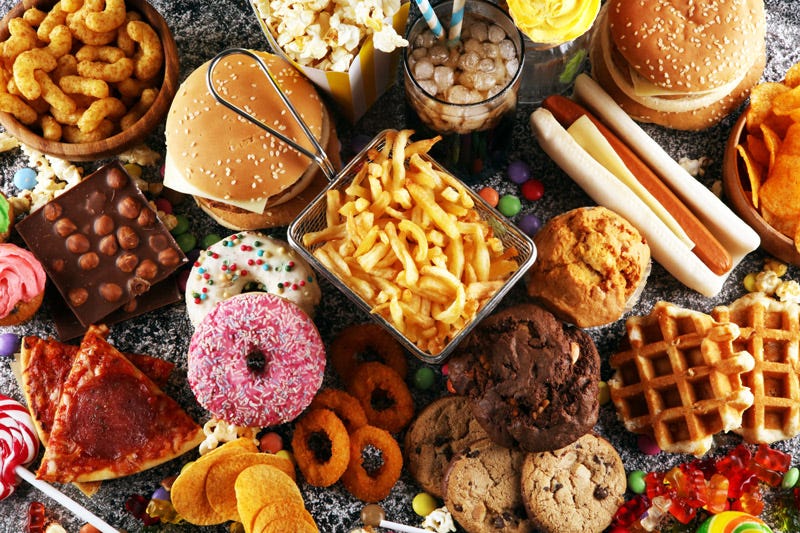
I’ve always been interested in what makes “Ultraprocessed Food” so bad for us.1 Of course, one aspect is seed oils. But there are also other potentially bad things added to our food that could make the Standard American Diet bad for health. Ideally, we would resolve this by running an experiment where we have different groups of people eat the same foods, but with slightly different components. For example, what if I could eat Oreos that were made from beef tallow or butter instead of soybean or canola oil? To really understand what’s going on, we’d have to have many different groups of people eating the same sorts of “processed foods” but with slightly different ingredients. Maybe one group gets enriched flour while the other doesn’t. Or one group eats soy lecithin while the other doesn’t. As you might expect, running such an experiment is infeasible for many reasons, not least because of the time it would take to follow people and the effort required to produce similar-looking “processed foods” that have different underlying ingredients.
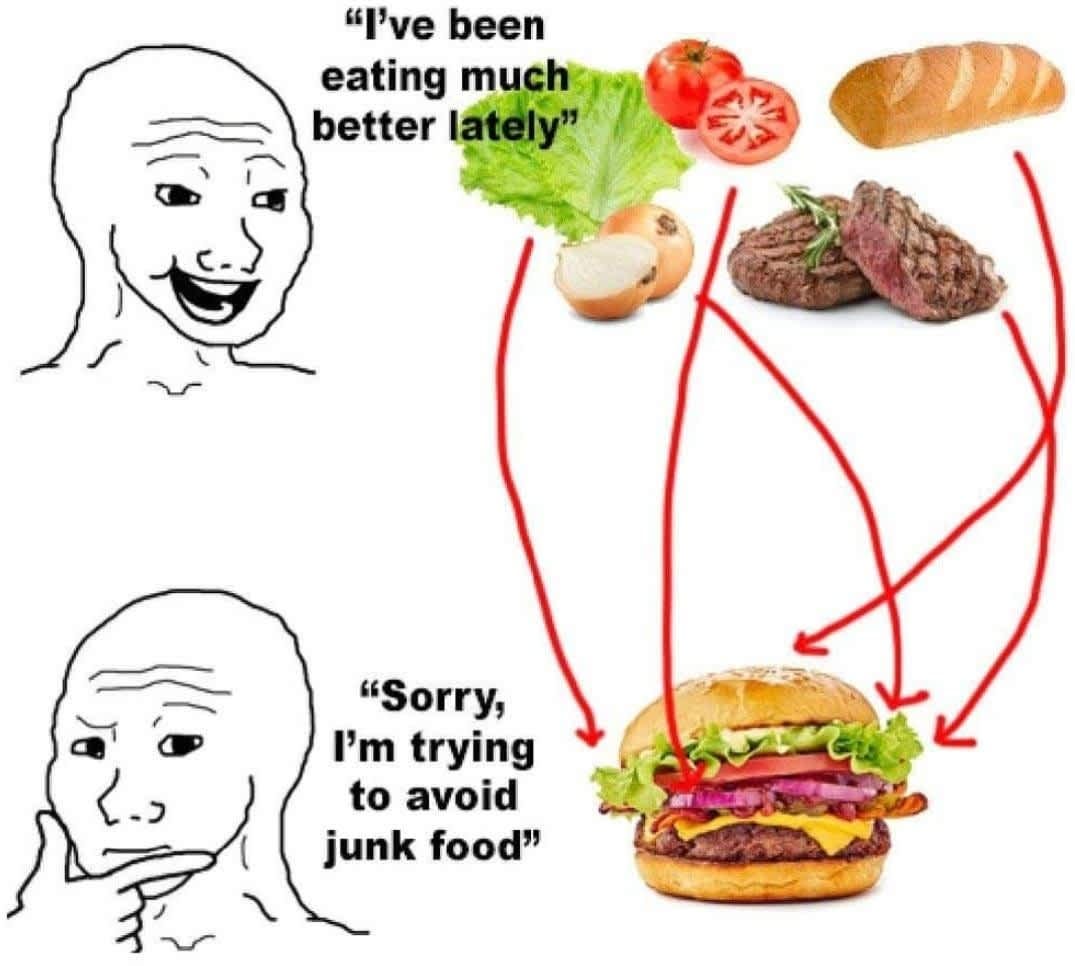
So my most recent experiment tries to get at this a bit: what if I could eat foods that are “clean” but “ultraprocessed”? Would I see deterioration in my health? My goal is to be able to eat any food that people could have eaten in the 1860s, before any of the modern food system’s excesses caused health problems. Of course, some things in the 1860s food supply simply don’t exist today due to differences in agricultural technology. But it should be possible to do an 1860s-style experiment, at least as it relates to processed foods.
In short, my experiment can be succinctly summarized by this popular meme:
You’ll get a different answer from different people, but let’s look at a standard loaf of white bread as an example. I include the ingredients below, with post-1900 ingredients highlighted in yellow and “existed in 1850” ingredients highlighted in green.

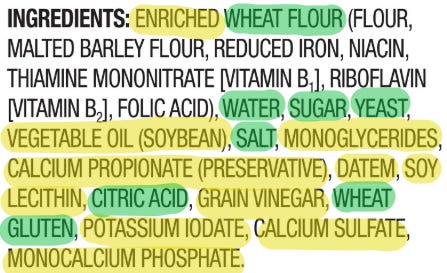
As you can see, we’ve got several potential culprits:
enriched flour
vegetable seed oils (soybean, in this case)
emulsifiers
monoglycerides
soy lecithin
preservatives
calcium propionate
citric acid (but that’s not a modern one)
grain vinegar
dough conditioners
DATEM
potassium iodate
calcium sulfate
leavening aids
sugar (but that’s not a modern one)
DATEM
monocalcium phosphate
glyphosate
Not disclosed on the label, but surely sprayed on the wheat somewhere along the line
So the most basic bread would look like this:


I’ve found that I don’t feel the ill effects of carbohydrates like I did in my 20s if I eat the minimal-ingredients bread. Why is that? I have some hypotheses. But first, I wanted to make a comparison between a minimal-ingredients croissant and a similar “all butter” croissant from the grocery store that nonetheless has many of the above modern additives (though not soybean oil).
These croissants come from Sprouts and have minimal questionable ingredients (bolded and italicized below). I don’t feel any negative effects from eating these.
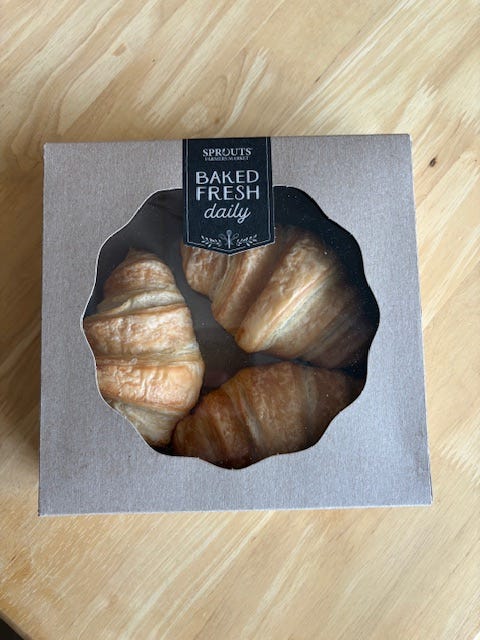
Unbleached Enriched Flour (Wheat Flour, Niacin, Reduced Iron, Thiamin Mononitrate, Riboflavin, Folic Acid), Butter (Cream), Water, Sugar, Yeast, Less Than 2% of: Whole Milk Powder, Eggs, Salt, Wheat, Food Enzymes (Xylanase, Amylase), Ascorbic Acid.
On the other hand, these all-butter croissants from Walmart bakery noticeably irritate my digestive tract. Claude says Sodium Stearoyl Lactylate (SSL)—a dough conditioner and emulsifier—is most likely to be the culprit, but I’m not sure.
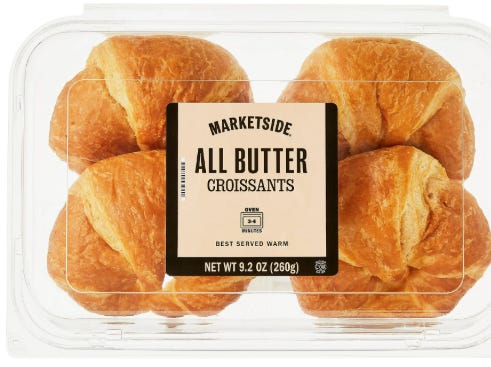
Enriched Wheat Flour (Wheat Flour, Niacin, Reduced Iron, Ascorbic Acid Added as a Dough Conditioner, Thiamine Mononitrate, Riboflavin, Enzyme, Folic Acid), Butter (Cream, Natural Flavor), Water, Sugar, Yeast, Dry Whole Milk, Eggs, Salt, Acacia, Enzymes, Sodium Stearoyl Lactylate, Corn Syrup, Malted Barley Extract, Dextrose, Ascorbic Acid Added as a Dough Conditioner.
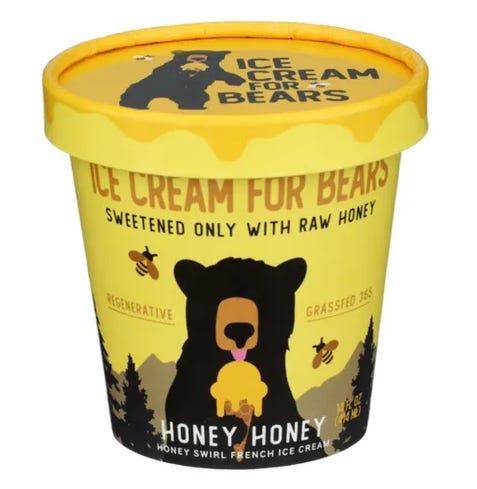
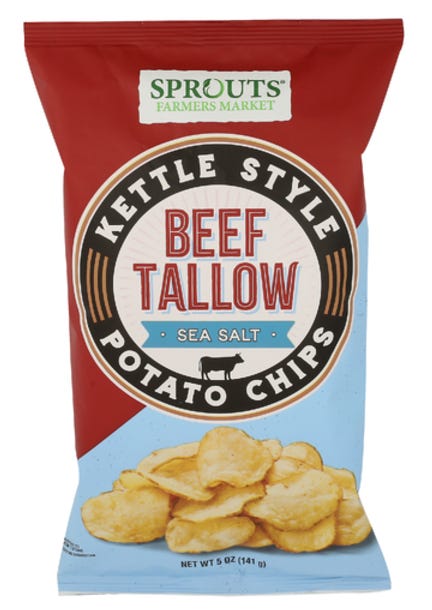
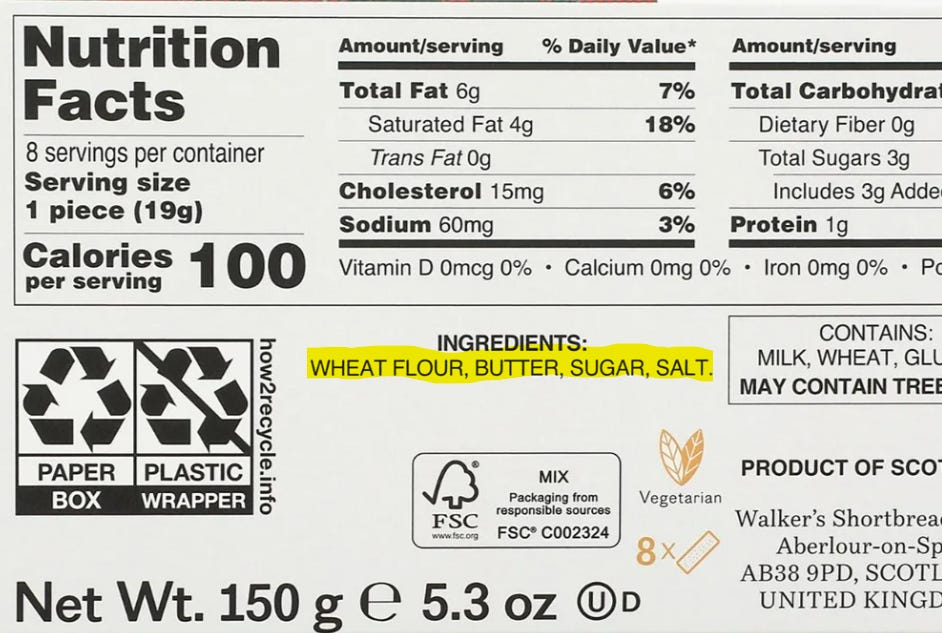
Aside from eating the sourdough bread and croissants pictured above, I also enjoyed several other foods that I haven’t eaten in years: hamburgers with buns, ice cream, potato chips, cookies, and pizza. All of them are pictured below and have minimal ingredients—as close to 1860s style as one can get. Definitely no seed oils, and low amounts of high fructose corn syrup and other modern additives. Aside from the “junk foods” I also ate plenty of white rice and pearl couscous.
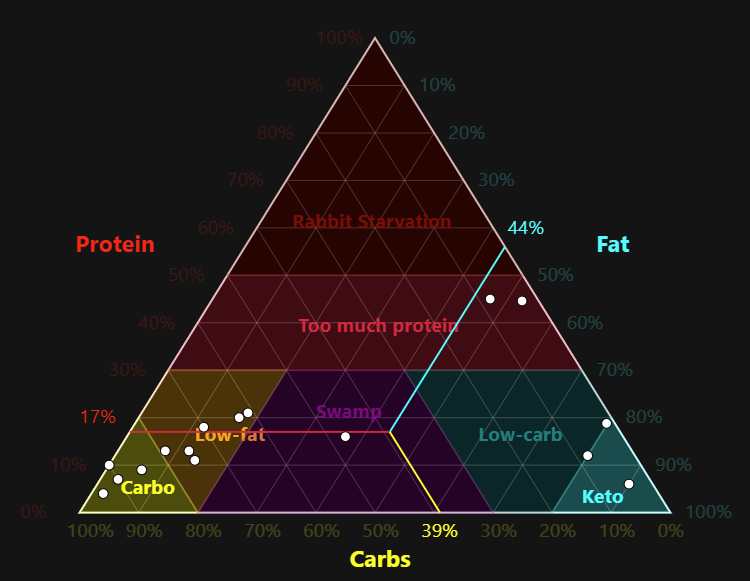
The macronutrient profile of this diet confirms that it is close to the Standard American Diet (SAD). The below screenshot from Experimental Fat Loss’s “swamp visualizer” puts this diet at 17% protein, 39% carbohydrates, and 44% fat. It’s about 2,700 kcal per day. I suspect I could shift it to exactly the SAD if I drank sugary drinks, but I only drink water.
I also suspect that I eat a lot less salt than the SAD. Ever since Experimental Fat Loss posted about how little salt he eats, I thought I’d tone down the salt and I’m surprised by how quickly I acclimated. Stuff I used to eat all the time now tastes way too salty.






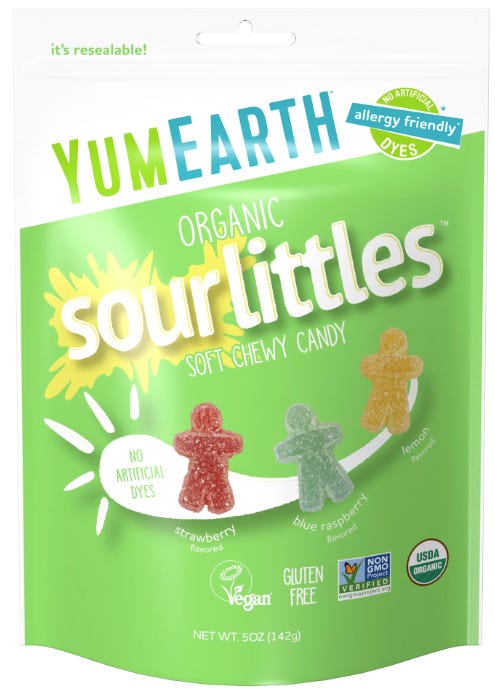
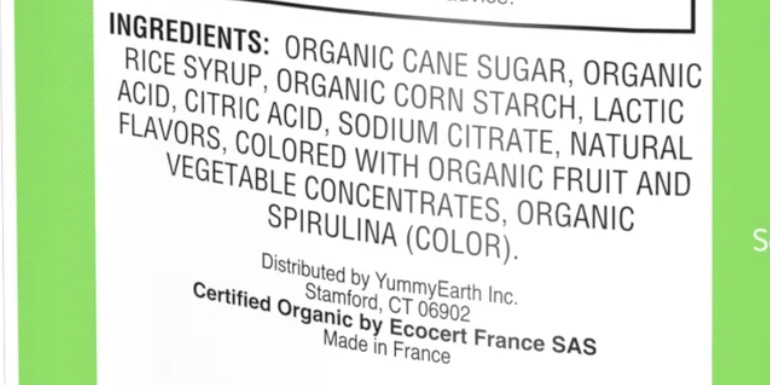
Sour Patch Kids are one of my favorite candies. But they’re loaded with artificial dyes and high fructose corn syrup. So I found these knock-offs that are a bit healthier (in that they are only sweetened with sugar and brown rice syrup) and have no artificial dyes. But they still have corn starch, so <shrug>? (My understanding is that corn starch was around in 1860, but probably in a different form than today [see also: glyphosate].)
This is my new favorite restaurant food because I don’t feel poor after eating it. Plus, I get to eat lots of tendons/cartilage and other parts of the cow that I don’t get in a steak.

I certainly haven’t lost any weight on this diet, though I have also not been as physically active as I have been over the past several years. (This is mostly due to my kids no longer being interested in playing at playgrounds, when I used to get a lot of my physical activity in.)
I will say that the diet hasn’t come with any of the symptoms that used to ail me in my 20s: sleep disruption, digestive issues, postprandial food coma, intense hunger, hyperphagia, or waking up the next morning feeling what other people might describe as hungover.2
I can also taste the awfulness of low-quality food now, to the point that when I try some of my kids’ snacks, they are repulsive to me.
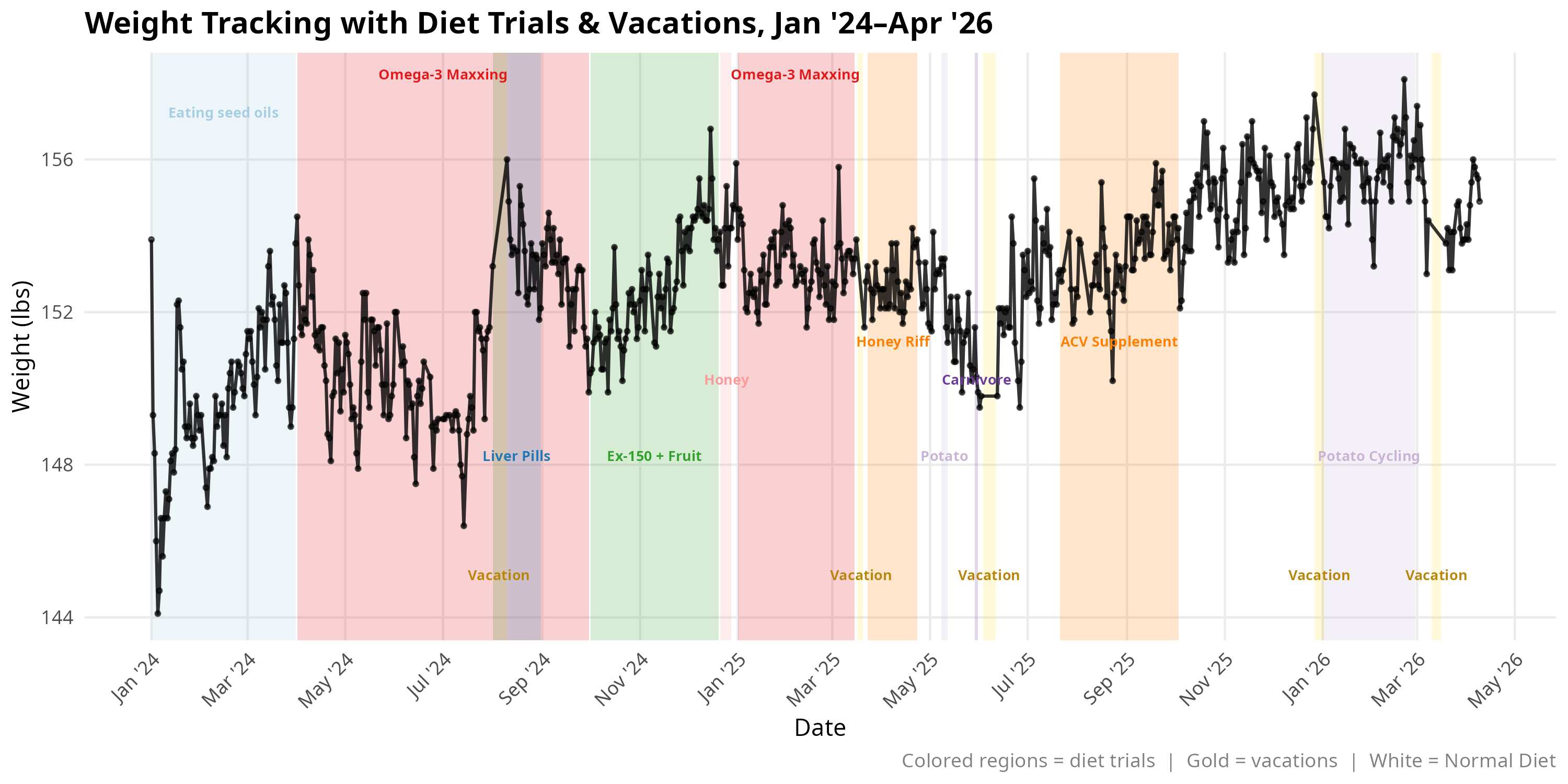
Below is my 2¼ year weight data, overlaid with different diet experiments. I basically started this SAD-variant diet around November 2025, though it might have been going on since July 2025.
As you can tell, my weight has gone up a bit over that time frame: about 3-4 lbs, with very little decline. I also ran a mini-experiment supplementing with Bragg Apple Cider Vinegar (ACV) capsules for a few months in late summer 2025. It didn’t have any noticeable effect on me. I also have been eating more potatoes on this SAD-variant diet, which is depicted as “potato cycling” below. I’ll sometimes eat two bags of tallow potato chips for a meal or eat lots of potatoes at a meal. But nothing else is special, so it’s hard to call it an experiment.
I can definitely see those extra few pounds on my waist, which, like most people, is the first place my body stores subcutaneous fat. But my clothes still fit, so I’m not too concerned.
Looking longer-run, here’s my weight trend over the past 6¼ years. You can see my dramatic weight loss in summer 2022 when I kicked a lot of the worst processed foods out. I stopped eating seed oils about 2 years ago and my weight hasn’t gone anywhere (except the more recent weight gain mentioned above).
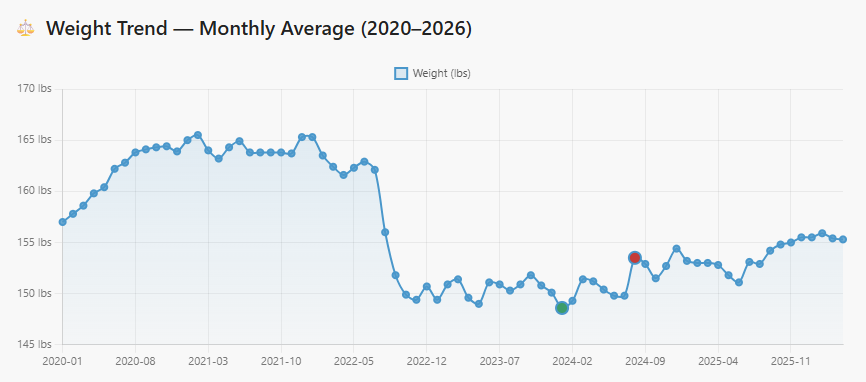
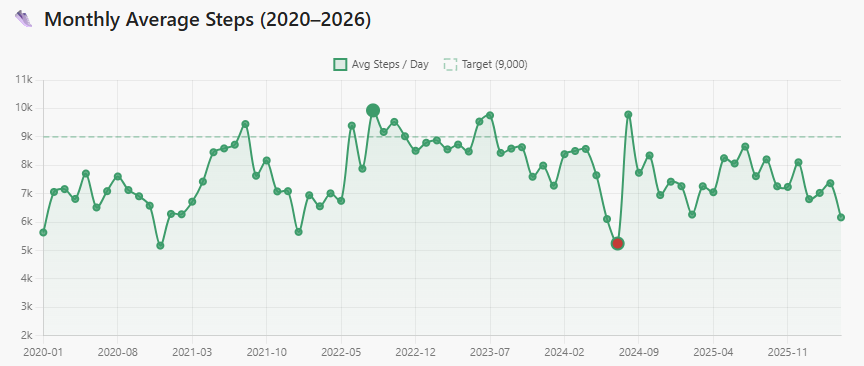
However, some of that could be confounded by physical activity. You can see here that my steps have gradually gone down over the past year. I was at my most active during my 2022 weight loss. It’s possible that I’m at the level of metabolic fitness where “move more” actually has an impact on my body weight.
While I don’t plan on re-introducing any of the modern food processing ingredients, I will see if my activity levels perk up this summer and whether minor weight loss follows that.
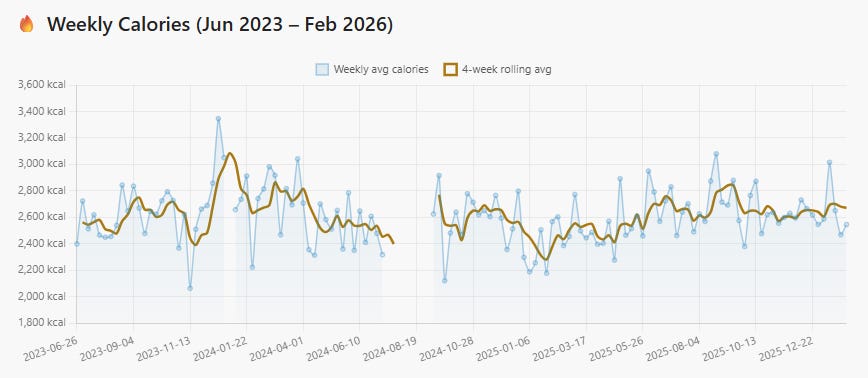
And before anyone asks about calories, here’s my weekly average calories over the past nearly-three-years that I’ve been tracking them. They’ve been pretty stable in the neighborhood of 2600 kcal per day.
For me, at least, there isn’t an inherent problem with eating “processed food” so long as it doesn’t have the “junk” in it. But as my friend Michael Dayah has posted, no one should be giving health advice to anyone else who is heavier than they’ve ever been. So I’d be cautious about generalizing from my experience since everyone is in a different metabolic stage.
My experience also shows that palates can change and that eliminating “foods of modernity” can have a strong impact on food intake even independent of any dietary goals. I suspect that most people, after cutting seed oils and other junk detailed above, will have a similar experience to mine: the “old food” will be repulsive and no longer tempting.
If you’re tempted to blame “ultraprocessed food” for all of America’s health problems, you might be right, but it’s helpful to zero in on what exactly is bad about UPF first.
I won’t delve into the debate about what Ultraprocessed Food means, but know that the definition is so illogical that even dietary ideological opposites Experimental Fat Loss and Cremieux agree that its definition is useless for any meaningful advice or policymaking.
I’ve never drunk alcohol to know what a hangover feels like, but often after eating party food I would wake up feeling super disoriented and brain foggy. I now believe that was the effect of seed oil oxidation, but it’s unconfirmed and likely impossible to formally indict.
No posts
Comments
Nothing yet. Say the first thing.
Sign in to join the conversation.