
Welcome to This Week in Social Science! We live in an abundant world. In fact, many of us might struggle more with deciding which food to eat rather than with whether we have food to eat. But, is having all of those options really good for us? The idea of choice overload is that too much choice can have a paralyzing effect by making choice too difficult. In this episode, we take a look at a foundational study of choice overload and the findings of two meta-analyses to better understand whether there can be too much choice.
Folk wisdom would seem to suggest that having choice is a good thing. And it’s not just folk wisdom. Many studies had shown that having choices was great for feelings of control, task performance, and life satisfaction. But those choices were all relatively easy, between 2-6 options. And maybe choice wasn’t as helpful when there were very many options?
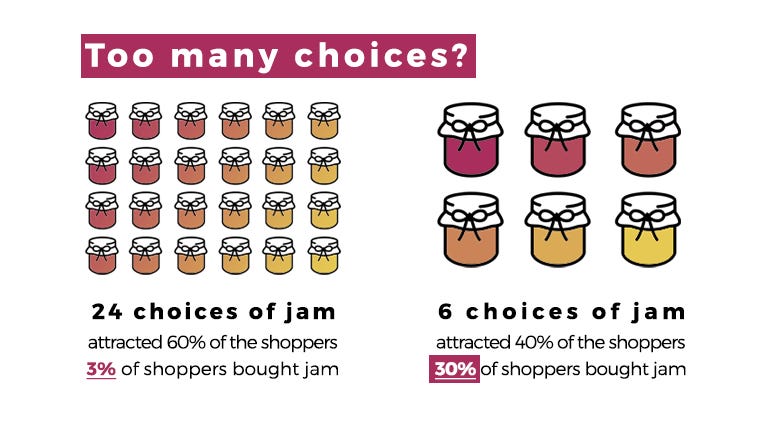
In one of three studies, a team of researchers set up sampling kiosks in a grocery store where prospective customers could sample good quality yet affordable jams. In one condition, the customers encountered a kiosk with a limited array of six choices of jam flavor, while in the second, the kiosk had a wider array of 24 choices. The researchers tracked how many people who saw the kiosk stopped to sample jam and whether or not they ended up making a jam purchase during their shopping trip.
The results showed that people were more likely to stop at a kiosk with more options than less options (60% to 40%). However, when it came to making a purchase, the numbers reversed. Nearly 30% of customers who went to the kiosk with only six options purchased jam, but only 3% of those who saw the kiosk with 24 options purchased jam.
The researchers found similar effects when testing whether students would choose to write an extra credit essay depending on whether they were given a small number or a large number of prompts, and whether they would purchase chocolates depending on whether they were presented with a limited or extended array of chocolate options.1
They concluded that while choice was great when there was a small amount of options, the benefits of choice collapse when people are faced with too many options.
Over a decade after the first study was published, teams of researchers applied meta-analytic methods to investigate whether the previous study was a one-off finding, or whether it really represented an important insight into human behavior. In 2010, a team of researchers published a meta-analysis in which they reported looking at 63 conditions from 50 published and unpublished experiments to determine whether, overall, there was a negative impact of having many choices. Their study found that, taking all of that evidence into account, there was no negative effect of many choices. Overall, they reported, having more choices was a good thing.2
But in a second meta-analysis from 2015, a separate team of researchers identified four key factors which determine whether or not having many options can lead to choice overload. From their meta-analysis of 99 conditions from 53 studies, they note that time constraints in making a choice, the complexity of the options available, consumers’ level of uncertainty about how to make a choice, and whether consumers have a clear decision goal all affect whether more choice leads to more pleasant decisions or whether it leads to choice overload.3
An abundance of choice affects many of us today in ways previous generations did not have to face. From choice in jams, to health insurance options, to looking for love, too many options can seem to get in our way. But this research seems to indicate that it’s not necessarily the case that being faced with too many options leads us to difficulty in making decisions, or to making poor decisions.
If, for example, we can clarify to ourselves what we are looking for, and give ourselves time to make the right choice for us, we may be able to bypass the dangers of choice overload and take positive advantage of the blessing of having choices and the power to make them.
Comments
Nothing yet. Say the first thing.
Sign in to join the conversation.