
Welcome to This Week in Social Science. In edition #70 (and #33, in the more distant past), we covered the positive effects of intergroup contact, interaction between members of opposing groups. We saw that Israelis treated by Arab doctors felt more positive about intergroup relations, and that areas hosting more Venezuelan migrants showed no more bias than other areas.
But can contact backfire? Today we look at three articles that illuminate the conditions under which contact can have no impact or even worsen prejudice.1
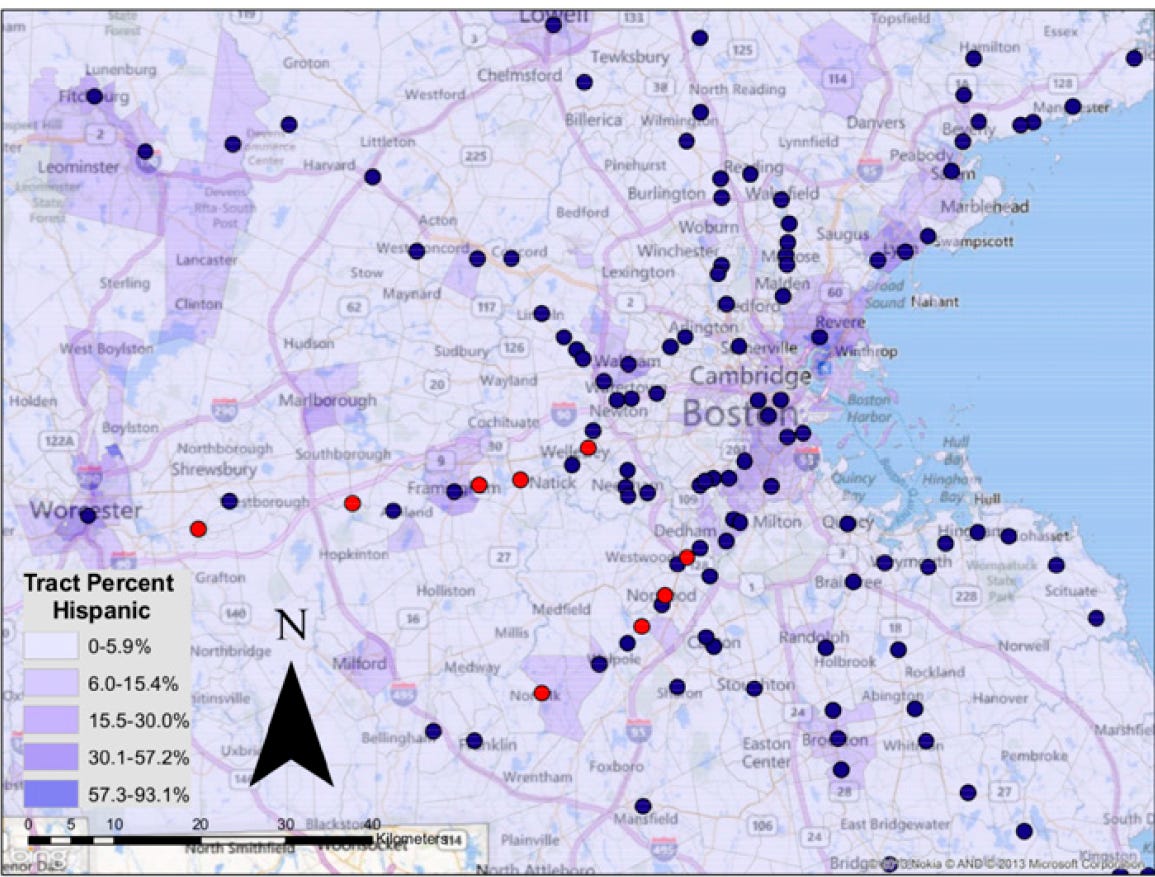
In a now classic study, researchers simulated the type of demographic change that results from immigration. They randomly assigned pairs of Hispanic, Spanish-speaking confederates to ride commuter trains in homogeneously Anglo-American communities, so that some Anglo-Americans would encounter Spanish-speakers as-if they had moved into the neighborhood.
The researchers then compared riders of the treated trains to riders of different trains at the same commuter stations. Riders of the treated trains expressed more exclusionary attitudes across three policy areas:
The number of immigrants from Mexico who are permitted to come to the United States
Allowing undocumented immigrants to remain in the country if they are employed and have no criminal history
A state law declaring English as the Official Language
This research shows that exclusionary attitudes can be provoked by minor, noninvasive demographic change. Contact with members of other groups may improve attitudes, but incidentally encountering them may backfire.2
A recent study tested intergroup contact in the context of refugee-host relations in Lebanon, where Syrian refugees comprise one quarter of the population. Syrian and Lebanese youth were randomly assigned to either mixed (Lebanese-Syrian) or homogeneous (Syrian or Lebanese) classrooms for a psycho-social support program.
Participating in a mixed group made Lebanese youth – and their parents – less willing to engage in future activities with Syrians. This research shows that social integration takes both groups: minority-group members must be willing to integrate, and majority-group members must be willing to accept them.3
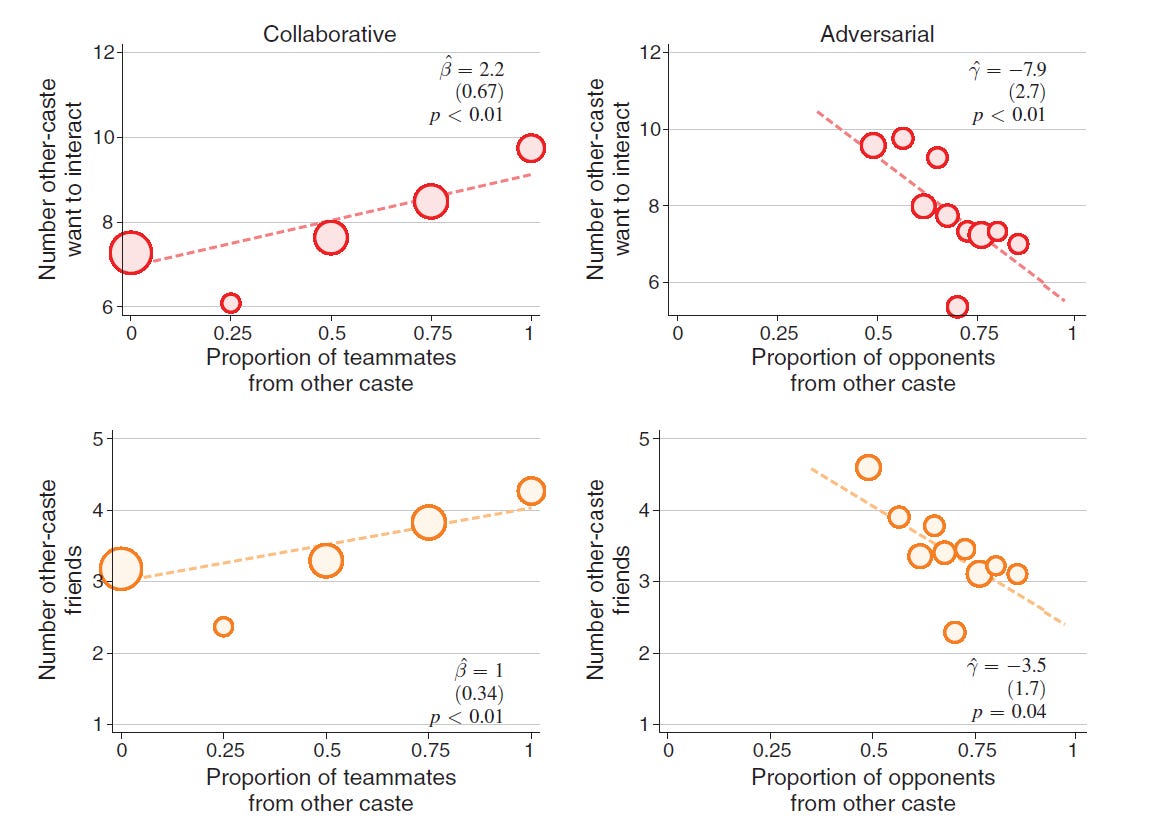
Another study randomized players in an Indian cricket league to homogeneous-caste or mixed-caste teams. The study design created variation in collaborative contact, through random assignment to the homogeneous-caste or mixed-caste teams, and adversarial contact, the proportion of opponents from other castes.
Collaborative contact increased cross-caste friendships, while adversarial contact reduced cross-caste friendships. This research shows how contact only improves intergroup relations when the groups have common goals.4
Contact is not a magic cure for prejudice. When members of different groups work together toward common goals, they tend to realize the other side isn’t so bad. But when contact is reduced to passive exposure or direct competition, it highlights group differences rather than demonstrating the benefits of collaboration.
Enos, R. D. (2014). Causal effect of intergroup contact on exclusionary attitudes. Proceedings of the National Academy of Sciences, 111(10), 3699-3704.
Mousa, S., Naumann, L., & Scacco, A. (2026). Intergroup contact, empathy education, and refugee-native integration: Evidence from a field experiment in Lebanon. Unpublished manuscript]. https://www. salmamousa. com/s/empathy-contact-lebanon-2May25. pdf.
Lowe, M. (2021). Types of contact: A field experiment on collaborative and adversarial caste integration. American Economic Review, 111(6), 1807-1844.
Comments
Nothing yet. Say the first thing.
Sign in to join the conversation.