
Welcome to This Week in Social Science. As a new father, I often look at my son and wonder: What’s going on in there? What can you perceive? What do you know about the world, and what are you learning? Today let’s look at some research about the minds of these amazing little humans.1
Like most parents, I am constantly smiling at my son. Does he know that I am smiling at him, does he like looking at my smile, and does he realize that my smile means I am happy?
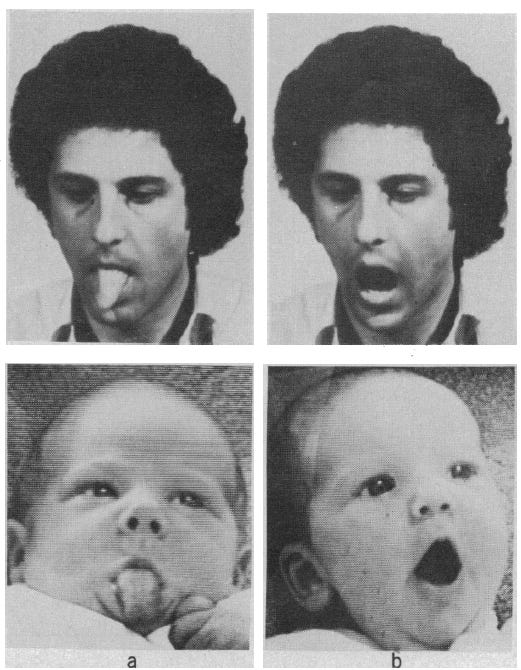
Some classic studies of infants suggest that they can recognize and mimic facial expressions. In one set of studies, researchers either stuck their tongue out or opened their mouth at newborn infants. Infants as young as a few hours old tended to mimic the researchers’ expression, indicating that they could recognize the facial expression and imitate it themselves.2
Though infants seem to recognize facial expressions very early, they probably do not innately understand the emotional content of different facial expressions. The ability to interpret the emotional content behind facial expressions, and a preference for happy faces, seems to emerge after the first few months of life and continue to improve into adulthood.
My son can very effectively cause me to pick him up or get him a bottle. And I wonder, how much does he understand that his actions can influence his world?
It turns out that babies begin to understand that their actions can affect the world quite early! In one study, researchers gave three month old babies the power to cause a crib mobile to move. They tied one end of a ribbon to the mobile and the other to the baby’s foot. The babies could move the mobile by kicking their foot.
Babies quickly learned to move the mobile with their kicks, to their infinite glee. And they would remember their power for over a week, immediately kicking their foot after seeing the same mobile (but not a different mobile! They didn’t generalize their power to all other objects, just the specific object they moved initially).
But babies did not understand how their kicks moved the mobile. For example, they would kick their leg even when the ribbon was not tied to it, and they would coo at the mobile as if they could persuade it to move.3
Newborn infants are born with amazing capabilities, the most amazing of which is their ability to reason about the world. Babies are like little scientists, studying the people and things around them to learn how their new world works. But they have a lot of details to work out — cooing can effectively get dad and mom to pick you up, but it will not make a crib mobile spin.
“Other species survive by having elaborately developed instincts that are exquisitely adapted to their particular ecological niche. We survive by being able to learn how to behave in almost any ecological niche.” — Alison Gopnik from The Scientist in the Crib
Andrew N. Meltzoff, M. Keith Moore, Imitation of Facial and Manual Gestures by Human Neonates. Science 198, 75-78 (1977). DOI:10.1126/science.198.4312.75
Carolyn K. Rovee-Collier et al., Reactivation of Infant Memory. Science 208, 1159-1161 (1980). DOI:10.1126/science.7375924
Comments
Nothing yet. Say the first thing.
Sign in to join the conversation.