
Thank you to everyone who reached out to congratulate my wife and me on the birth of our first child. It meant a lot to us! It’s been an amazing two weeks and we are grateful to be part of such a supportive community.
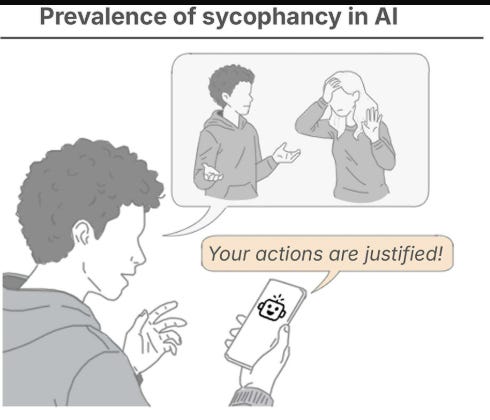
Welcome to This Week in Social Science. If you’ve ever used AI chatbots, you might have noticed that they’re…well, suckups. Brown-nosers. Sycophants! They tend to tell us what we want to hear rather than what we need to hear. Chatbots don’t have their own preferences or dreams, so they can cater completely to ours.
But do you ever wonder how that subtly affects our relationships with other people, who do have their own preferences and dreams? How does a tool that affirms our every thought affect our interactions with human beings who have their own?
Today we’ll look at one article that tests how interacting with AI affects our personal relationships, and another that shows how the structure of a social media site can either create opinion echo chambers or expose us to divergent views.1
A new paper investigates how interacting with AI chatbots affects our personal relationships.
The researchers first estimated the prevalence of sycophancy across 11 leading chatbots. They prompted the AI with social & moral questions, such as those posed on Reddit’s “AmITheAsshole” subreddit. Across these questions, AI chatbots were ~50 percentage points more likely to give sycophantic responses than humans.
The researchers then conducted experiments to understand how these sycophantic responses affected users’ judgments and behaviors. For example, participants discussed a real interpersonal conflict with either a sycophantic chatbot, or a chatbot customized to be non-sycophantic.
Sycophantic AI’s were less likely to encourage the participant to consider the other person’s perspective, and participants who discussed the conflict with a sycophantic chatbot became more convinced they were right and less willing to take responsibility or apologize for their behavior.
Perhaps worst of all, participants consistently trusted sycophantic AI more, rated their responses as higher quality, and said they would use the AI for similar questions in the future.2

Chatbots aren’t the only echo chambers we’re embedded in. While AI reinforces our internal biases by telling us what we want to hear, a 2021 paper showed how social media platforms often structure external information to show us what we want to see.
The researchers analyzed how different social media sites disseminated content about controversial topics like gun control, vaccinations, and abortion. They found that personalized social media (like Twitter) shows users content from like-minded peers and rarely exposes them to other viewpoints. Topic-based social media (like Reddit) has far less ideological segregation, exposing users to the diversity of views present on the platform.
This research shows how the structure of social media can either feed our human desire for confirmation or expose us to a broad set of viewpoints.3
We are suckers for validation, but not everything we think is right, and sometimes we need a reality check. We’re more likely to get that reality from other humans than from algorithms designed to make us feel good. The friction inherent in human relationships keeps us empathetic and grounded, even if it doesn’t always feel good in the moment.
This week’s first article came to us from Çağlayan Başer. Thank you, Çağlayan! If you ever see research we should cover, email us at twiss.weekly@gmail.com.
Myra Cheng et al., Sycophantic AI decreases prosocial intentions and promotes dependence. Science 391, eaec8352(2026). DOI:10.1126/science.aec8352
M. Cinelli, G. De Francisci Morales, A. Galeazzi, W. Quattrociocchi, & M. Starnini, The echo chamber effect on social media, Proc. Natl. Acad. Sci. U.S.A. 118 (9) e2023301118, https://doi.org/10.1073/pnas.2023301118 (2021).
Comments
Nothing yet. Say the first thing.
Sign in to join the conversation.