
Why U.S. Tech Podcasts Scale—and Taiwan’s Don’t
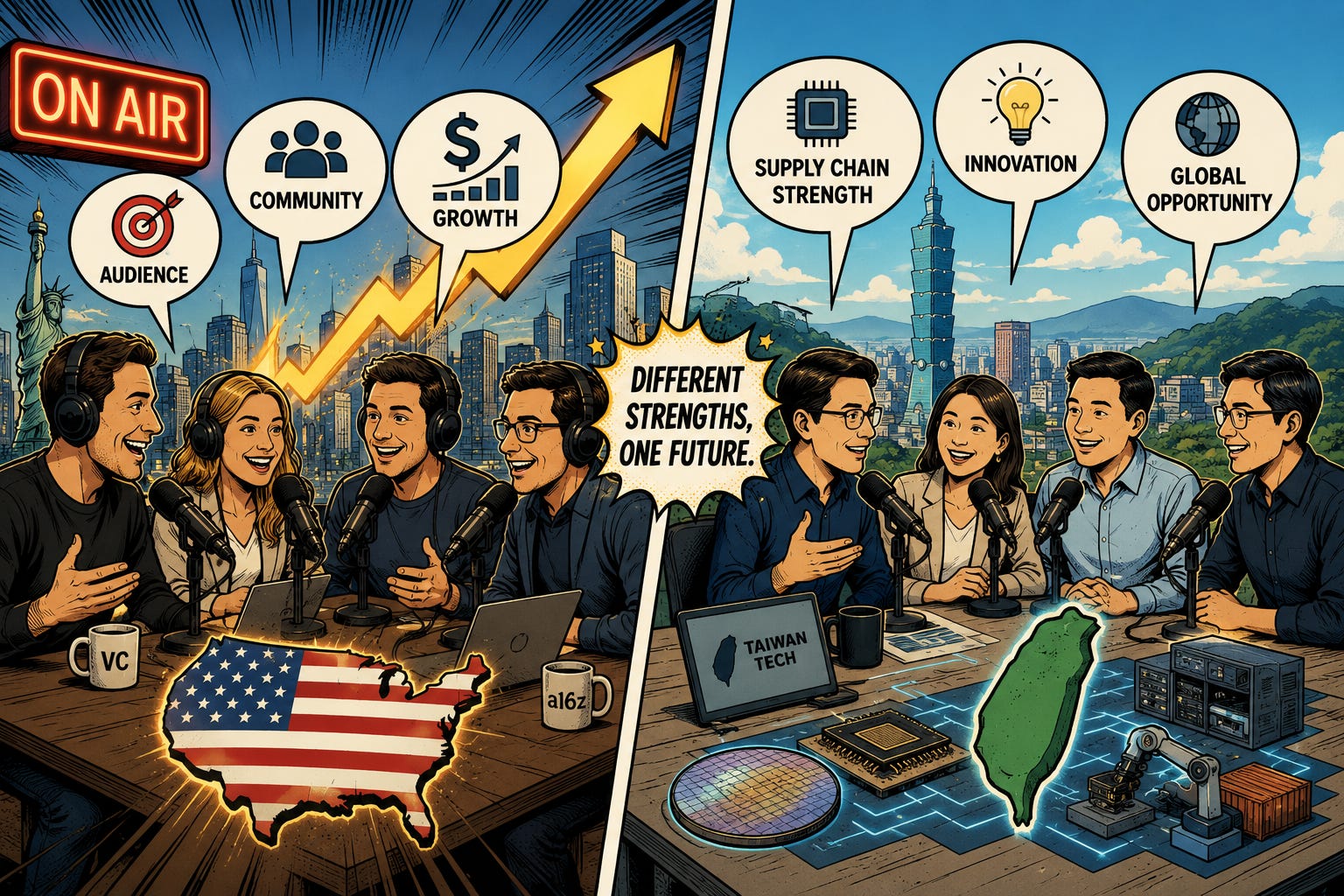
Taiwan Does Not Lack Experts. The Real Difference Is the Incentive to Speak Publicly.
I recently came across an interesting discussion: Taiwan has one of the world’s highest concentrations of semiconductor talent. It is home to TSMC, MediaTek, Quanta, Foxconn, Delta Electronics, and a global network of equipment, materials, PCB, server, and component suppliers. So why has Taiwan struggled to produce technology podcasts with the global influence of those coming out of Silicon Valley?
The intuitive answers are usually that Taiwanese shows are not good enough, the hosts are not strong enough, or they fail to attract sufficiently prominent guests.
But that may get the causality backwards.
The biggest problem for Taiwan’s technology podcast ecosystem may not be a lack of talent. It may be that the people with the most valuable information often have the least commercial incentive to speak publicly.
In the United States, the opposite is often true.
That is why the success of American technology podcasts cannot be replicated simply by copying their format. The real issue is the underlying industry structure, capital-market ecosystem, and incentive system.

Silicon Valley relevance, and impact on investors and technology decision-makers, my top Six would be:
All-In Podcast : Probably the clearest example of a Silicon Valley insider podcast. The hosts are investors, founders, and participants in the policy and technology ecosystem themselves.
Acquired Podcast: Known for extremely long-form, research-intensive episodes on companies such as NVIDIA, TSMC, Google, and Costco. It represents the “research-driven podcast” model.
Lex Fridman Podcast: Features exceptionally high-profile guests, including AI lab leaders, scientists, founders, and major technology figures. It has become one of the most important long-form interview platforms in global tech.
Hard Fork: A New York Times podcast combining reporting and commentary. It is particularly good at translating complex AI and technology developments into compelling mainstream narratives.
BG2 Pod: Particularly influential among institutional investors. Its discussions around AI capex, Big Tech, valuation, and technology investment theses are consistently strong.
Dwarkesh Podcast: is a long-form technology and ideas show hosted by Dwarkesh Patel, known for deep conversations with leading AI researchers, founders, economists, and scientists. Rather than chasing headlines, it focuses on frontier AI, compute, scaling, economics, and strategy, offering unusually technical discussions for serious technology audiences and investors worldwide.
Consider Silicon Valley.
For the CEO of an American AI startup, spending two hours on a podcast can directly generate investor interest, engineering candidates, customers, and even momentum for the next funding round.
The same applies to venture capitalists.
Speaking publicly about AI, SaaS, energy, defense technology, or capital markets can build thought leadership, which in turn attracts LPs, founders, and new deal flow.
There is therefore a relatively clear conversion funnel:
Podcast → Attention → Reputation → Talent / Capital / Customers → Enterprise Value
Public communication itself is a business activity.
This helps explain why many of America’s most successful technology podcasts are not hosted by traditional journalists.
The people behind All-In are themselves investors and technology-industry participants. BG2 is hosted by Altimeter founder Brad Gerstner and former Benchmark general partner Bill Gurley. Andreessen Horowitz has built an entire media and podcast platform around investors, founders, and technologists discussing emerging industries.
In other words:
They are not media people interviewing the industry.
They are the industry.
Taiwan’s semiconductor ecosystem operates under very different rules.
For a CCL, PCB, advanced-packaging materials, equipment, or AI-server component supplier, the company’s most valuable asset is usually not its number of social-media followers.
It is customer trust, qualification status, yield, delivery performance, and relationships built over ten or twenty years with a handful of major global customers.
This is a classic B2B Trust Economy.
And the most valuable information is usually precisely what cannot be discussed publicly:
Who is the customer?
What are the specifications of the next-generation product?
How far has qualification progressed?
Which material is being replaced?
Which production line is expanding?
What is the yield?
When will the next GPU platform actually enter mass production?
The more someone knows, the less they are often able to say.
That creates a structural dilemma for technology podcasts in Taiwan:
The people most worth interviewing are often the people with the least reason to be interviewed.
This distinction matters.
People often explain the difference culturally: Americans are more outspoken, while Taiwanese executives are more conservative.
A more precise explanation is that the incentive structures are different.
A Silicon Valley founder who publicly articulates a compelling view of the future can improve fundraising, recruiting, and brand visibility.
A VC who builds an audience can generate more deal flow.
A fund manager who shares an investment framework can attract LP capital.
A technology executive appearing on a long-form interview can help shape how markets understand the company’s strategy.
Speech therefore has asset value.
Now consider a vice president or senior R&D executive at a Taiwanese semiconductor supplier.
They can say ten things correctly and receive virtually no additional compensation.
But one poorly phrased sentence can trigger a call from a customer.
Even when the information is technically accurate, mentioning an undisclosed customer, product roadmap, qualification status, or competitive situation can create unnecessary risk.
The rational behavior is therefore simple:
Say less.
This is not necessarily a weakness of Taiwan’s technology industry. In many ways, it is part of why Taiwan’s supply chain has been so successful.
Silicon Valley often competes by aggressively telling the story. Taiwan’s supply chain often competes by quietly delivering the product.
Both models can create enormous value.
But they produce very different media ecosystems.
Thanks for reading SEMIVISION @_@! This post is public so feel free to share it.
Content is ultimately an economics problem.
The U.S. podcast audience is enormous, and the advertising market is correspondingly large.
When the addressable market reaches that scale, even a highly specialized technology program only needs a tiny share of the overall audience to support researchers, producers, editors, studio costs, and full-time hosts.
That creates a positive feedback loop:
Audience → Revenue → Better Research → Better Guests → Better Content → Larger Audience
Taiwan certainly has a meaningful podcast audience.
The real constraint is that the monetizable audience for highly technical content is much smaller.
Once the subject becomes semiconductor equipment, CCL, CPO, HBM, CoWoS, or 800V HVDC architectures, the number of people willing to spend an hour listening falls rapidly.
Those listeners may be extremely valuable.
But they are not necessarily well suited to a traditional CPM-based advertising model.
This distinction matters.
A podcast with 50,000 casual listeners may have more advertising value than one with 5,000 semiconductor portfolio managers, engineers, and corporate executives.
But the second audience may have dramatically higher business value.
Taiwan therefore needs a different monetization model.
This distinction becomes even more important in the AI era.
In the past, a technology show could create value by explaining:
“What did NVIDIA announce today?”
“What were TSMC’s quarterly results?”
“What new product did Apple release?”
AI can now summarize that information in seconds.
Pure news aggregation is becoming commoditized.
What remains scarce is interpretation:
What does it mean?
Why is NVIDIA building NVLink?
Why are hyperscalers developing their own ASICs?
Why will HBM4 change advanced packaging?
Why could the bottleneck in AI servers move from GPUs toward power, memory, PCB, cooling, or even financing?
Who wins?
Who loses?
Where is the market wrong?
That is the real product behind many successful American technology podcasts.
BG2, for example, is not primarily a news program. Its value comes from two experienced investors developing theses about technology, capital markets, and corporate strategy.
Acquired follows an entirely different model but reaches a similar conclusion. Instead of chasing breaking news, it spends hours examining corporate history, competitive strategy, and the playbooks behind some of the world’s most important businesses.
The competition in podcasting is therefore shifting from information toward interpretation.
That is also where Taiwanese technology media has the greatest opportunity to upgrade.
Another underestimated change is distribution.
A two-hour conversation today can become:
a full YouTube episode,
a Spotify podcast,
an Apple Podcasts episode,
ten YouTube Shorts,
ten clips for X or LinkedIn,
several written posts,
a newsletter article,
a conference discussion,
a membership product,
and eventually even a research service.
The long-form podcast becomes the central content engine.
The real competition is therefore no longer about who produces the best audio.
It is about who can build the strongest:
Attention → Trust → Community → Business
flywheel.
The most successful American technology podcasts are increasingly media businesses rather than individual programs.
Overall, Taiwan does not lack technology talent, nor does it lack compelling stories. The bigger issue is that the structure of Taiwan’s tech industry is simply less suited to the American-style technology podcast model.
Taiwan’s technology sector has long been built around semiconductor manufacturing, ODM/OEM, components, and supply-chain execution. The real competitive advantages of these companies are usually customer relationships, manufacturing know-how, yield, qualification, and delivery—not the personal brand of the founder. As a result, much of the most valuable information is constrained by NDAs, customer confidentiality, and commercial sensitivity. Executives therefore have a strong incentive to say less and execute more.
There is also a generational and cultural factor. Many founders and senior executives at Taiwan’s major technology companies are older and grew up in a business culture that values discretion. Unlike a new generation of Silicon Valley founders, they are generally less accustomed to using podcasts, X, YouTube, or personal branding to influence the market. For them, appearing on a podcast rarely generates orders directly, while one careless comment could create problems with customers, investors, or compliance.
That helps explain why technology podcasts can create a much stronger flywheel in the United States. The U.S. tech ecosystem is heavily centered on startups, software, venture capital, and capital markets. The more visible a founder becomes, the easier it can be to raise capital, recruit talent, attract customers, and shape valuation. Taiwan operates differently: its technology industry is built more around execution and supply-chain trust, where the most important companies are often the most discreet.
So Taiwan does not need to copy the American model.
Taiwan’s real advantage is not celebrity founders. It is being positioned at the center of the global AI and semiconductor supply chain. The bigger opportunity is to turn what Taiwan knows exceptionally well—but has historically struggled to communicate globally—into compelling content: manufacturing know-how, supply-chain changes, technology trends, and industry intelligence.
In other words, Taiwan may find it difficult to build another American-style tech podcast. But it has the potential to create a format that is much harder for the U.S. to replicate:
Supply Chain × Technology × Investment Insight.
That could become the real moat for Taiwan’s technology media.
Comments
Nothing yet. Say the first thing.
Sign in to join the conversation.