
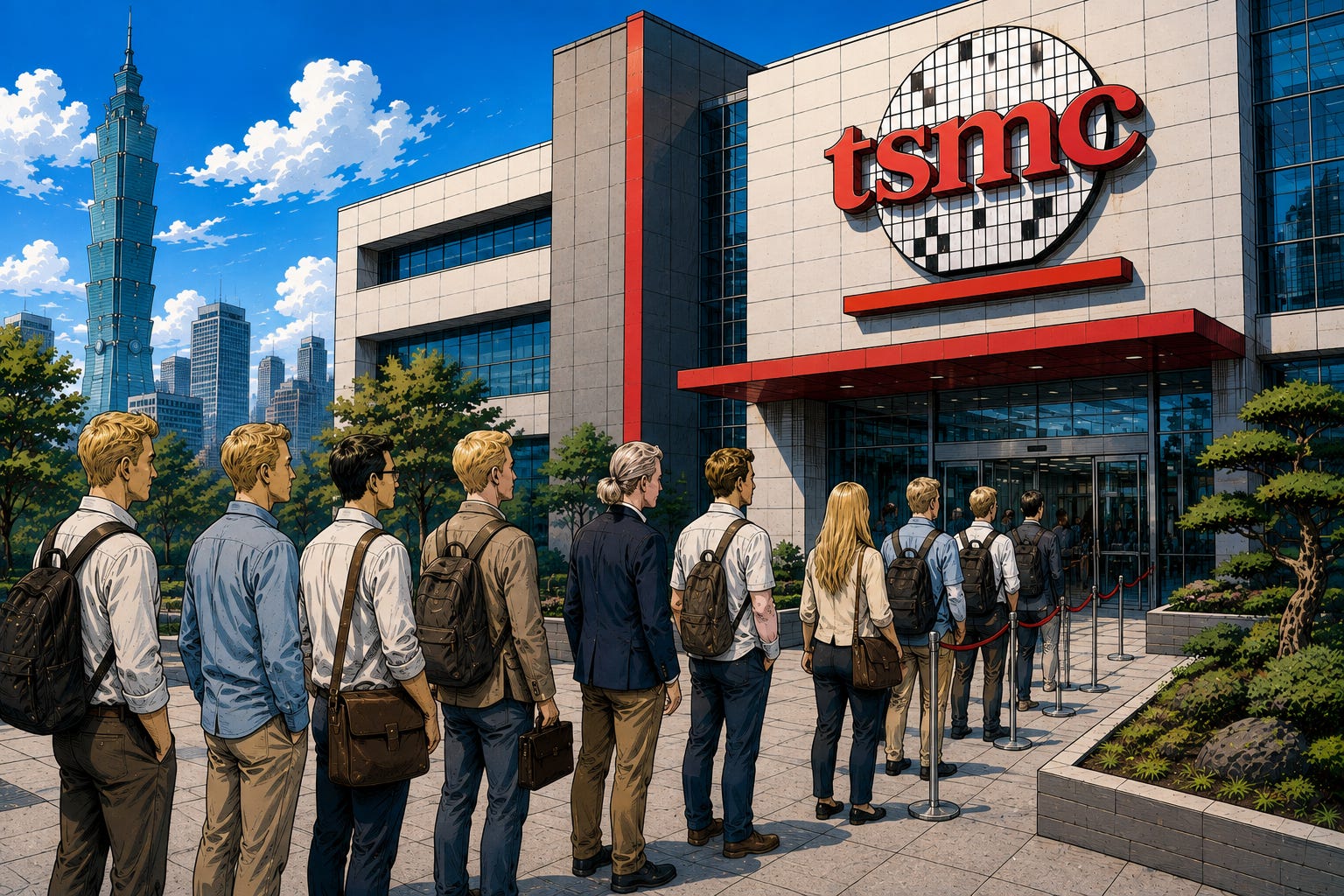
The geography of TSMC’s factories is beginning to follow the geography of its customers.
For years, the debate over Taiwan Semiconductor Manufacturing Company’s expansion in America has been framed mainly as a geopolitical one. Washington wants more advanced semiconductor production on American soil. Taiwan worries about the gradual migration of one of its most strategic industries. And critics point out, correctly, that manufacturing chips in Arizona is more expensive and cumbersome than doing so in Taiwan.
Yet this framing misses an increasingly important fact: TSMC’s customers are already overwhelmingly American.
In the first half of 2026, customers headquartered in the United States accounted for 75.64% of TSMC’s consolidated revenue, according to the company’s financial statements. That compares with just 6.85% from Taiwan, 6.76% from China, 3.62% from Japan and 4.05% from Europe, the Middle East and Africa.
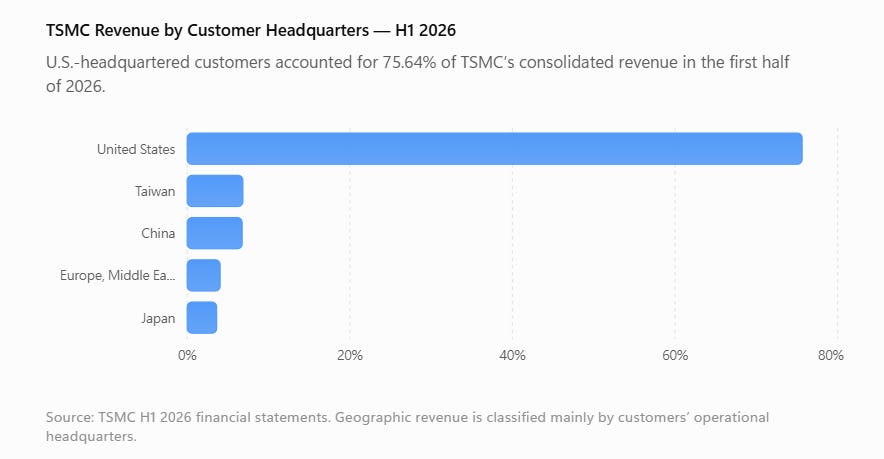
Put differently, for every NT$100 of revenue generated by TSMC, roughly NT$76 now comes from customers headquartered in America.
That makes the question of why TSMC is building fabs in Arizona rather less mysterious.
TSMC remains Taiwanese in ownership, engineering culture and manufacturing concentration. But commercially it has become deeply American.
Its most important customers include the companies driving the global computing boom: Apple, Nvidia, AMD, Broadcom and a growing collection of developers of custom AI accelerators. American cloud giants are also spending extraordinary sums on data centres, networking equipment and artificial-intelligence infrastructure.
These firms increasingly depend on TSMC not merely for chips, but for access to the world’s most sophisticated manufacturing ecosystem.
The distinction matters.
A decade ago, a semiconductor company might have thought primarily about whether a foundry could offer the right transistor technology at the right cost. Today the calculation is broader. Advanced processors depend on leading-edge logic, sophisticated packaging, high-bandwidth memory and increasingly intricate supply chains.
For the largest American technology companies, TSMC has therefore become less like an ordinary supplier and more like a piece of strategic infrastructure.
That changes the value of geographical diversification.
If more than three-quarters of a company’s revenue comes from customers headquartered in one country, establishing meaningful production capacity in that country is hardly an eccentric corporate decision. It is what many multinational manufacturers eventually do.
Customers tend to pull suppliers closer.
There are, of course, good reasons why TSMC spent decades concentrating its most advanced manufacturing in Taiwan.
Semiconductor fabrication benefits enormously from clustering. Taiwan offers experienced engineers, specialised contractors, equipment-support teams and suppliers of chemicals, gases, wafers and components within a remarkably compact geography.
Reproducing such an ecosystem in Arizona is difficult.
Labour costs are higher. Construction is more complicated. Semiconductor workers are harder to recruit. Suppliers have to build local operations. Management practices developed over decades in Hsinchu cannot simply be transplanted into the Sonoran Desert.
This is why comparing the cost of an Arizona wafer with a Taiwanese one will almost inevitably make America look unattractive.
But that is too narrow a comparison.
TSMC is not merely deciding where a wafer can be manufactured most cheaply. It is deciding how to serve customers whose chips are becoming economically and politically indispensable.
For Nvidia, Apple or a hyperscale cloud provider, supply security may be worth paying for. Having some advanced production capacity in America creates an additional layer of resilience against disruptions elsewhere.
That does not make Arizona cheaper.
It may make it valuable.
The argument becomes more interesting when the factories themselves cease to look purely strategic.
TSMC Arizona reported approximately NT$36.1bn ($1.2bn) in profit in the first half of 2026. After adjustments including unrealised gains from intercompany transactions, TSMC recognised roughly NT$31.2bn in investment income.
One six-month period does not settle the economics of American semiconductor manufacturing. Profitability will vary with utilisation, depreciation, product mix, wafer pricing and government support.
But the numbers weaken the simplest criticism of TSMC’s American expansion: that Arizona is merely an expensive political project with little commercial rationale.
Increasingly, four forces are pointing in the same direction.
The customers are American. The fastest-growing demand is American. The government incentives are American. And now the factories themselves are beginning to generate meaningful earnings.
The alignment is difficult to ignore.
None of this means politics is irrelevant.
America has made semiconductor localisation a national priority. The CHIPS Act, export controls and the intensifying technological rivalry with China have all pushed TSMC towards greater geographical diversification.
Washington plainly wants more of the semiconductor supply chain on American soil.
But it is too simplistic to describe TSMC as merely being forced overseas by the American government.
Imagine almost any global manufacturer whose largest customers are concentrated in one country and whose biggest customers are simultaneously increasing capital expenditure at an exceptional pace.
Would it be surprising for that manufacturer to build capacity closer to them?
Probably not.
Indeed, the more useful question is no longer why TSMC is manufacturing in America.
It is how much manufacturing capacity TSMC should eventually put there.
Those are very different questions.
There is another important qualification.
The fact that 75.64% of TSMC’s revenue comes from American-headquartered customers does not mean that 75.64% of its production should move to America.
Nor does it mean that three-quarters of TSMC’s chips are currently manufactured there.
TSMC classifies geographical revenue largely according to the location of a customer’s operational headquarters. An Nvidia processor fabricated in Taiwan, packaged in Asia and installed in a server elsewhere can still contribute to the company’s American customer category.
The geographical distribution of customers and the geographical distribution of factories are therefore very different things.
And Taiwan retains formidable advantages.
The company’s leading-edge research, manufacturing expertise, supplier network and increasingly important advanced-packaging infrastructure remain concentrated there. As semiconductor technology moves towards 2nm, A16 and more complicated three-dimensional integration, the benefits of having engineers, production lines and suppliers close together may become even greater.
Arizona is therefore unlikely to replace Hsinchu.
A more plausible outcome is the emergence of a two-tier geographical structure.
Taiwan remains TSMC’s technological and manufacturing core. America becomes its most important overseas production base, positioned close to its largest and strategically most important customers.
Japan can play a similar role for automotive, industrial and speciality semiconductor demand. Europe may develop around automotive and industrial chips.
This is not de-Taiwanisation so much as globalisation of manufacturing around a Taiwanese core.
For investors, the most revealing number may therefore not be Arizona’s profit.
It may be 75.64%.
That figure exposes how far TSMC’s commercial centre of gravity has already shifted towards America.
And artificial intelligence could reinforce the trend.
The companies spending most aggressively on GPUs, custom accelerators, networking silicon and cloud infrastructure are overwhelmingly American. As their semiconductor requirements become larger and more strategically sensitive, pressure for more geographically diversified manufacturing is likely to increase.
TSMC’s factory map is beginning, slowly, to resemble its customer map.
That does not mean the company will abandon the enormous advantages it has built in Taiwan. Quite the opposite: preserving Taiwan as the centre of its technological ecosystem remains essential to maintaining TSMC’s competitive advantage.
But a company whose customers are global cannot indefinitely remain geographically concentrated to the same degree as before.
Seen in that light, Arizona is neither an aberration nor merely the price of political pressure.
It is part of TSMC’s evolution from a Taiwanese manufacturer serving the world into a global manufacturer whose indispensable core remains in Taiwan.
When more than three-quarters of your revenue comes from American customers, building some of your most important factories in America is not particularly surprising.
It may simply be good business.
Comments
Nothing yet. Say the first thing.
Sign in to join the conversation.