
Taiwan’s artificial-intelligence boom is no longer merely a semiconductor story. It is becoming a fiscal story as well.
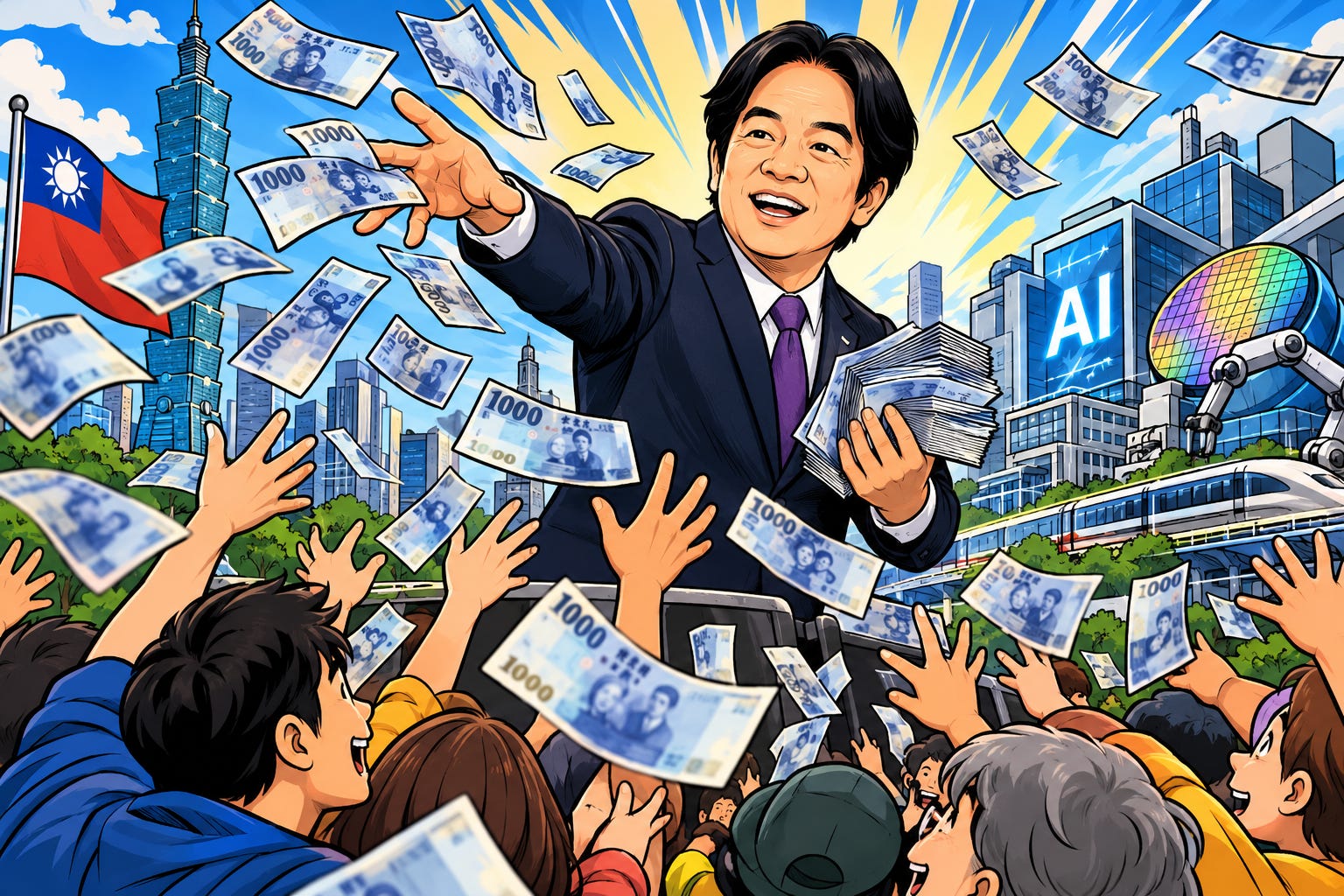
President Lai Ching-te said on Monday that Taiwan’s stronger-than-expected economic growth has given the government enough fiscal room to distribute NT$10,000 in cash to every eligible citizen next year, while still maintaining what the administration describes as a balanced budget and effectively zero new borrowing.
The political message is straightforward: if AI is creating extraordinary growth, the benefits should not remain concentrated among semiconductor companies, exporters and their shareholders. Part of the windfall should flow back to households.
The more important economic question is what Taiwan plans to do with the rest of that windfall.
Taiwan’s economic growth has accelerated sharply as global demand for AI servers, high-performance computing and cloud infrastructure continues to rise.
According to the government’s latest estimates, first-quarter GDP growth in 2026 was revised upward from 14.55% to 15.43%, while second-quarter growth was estimated at 12.93%. Growth for the first half reached 14.15%.
The government now expects full-year GDP growth of 11.05%, up from an earlier forecast of 9.64%. If achieved, it would represent Taiwan’s strongest annual growth performance in 39 years.
Behind these numbers sits an unusually powerful industrial engine.
Taiwan has become one of the principal manufacturing hubs of the global AI economy. TSMC produces many of the world’s most advanced AI processors. Taiwanese companies manufacture AI servers, networking equipment, substrates, printed circuit boards, cooling systems and power electronics. A large portion of the infrastructure required to build modern AI data centres either passes through Taiwan or depends on Taiwanese suppliers.
This has translated into higher exports, stronger corporate investment and, increasingly, higher tax revenue.
For fiscal year 2027 — officially year 116 under Taiwan’s calendar — projected central-government revenue has been raised to NT$3.9266 trillion.
The government therefore plans to increase expenditure by NT$235.7 billion, including funding for a NT$10,000 cash payment per person.
Lai has branded the policy as a way of ensuring that the “AI dividend” is shared by everyone.
There is an important economic rationale behind the political slogan.
Taiwan’s AI boom is highly uneven.
Workers, investors and companies connected to semiconductors, servers and the broader technology supply chain have benefited disproportionately from the current investment cycle. But much of Taiwan’s workforce remains employed in services, traditional industries and small and medium-sized businesses where productivity growth — and wage increases — may be considerably slower.
A country can therefore report double-digit GDP growth while many households experience only modest improvements in disposable income.
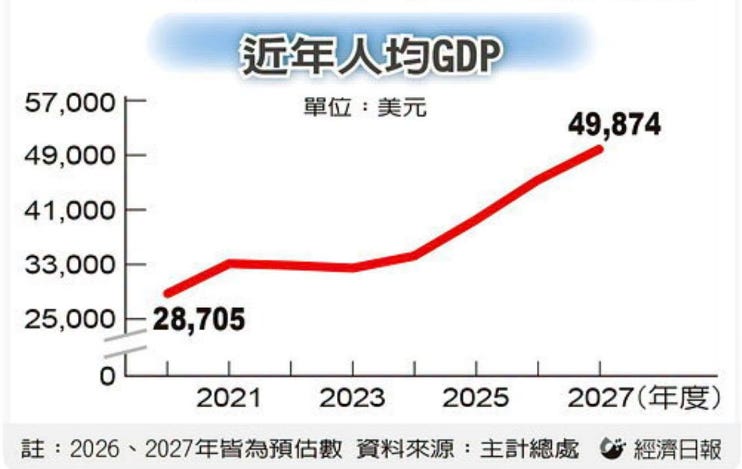
That creates a growing gap between headline economic performance and household perception.
The NT$10,000 payment is designed partly to bridge that gap.
For a middle-class household the amount is unlikely to transform household finances. But collectively, the payments could support consumption, particularly among lower-income households with a higher propensity to spend.
The broader political objective is equally important: making the AI boom visible outside Taiwan’s technology clusters.
The cash payment has attracted attention, but it represents only one part of the government’s fiscal expansion.
The more consequential spending may be directed toward long-term structural priorities.
Five areas stand out.
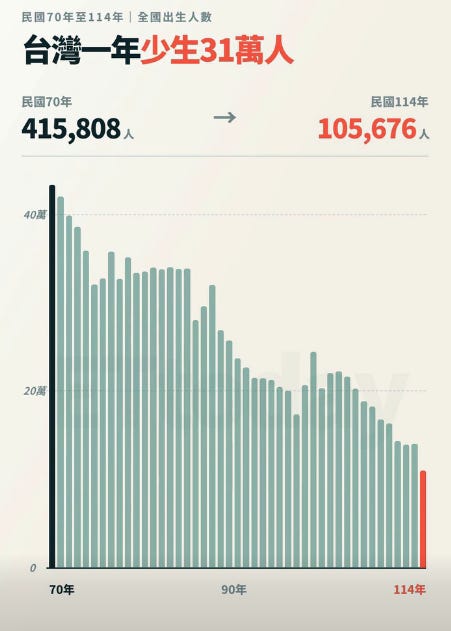
First is demographics.
Taiwan plans around NT$373 billion of family-support measures, including childcare, parental leave, education assistance and programmes intended to reduce the financial burden of raising children.
Like Japan, South Korea and China, Taiwan faces an extremely challenging demographic outlook. Subsidies alone will not reverse the trend, but demographic policy is increasingly becoming part of Taiwan’s long-term economic strategy.
Second is defence.
Total defence spending, including regular and special budgets, is expected to exceed NT$1.12 trillion and remain above 3% of GDP.
Taiwan’s economic strength is therefore increasingly being converted into defence capacity — another example of how the semiconductor and AI boom is influencing policy well beyond the technology industry itself.
Third is technology.
Government technology programmes will receive NT$229.2 billion, an increase of 12.7%, including NT$40.6 billion for the so-called “AI Ten Major Infrastructure Projects.”
The focus includes computing infrastructure, scientific research, talent development and critical technologies.
The objective is clear: Taiwan does not want merely to manufacture AI hardware for foreign technology companies. It wants the domestic economy to absorb more of the productivity gains generated by AI.
Fourth is infrastructure.
Public-infrastructure spending will reach NT$728.8 billion, including transportation, water management, wastewater systems, regional development and infrastructure resilience.
Finally, central-government transfers to local governments will increase to NT$1.36 trillion.
Taken together, these programmes show that Taipei is attempting to convert a cyclical export boom into longer-term economic capacity.
This is where the policy becomes more interesting.
Taiwan currently occupies one of the most valuable positions in the global economy. AI investment requires enormous amounts of advanced semiconductors, packaging, servers, networking equipment and power infrastructure — exactly the areas in which Taiwan has accumulated decades of expertise.
But AI capital expenditure will not necessarily expand at today’s pace indefinitely.
Taiwan therefore faces an unusual window of opportunity.
If the current boom merely produces higher corporate profits, asset prices and temporary tax revenue, its economic legacy could eventually prove narrower than the headline GDP numbers suggest.
If the windfall is instead converted into infrastructure, technology, energy resilience, defence capacity, demographic support and productivity improvements across smaller businesses, the consequences could be much more durable.
That makes the NT$10,000 payment symbolically significant but economically secondary.
The real test of Taiwan’s AI dividend is not whether households receive a cheque.
It is whether the extraordinary profits generated by the current AI investment cycle can finance the foundations of Taiwan’s next growth cycle.
For decades, Taiwan’s semiconductor industry accumulated capabilities before the rest of the world fully understood their strategic value.
AI is now monetising that investment on an unprecedented scale.
The challenge for Taiwan is to make sure that the country does the same thing again: use today’s windfall to build assets whose value will only become obvious years from now.
Comments
Nothing yet. Say the first thing.
Sign in to join the conversation.