
Written on 10/08/2026,
As of now, this is the last summer Curtis Jones is under contract at Liverpool. An extension does not seem like a solution (at the moment), while a January 2027 exit would leave a sour taste. So, either he leaves now for a fee that the club is happy with, or goes on a free next summer after giving it his all (as he has always done for the club, contrary to a few opinions about him).
Some of the reported reasons why a new contract has not materialised are the fact that the player wants guarantees around playing time, along with a pay rise consistent with what fellow midfielders have received. Liverpool are not going that high as they have seen the numbers around his playing time over the last few years (these are reported reasons, not a made-up opinion from my side).
Jones is 25 now and has been playing first-team football regularly since the 2020/21 season. He has played in different positions across the midfield and was even used at right-back in some games last season. In his corner, he is right to think that he has done all the right things to now warrant game time of some level, with a pay rise that reflects that in a new contract.
In this article, we will first look at the club’s side and run through the numbers around the player’s game time and how his inconsistent availability makes it difficult for managers to pick him. We will follow that up by looking at his 25/26 numbers, as well as visualising his numbers from the past three seasons to see whether he has improved during this time.
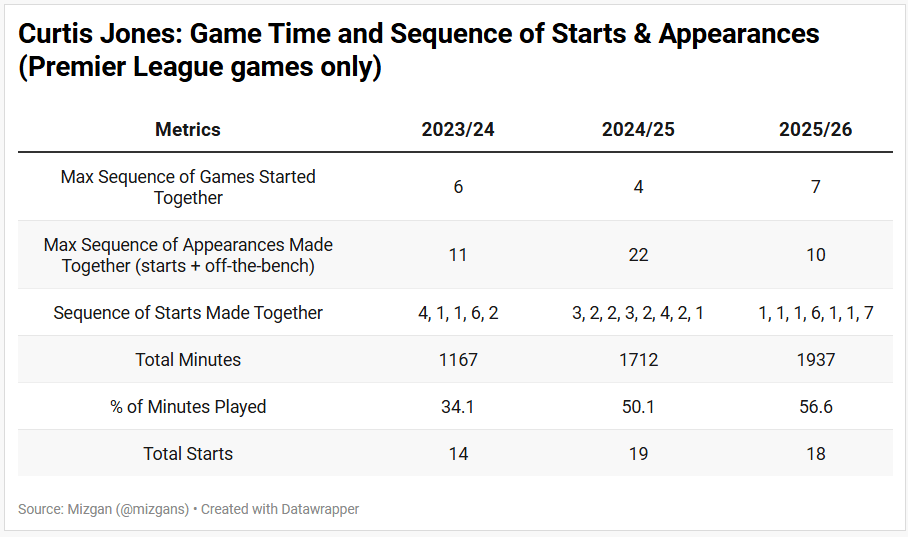
If we look at his last three Premier League campaigns for Liverpool, the maximum number of consecutive games he has started came last season (seven), while his maximum number of consecutive appearances came in the 2024/25 season (22), which was probably the campaign when everyone thought he had properly arrived at Anfield as one of the mainstays in midfield.
You look at the different sequences of starts he has made during this time, and it does not resemble the profile of a regular starter in midfield, a position where continuity is paramount given that it is the engine room of the team.
In terms of the percentage of minutes played, it has barely crossed the 50% mark in the last two seasons and was below 40% before that, while his total number of starts in a league campaign has not crossed 50% of the available games. Why is that? Niggly injuries have hampered his progress time and time again.
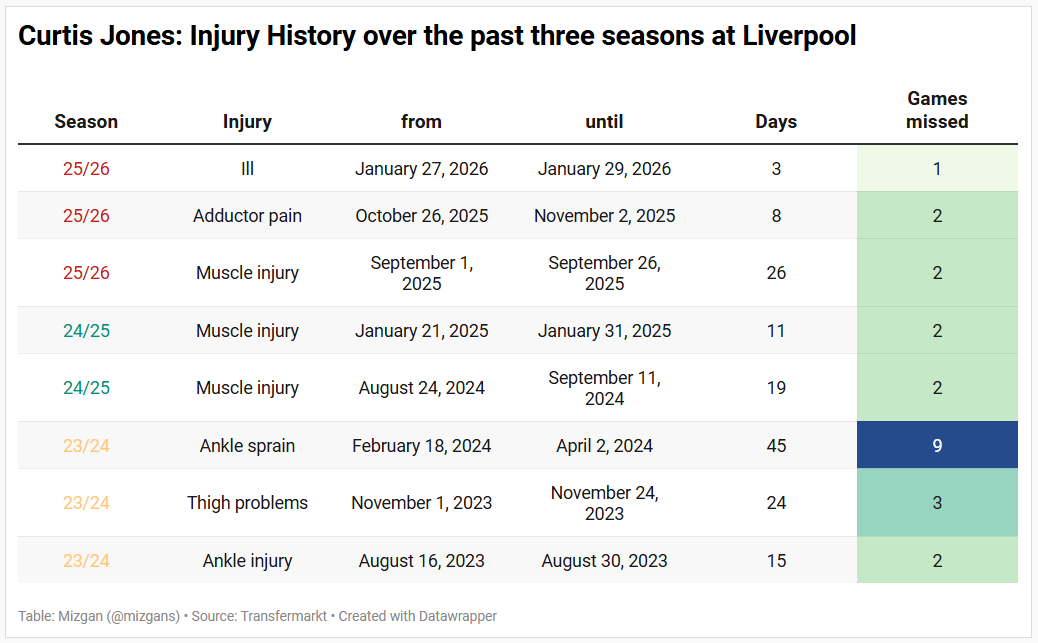
This comes on the back of spending the 2021/22 and 2022/23 seasons with 17 and 16 games missed, respectively, due to different injury issues.
As you can see in the table above, barring an ankle sprain that kept him out for six weeks in 23/24, the injuries have not been long-term, but they have come at different stages of the season.
He has not had a full season with almost no injury issues where he can start 10 to 12 games on the spin and establish himself as a mainstay in the team. Hence, managers are not always sure about putting him in the bracket of a “regular starter” in the squad.
Now, when the 25-year-old plays, he is often a reliable performer, albeit one with strengths and weaknesses in his game. Although he does not have a specialised position in midfield yet, he provides a stable presence with his ability to recycle the ball, while still playing a particular role for the team.
We start by looking at a bar chart showing his percentile ranks among Premier League midfielders for the 2025/26 season.
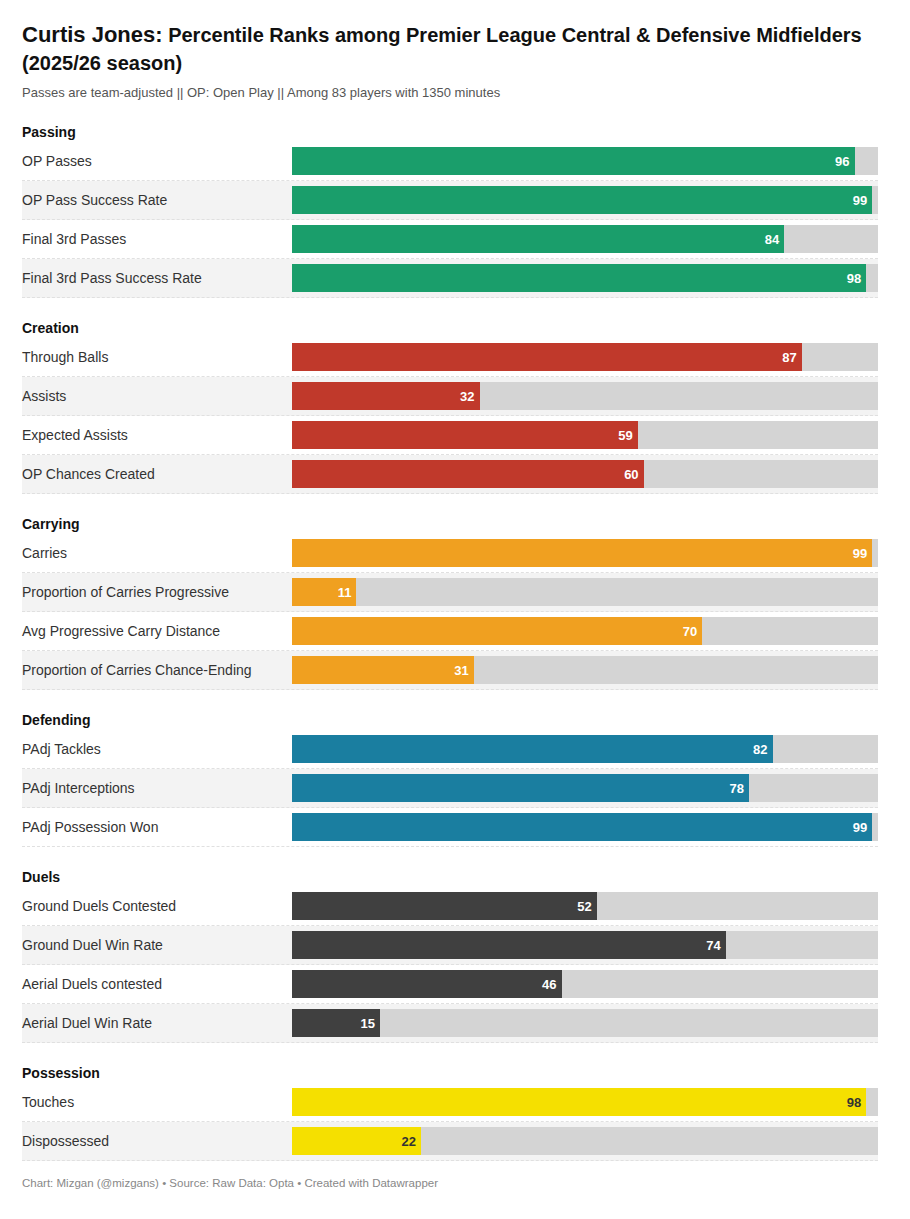
This describes Jones as a player, to be honest. He is a very good passer of the ball, with or without pressure, and plays a high volume of passes into the final third. But the flip side is that, considering the number of touches he has (98th percentile in that), and the zones in which he has those touches (mostly in the final third or around areas where the team is in stable possession), his chance creation and chance-ending carry numbers do not match that to any great extent.
Off the ball, he is very good at reading the game and making interceptions or recoveries in general (he improved his tackling last season relatively).
Aerially, though, he can be better for a 6ft 1inch midfielder. Last season, he had an aerial win rate of 28%, which is not good enough for a central midfielder playing in such an up-and-down league (in terms of aerial duels).
So, there are clear strengths and weaknesses to his game.
But why restrict the analysis to just last season? Let’s take a broader look at the 25-year-old’s numbers across the seasons since 2023/24 to see where he has developed as a player and whether there are signs of stagnation.
Let’s start by looking at the touch maps.
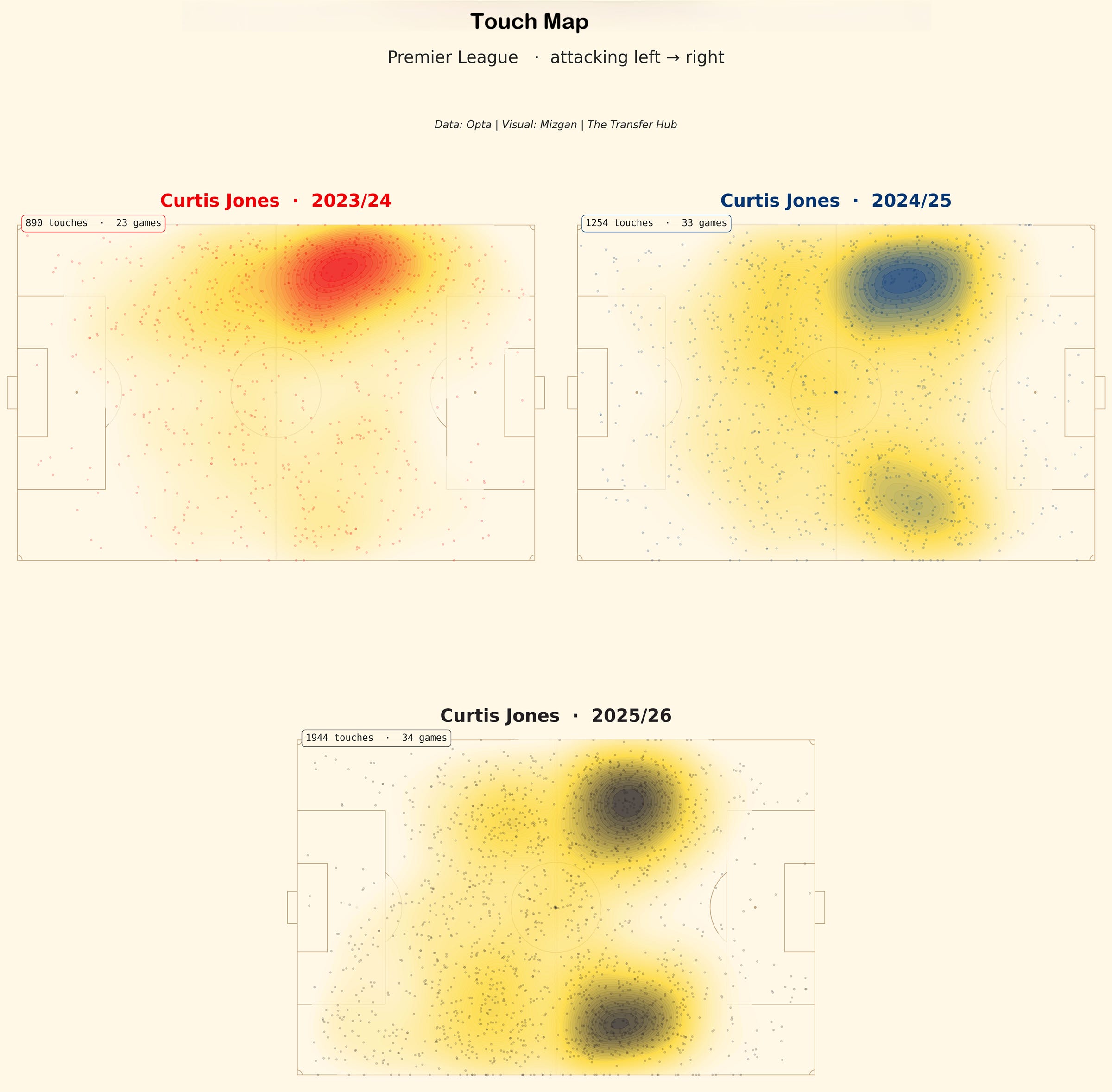
He was always preferred on the left-hand side of the midfield under Jürgen Klopp, hence the clear concentration of his actions in the left-midfield zone during the 2023/24 season. Under Arne Slot, in the last two seasons, he was used on both sides of the midfield, either in a two-man setup or as one of the number 10s in a no-striker system during the 2024/25 season. Last season, he also played a few games at right-back, hence the slightly greater concentration of his actions on that side of the field.
Let’s look at the pass map next, followed by the carry map, post-carry actions, chance creation, ball recoveries, and, finally, a discussion around distance covered (which gave up some clues around what he thinks about staying at Anfield for the moment).
The rest of this analysis is for paid subscribers. Get unlimited access to in-depth, data-driven player and team analyses, scout reports, and tactical breakdowns covering the Premier League and European football for just £3.50/month, or £3.16/month with an annual subscription. Start with a seven-day free trial.
Comments
Nothing yet. Say the first thing.
Sign in to join the conversation.