
Written on 12/08/2026. Figures in the visuals are presented in different currencies.
A consortium consisting of Amazon founder Jeff Bezos, Facebook co-founder Eduardo Saverin and former Queens Park Rangers director Amit Bhatia is set to acquire close to 30% of the minority stake in Liverpool Football Club from Fenway Sports Group (FSG).
This is the biggest stake FSG are set to give up since taking over the club in October 2010. They sold a 2-4% stake to Dynasty Equity in September 2023 to help deal with the rising debts following the effects of Covid-19 and the cost of the growing infrastructure they had invested in. Before that, RedBird Capital acquired an 11% stake in March 2021 to provide capital to FSG’s wider portfolio.
FSG, led by American businessman John W. Henry, took over Liverpool FC from previous owners Tom Hicks and George Gillett following an intense legal battle. They bought the club for around $344 million and saved it from major financial trouble, with the club close to going into administration.
In the last 16 years, they have done some splendid work at Liverpool, keeping it self-sustaining while putting the club back on the map as one of the largest forces in world football. Mistakes have been made along the way, but they have also reversed decisions (such as the idea of the Super League and changes to ticket prices) in response to what the fans had to say about them.
In this article, we will discuss the numbers behind FSG’s tenure at the club so far, both in terms of performance and financial commitment, while also discussing some of the major decisions they have made to put the club back on such a high pedestal.
We start by looking at the valuation of the club over the years and how it has experienced exponential growth since the current owner’s takeover. These valuation figures are from the official Forbes records.
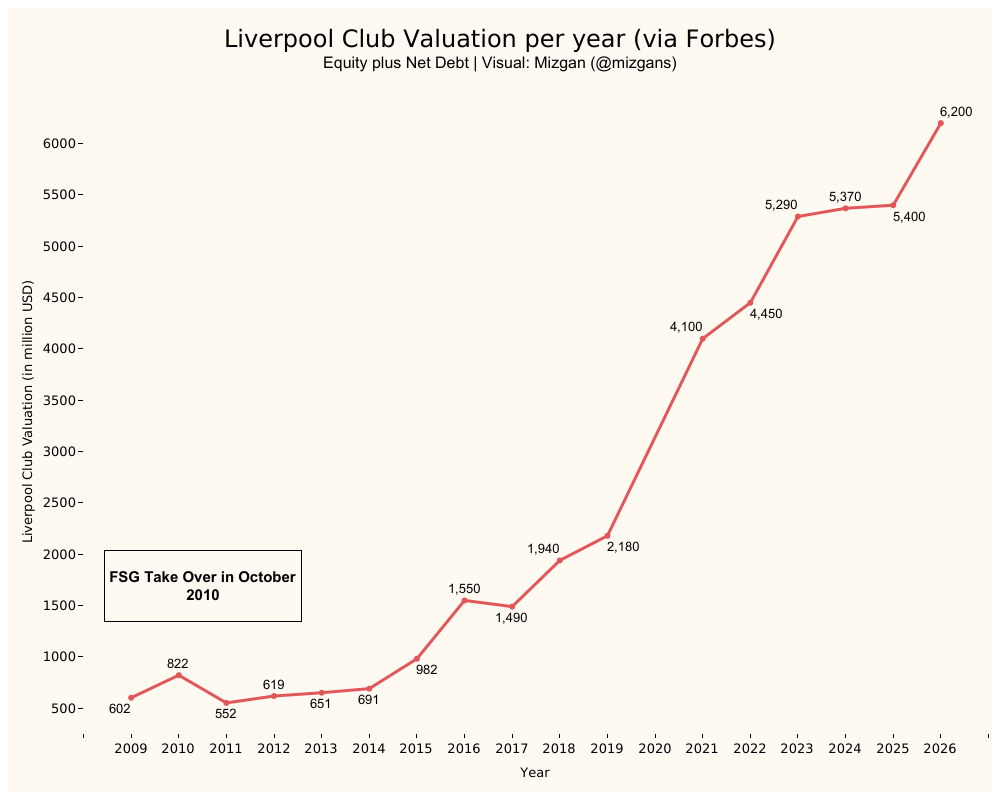
Even though FSG bought the club for somewhere around $344 million, the enterprise value was still well over $800 million (the equity value of a severely damaged business was bought).
The enterprise value did come down over the next four years as the new ownership had to do a lot of work in terms of paying off severance packages for managers before appointing Brendan Rodgers in 2012 (Sir Kenny Dalglish and Roy Hodgson), along with major transfers not working out (i.e., Andy Carroll and Stewart Downing) and much more.
A consistent spell out of the Champions League was also a major factor, along with a lag in global sponsorship deals and stagnant revenue coming from the stadium.
The valuation went up by a decent margin in 2015 after a year back in the Champions League, which was followed by a run to the Europa League final in 2016 under Jürgen Klopp.
The rise since 2017 has been exponential, to say the least. Consistent appearances in the Champions League, combined with rising sponsorship deals, the worldwide reach of the club, major trophies won, TV revenues shooting up, and an expanded Anfield generating greater matchday revenue than ever before, have all contributed to this growth.
All in all, the club is currently in a good place following more than a decade of good work being put in.
In keeping with the valuation topic discussed above, let’s have a look at the growth of the club’s revenue over the years and discuss the key factors driving it.
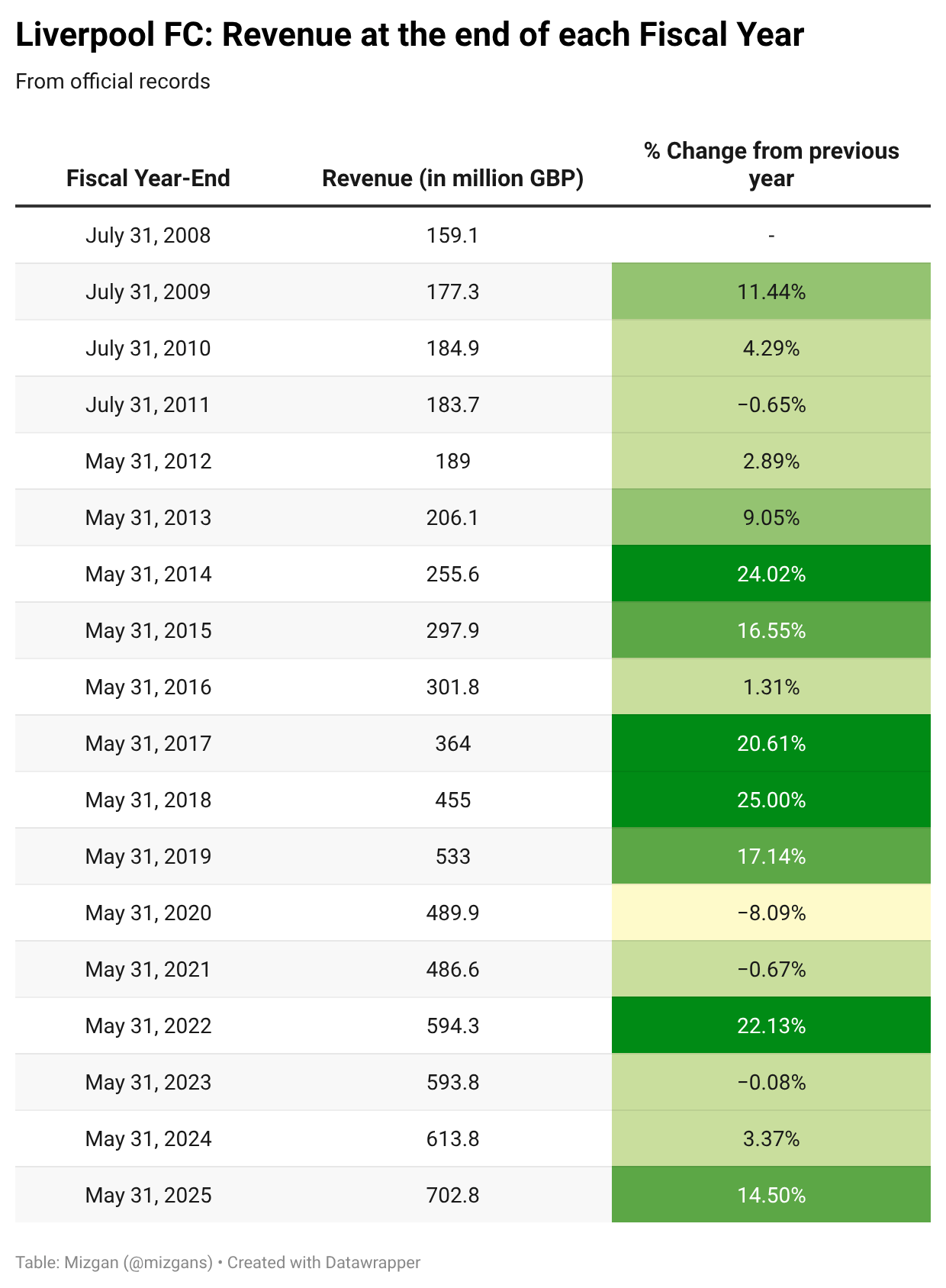
Just a reminder: FSG took over in October, 2010. The fiscal year-end changed from July to May in 2012 to keep the club’s accounting period in line with the European football season.
These are the combined revenue values from commercial deals, broadcasting revenue, and money generated from matchdays at the stadium. Following a period of stagnation in the first couple of years under FSG, Liverpool’s revenue boomed for the first time in 2014 after a return to the Champions League under Brendan Rodgers.
The increases of at least 17% for three years running in 2017, 2018 and 2019 came during the peak years under Klopp, when Liverpool won the Champions League, followed by a Premier League title in 2020.
The expected downturn came during the two years of the pandemic (2020 and 2021), before a boom in 2022 following a historic season for the club on the field, where they came within two games of winning the Quadruple.
Following Klopp’s departure in 2024, Arne Slot leading the team to a Premier League title in his first season helped drive a further rise in the club’s revenue streams (also helped by the expanded format of the Champions League).
The 2025/26 season was disappointing, but staying in Europe’s elite competition would have been a huge relief for everyone involved this summer.
This is a free read! But get unlimited access to in-depth, data-driven player and team analyses, scout reports, and tactical breakdowns covering the Premier League and European football for just £3.50/month, or £3.16/month with an annual subscription. Start with a seven-day free trial.
FSG are ‘revenue-to-wage ratio’ owners, meaning the wages they pay their playing staff are largely based on the revenue generated by the club. This revenue is mainly driven by success achieved on the field. They are also very big on including bonuses in player contracts, which takes their wage bill to the higher echelons whenever the team wins a major competition.
In the table below, we will see how the above-explained approach meant that slowly but surely, they became one of the highest payers in Europe.
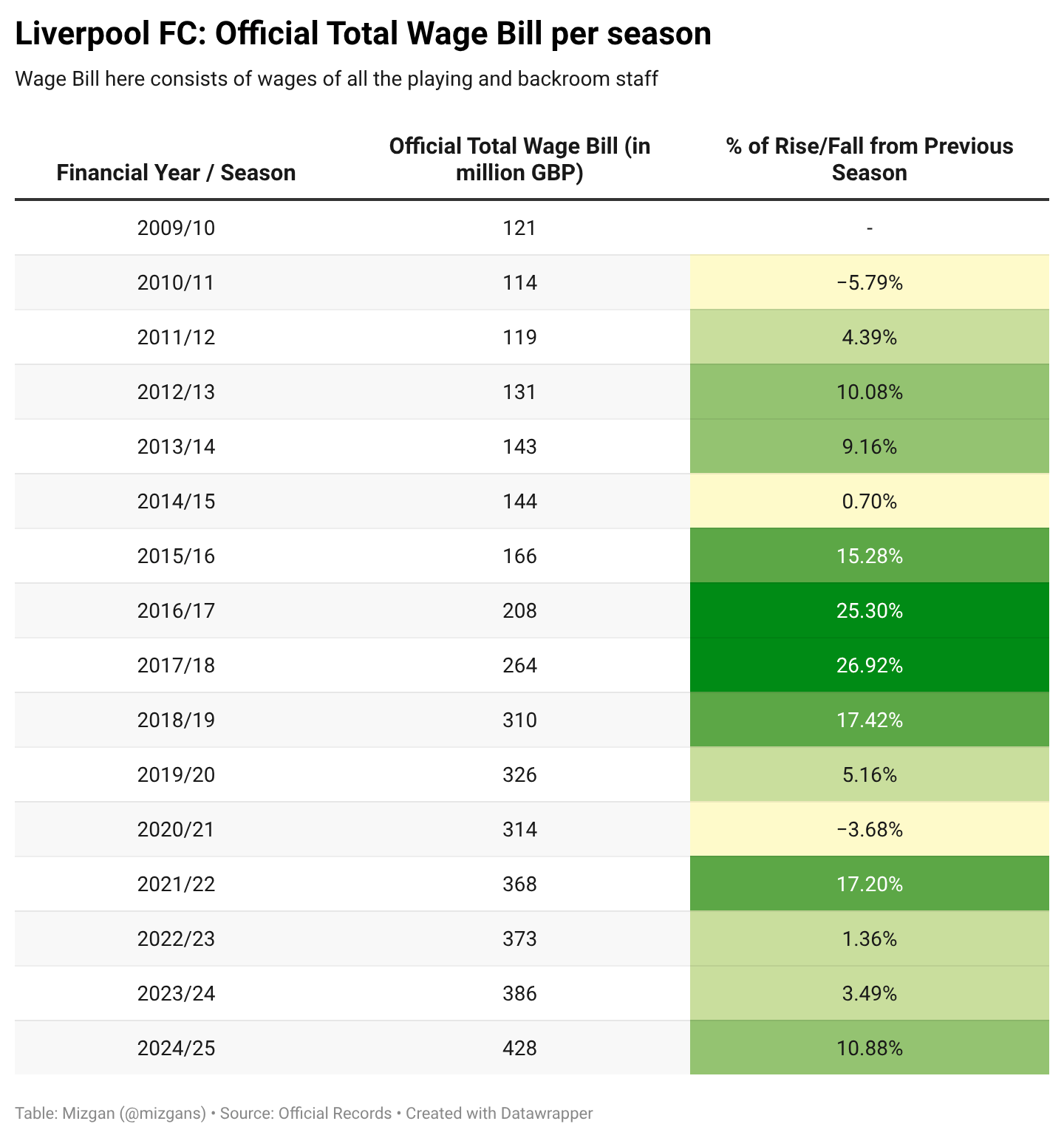
The highest growth in wages came in line with the boom in revenue. As we saw in the revenue section, the period between 2017 and 2019 generated the highest growth in revenue, and the growth in FSG’s wage bill closely matches that, as shown in the table above.
There was another spike in the 2021/22 season, when the team had a historic campaign, again in keeping with the recovery in revenue following the two-year hit during the pandemic. The rise in the 2024/25 season was also expected, with bonus payments being triggered following another Premier League title win.
Although one can question FSG’s approach to transfers and the fact that they are not ‘sugar daddy’ type owners, they are one of the best when it comes to rewarding players and staff when success is generated on the field (in addition to not shying away from paying big wages to key players and the manager). There is a reason why they have been in the top five in Europe for wages spent every year over the past decade or so.
Along with the above, the owners have made significant investments to bring the stadium and training facilities up to modern-day standards. They spent somewhere around £195m on two stand expansions at Anfield (the Main Stand and the Anfield Road End). They also forked out more than £50m on developing the new AXA Training Centre in Kirkby, which opened in 2020 to bring the men’s first team and youth academy onto the same site. In 2023, they bought the old Melwood training facility for the club’s Women’s team.
There is also a £20m investment promised to modernise the youth academy facilities in Kirkby, which includes adding a full-size indoor training centre. This is slated to be completed by 2028.
The first part of the article has covered how well FSG have done in putting a club of Liverpool’s stature back on track after a dark phase under Hicks and Gillett, along with the financials behind it all.
Now, let’s look at some of the footballing numbers, how things have looked over the years on the field, and how the club’s transfer strategy has remained consistent throughout, with a sudden change in 2025.
We start by looking at the monthly Elo Ratings of the club over an 18-year period, starting from 2008 and going up to July 2026. An Elo Rating practically gives us a dynamic, numerical measure of a team’s strength relative to other clubs based on their performances on the field. Since I have extracted this data via the ClubElo API, it is strictly based on clubs under UEFA (Europe).
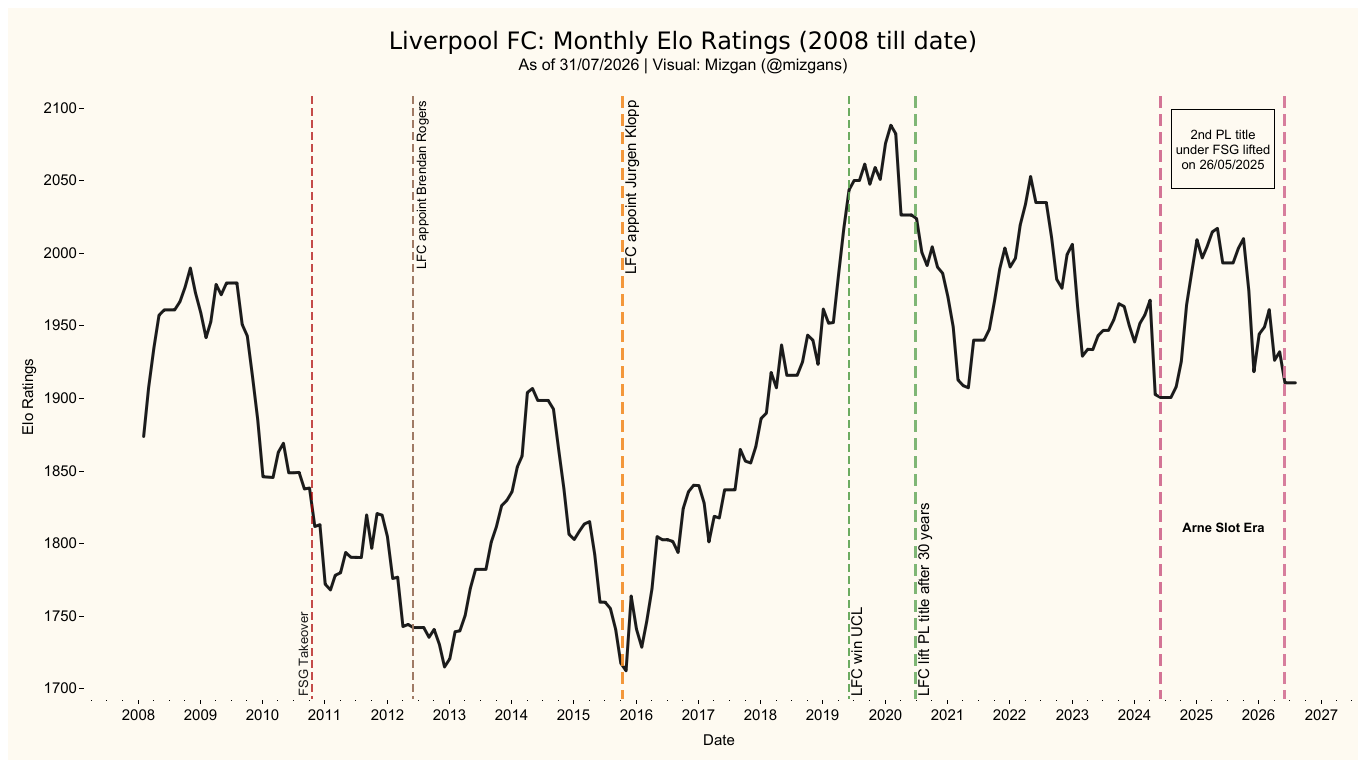
Around 2008 and 2009, the club was in a decent place on the field, following a consistent period in the Champions League and doing decently well in the Premier League (finishing second in the latter in the 2008/09 season). The decline came after 2009.
The first couple of years under FSG were volatile before a major dip in 2013, following a disappointing first season under Brendan Rodgers, with the team finishing eighth in the league.
It went up drastically in 2014 after Rodgers’ side nearly won the league title. This was followed by a dip, as the Reds’ first season back in Europe’s big time did not go well, alongside a drop-off in Premier League performances.
Klopp was appointed in October 2015, and we can see consistent growth in the team’s Elo Ratings between 2016 and 2018, before striking gold in 2019 by winning the Champions League, followed by a Premier League title in 2020. Liverpool were comfortably the best team in Europe between 2018 and 2020.
The title defence did not go well in 2020/21 following a raft of injuries, but things picked up again for a magnificent 2021/22 campaign. Looking at the two-year Slot era, the spike was recovered as Liverpool won their second league title in five years. This was followed by a disappointing title defence, although there were a lot of caveats involved, including the shock death of first-team player Diogo Jota in the summer of 2025 that hampered the pre-season (and much more).
This is a free read! But get unlimited access to in-depth, data-driven player and team analyses, scout reports, and tactical breakdowns covering the Premier League and European football for just £3.50/month, or £3.16/month with an annual subscription. Start with a seven-day free trial.
How have Liverpool’s Premier League points tally and league position looked over the years?
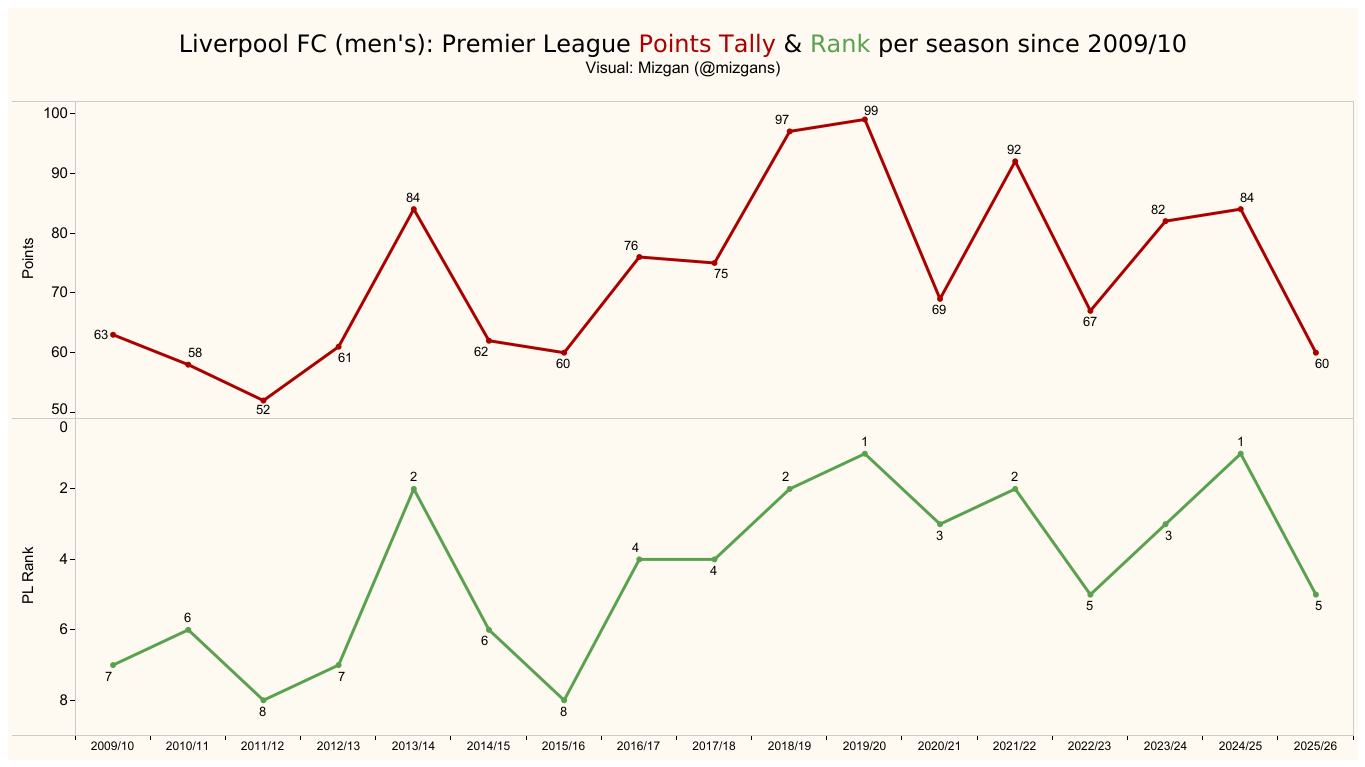
The nature of the graph we are seeing here was more or less discussed in the previous paragraph. It was a super achievement from Klopp that Liverpool dropped out of the top four only once in his eight full seasons in charge of the team (2016/17 to 2023/24). It is even more impressive when you consider that the team had finished in the top four only once in the previous seven campaigns.
Lastly, we look at some of the transfer window numbers to see how consistent FSG have been in this regard. As mentioned above, they wanted to make Liverpool a self-sustaining model, where whatever is earned is largely spent back into the club.
Let’s go through the net spend per season over the years, along with their relative rank in the league for those seasons.
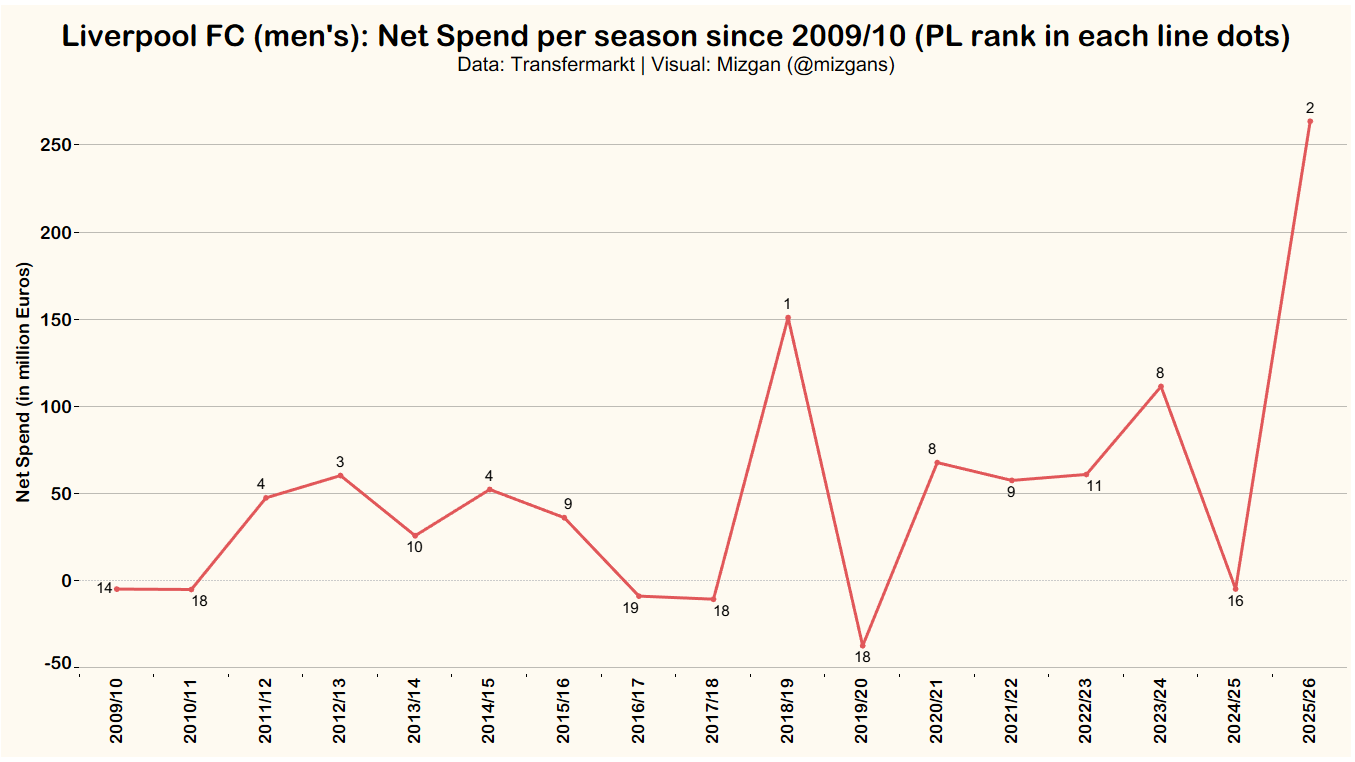
Net Spend = Money spent on buying players - Money recouped from selling players (the higher the net spend, the better the rank in the plot above).
2018/19 was the first season in which the net spend crossed the €100m mark. The summer of 2018 did involve paying big money to sign Alisson Becker from AS Roma, but it was also the first time in a long time that Liverpool did not have to sell one of their key assets to raise funds for buying players.
Two consecutive seasons of Champions League qualification meant the club had started generating more revenue, while the team was becoming settled under Klopp. As a result, the major transfer activity involved incoming players rather than having to sell key assets to fund them.
The squad did not get much of a boost in the summer after winning the Champions League. Although that did not affect the 2019/20 campaign, it did in 2020/21, when a shortage of centre-backs following a raft of injuries in that position meant everything became a mess.
If we look at the relative league ranking of Liverpool’s net spend, it was first in 2018 and has been underwhelming since. This is despite the team’s growth on the field and the revenue streams flowing through the roof, even with the two-year halt caused by the pandemic.
Following relatively little major transfer activity in the 2024/25 season, the club went big in the summer of 2025 after winning the title and seeing another decent level of revenue growth. In my opinion, they had to do it. The Klopp team was ageing, and quite a few key players had left. That is set to continue this summer as well.
But this is where the current market creates a problem for FSG’s model. Even with revenue increasing significantly and everything around the club looking positive, the idea of ‘paying what we earn’ would not be sustainable.
We have seen good players going for crazy money in the Premier League this summer, and elite players will obviously cost even more.
So, it is not surprising to see FSG inviting major investment from a consortium. It is an acceptance that they may need some help to keep Liverpool competitive at the highest level.
It would also not be surprising if this turns out to be the start of a full takeover of the club by the above-mentioned consortium. I mean, there has to be a reason why Amit Bhatia resigned as a director at QPR to form this consortium alongside Bezos and Saverin, right?
Although they have made mistakes during their tenure at Liverpool so far, FSG’s overall work at the club has been positive. This article was about putting the numbers behind the work they have done to improve the stature of the club, both financially and on the field.
At the same time, it feels like the right time for their model to evolve. The game has changed, the transfer market has changed, and keeping Liverpool competitive at the very top is becoming increasingly expensive.
This is a free read! But get unlimited access to in-depth, data-driven player and team analyses, scout reports, and tactical breakdowns covering the Premier League and European football for just £3.50/month, or £3.16/month with an annual subscription. Start with a seven-day free trial.
No posts
Comments
Nothing yet. Say the first thing.
Sign in to join the conversation.