
Written on 08/08/2026,
Well, no one saw that coming (at least the people who aren’t inside the workings of the club). Liverpool are completing the signing of Ronald Araújo on a loan deal with an option to buy him for €55m next summer if things go to plan (I still think this would end up being just a one-year loan unless surprising turns of events happen).
Getting a dynamic centre-back was the need of the hour after seeing Joe Gomez get injured once more, just seven minutes into the first pre-season game, while Giovanni Leoni is still recovering from an ACL injury and Jérémy Jacquet is yet to feature in pre-season after picking up a minor issue (we do not know the extent of it).
Not signing a centre-back, even on loan, would have left the squad light in that department going into the season, with so many games to navigate as always.
Araújo (27) sounds like an interesting move if no context is added. However, there is a lot to uncover regarding the player and what he could bring to the table at Anfield.
The Uruguayan international has been at Barcelona since 2018. He initially joined their B side after spending a year playing first-team football for clubs back in his home country (Rentistas and Boston River).
The defender then made his senior debut for the La Liga champions in 2019 and has played 213 games in all competitions, with 157 starts. After playing only 238 minutes in his first season as a Barcelona first-team player, he has averaged around 2,387 minutes per season over the past six campaigns, with his highest playing time coming in the 2021/22 season (3,274 minutes).
Despite being a big part of the leadership group (in the squad) at Barcelona for some time now, why has Araújo’s playing time been relatively low in all competitions? The answer: injuries.
In six full seasons at Barcelona, the 27-year-old has missed 100 games due to injuries and a mental health break (he took the latter in the middle of last season). In total, he has had 16 injuries, nine of them muscle-related. He has had two significant hamstring injuries, one in 2021/22, which made him miss six games, and another in 2024/25, which made him miss 29 games.
So, although he is fit and was part of Barcelona’s pre-season as of now, there is a lingering concern that he might break down again if regular game time is asked of him at Anfield. One to keep an eye on during the season.
Now, about his profile, there are discernible strengths and weaknesses there.
We start the analysis by looking at a bar chart showing his percentile ranks against La Liga centre-backs during the 2025/26 season, since he played just over 1,000 minutes in the league last season, clearing the minutes threshold.
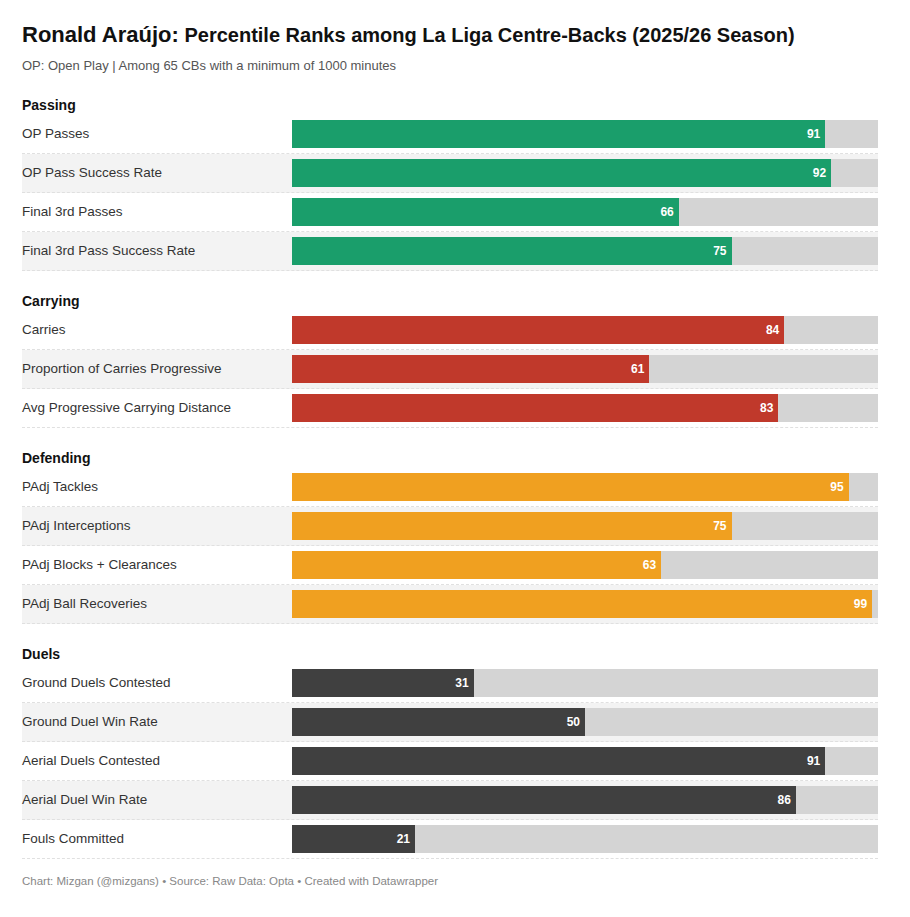
Even in a distorted season in terms of playing time and mental health issues, Araújo managed to be one of the best centre-backs in Spain when it came to passing with accuracy and purpose, as well as ball-carrying. His ground defending numbers were exceptional as well (along with the impressive numbers shown above, he was in the 85th percentile for being dribbled past), while aerial superiority has been one of his strengths for some time now.
One of the drawbacks of his game is his rashness; hence, he is in the 21st percentile for fouls committed (the more fouls committed, the lower the percentile). He has a tendency to rush into challenges and have a brain-fade moment, which can lead to fouls in dangerous positions. Despite being very good on the ball, he can also lose possession in key areas, potentially allowing the opposition to create a chance as a result.
Next up, we have a series of event data visuals that will help us further analyse the player’s profile and identify where his strengths and weaknesses lie. I have used three seasons of La Liga data to ensure there is enough information in the visuals to draw meaningful conclusions from (since he didn’t play much in the last two seasons for various reasons).
We start with the touch map.
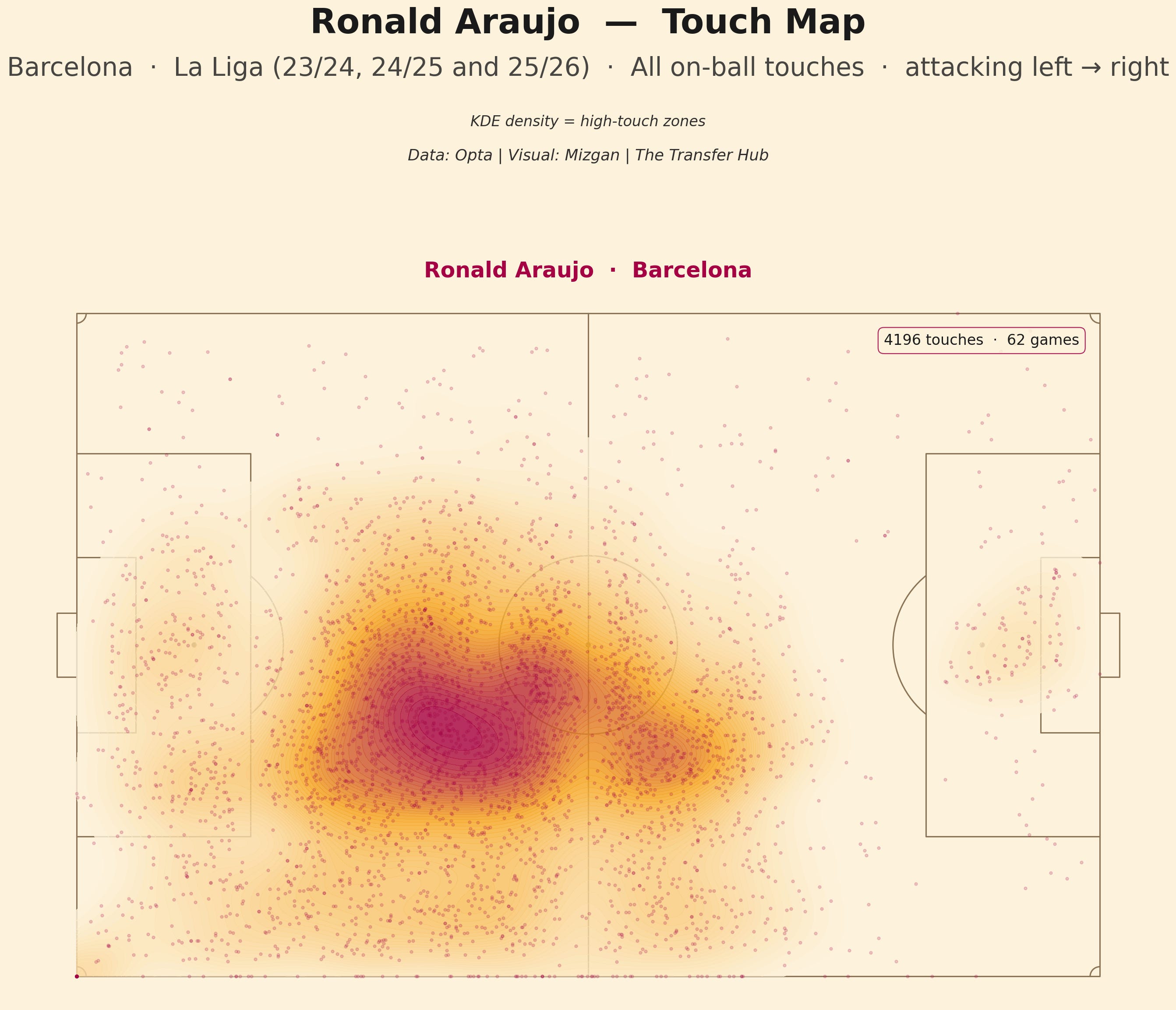
Out of the 62 games played during the given period, 45 came from the start, with 40 of those coming as a centre-back and five as a right-back. This is reflected in the touch map above, with a greater concentration of his actions coming as an orthodox right-sided centre-back in a back four.
Next up, we have his pass map.
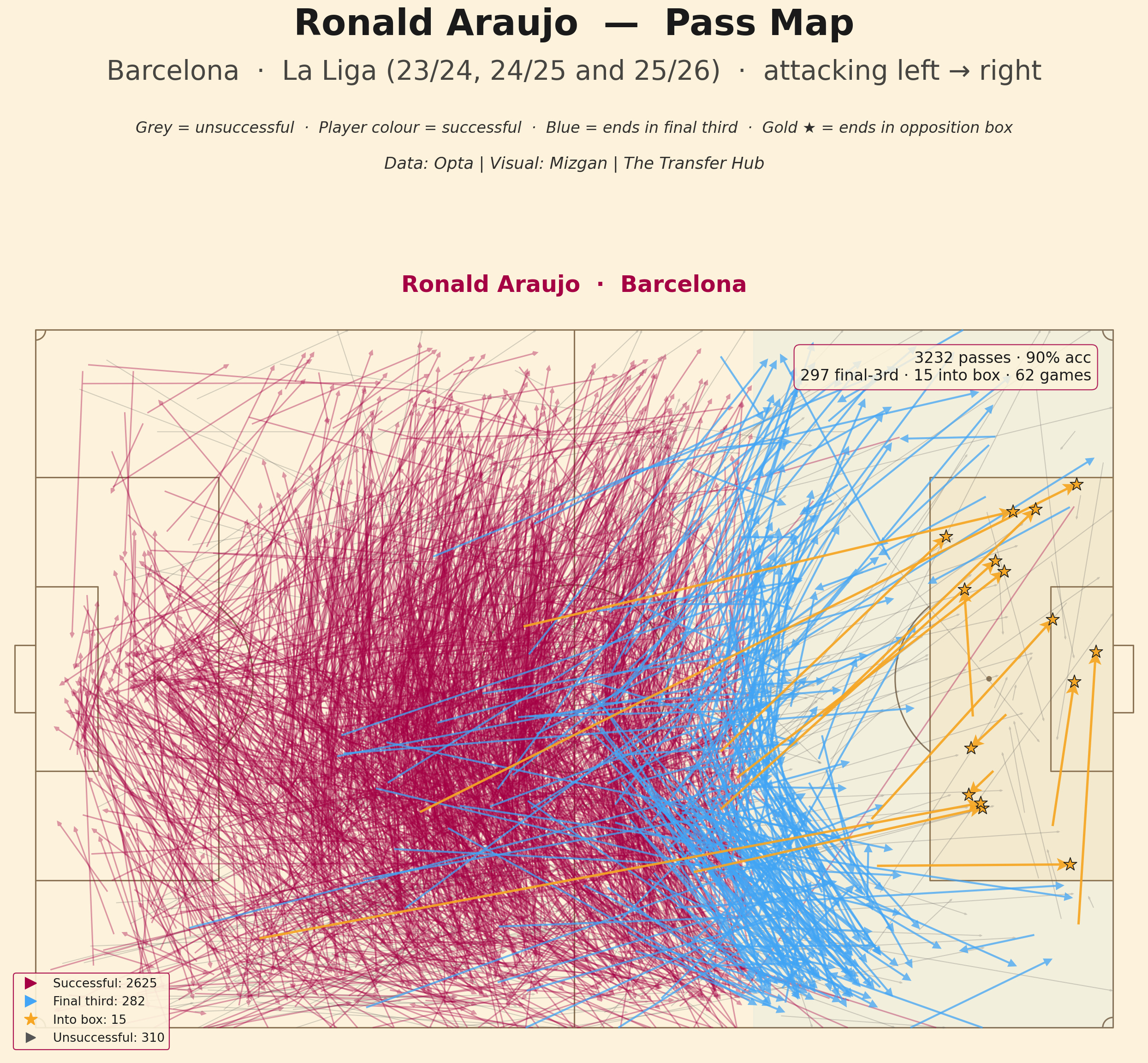
More than 10% of his completed passes ended up in the final third or the opposition box. Those are high returns for a centre-back, even one playing for a possession-dominant side like Barcelona.
The pass map gives us the impression that he does not attempt a lot of long balls or diagonals from one side to the other. Although his long-pass accuracy was around 50% across the three seasons covered here (relatively decent), he prefers to play passes along the ground, with occasional punchy passes through the lines into the final third. An overall pass accuracy rate of 90% is impressive.
Next up, we have an expected threat (xT) map showing the threat created by the player, along with the passes that generate the most threat. This will be followed by his aerial duel map, defensive actions map, post-recovery pass map, and ball-loss map, including instances where those losses lead to opposition chances.
The rest of this analysis is for paid subscribers. Get unlimited access to in-depth, data-driven player and team analyses, scout reports, and tactical breakdowns covering the Premier League and European football for just £3.50/month, or £3.16/month with an annual subscription. Start with a seven-day free trial.
Comments
Nothing yet. Say the first thing.
Sign in to join the conversation.