
Written on 28/07/2026
If we believe the current direction of travel, Bradley Barcola (23) will end up at Liverpool by the end of this transfer window, while Yan Diomandé (19) will head to Real Madrid. Both deals will comfortably be worth over €100m, with Barcola’s valuation (currently €170m, as quoted by Paris Saint-Germain) higher than what Madrid may end up paying for Diomandé. I know Liverpool will not pay Barcola’s asking price, but I would not be surprised if the French international ends up commanding the higher transfer fee after all.
I know the market does not make sense. A player after one full season of Bundesliga football is set to go for more than €100m, while another player, who admittedly has more experience (128 appearances in Ligue 1 for Lyon and PSG), but played a backup role in PSG’s triumphant 2025/26 season, is being labelled as a €150m+ asset.
Regardless of the inflation, though, both Barcola (France international) and Diomandé (Ivory Coast international) would have commanded relatively high transfer fees. Why, you ask? Because they are elite players in their positions, and wingers and forwards tend to cost more because they make the difference in a low-scoring sport (although even midfielders are going for huge fees these days).
Their percentile ranks against Europe’s top wingers and forwards during the 2025/26 season give us a glimpse of how good they are.
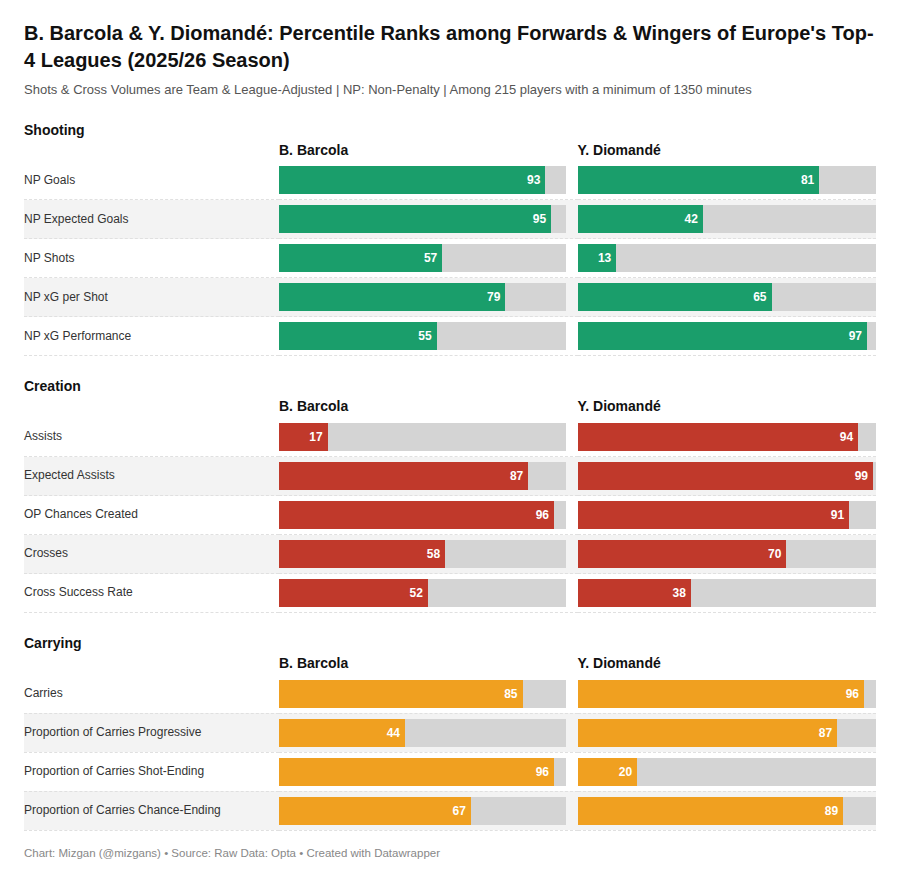
Output-wise, this was not Barcola’s best season (his best came in 2024/25). Yet, the French international still ranks highly across most shooting, chance creation and carrying metrics, with a particular emphasis on shot-ending carries.
Diomandé, in his first full season of first-team football (following half a season at Leganés the previous campaign), posted excellent numbers in chance creation and carrying.
He has, to be fair, significantly overperformed his expected goals despite relatively low shooting numbers. I would class that as something likely to even out over the coming seasons. The combination of his high chance creation and carrying numbers, particularly those that end in chance creation, suggests he would still contribute plenty even if his goalscoring performance regresses towards the mean.
Looking at just one season’s worth of data is not enough to identify the similarities and differences in the profiles of these two players. So, what I have done is feed two seasons of data into the pipeline to analyse them and draw clearer conclusions about what they are like as wingers and what Liverpool and Real Madrid would eventually get as players (bearing in mind that they are still young and have room for growth).
We are looking at Barcola’s numbers across the 2024/25 and 2025/26 seasons for PSG, and Diomandé’s numbers for Leganés in 2024/25 and Leipzig in 2025/26 (league numbers only).
We start with the touch maps.
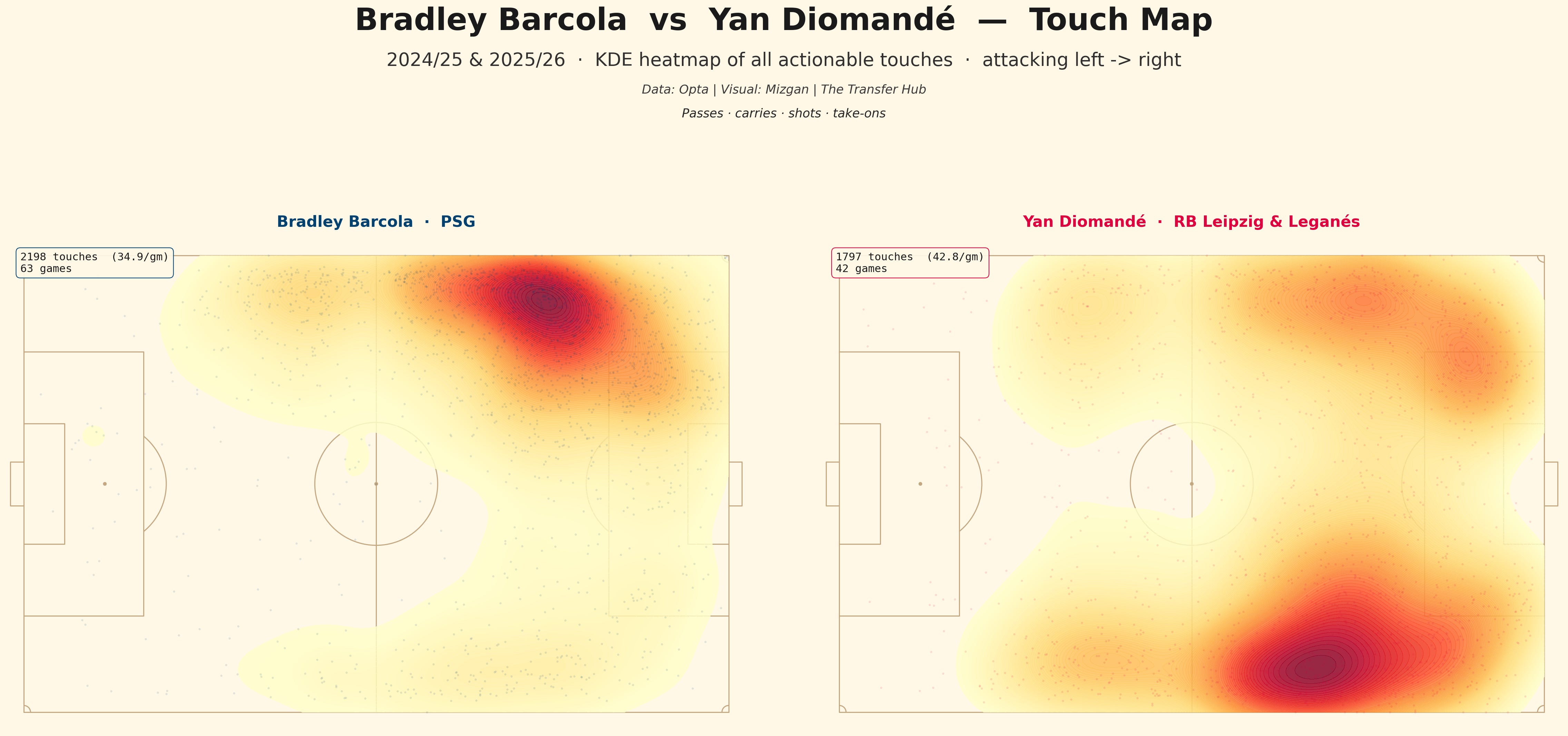
Over the last two seasons, Barcola has played more than 70% of his games on the left wing and around 15% on the right. We can tell from the touch map that, although he can hold the width on the left, he records more touches around the edge of the box and inside the penalty area, either by making out-to-in runs without the ball or by cutting inside with it. He can also get to the byline when required.
Diomandé played around 70% of the time on the right for Leipzig, while starting predominantly on the left during his brief spell at Leganés. As a right-footed player, the natural tendency is to hold the width more when operating on the right and attack the byline more often than when playing on the opposite flank. The encouraging thing, which we will explore in more detail later, is that the 19-year-old does not appear to have an angle bias. He is equally willing to come inside, both with and without the ball.
Next up, the nature of runs made before receiving the ball in the final third or beyond.
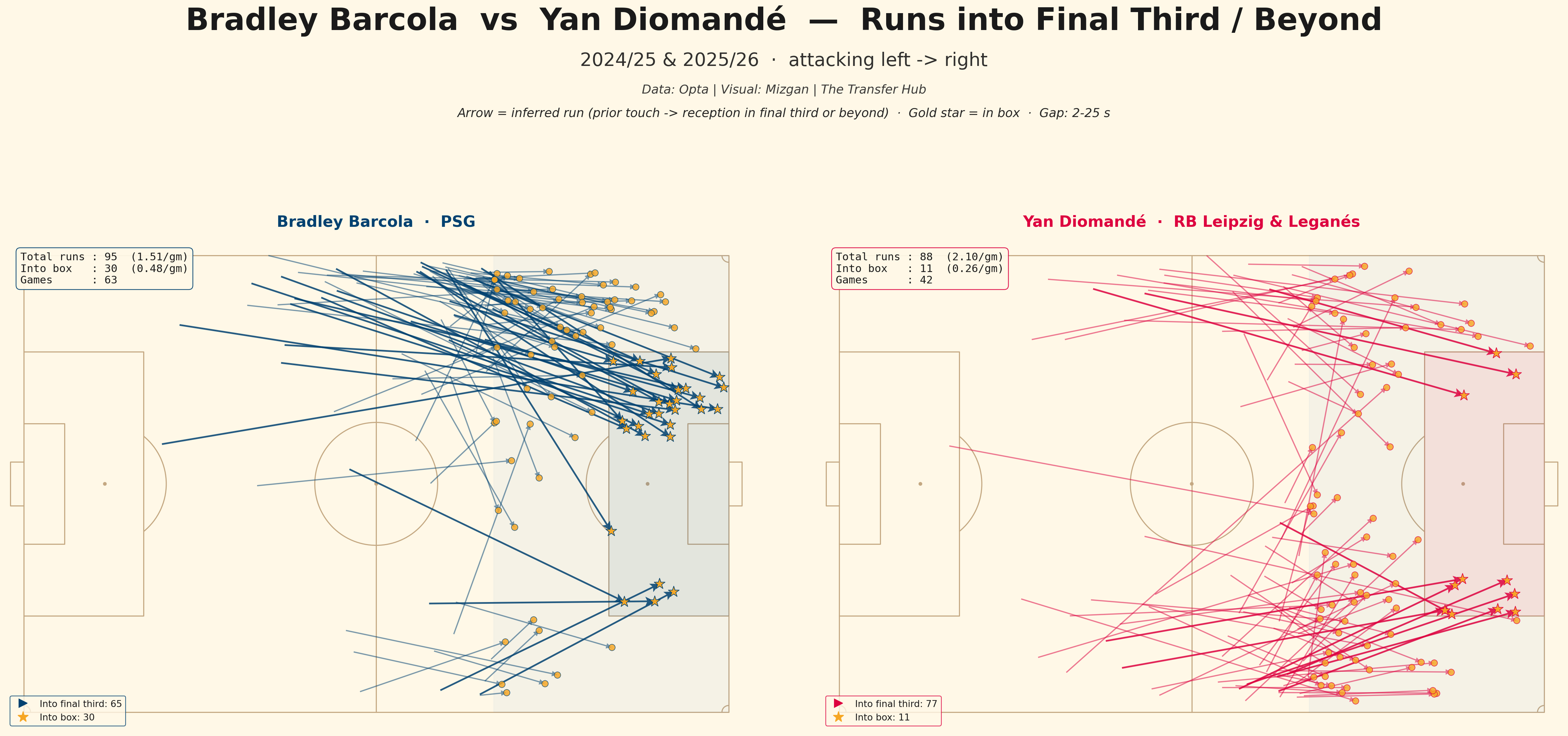
This can be team-dependent as well, but the natural tendencies of a player also come into effect when we are looking at two seasons’ worth of data.
Compared to Barcola’s 32% of runs ending inside the box, Diomandé has just 13%. This highlights the directness in the former’s game when making off-the-ball runs in the attacking third. Even when playing on the left, the latter prefers holding the width rather than making box-crashing runs.
So, it is not surprising that Barcola takes more shots and is more of a goalscoring winger, whereas Diomandé is more of a supporting-cast winger who will score goals but is happier making most of his actions outside the box.
Next up, we have the chance creation maps, followed by take-on maps, post-take-on action maps, progressive carry maps and shot maps, which will help us understand the similarities/differences in their attacking profiles.
Comments
Nothing yet. Say the first thing.
Sign in to join the conversation.