
Written on 26/07/2026
With Real Madrid aiming to sign Yan Diomandé (it would be a difficult deal, but one they appear likely to complete) while also looking to extend Vinícius Júnior’s contract, they already boast an abundance of attacking talent. Alongside Vinícius are Kylian Mbappé, Arda Güler, Franco Mastantuono (whose future is also uncertain) and the currently injured Rodrygo. As a result, it is understandable why there are rumours that José Mourinho may not fancy Endrick. That decision is likely to be made once the Brazilian returns for pre-season following his involvement at the World Cup.
If I were Endrick (20), looking at the options Madrid already have, even if Diomandé does not arrive, there is a strong case for pushing for either a permanent move during this transfer window or another season-long loan following an encouraging spell at Lyon during the second half of the 2025/26 season.
Madrid signed the Brazil international from Palmeiras in the summer of 2024 after he enjoyed a terrific Série A campaign in 2023, scoring 11 goals in 31 appearances as a 17-year-old, while also impressing in the 2024 Copa Libertadores.
He played only 863 minutes in all competitions during his first season in the Spanish capital, which was understandable for a young player arriving from Brazil. In the first half of the 2025/26 season, he featured for just 100 minutes before joining Lyon on loan during the January transfer window.
Below, we analyse Endrick’s numbers from an impressive half-season in Ligue 1, while also breaking down his profile in detail to understand why clubs should take a chance on him if Real Madrid are not prepared to offer him regular game time in the near future.
We begin with his percentile ranks against Ligue 1 wingers and forwards from the 2025/26 season, highlighting both how he performed overall and the areas of his game in which he already excels despite his young age.
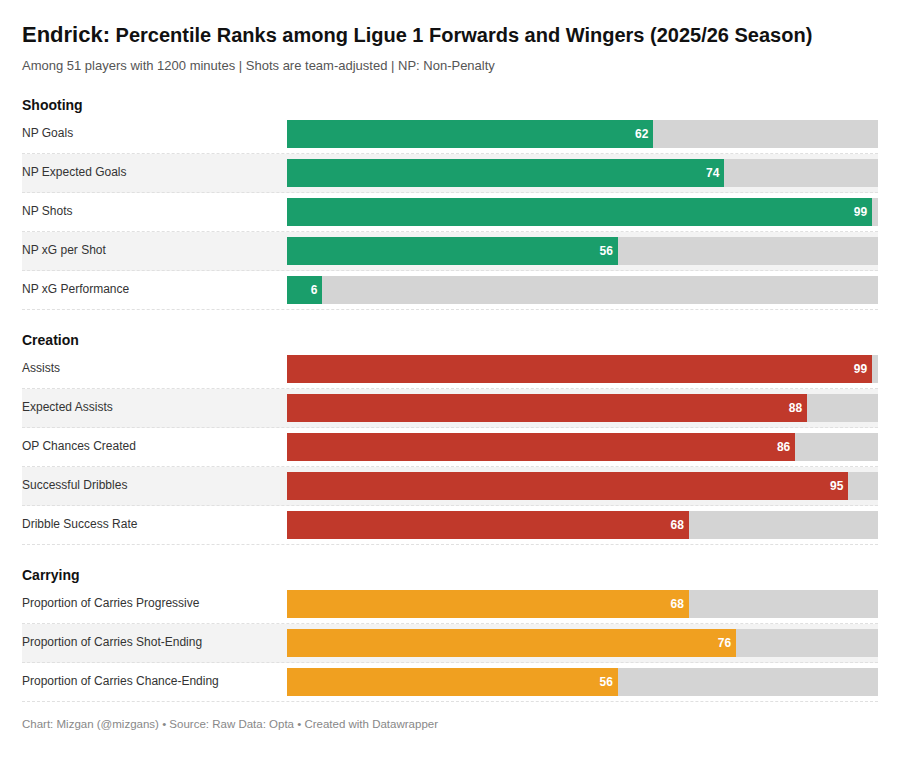
Endrick played just over 1,200 league minutes, starting 10 games as a right winger and five as a striker. Aside from a below-par expected goal performance (something that can improve over time), he was one of Ligue 1’s standout forwards during the second half of the 2025/26 campaign.
He is certainly not shy about shooting and still produced a respectable goal return despite a relatively low conversion rate. Among the 51 forwards and wingers who played over 1,200 league minutes last season, he ranked 43rd for shot-to-goal conversion rate.
The creative numbers are particularly impressive. Although his 0.52 assists per 90 overperformed his expected assists (xA) by 0.28, an xA figure of 0.24 per 90 is still impressive when viewed in the context of the league. His open play chance creation and dribbling numbers were also very strong.
His carrying numbers are above average, with a greater emphasis on carries that end with a shot rather than creating a chance for a team-mate. That aligns well with his profile as a high shot-volume forward, even when deployed on the right wing. He also ranked in the 95th percentile among Ligue 1 forwards for final-third ball recoveries (1.1 per 90).
Next, we examine his profile through event data visualisations to understand the areas of the pitch he likes to operate in and where he is most effective.
Starting with the touch map.
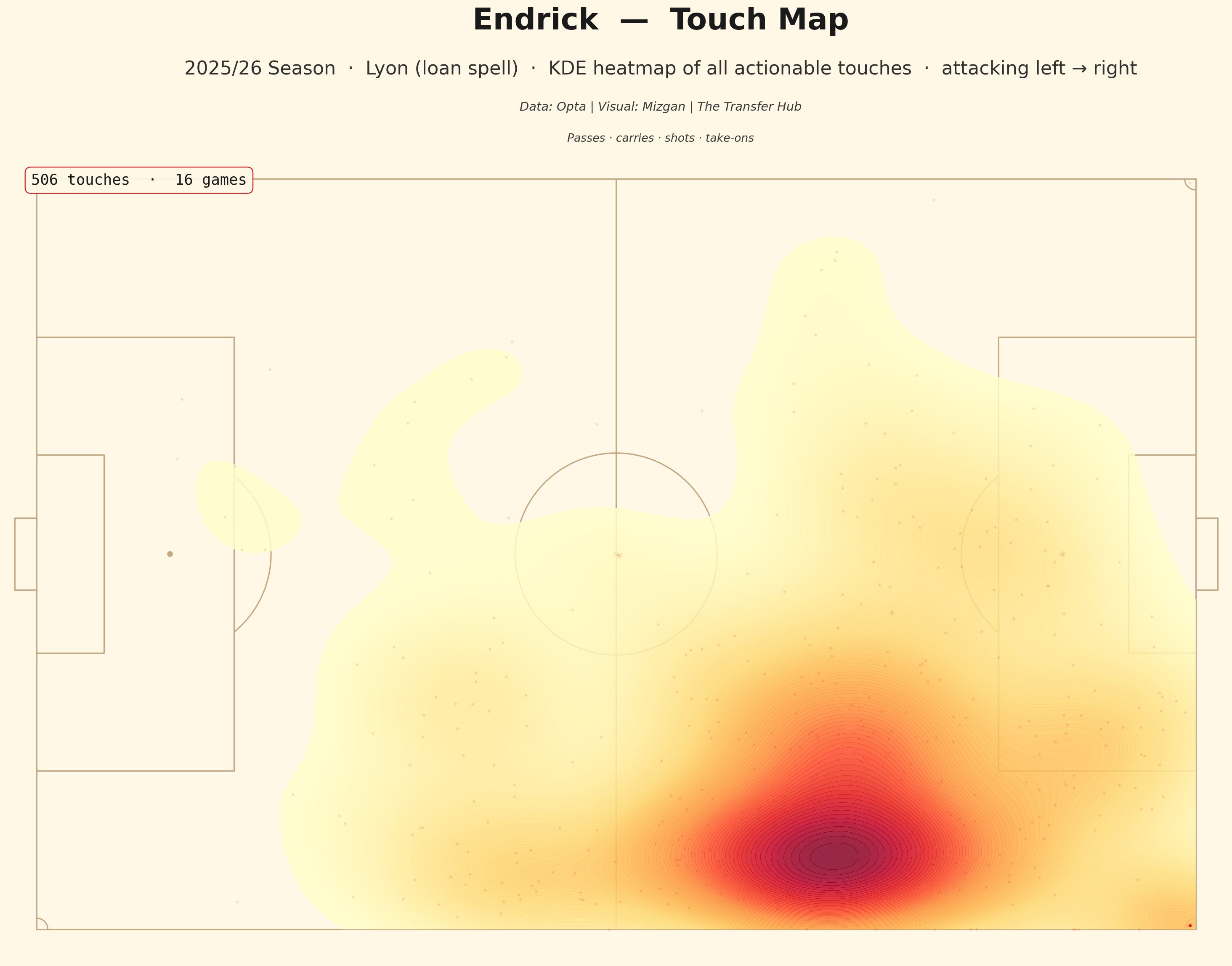
The 20-year-old started 10 games on the right wing and only five as a striker. Even when deployed as a striker, he operated in a front two system, meaning his focus of operation remained heavily towards the right-hand side.
When starting from a wide position, he preferred to hold the width before cutting inside onto his favoured left foot. As a result, there is limited activity close to the byline, with his attacking actions generally occurring in the right half-space and right-centre areas.
Next up, we analyse his runs made before receiving the ball in the final third and beyond.
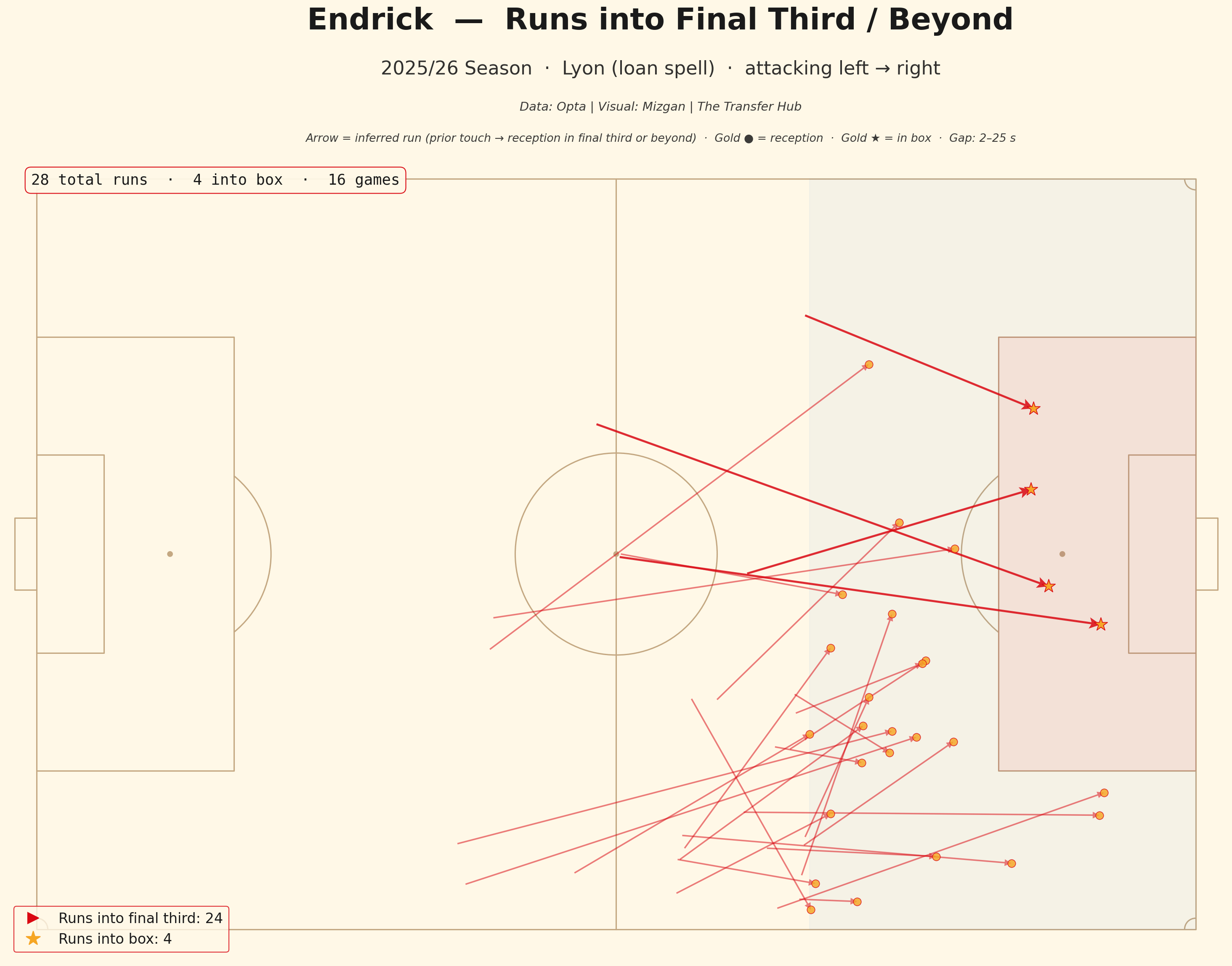
If we focus on the runs starting from the wide right position, they are typical out-to-in movements that inverted wingers make regularly. We saw similar patterns from Mohamed Salah and Sadio Mané during their peak years at Liverpool.
Although the proportion of runs ending inside the box is relatively low, the intention behind them is clear, with most runs consistently aimed towards crashing the box. I identified only three runs that went against this tendency, where he moved away from goal and towards the byline.
Next, we examine his take-on map, his actions after completing a take-on, carry map, his expected threat (xT) per zone contribution from passes and crosses, and his shot map.

Comments
Nothing yet. Say the first thing.
Sign in to join the conversation.