
As I continue to build my PR consultancy and freelance career, I keep returning to a statement from actress, writer, and producer Issa Rae made years ago about networking. One that feels more resonant now than ever.
“We have a tendency of trying to network up, but it’s really about networking across. Who’s next to you? Who’s struggling? Who’s in the trenches with you? Who’s just as hungry as you are? And those are the people that you need to build with.” — Issa Rae
It is one of those statements that sounded so simple until now, when I realise how few people actually practise it, myself included, especially in an industry built around visibility, access and proximity to power.
So much of entertainment still misunderstands networking as a form of professional ladder-climbing: find the most senior person in the room, impress them, stay visible, be useful, and hope that at some undefined point in your career, that usefulness converts into opportunity.
Sometimes it does. Often it doesn’t.
And even when it does, the relationship usually remains structurally uneven, because the person with power is still the person granting permission, setting the terms, deciding when your presence is valuable and when it is no longer convenient.
That model is short-term, transactional and, honestly, exhausting.
In an industry where the goalposts keep moving, where commissioning has slowed, theatrical risk is being recalculated, streamers are more selective, awards campaigns are more crowded, and the definition of success seems to change from one market cycle to the next, the people who are building sustainable careers are doing something else entirely. They are building with their peers.
Issa’s original point was not simply “be nice to people”, it was that the people in the trenches with you are often the people you are most likely to build real power with, precisely because the relationship begins before either side has anything obvious to extract. The people beside you are also learning, failing, experimenting, taking the smaller jobs, stretching tiny budgets, making impossible decks, writing speculative scripts, producing shorts with no money, programming basement screenings, pitching ideas nobody has validated yet, and trying to build from the ground up, creating something before the industry has decided whether to take them seriously.
You don’t build a sustainable career by networking upwards. You build it sideways.
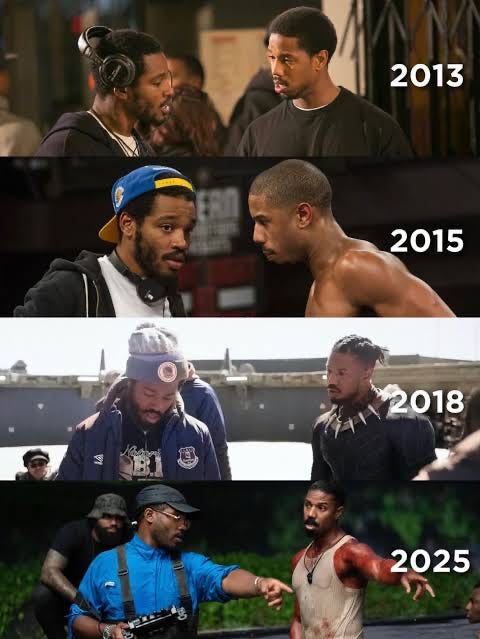
Networking sideways is the slow, often unglamorous process of becoming known to people at the same stage of ambition as you, long before any of you have become useful in the obvious way. And in film and television, where so much of the work is collaborative, reputation-led and dependent on trust under pressure, that kind of relationship can become more powerful than almost any one-off introduction to someone senior.
The clearest current example is Ryan Coogler and Michael B. Jordan. They did not meet at the top of their careers. They met at the beginning, with Fruitvale Station, Ryan’s debut feature and a Sundance breakout, made before either of them had commercial success or awards recognition. This film was their first collaboration, and it established something that would matter far beyond that one project: a director and actor finding each other early, building trust and continuing to choose each other again and again, film after film, risk after risk, as the scale of their projects grew and changed. From Fruitvale Station to Creed to Black Panther, and now to Sinners, their partnership has become part of their own industrial narrative. Ryan’s Oscar win for Best Original Screenplay and Jordan’s Oscar win for Best Actor for Sinners are not just individual milestones, they are the visible result of a creative relationship that has had time to deepen, recalibrate and scale.
Ryan’s wider creative ecosystem tells the same story.
Ludwig Göransson’s creative relationship with Coogler began with Fruitvale Station, and he has continued to score Coogler’s films across Creed, Black Panther and Sinners. His Oscar wins for Black Panther and Sinners matters here not simply because they reward individual scores, but because they show what happens when a working relationship is given enough time, trust and creative range to become part of the filmmaker’s language. Additionally, Autumn Durald Arkapaw’s historic Oscar win for Sinners adds another layer. Her win made her the first woman to win the Academy Award for Best Cinematography, after previously collaborating with Ryan on Black Panther: Wakanda Forever.
That is what networking sideways looks like in practice. It is not opportunistic. The relationship did not simply survive success; it expands with it. From indie cinema to billion-dollar franchise filmmaking. From emerging talent to industry power players.
It becomes infrastructure. They do it by building and creating environments, systems and habits of trust around them, where other people can do career-defining work, and by repeatedly choosing collaborators before the market has fully caught up to their value.
You can see the same principle in Barry Jenkins’s recurring creative circle. Cinematographer James Laxton shot Medicine for Melancholy, Moonlight and If Beale Street Could Talk, while Nicholas Britell composed Moonlight and If Beale Street Could Talk, and producer Adele Romanski was central to Moonlight and the wider Jenkins ecosystem. From the outside, this could look like a sudden industry and awards breakthrough, but was actually years of creative relationships, taste alignment and mutual trust.
Donald Glover and Hiro Murai worked together on Childish Gambino music videos long before before the tv series Atlanta, then went on to direct a significant number of the show’s episodes, helping establish its unique tone. Atlanta is not just an example of friends working together, it is an example of a peer relationship creating something new, because the show’s power comes from the fact that it refused to behave like other half-hour comedy the industry already knew how to sell.
Issa Rae herself is one of the best examples of the principle she articulated. Her career did not move from “unknown creative” to HBO to Hoorae in isolation; it moved through a network of collaborators who helped turn a web series into a domestic and international culturally relevant television show and then into production infrastructure. Deniese Davis produced The Misadventures of Awkward Black Girl web series on YouTube, went on to become a co-executive producer on Insecure, and later co-founded ColorCreative with Rae and Talitha Watkins. That is networking across as business model: not simply bringing your friends with you, but building companies, shows and opportunities.
A more recent version of this is Emma Seligman and Rachel Sennott, whose relationship began around Shiva Baby, which started as Seligman’s NYU thesis short before becoming her feature debut.
Like Issa, Donald and Barry, this is emerging creatives recognising the same creative language in others before the industry had fully assigned either of them value. When Emma and Rachel moved from Shiva Baby to Bottoms, the collaboration did not simply repeat itself, it scaled. What began as microbudget project became studio-backed feature with global distribution.
That is the thing repeated collaboration gives you: not just familiarity, but creative shorthand.
The industry tends to reward the visible result, but the advantage is often built much earlier, in the invisible repetition. That is why access alone is an insufficient strategy for anyone trying to build a serious career now.
Access can get you a meeting. It can get you a room. It can occasionally get you a job. But it does not automatically give you trust, alignment, creative history or the kind of mutual investment that makes someone bring you with them when the stakes get higher.
And right now, that distinction feels particularly important because the industry is contracting and professional anxiety is high. In tighter markets, people become more obsessed with proximity to power because power feels scarce. Everyone wants the commissioner, the studio executive, the festival programmer, the financier, the tastemaker, the person who can say yes. But the yeses are fewer and fewer, the rooms are more crowded, and the old access routes are not delivering in the way they once did.
In that environment, peer networks become more valuable, not less.
When you network upwards, you are trying to access someone else’s power. When you build sideways, you are creating power together.
The producer you know now may not be able to finance your project today, but they may be building the slate that becomes relevant in three years. The assistant you met at a festival may become the executive tracking precisely the kind of work you do. The journalist you had a proper conversation with before you needed coverage may become the editor who actually understands your taste. The filmmaker whose short you helped platform may become the director with a feature at Sundance, Cannes, Venice or Toronto. The junior awards executive, agency coordinator, programmer, publicist, sales assistant or development executive who feels peripheral now may be central later.
And if you have built something real, trust, creative alignment, shared history, you are not reaching out cold when they get there. You are already in relationship.
This does not mean people should never network upwards. Of course access matters. Senior relationships matter. Gatekeepers still exist, even if the industry likes to pretend it has become more open than it really has. But upward networking is rarely enough on its own, because access without a base is fragile. It can disappear with one executive move, one commissioning freeze, one regime change, one studio restructure, one festival rejection, one campaign cycle that does not land.
Sideways networking is much much slower. They sit across companies, roles, countries, festivals, publications, disciplines and career stages. They survive job changes because they are attached to people, not just institutions.
For publicists, awards consultants and strategists like me, this is not separate from the work; it is part of the work. We often inherit campaigns late, once the film is finished, the release date is locked, the festival slot is confirmed or the awards spend has been approved, but the strongest narratives are usually formed much earlier, through the creative relationships that made the work possible. In an awards context especially, that can be the difference between a campaign that feels like a polished submission and one that feels like an industry story.
The same principle applies to media relationships. The most valuable journalist, editor and critic relationships are rarely built in the moment you need coverage; they are built through repeated, thoughtful contact long before there is a pitch on the table. It means understanding what someone actually covers, respecting their taste, knowing when not to send something, being honest about what a story is and what it is not, and treating journalists as editorial thinkers rather than distribution channels. A good press relationship is not simply access to coverage; it is alignment built over time, so that when the right film, filmmaker, craft story or industry shift comes along, you are not cold-pitching into the void, but continuing a conversation with someone who already understands your judgement and the value of what you are bringing to them.
The mistake is assuming the person above you is the only opportunity, when very often there are also other opportunities in the person beside you before the industry has noticed them.
So the better question is not, “Who is the most powerful person I can get in front of?”, it is, “Who around me is building something I genuinely align with and what could it look like to build alongside them now?”
Because one day, if the work holds, both of you may be further along than either of you could have predicted, and the relationship that once looked informal, lateral or even incidental may turn out to be the most valuable infrastructure you built.
No posts
Comments
Nothing yet. Say the first thing.
Sign in to join the conversation.