
On the left, immediately as I walk into the narrow entryway to Dominique Renson’s exhibition space in the Orangerie at Maison Caillebotte (just outside Paris), there’s a large, impressive half-length portrait of a woman.
Lean and intelligent, she seems familiar. A social personality? I wouldn’t know who – but she has a way with her. I haven’t seen Renson yet; it could be the artist herself. The info-tab says it is. Work from 1989.
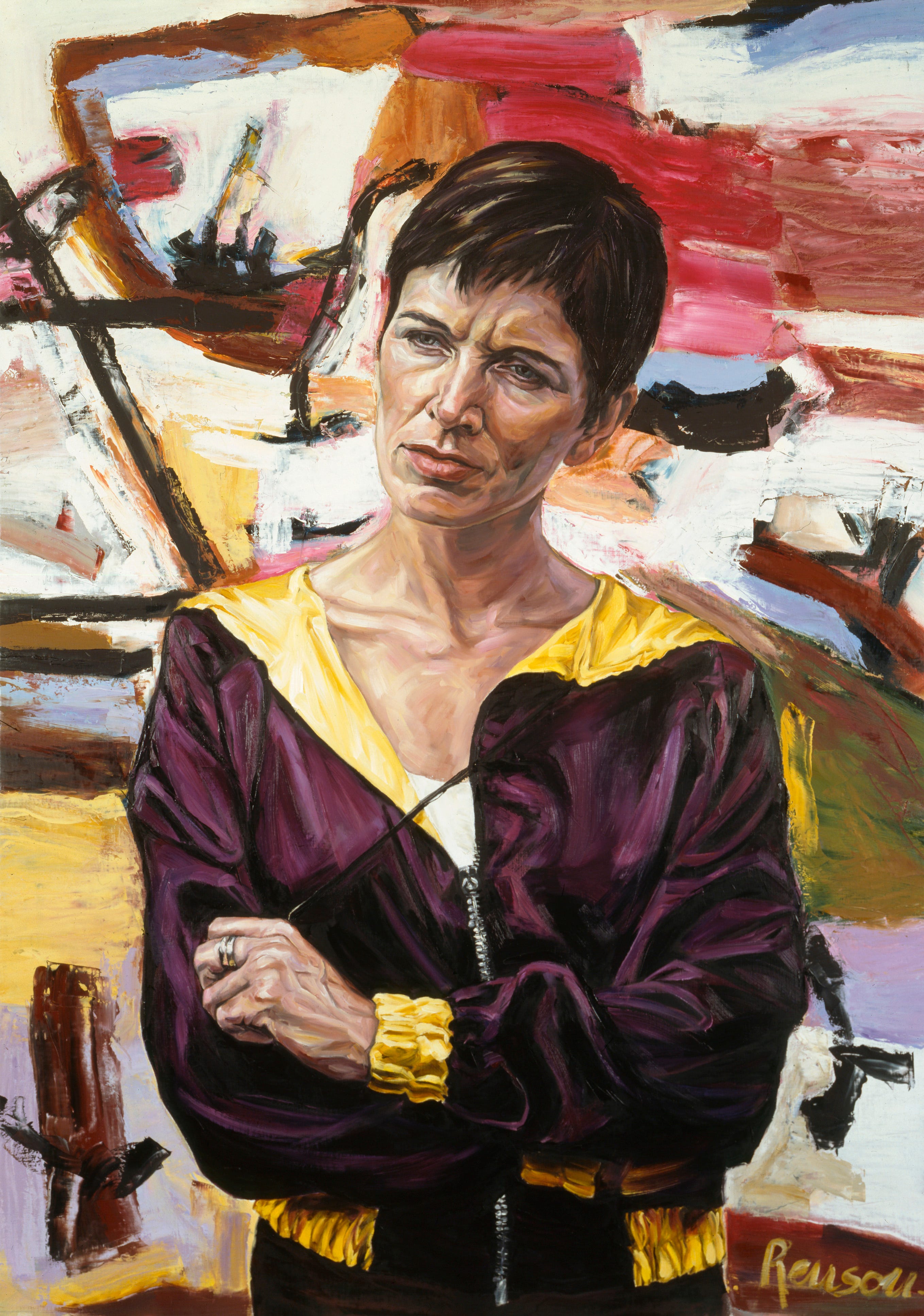
It’s a bit like coming into a crowded cocktail party at a friend’s apartment. I sort-of-recognize a number of the guests, usually just beyond some other knowns, unknowns or mistook knowns. I back up to the facing wall to take in the 1989 Renson. At just about arms-length I can see all her almost fleshy for-effect colorations, the painterly strokes of her applicator; I can touch, do run my finger over her shoulder. To get the texture.
Thanks for reading! This post is public so feel free to share it.
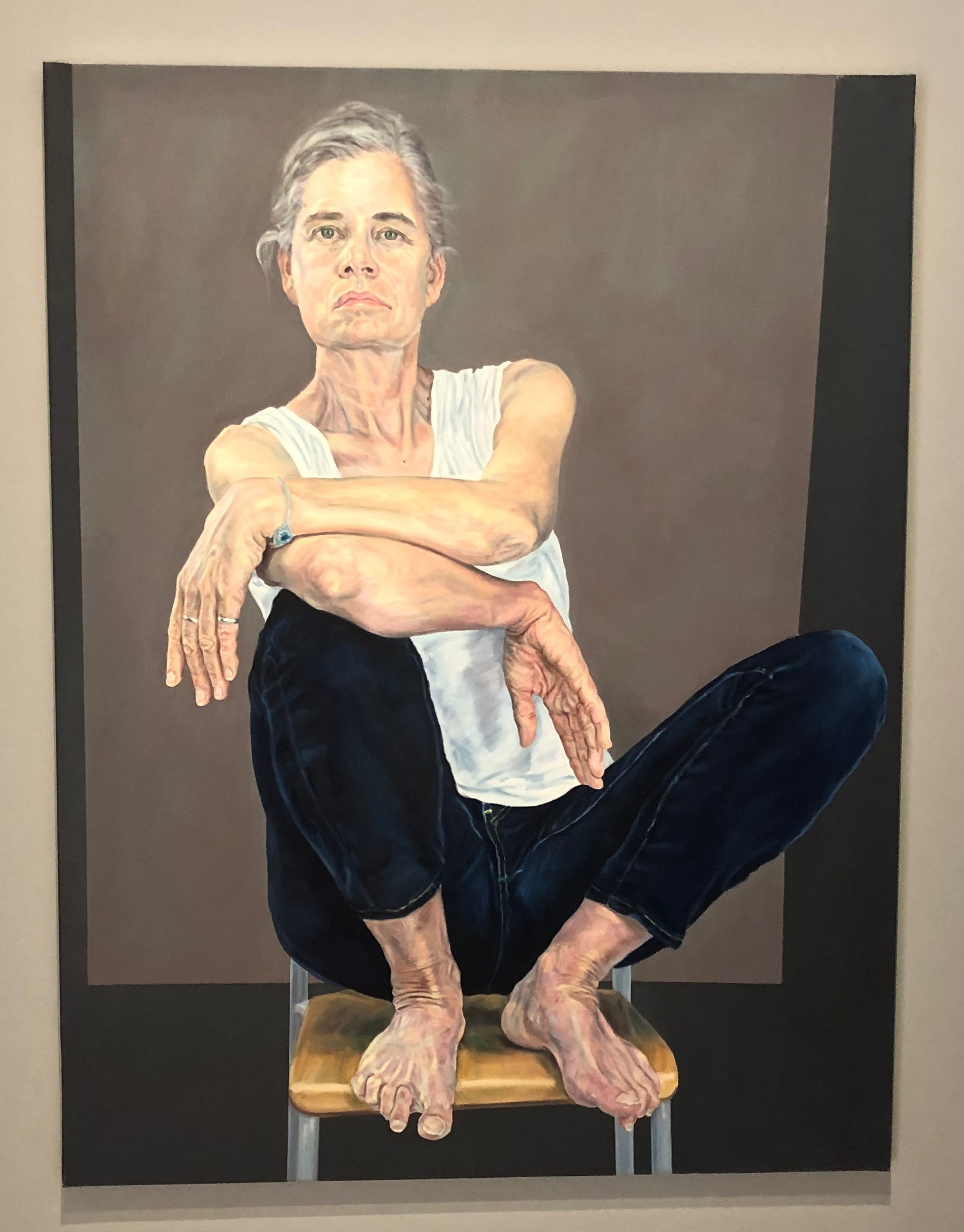
Just ahead, in the same narrow corridor, a shallow alcove, just a bit beyond the doorway that leads into the main exhibition room, another woman that I recognize, not so much by her aplomb as by her expression. A born sérieux. A certain go-at-it. By her look, it could be my whiskey-voiced friend, Sabine G.
The info-tab says it’s the art photographer Claudia Huidobro. I’ve never heard of her.
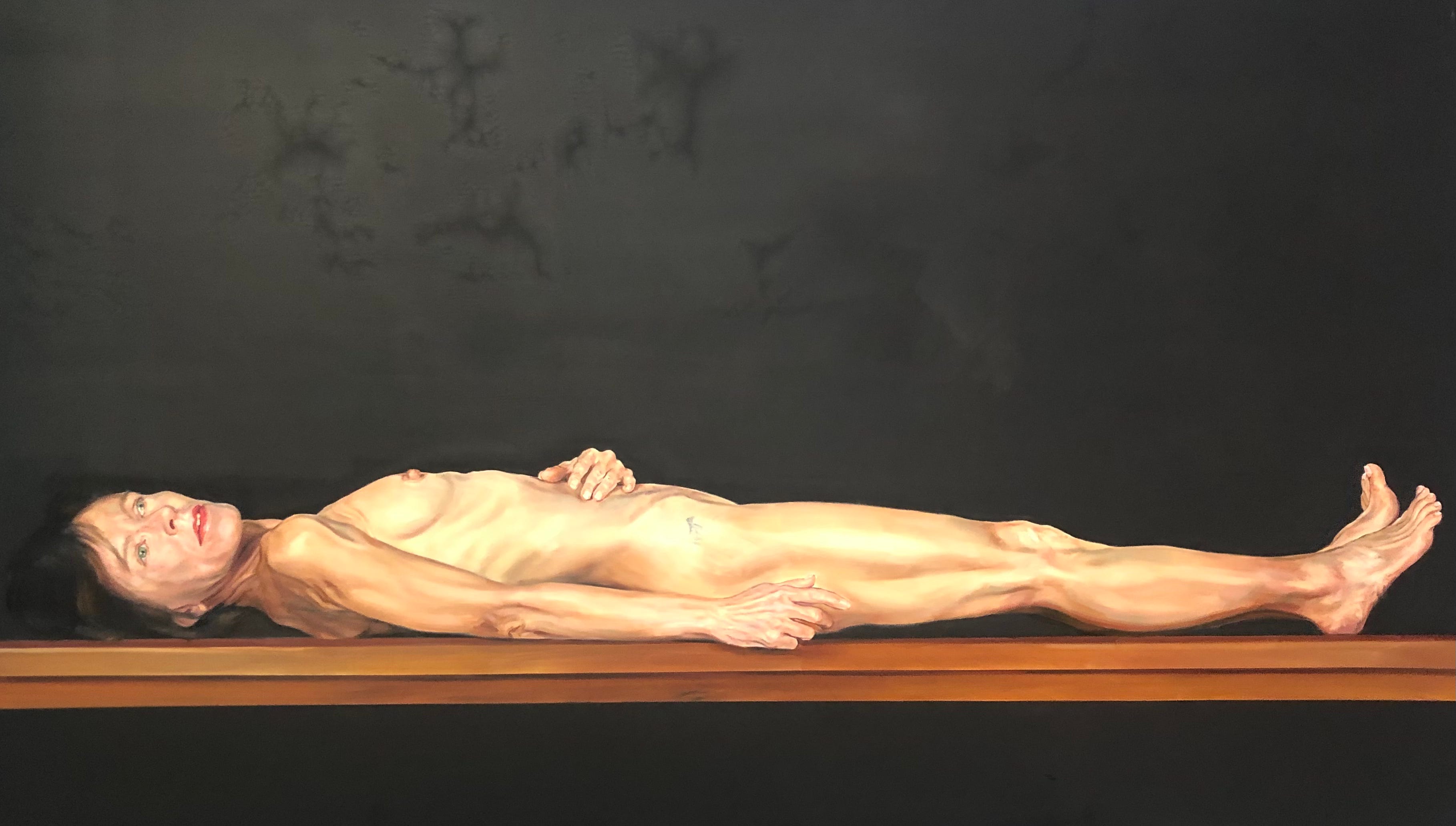
I turn into the main room. Renson is standing against a wall, like me, seventyish, but thin, wiry, with a sharp, but not unfriendly, regard. Standing in front of a full-length painting of herself gisant on a lab table?
Renson standing there in front of it makes me think of that poem: “Let us go then, you and I … Let us go, through certain half-deserted streets..”.
She’s saying she came late to painting, only after a stay in Australia, where she fell in with First People, whom she admires. I like hearing that from her because from childhood I’ve thought the First People of Australia are the most beautiful folk I’ve seen or heard about – my Dad had lots and lots of pictures he took during his second-world war-time stay in the country. The First people are a connector between the artist and I.
One of my fellow listeners, Paul Ardenne, an art critic, who wrote the preface to the presentation book for the exhibition and, as he now says, “a partisan of Renson’s esthetic” joins Renson’s talk.
Ardenne says that, unlike many portrait painters working today, Renson does not focus on a subject’s contemporaneity or on fitting them into a social context, noting that she doesn’t describe herself as a “portraitist”. According to her, and he agrees, he says, she depicts “faces” or “visages”.
Visually that makes sense: it seems to me that the faces are masks worn so lightly that they are no more remarkable than other clothing or even skin.
Then a sense of her whole project clicks for me: the Renson woman giving a little talk here, 37 years later, is very much a part of that 1989 Renson woman in the entryway.
Twisting myself around the doorway and craning my neck to take another, quick, look, I think there’s a 2026 part in 1989, too.
The other night I went to a wonderful play called Illusions. One of the characters asserts, Ce cosmos changeant doit avoir un minimum de constance (“This changing universe must have a minimum of constancy”). Whether demanded or asserted, there is a constancy in Renson’s universe.
Meeting a part of my long-time friend Sabine in the Huidobro painting also now makes sense as well as an impression. Huidobro, as a “face”, or, better, as a “facet”, of the sérieux and go-at-it that also inhabits Sabine G., is at once familiar and exotic to me, a little scary even, because, in her ways, said and done clutch each other so tightly.
I begin to look around at the faces in the paintings and at the people in the crowd of listeners. I’m trying to figure out if others are of or by or with Renson. A portrait of Renson, a painting from Renson, a painting by Renson, a painting with Renson, Renson’s paintings …
The hard-to-follow, subtle grammar of genitives, partitives and possessives comes to mind: being of or from or belonging to. All these are different aspects of belonging among things and people. The aspects are difficult to describe but definitely different: people are constantly using them and recognizing difference by them.
And, they are differences such as those my personal mythology would suggest the Hidden Continent’s Platonically-beautiful First People must surely recognize as frequently and easily as a body breathes.
The beauty in them, I’ve thought, is that, for true First People, everything that a body sees in others, feels in themself or imagines of the world – emotions, situations, landscapes, other species, smiles, curses, signs and wonders, star maps, chemicals, atomic tables and I-don’t-know-what-all … bodies, moods, ideas… – is in an of, from, by, with or belonging to relation of connection.
What a body thinks of as an “Individual” is essentially a “connector” within themself, with Other and the world around.
As a practical thing, I’ve thought, First People must frame the connector relation as autonomous “soul” and “self” inhabiting an equally autonomous “body”.
On the whole, I think that Dominique Renson has got the knack of painting an individual as a connector among connectors: soul, self, body.
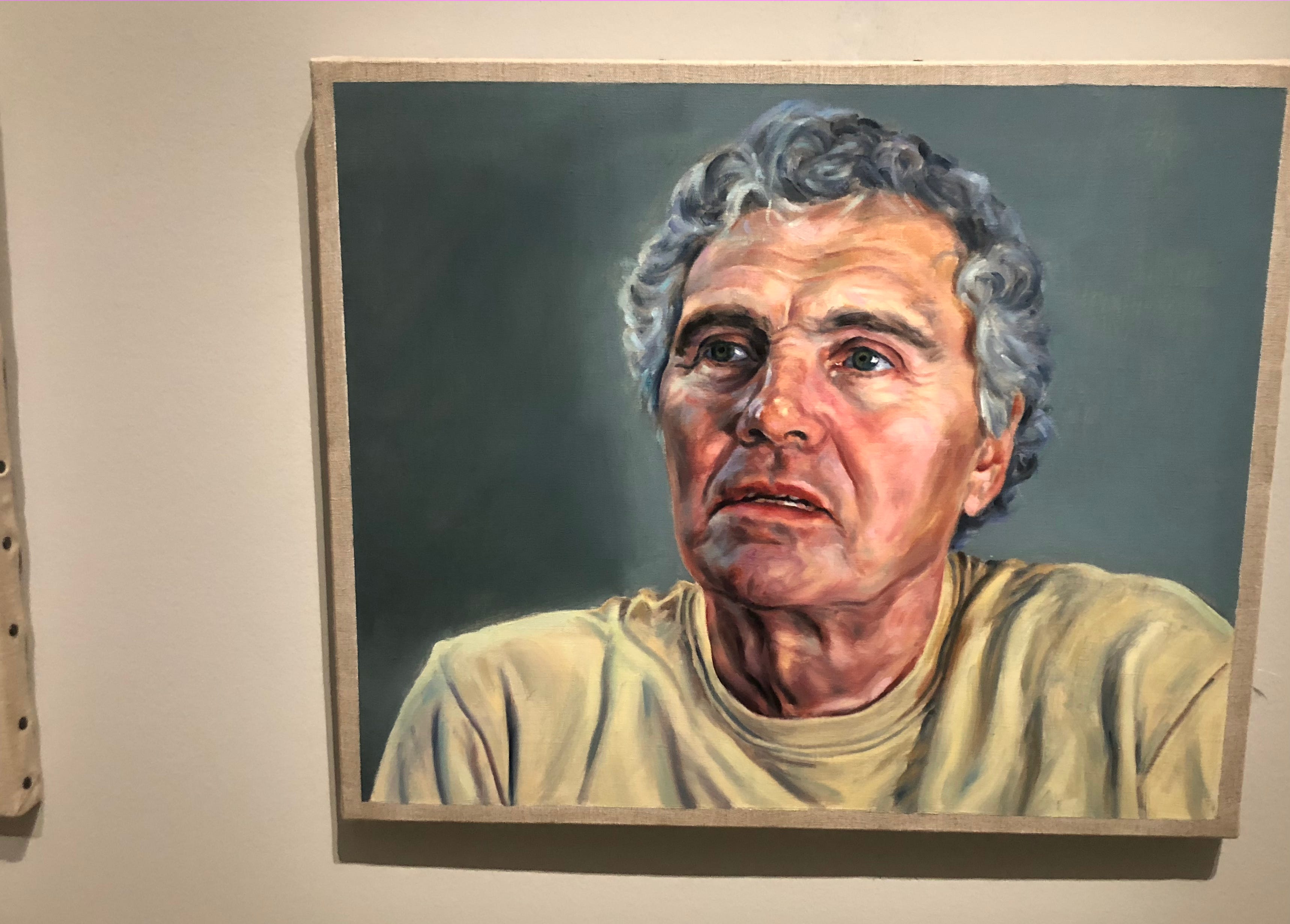
I think I recognize a visage of Paul Ardenne on the wall.
His face is not the advocate and commentator he is here today. He is passion and insight – indeed, he is part of a series Renson calls Ces personnes dans la peau desquelles je peux me glisser (“The people whose skin I can slip into”). Huidobro as my Sabine G. is part of Renson’s Pythies (“Pythia” or oracle of Apollo) series.
Two paintings in particular speak to me of Renson’s knack for … For getting snapshots (masks) of her subject-connectors as they encounter a world made up of similarly situated souls, selfs and bodies.
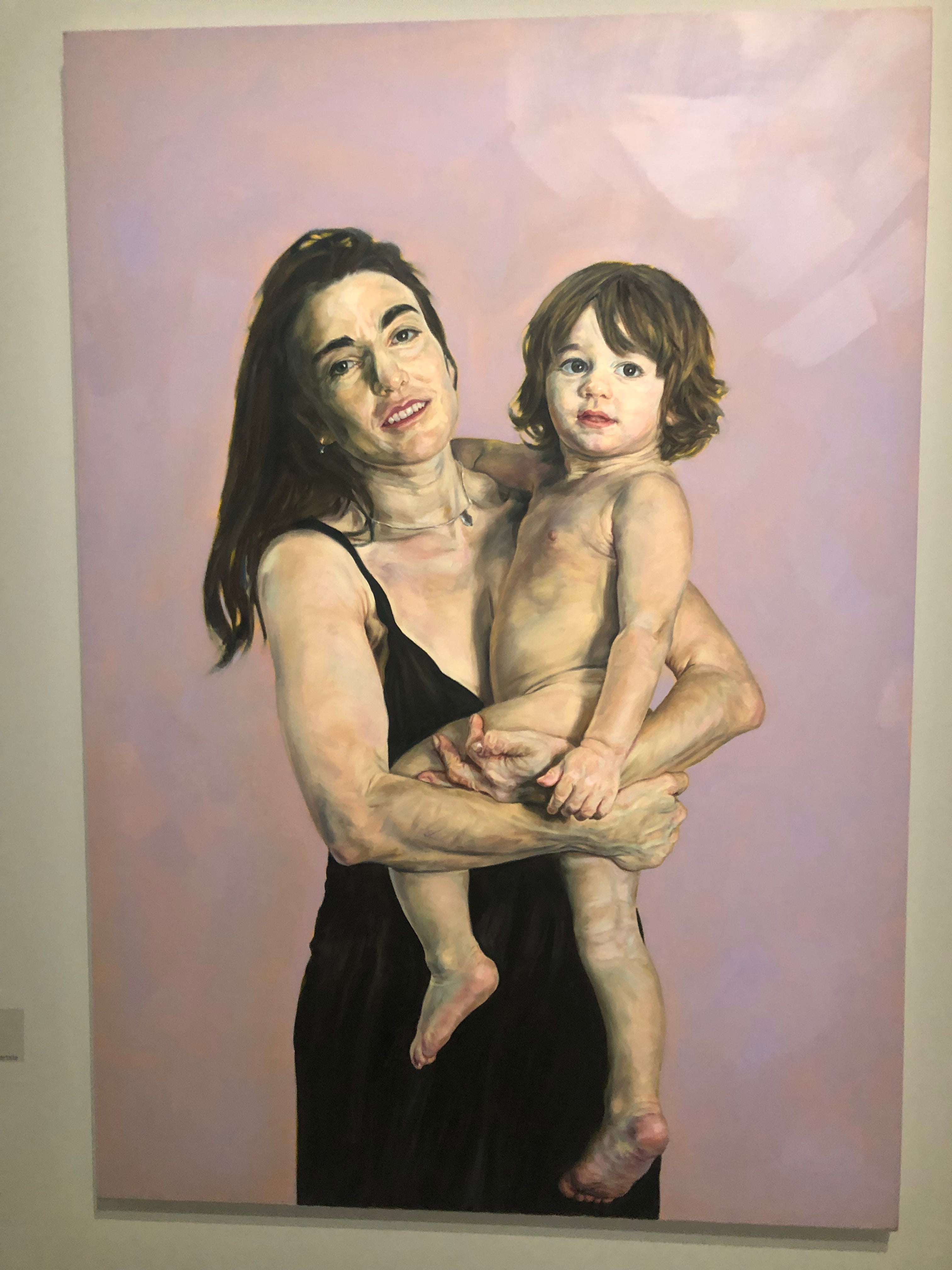
Joie 1 (“Joy”, 2015) and Joie 2 (2015), both with a woman in a loose black sack dress with a big, easy, affirmative, naked boy toddler. Although the paintings depict two very distinct persons in the woman and the boy, I situate them both in the Mother-and-Child thematic of what would have not long ago been religious genre painting.
In Joie 1, against a plain violet background, my visual attention is drawn to the woman’s strong right arm, crooked to be a bench to hold up a big boy – his size and heft are, at least, I think, partially, intentional underlining. The tension of her right arm shows up in the clavicle: this tension accommodates the unnatural bent needed to guard the boy’s back as well as to steady his leg. The boy’s left arm is loose, hand relaxed over the woman’s locking forearms. His right arm, hand out of sight, is draped negligently between her shoulder and neck. Gazing pleasantly (and, somehow, energetically) at somebody who must be looking at him, the boy couldn’t be more confidently seated in an oaken chair. The woman’s attention, however, is in two places at once: holding the boy and looking toward whoever is watching the boy.
in Joie 1, I identify six “snapshots” or “visages” or “faces” or “masks”, two sets each of three: soul, self, body: in the “Holding/Held” aspect of the Mother-and-Child thematic, I locate a “soul snapshot” dominating my overall sense of the painting; in the physical tension or absence of tension of the figures, I locate Self; in the texturing and coloration, I locate the Body.
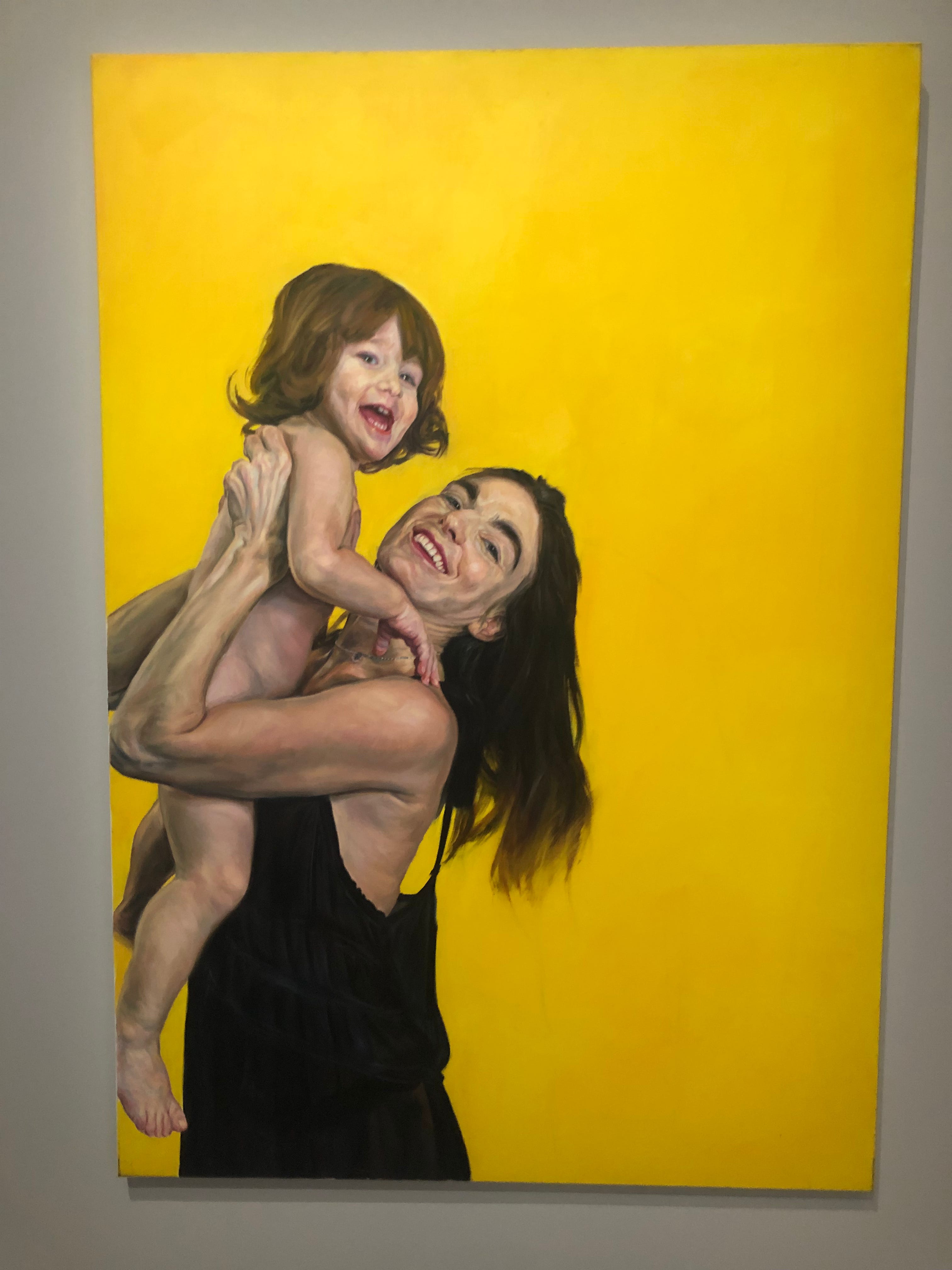
Joie 2 shares the thematic and genre of Joie 1, but as “woman with child”, the aspect is “Separateness of Self”. An straightforward mask effect emphasizes the indescribability of Self: the boy, framed by his hair, is all jutting laughing mouth while a line of shadow frames the woman’s face. The woman’s strong hands under the toddler’s arms and over his shoulder blades don’t hold him, they enable him to show him-Self. Separateness is highlighted by a forward decentering of the scene that implies either a change of scene or a centering of the seen one by the unseen addition from outside.
The boy, bright-eyed, is glad to show off, pointing to an outside complicity; the woman’s eyes seem to make contact with somebody, pointing to outside complicities, certainly complicities beyond the what I see, but also, I think, beyond “woman with child”. I come away from the painting involved in it and sobered by the possible ofs, froms, bys, withs or belonging tos of being an individual connector of soul(s), self(s) and body(ies).
_____
Notes on the Exhibition
Dominique Renson’s exhibition Artistes et modèles runs until 18 October 2026 at Maison Caillebotte, Yerres, Essonne, an 18-minute commuter-train ride from Gare de Lyon Paris. It’s worth a visit.
Maison Caillebotte, Yerres, Essonne: https://en.maisoncaillebotte.fr
Dominique Renson: https://www.dominique-renson.com/index.html
_____
Notes on the Essay
… Illusions by Ivan Viripaev, 4 – 21 June 2026, Théâtre de la Tempête, Paris, directed by Yordan Goldwaser, performed by Pierre Devérines, Jeanne Lepers, Barthélémy Meridjen, Julie Moulier
Théâtre de la Tempête: https://www.la-tempete.fr
… The art photographer Claudia Huidobro… : https://www.instagram.com/claudia_huidobro_artist/?hl=en
… those lines from that poem …: T.S. Eliot, The Love Song of J. Alfred Prufrock
Let us go then, you and I,
When the evening is spread out against the sky
Like a patient etherized upon a table;
Let us go, through certain half-deserted streets…
https://www.poetryfoundation.org/poetrymagazine/poems/44212/the-love-song-of-j-alfred-prufrock
… Paul Ardenne… Paul Ardenne has put together the concept of “art contextuel” which posits, as I understand it, that art, is above all a product of its creator in their environment and that the context of their created thing will determine its esthetics, materials and objectives of it: https://en.wikipedia.org/wiki/Paul_Ardenne
For getting snapshots of her subjects as they encounter a world as a soul, self and body. Paul Ardenne: One of the sections of Ardenne’s text for Dominique Renson: Artiste and modèles (ISBN: 978-2-35404-129-8), a critical look at Renson’s work, is entitled “Contrer l’artificiel” where Ardenne describes what he sees as Renson’s effort to push back against idealization or, I expect, social localization of her subjects: https://www.librairiedialogues.fr/livre/26452682-dominique-renson-artiste-et-modeles-paul-ardenne-illustria-librairie-des-musees
… in the texturing and coloration, the body… The half-length paintings of her son screaming (Le Cri °1, Le Cri °2, Le Cri °3 (2015) leave me an impression I always have when I have to deal with strong emotion: My body not reflecting my feeling! …
No posts
Comments
Nothing yet. Say the first thing.
Sign in to join the conversation.